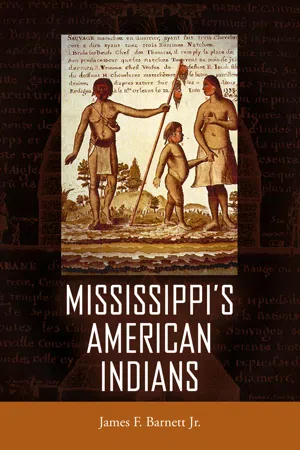
At the beginning of the eighteenth century, over twenty different American Indian tribal groups inhabited present-day Mississippi. Today, Mississippi is home to only one tribe, the Mississippi Band of Choctaw Indians. In Mississippi's American Indians, author James F. Barnett Jr. explores the historical forces and processes that led to this sweeping change in the diversity of the state's native peoples.
The book begins with a chapter on Mississippi's approximately 12,000-year prehistory, from early hunter-gatherer societies through the powerful mound building civilizations encountered by the first European expeditions. With the coming of the Spanish, French, and English to the New World, native societies in the Mississippi region connected with the Atlantic market economy, a source for guns, blankets, and many other trade items. Europeans offered these trade materials in exchange for Indian slaves and deerskins, currencies that radically altered the relationships between tribal groups. Smallpox and other diseases followed along the trading paths. Colonial competition between the French and English helped to spark the Natchez rebellion, the Chickasaw-French wars, the Choctaw civil war, and a half-century of client warfare between the Choctaws and Chickasaws. The Treaty of Paris in 1763 forced Mississippi's pro-French tribes to move west of the Mississippi River. The Diaspora included the Tunicas, Houmas, Pascagoulas, Biloxis, and a portion of the Choctaw confederacy. In the early nineteenth century, Mississippi's remaining Choctaws and Chickasaws faced a series of treaties with the United States government that ended in destitution and removal. Despite the intense pressures of European invasion, the Mississippi tribes survived by adapting and contributing to their rapidly evolving world.
- 272 pages
- English
- ePUB (mobile friendly)
- Available on iOS & Android
eBook - ePub
Mississippi's American Indians
About this book
Information
Table of contents
- Cover Page
- Title Page
- Copyright Page
- Dedication
- Contents
- Acknowledgments
- Introduction
- Chapter One. Mississippi Indians in Prehistory
- Chapter Two. 1540–1684: Early European Contact
- Chapter Three. 1685–1715: The Era of the Indian Slave Trade
- Chapter Four. 1716–1762: The Deerskin Trade and Client Warfare
- Chapter Five. 1763–1800: Cultural Survival and Emigration
- Chapter Six. 1801–1837: Treaties and Removal
- Epilogue
- Appendix 1. Treaty of Dancing Rabbit Creek
- Appendix 2. Treaty with the Chickasaw, October 20, 1832
- Notes
- Bibliography
- Index
Trusted by 375,005 students
Access to over 1.5 million titles for a fair monthly price.
Study more efficiently using our study tools.
Frequently asked questions
Yes, you can cancel anytime from the Subscription tab in your account settings on the Perlego website. Your subscription will stay active until the end of your current billing period. Learn how to cancel your subscription
No, books cannot be downloaded as external files, such as PDFs, for use outside of Perlego. However, you can download books within the Perlego app for offline reading on mobile or tablet. Learn how to download books offline
Perlego offers two plans: Essential and Complete
- Essential is ideal for learners and professionals who enjoy exploring a wide range of subjects. Access the Essential Library with 800,000+ trusted titles and best-sellers across business, personal growth, and the humanities. Includes unlimited reading time and Standard Read Aloud voice.
- Complete: Perfect for advanced learners and researchers needing full, unrestricted access. Unlock 1.5M+ books across hundreds of subjects, including academic and specialized titles. The Complete Plan also includes advanced features like Premium Read Aloud and Research Assistant.
We are an online textbook subscription service, where you can get access to an entire online library for less than the price of a single book per month. With over 1.5 million books across 990+ topics, we’ve got you covered! Learn about our mission
Look out for the read-aloud symbol on your next book to see if you can listen to it. The read-aloud tool reads text aloud for you, highlighting the text as it is being read. You can pause it, speed it up and slow it down. Learn more about Read Aloud
Yes! You can use the Perlego app on both iOS and Android devices to read anytime, anywhere — even offline. Perfect for commutes or when you’re on the go.
Please note we cannot support devices running on iOS 13 and Android 7 or earlier. Learn more about using the app
Please note we cannot support devices running on iOS 13 and Android 7 or earlier. Learn more about using the app
Yes, you can access Mississippi's American Indians by James F. Barnett Jr. in PDF and/or ePUB format, as well as other popular books in History & North American History. We have over 1.5 million books available in our catalogue for you to explore.