At least three major questions can be asked of myth: what is its subject matter? what is its origin? and what is its function? Theories of myth may differ on the answers they give to any of these questions, but more basically they may also differ on which of the questions they ask. C. G. Jung's theory is one of the few that purports to answer fully all three questions. This volume collects and organizes the key passages on myth by Jung himself and by some of the most prominent Jungian writers after him: Erich Neumann, Marie-Louise von Franz, and James Hillman. The book synthesizes the discovery of myth as a way of thinking, where it becomes a therapeutic tool providing an entrance to the unconscious.
In the first selections, Jung begins to differentiate his theory from Freud's by asserting that there are fantasies and dreams of an "impersonal" nature that cannot be reduced to experiences in a person's past. Jung then asserts that the similarities among myths are the result of the projection of the collective rather than the personal unconscious onto the external world. Finally, he comes to the conclusion that myth originates and functions to satisfy the psychological need for contact with the unconscious--not merely to announce the existence of the unconscious, but to let us experience it.
- English
- ePUB (mobile friendly)
- Available on iOS & Android
eBook - ePub
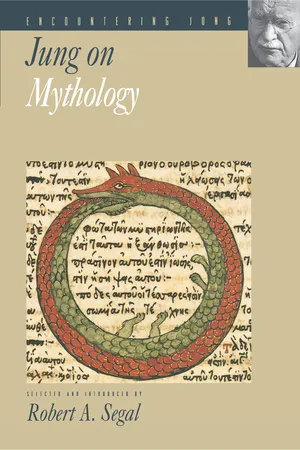
Jung on Mythology
About this book
Information
Topic
PsicologiaSubtopic
PsicoanalisiChapter 1.Jung vis-à-vis Freud on Myth
(a) Jung’s Freudian Interpretation of Myth
Jung here offers an orthodox Freudian analysis of myth in the course of analyzing the case of an eleven-year-old girl who had been treated by an assistant of his. While Jung's use of mythological parallels to amplify the meaning of the girl's dreams might seem Jungian, the meaning Jung accords the parallels is Freudian. The long work in which the case appears, “The Theory of Psychoanalysis,'' represents Jung's final attempt to revise Freud's theory without breaking with it.
From “The Theory of Psychoanalysis,” CW 4, pars. 475-86
THIRD INTERVIEW
475 The girl related a dream she had had when she was five years old, which made an unforgettable impression on her. “I’ll never forget the dream as long as I live,” she said. I would like to add here that such dreams are of quite special interest. The longer a dream remains spontaneously in the memory, the greater is the importance to be attributed to it. This is the dream: “I was in a wood with my little brother, looking for strawberries. Then a wolf came and jumped at me. I fled up a staircase, the wolf after me. I fell down and the wolf bit me in the leg. I awoke in deadly fear.”
476 Before we take up the associations given us by the little girl, I will try to form an arbitrary opinion as to the possible content of the dream, and then see how our results compare with the associations given by the child. The beginning of the dream reminds us of the well-known fairytale of Little Red Ridinghood, which is, of course, known to every child. The wolf ate the grandmother first, then took her shape, and afterwards ate Little Red Ridinghood. But the hunter killed the wolf, cut open the belly, and Little Red Ridinghood sprang out safe and sound.
477 This motif is found in countless myths all over the world, and is the motif of the Bible story of Jonah. The meaning immediately lying behind it is astro-mythological: the sun is swallowed by the sea monster and is born again in the morning. Of course, the whole of astro-mythology is at bottom nothing but psychology – unconscious psychology – projected into the heavens; for myths never were and never are made consciously, they arise from man’s unconscious. This is the reason for the sometimes miraculous similarity or identity of myth-forms among races that have been separated from each other in space ever since time began. It explains, for instance, the extraordinary distribution of the cross symbol, quite independently of Christianity, of which America offers specially remarkable examples. It is not possible to suppose that myths were created merely in order to explain meteorological or astronomical processes; they are, in the first instance, manifestations of unconscious impulses, comparable to dreams. These impulses were actuated by the regressive libido in the unconscious. The material which comes to light is naturally infantile material – fantasies connected with the incest complex. Thus, in all these so-called solar myths, we can easily recognize infantile theories about procreation, birth, and incestuous relations. In the fairytale of Little Red Ridinghood it is the fantasy that the mother has to eat something which is like a child, and that the child is born by cutting open the mother’s body. This fantasy is one of the commonest and can be found everywhere.
478 From these general psychological considerations we can conclude that the child, in this dream, was elaborating the problem of procreation and birth. As to the wolf, we must probably put him in the father’s place, for the child unconsciously attributed to the father any act of violence towards the mother. This motif, too, is based on countless myths dealing with the violation of the mother. With regard to the mythological parallels, I would like to call your attention to the work of Boas,1 which includes a magnificent collection of American Indian sagas; then the book by Frobenius, Das Zeitalter des Sonnengottes; and finally the works of Abraham, Rank, Riklin, Jones, Freud, Maeder, Silberer, and Spielrein, and my own investigations in Symbols of Transformation.
479 After these general reflections, which I give here for theoretical reasons but which naturally formed no part of the treatment, we will go on to see what the child has to tell us about her dream. Needless to say, she was allowed to speak about her dream just as she liked, without being influenced in any way. She picked first on the bite in the leg, and explained that she had once been told by a woman who had had a baby that she could still show the place where the stork had bitten her. This expression is, in Switzerland, a variant of the widespread symbolism of copulation and birth. Here we have a perfect parallelism between our interpretation and the association process of the child. For the first association she produced, quite uninfluenced, goes back to the problem we conjectured above on theoretical grounds. I know that the innumerable cases published in the psychoanalytic literature, which were definitely not influenced, have not been able to quash our critics’ contention that we suggest our interpretations to the patients. This case, too, will convince no one who is determined to impute to us the crude mistakes of beginners – or, what is worse, falsification.
480 After this first association the little patient was asked what the wolf made her think of. She answered, “I think of my father when he is angry.” This, too, coincides absolutely with our theoretical considerations. It might be objected that these considerations were made expressly for this purpose and therefore lack general validity. I think this objection vanishes of itself as soon as one has the requisite psychoanalytic and mythological knowledge. The validity of a hypothesis can be seen only on the basis of the right knowledge, otherwise not at all.
481 The first association put the stork in the place of the wolf; the association to the wolf now brings us to the father. In the popular myth the stork stands for the father, for he brings the children. The apparent contradiction between the fairytale, where the wolf is the mother, and the dream, where the wolf is the father, is of no importance for the dream or the dreamer. We can therefore dispense with a detailed explanation. I have dealt with this problem of bisexual symbols in my book.2 As you know, in the legend of Romulus and Remus both animals, the bird Picus and the wolf, were raised to the rank of parents.
482 Her fear of the wolf in the dream is therefore her fear of the father. The dreamer explained that she was afraid of her father because he was very strict with her. He had also told her that we have bad dreams only when we have done something wrong. She then asked her father, “But what does Mama do wrong? She always has bad dreams.”
483 Once her father slapped her because she was sucking her finger. She kept on doing this despite his prohibition. Was this, perhaps, the wrong she had done? Hardly, because sucking the finger was simply a rather anachronistic infantile habit, of little real interest at her age, and serving more to irritate her father so that he would punish her by slapping. In this way she relieved her conscience of an unconfessed and much more serious “sin”: it came out that she had induced a number of girls of her own age to perform mutual masturbation.
484 It was because of these sexual interests that she was afraid of her father. But we must not forget that she had the wolf dream in her fifth year. At that time these sexual acts had not been committed. Hence we must regard the affair with the other girls at most as a reason for her present fear of her father, but that does not explain her earlier fear. Nevertheless, we may expect that it was something similar, some unconscious sexual wish in keeping with the psychology of the forbidden act just mentioned. The character and moral evaluation of this act are naturally far more unconscious to a child than to an adult. In order to understand what could have made an impression on the child so early, we have to ask what happened in her fifth year. That was the year in which her younger brother was born. So even then she was afraid of her father. The associations already discussed show us the unmistakable connection between her sexual interests and her fear.
485 The problem of sex, which nature connects with positive feelings of pleasure, appears in the wolf dream in the form of fear, apparently on account of the bad father, who stands for moral education. The dream was therefore the first impressive manifestation of the sexual problem, obviously stimulated by the recent birth of a younger brother, when as we know all these questions become aired. But because the sexual problem was connected at all points with the history of certain pleasurable physical sensations which education devalues as “bad habits,” it could apparently manifest itself only in the guise of moral guilt and fear.
486 This explanation, plausible though it is, seems to me superficial and inadequate. We then attribute the whole difficulty to moral education, on the unproven assumption that education can cause a neurosis. This is to disregard the fact that even people with no trace of moral education become neurotic and suffer from morbid fears. Furthermore, moral law is not just an evil that has to be resisted, but a necessity born from the innermost needs of man. Moral law is nothing other than an outward manifestation of man’s innate urge to dominate and control himself. This impulse to domestication and civilization is lost in the dim, unfathomable depths of man’s evolutionary history and can never be conceived as the consequence of laws imposed from without. Man himself, obeying his instincts, created his laws. We shall never understand the reasons for the fear and suppression of the sexual problem in a child if we take into account only the moral influences of education. The real reasons lie much deeper, in human nature itself, perhaps in that tragic conflict between nature and culture, or between individual consciousness and collective feeling.
From “The Theory of Psychoanalysis,” CW 4, pars. 506-10
NINTH INTERVIEW
506 This interview contributed some important details to the history of her sexual problem. First came a significant dream fragment: “I was with other children in a clearing in a wood, surrounded by beautiful fir-trees. It began to rain, there was thunder and lightning, and it grew dark. Then I suddenly saw a stork in the air.”
507 Before we start analysing this dream, I must mention its parallels with certain mythological ideas. To anyone familiar with the works of Adalbert Kuhn and Steinthal, to which Abraham3 has recently drawn attention, the curious combination of thunderstorm and stork is not at all surprising. Since ancient times the thunderstorm has had the meaning of an earth-fecundating act, it is the cohabitation of Father Heaven and Mother Earth, where the lightning takes over the role of the winged phallus. The stork in flight is just the same thing, a winged phallus, and its psychosexual meaning is known to every child. But the psychosexual meaning of the thunderstorm is not known to everyone, and certainly not to our little patient. In view of the whole psychological constellation previously described, the stork must unquestionably be given a psychosexual interpretation. The fact that the thunderstorm is connected with the stork and, like it, has a psychosexual meaning seems difficult to accept at first. But when we remember that psychoanalytic research has already discovered a vast number of purely mythological connections in the unconscious psychic products, we may conclude that the psychosexual link between the two images is present also in this case. We know from other experiences that those unconscious strata which once produced mythological formations are still active in modern individuals and are unceasingly productive. Only, the production is limited to dreams and to the symptomatology of the neuroses and psychoses, as the correction by reality is so strong in the modern mind that it prevents them from being projected upon the real world.
508 To return to the analysis of the dream: the associations that led to the heart of this image began with the idea of rain during a thunderstorm. Her actual words were: “I think of water – my uncle was drowned in the water – it must be awful to be stuck in the water like that, in the dark – but wouldn’t the baby drown in the water, too? Does it drink the water that is in the stomach? Queer, when I was ill Mama sent my water to the doctor. I thought he was going to mix something with it like syrup, which babies grow from, and Mama would have to drink it.”
509 We see with unquestionable clearness from this string of associations that the child connected psychosexual ideas specifically relating to fertilization with the rain during the thunderstorm.
510 Here again we see that remarkable parallelism between mytho...
Table of contents
- Cover Page
- Title Page
- Copyright Page
- Contents
- Introduction
- Part 1: Jung on Myth
- Part 2: Developments in the Jungian Theory of Myth
- Index
Trusted by 375,005 students
Access to over 1.5 million titles for a fair monthly price.
Study more efficiently using our study tools.
Frequently asked questions
Yes, you can cancel anytime from the Subscription tab in your account settings on the Perlego website. Your subscription will stay active until the end of your current billing period. Learn how to cancel your subscription
No, books cannot be downloaded as external files, such as PDFs, for use outside of Perlego. However, you can download books within the Perlego app for offline reading on mobile or tablet. Learn how to download books offline
Perlego offers two plans: Essential and Complete
- Essential is ideal for learners and professionals who enjoy exploring a wide range of subjects. Access the Essential Library with 800,000+ trusted titles and best-sellers across business, personal growth, and the humanities. Includes unlimited reading time and Standard Read Aloud voice.
- Complete: Perfect for advanced learners and researchers needing full, unrestricted access. Unlock 1.5M+ books across hundreds of subjects, including academic and specialized titles. The Complete Plan also includes advanced features like Premium Read Aloud and Research Assistant.
We are an online textbook subscription service, where you can get access to an entire online library for less than the price of a single book per month. With over 1.5 million books across 990+ topics, we’ve got you covered! Learn about our mission
Look out for the read-aloud symbol on your next book to see if you can listen to it. The read-aloud tool reads text aloud for you, highlighting the text as it is being read. You can pause it, speed it up and slow it down. Learn more about Read Aloud
Yes! You can use the Perlego app on both iOS and Android devices to read anytime, anywhere — even offline. Perfect for commutes or when you’re on the go.
Please note we cannot support devices running on iOS 13 and Android 7 or earlier. Learn more about using the app
Please note we cannot support devices running on iOS 13 and Android 7 or earlier. Learn more about using the app
Yes, you can access Jung on Mythology by C. G. Jung, Robert A. Segal in PDF and/or ePUB format, as well as other popular books in Psicologia & Psicoanalisi. We have over 1.5 million books available in our catalogue for you to explore.