Smarter Data Science
eBook - ePub

Smarter Data Science

Succeeding with Enterprise-Grade Data and AI Projects

  1. English
  2. ePUB (mobile friendly)
  3. Available on iOS & Android
eBook - ePub

Smarter Data Science

Succeeding with Enterprise-Grade Data and AI Projects

About this book

Organizations can make data science a repeatable, predictable tool, which business professionals use to get more value from their data

Enterprise data and AI projects are often scattershot, underbaked, siloed, and not adaptable to predictable business changes. As a result, the vast majority fail. These expensive quagmires can be avoided, and this book explains precisely how.

Data science is emerging as a hands-on tool for not just data scientists, but business professionals as well. Managers, directors, IT leaders, and analysts must expand their use of data science capabilities for the organization to stay competitive. Smarter Data Science helps them achieve their enterprise-grade data projects and AI goals. It serves as a guide to building a robust and comprehensive information architecture program that enables sustainable and scalable AI deployments.

When an organization manages its data effectively, its data science program becomes a fully scalable function that's both prescriptive and repeatable. With an understanding of data science principles, practitioners are also empowered to lead their organizations in establishing and deploying viable AI. They employ the tools of machine learning, deep learning, and AI to extract greater value from data for the benefit of the enterprise.

By following a ladder framework that promotes prescriptive capabilities, organizations can make data science accessible to a range of team members, democratizing data science throughout the organization. Companies that collect, organize, and analyze data can move forward to additional data science achievements:

  • Improving time-to-value with infused AI models for common use cases
  • Optimizing knowledge work and business processes
  • Utilizing AI-based business intelligence and data visualization
  • Establishing a data topology to support general or highly specialized needs
  • Successfully completing AI projects in a predictable manner
  • Coordinating the use of AI from any compute node. From inner edges to outer edges: cloud, fog, and mist computing

When they climb the ladder presented in this book, businesspeople and data scientists alike will be able to improve and foster repeatable capabilities. They will have the knowledge to maximize their AI and data assets for the benefit of their organizations.
Frequently asked questions

Yes, you can cancel anytime from the Subscription tab in your account settings on the Perlego website. Your subscription will stay active until the end of your current billing period. Learn how to cancel your subscription.
No, books cannot be downloaded as external files, such as PDFs, for use outside of Perlego. However, you can download books within the Perlego app for offline reading on mobile or tablet. Learn more here.
Perlego offers two plans: Essential and Complete
  • Essential is ideal for learners and professionals who enjoy exploring a wide range of subjects. Access the Essential Library with 800,000+ trusted titles and best-sellers across business, personal growth, and the humanities. Includes unlimited reading time and Standard Read Aloud voice.
  • Complete: Perfect for advanced learners and researchers needing full, unrestricted access. Unlock 1.4M+ books across hundreds of subjects, including academic and specialized titles. The Complete Plan also includes advanced features like Premium Read Aloud and Research Assistant.
Both plans are available with monthly, semester, or annual billing cycles.
We are an online textbook subscription service, where you can get access to an entire online library for less than the price of a single book per month. With over 1 million books across 1000+ topics, we’ve got you covered! Learn more here.
Look out for the read-aloud symbol on your next book to see if you can listen to it. The read-aloud tool reads text aloud for you, highlighting the text as it is being read. You can pause it, speed it up and slow it down. Learn more here.
Yes! You can use the Perlego app on both iOS or Android devices to read anytime, anywhere — even offline. Perfect for commutes or when you’re on the go.
Please note we cannot support devices running on iOS 13 and Android 7 or earlier. Learn more about using the app.
Yes, you can access Smarter Data Science by Neal Fishman,Cole Stryker in PDF and/or ePUB format, as well as other popular books in Computer Science & Data Modelling & Design. We have over one million books available in our catalogue for you to explore.

Information

CHAPTER 1
Climbing the AI Ladder

ā€œThe first characteristic of interest is the fraction of the computational load, which is associated with data management housekeeping.ā€
—Gene Amdahl
ā€œApproach to Achieving Large Scale Computing Capabilitiesā€
To remain competitive, enterprises in every industry need to use advanced analytics to draw insights from their data. The urgency of this need is an accelerating imperative. Even public-sector and nonprofit organizations, which traditionally are less motivated by competition, believe that the rewards derived from the use of artificial intelligence (AI) are too attractive to ignore. Diagnostic analytics, predictive analytics, prescriptive analytics, machine learning, deep learning, and AI complement the use of traditional descriptive analytics and business intelligence (BI) to identify opportunities or to increase effectiveness.
Traditionally an organization used analytics to explain the past. Today analytics are harnessed to help explain the immediate now (the present) and the future for the opportunities and threats that await or are impending. These insights can enable the organization to become more proficient, efficient, and resilient.
However, successfully integrating advanced analytics is not turnkey, nor is it a binary state, where a company either does or doesn't possess AI readiness. Rather, it's a journey. As part of its own recent transformation, IBM developed a visual metaphor to explain a journey toward readiness that can be adopted and applied by any company: the AI Ladder.
As a ladder, the journey to AI can be thought of as a series of rungs to climb. Any attempt to zoom up the ladder in one hop will lead to failure. Only when each rung is firmly in hand can your organization move on to the next rung. The climb is not hapless or random, and climbers can reach the top only by approaching each rung with purpose and a clear-eyed understanding of what each rung represents for their business.
You don't need a crystal ball to know that your organization needs data science, but you do need some means of insight to know your organization's efforts can be effective and are moving toward the goal of AI-centricity. This chapter touches on the major concepts behind each rung of the metaphorical ladder for AI, why data must be addressed as a peer discipline to AI, and why you'll need to be creative as well as a polymath—showcasing your proficiency to incorporate multiple specializations that you'll be able to read about within this book.

Readying Data for AI

The limitations can be technological, but much of the journey to AI is made up of organizational change. The adoption of AI may require the creation of a new workforce category: the new-collar worker. New-collar jobs can include roles in cybersecurity, cloud computing, digital design, and cognitive business. New-collar work for the cognitive business has been invoked to describe the radically different ways AI-empowered employees will approach their duties. This worker must progress methodically from observing the results of a previous action to justifying a new course of action to suggesting and ultimately prescribing a course of action.
When an organization targets a future state for itself, the future state simply becomes the current state once it's attained. The continual need to define another future state is a cycle that propels the organization forward. Ideally, the organization can, over time, reduce the time and expense required to move from one state to the next, and these costs will be viewed not as expenses but as derived value, and money will cease to inhibit the cycle's progression.
Worldwide, most organizations now agree that AI will help them stay competitive, but many organizations can often still struggle with less advanced forms of analytics. For organizations that experience failure or less than optimal outcomes with AI, the natural recourse seems to be to remove rigor and not increase it. From the perspective of the AI Ladder, rungs are hurried or simply skipped altogether. When an organization begins to recognize and acknowledge this paradigm, they must revisit the fundamentals of analytics in order to prepare themselves for their desired future state and the ability to benefit from AI. They don't necessarily need to start from scratch, but they need to evaluate their capabilities to determine from which rung they can begin. Many of the technological pieces they need may already be in place.
Organizations will struggle to realize value from AI without first making data simple, accessible, and available across the enterprise, but this democratization of data must be tempered by methods to ensure security and privacy because, within the organization, not all data can be considered equal.

Technology Focus Areas

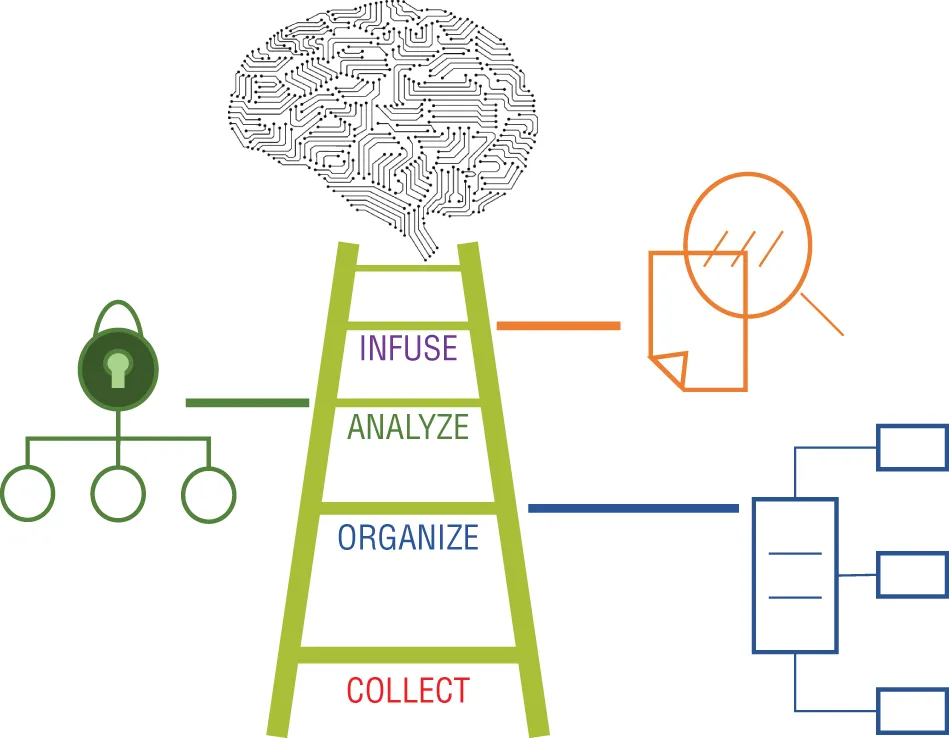
Illustrated in Figure 1-1, the level of analytics sophistication accessible to the organization increases with each rung. This sophistication can lead to a thriving data management practice that benefits from machine learning and the momentum of AI.
Organizations that possess large amounts of data will, at some point, need to explore a multicloud deployment. They'll need to consider three technology-based areas as they move up the ladder.
  • Hybrid data management for the core of their machine learning
  • Governance and integration to provide security and seamless user access within a secured user profile
  • Data science and AI to support self-service and full-service user environments for both advanced and traditional analytics
Schematic illustration of the AI Ladder to achieve a full complement of data and analytics.
Figure 1-1: The AI Ladder to achieve a full complement of data and analytics
These foundational technologies must embrace modern cloud and microservice infrastructures to create pathways for the organization to move forward and upward with agility and speed. These technologies must be implemented at various rungs, enabling the movement of data and delivering predictive power from machine learning models in various types of deployment, from a single environment to a multicloud environment.

Taking the Ladder Rung by Rung

As shown in Figure 1-1, the rungs of the ladder are labeled Collect, Organize, Analyze, and Infuse. Each rung provides insight into elements that are required for an information architecture.
Collect, the first rung, represents a series of disciplines used to establish foundational data skills. Ideally, access to the data should be simplified and made available regardless of the form of the data and where it resides. Since the data used with advanced analytics and AI can be dynamic and fluid, not all data can be managed in a physical central location. With the ever-expanding number of data sources, virtualizing how data is collected is one of the critical activities that must be considered in an information architecture.
These are key themes included in the Collect rung:
  • Collecting data with a common SQL engine, the use of APIs for NoSQL access, and support for data virtualization across a broad ecosystem of data that can be referred to as a data estate
  • Deploying data warehouses, data lakes, and other analytical-based repositories with always-on resiliency and scalability
  • Scaling with real-time data ingestio...

Table of contents

  1. Cover
  2. Table of Contents
  3. About the Authors
  4. Acknowledgments
  5. Foreword for Smarter Data Science
  6. Epigraph
  7. Preamble
  8. CHAPTER 1: Climbing the AI Ladder
  9. CHAPTER 2: Framing Part I: Considerations for Organizations Using AI
  10. CHAPTER 3: Framing Part II: Considerations for Working with Data and AI
  11. CHAPTER 4: A Look Back on Analytics: More Than One Hammer
  12. CHAPTER 5: A Look Forward on Analytics: Not Everything Can Be a Nail
  13. CHAPTER 6: Addressing Operational Disciplines on the AI Ladder
  14. CHAPTER 7: Maximizing the Use of Your Data: Being Value Driven
  15. CHAPTER 8: Valuing Data with Statistical Analysis and Enabling Meaningful Access
  16. CHAPTER 9: Constructing for the Long-Term
  17. CHAPTER 10: A Journey's End: An IA for AI
  18. Appendix: Glossary of Terms
  19. Index
  20. End User License Agreement