Explores the interpretive history of the Book of Jeremiah, and highlights its influence on various cultures through the centuries
Jeremiah Through the Centuries explores the reception history of this enigmatic prophet and his words. The book offers an introduction telling the story of the surprising ways in which both voice and persona of this elusive prophet were used in critical historical moments, as well as a complete chapter-by-chapter commentary that presents the significant historical effects of selected texts. The spiritual struggles of the faithful and critiques of philosophers and scientists are often presented in their own voices. The book offers original ideas about the effects of the "slipping figure of Jeremiah" on the developing idea of the self, shown in a wide range of liturgical, political, artistic, literary, and cultural contexts.
The book guides readers through various interpretations of Jeremiah's poetry and prose, discussing the profound influence that Jeremiah and Western culturehave had on each other through the centuries. Significant texts from every chapter of Jeremiah are presented in a chronological narrative as both conversation and debate – enabling readers to encounter the prophet in the text of the Bible and in previous exegeses. Throughout the text, the receptions reflect historical contexts and highlight the ways they shaped specific receptions of Jeremiah. This book:
Illustrates how the Book of Jeremiah was adapted by readers to face new challenges, both in the past and present
Includes examples of Jeremiah in social satire, Islamic tradition, political debate, and religious controversy
Provides a detailed introduction that traces Jeremiah's influence on events and traditions
Offers insights into both celebrated texts and lesser-known passages that are relevant to contemporary readers
Features numerous, previously unpublished illustrations demonstrating the influence of Jeremiah on traditions in Western art
Featuring engaging narrative and expert commentary, Jeremiah Through the Centuries is ideal for students, teachers, and general readers with interest in theology and biblical studies, Judaic studies, ancient literature, cultural criticism, reception history of the Bible, and the history of Western civilization.
Readers from the beginning wrestled with the complex relation between divine speech and its human record. Septuagint begins “The word of God that came to Jeremiah…” but the Hebrew reads “The words of Jeremiah son of Hilkiah… which was the word of the Lord to him.” Dead Sea scrolls of Jeremiah offer evidence that multiple versions co‐existed, some supporting what became the Masoretic text and others the Septuagint. The Septuagint, though later than our Hebrew text, translates an earlier Hebrew version no longer extant. Why does this matter? For redactors of Jeremiah in the exile the uncontrolled nature of prophecy was a problem, hence seven references to a scroll (25:13; 30:1; 36:2, 28, 32; 45:1; 51:63) highlight the authority of the written text as privileged repository of the divine words. Historians suggest that exilic redactors codified their version of the Jeremiah tradition to emphasize an authoritative scroll, as in Jer 1:1, partly to counter voices of the remnant in Judah who heard or read the prophet differently (Sharp 2011: 35–46). Reception history displays persistent engagement with the complex relation between divine word and human writing. Jerome reassures readers that both the Hebrew and Greek of Jer 1:1 identify Jeremiah’s words as the word of the Lord, which by the fifth century had already taken on the technical sense of “Scripture” (Jerome 1960).
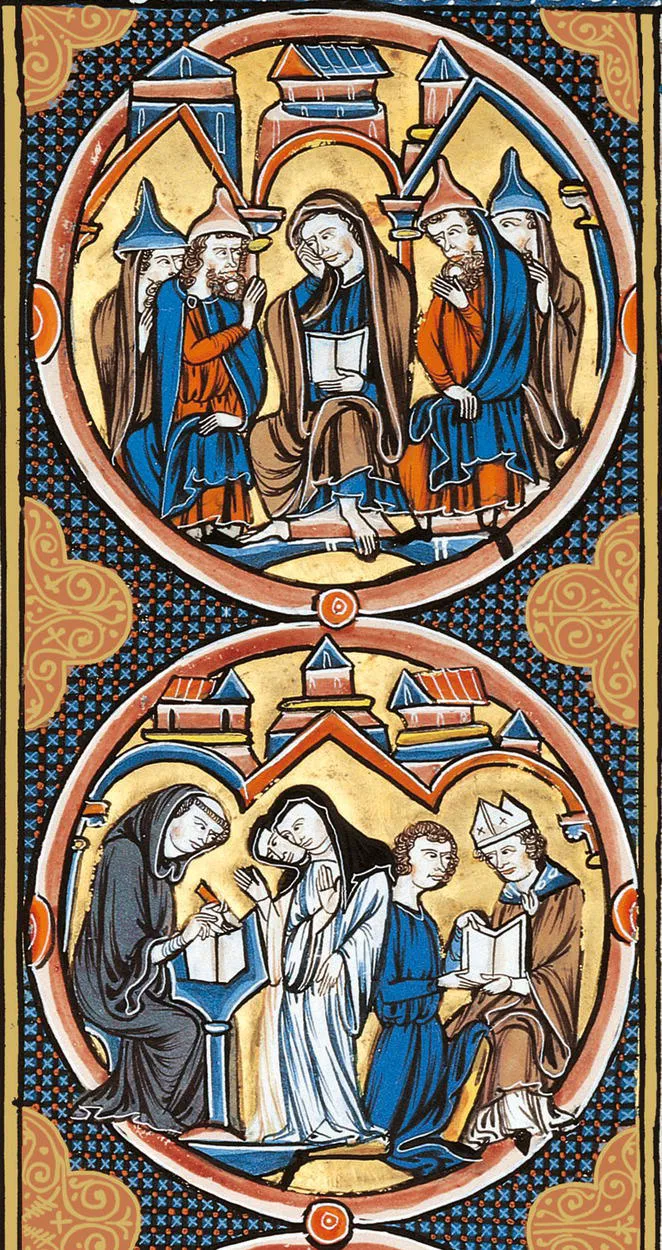
Jeremiah persists as human site of the divine word and contested text in medieval interactions between Jews and Christians. The Bible moralisée illustrates Jer 1:1 with the prophet in the traditional pose of lament, holding an open book, surrounded by four Jews with hands raised in gestures of opposition (Figure 19). The historical prophet rejected by his people here becomes the book whose Christological interpretations are rejected by medieval Jews. At least 26 more roundels throughout Bible moralisée show Jeremiah with an open book in images designed to contrast the church’s teaching over against that of Jews, philosophers, heretics, or even other Christians. The accompanying interpretive roundel shows Jerome at his desk translating Jeremiah into Latin and the bishop authorizing his translation as the church’s scriptures. The two roundels together address contemporary disputes about biblical interpretation. In thirteenth‐century France, Christian scholars who knew Hebrew, especially at the Abby of St. Victor in Paris, sometimes challenged the church’s traditional allegories. The beginning of Jeremiah addresses these debates by visually identifying the book on Jeremiah’s lap, which signifies his original Hebrew words, with Jerome’s Vulgate, shown firmly under the ecclesial authority of a saint and a bishop.
The effects of Jeremiah as book and person are apparent in Figure 20, a copper‐plate engraving that appeared in Cornelius Martinus Spanghoe’s 1784 Dutch picture Bible entitled Very Correct Discourse of the History of the Old Testament. The codex, pen, and distinctive face contemporize Jeremiah for eighteenth‐century readers as a consumer of the divine word, mirroring their own experience with the Bible.
Nineteenth‐century readers were reassured that their individuality mattered to God. Jeremiah’s “personality, temperament, experiences, style of thought, modes of expression, are all stamped upon these Divine messages. Inspiration does not obliterate, scarcely subordinates individuality” (Jellie 1892: 17:8). Twice the text urges reading Jeremiah 1:1 as evidence that God uses “the true self,” an idea that would surely have puzzled Jeremiah’s redactors.
Reception begins in Sirach 49:5–9, a poetic narration of Israel’s history from the beginning to the author’s own time around 180 bce. Prominent in Sirach’s praise of Jeremiah is “sanctified a prophet in the womb.” Paul permanently influences reception by combining Jeremiah with Isa 49:1 to claim that God set him apart in his mother’s womb and called him (Gal1:15). Paul’s change marks Protestant theology from the sixteenth century forward (see below).
Figure 20 Jeremiah 1:1. Cornelius Martinus Spanghoe, 1784. Private collection.
In the third century ce, Jeremiah’s conception becomes part of Christian speculation about the nature of the soul. Origen argued that Jeremiah offers evidence for the neo‐Platonic teaching that souls are pre‐existent. Reading the verbs “formed” and “knew” as two chronologically distinct divine actions, Origen argued from Gen 2:15 (God formed Adam from the earth) that “formed” indicates physical creation subsequent to knowing. When God knew him, Jeremiah already existed as a soul but not a body. Origen’s use of Jeremiah to support pre‐existence of souls met with fierce resistance. Jerome comments: “Not that he existed before conception, as the heretic [Origen] believes, but rather that the Lord, for whom deeds not yet done have already happened, knew his future” (Jerome 1960: 4). For Jerome the allegorical sense of Jer 1:5 is apparent in John 10:38: “Before he came forth from his mother, he was sanctified in the womb and known to the father; indeed, he was always in the father and the father was always in him” (Jerome 1960: 5). Jerome’s Christological reading of Jer 1:5 contributed to the early identification of Jeremiah with Jesus, which persisted through the Middle Ages.
The verse also figured in passionate arguments against Arius and his many followers who held that Christ was not co‐eternal with the Father, but came into existence at birth. In his list of the genuine books of Scripture, Gregory Nazianzus describes Jeremiah as “the one called before birth” (Gregory Nazianzus 1890: 7), while no other prophet in his catalogue is given more than a name. Ambrose more than once invokes Jer 1:5 to argue against Arian teaching, citing Jacob and Jeremiah as examples of those existing and indeed appointed before birth. Ambrose uses Jeremiah to explain the unusual phrase in John 1:18 on the pre‐existence of Jesus in the bosom of the Father: “The Father’s womb is the spiritual womb of an inner sanctuary, from which the Son has proceeded just as from a generative womb… The Father speaks of that womb through the prophet Jeremiah (1:5). Therefore, the prophet showed that there was a twofold nature in Christ, the divine and the fleshly” (Wenthe 2009: 4–5). The description of Jesus in the Nicene Creed as “eternally begotten of the Father” reflects the victory of this idea.
In the eleventh century, Rashi challenges Christian use of Jeremiah’s origins with rabbinic hermeneutics. Reading with the Targum “I established you” and “I appointed you,” Rashi finds in Jeremiah fulfillment of the mysterious promise to Moses, “I will establish a prophet like you” (Deut 18:18). That both texts use establish, and that Moses and Jeremiah both reproved Israel and prophesied for 40 years, signals that the texts interpret each other. Rashi’s countering of Christian allegory with classic Jewish exegetical principles gave French rabbis support in their debates with Christian scholars.
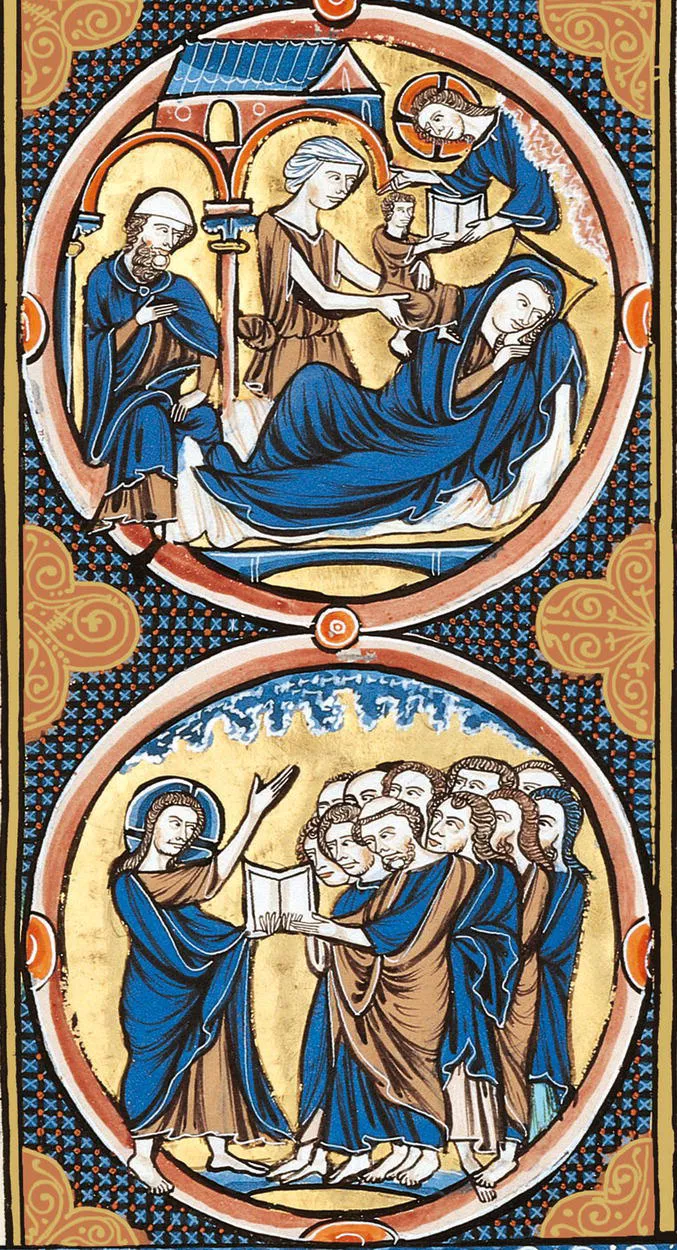
The thirteenth‐century Bible moralisée pictures Jeremiah’s birth as Christian allegory (Figure 21). A nativity scene of reclining mother and watchful father clearly evokes images of Jesus’ birth, but the midwife holds up a fully formed miniature prophet who receives a book from God’s hand. The visual allusion to Luke’s nativity story offers a hermeneutic to readers, encouraging them to see Jesus in Jeremiah from the very beginning of the book. The visual trope linking God, the prophet, and the book also reminds readers of the divine origins of the text in their hands. The accompanying roundel reinforces Jesus as a figure of Jeremiah by showing him, like Jeremiah, holding an open book. The text instructs that Jer 1:5 foretells Christ, “who called all the nations through the apostles” as Jeremiah was prophet to the nations.
The artist used the patristic tradition preserved in the Glossa Ordinaria, which glosses Jer 1:5 by writing “Father” over “the Lord” and “the Son through whom all things [were made]” over “his hand.” God’s commission to Jeremiah is explained as “the Father to the Son” and explained by Ps 2:8 (“Ask and I will give you the nations as your inheritance”). This elaborate tradition linking the origins of Jeremiah and Jesus continues in the storied thirteenth‐century stained glass of Sainte‐Chapelle in Paris. Of seven windows devoted to Jeremiah, one shows the prophet kneeling to receive an ornate book from God, whose right hand is raised in a priestly blessing. Another image, now in the Victoria and Albert Museum in London, shows a swaddled newborn being handed to his reclining mother. The rest of this image is no longer extant, but art historians conclude that the lancet portrays the thirteenth‐century French tradition of Jeremiah’s birth prefiguring Jesus. That King Louis IX was patron of both the Bible moralisée and Sainte‐Chapelle suggests that this shared artistic tradition is a thirteenth‐century innovation in the reception of Jeremiah.
Reading the divine “I chose you” as instructive of Christian vocation becomes the norm in the sixteenth century, but it has one precedent. In the eleventh century, Peter Damian used Jeremiah constructively to teach his monks that God chooses people at different times of life, some in youth, others in old age (Damian 1998:...
Table of contents
Cover
Table of Contents
Wiley Blackwell Bible Commentaries
List of Illustrations
Series Editors’ Preface
Acknowledgments
Testimonia
Introduction
Jeremiah 1:
Jeremiah 2:
Jeremiah 3:
Jeremiah 4:
Jeremiah 5:
Jeremiah 6:
Jeremiah 7:
Jeremiah 8:
Jeremiah 9:
Jeremiah 10:
Jeremiah 11:
Jeremiah 12:
Jeremiah 13:
Jeremiah 14:
Jeremiah 15:
Jeremiah 16:
Jeremiah 17:
Jeremiah 18:
Jeremiah 19:
Jeremiah 20–21:
Jeremiah 22:
Jeremiah 23:
Jeremiah 24:
Jeremiah 25:
Jeremiah 26–28:
Jeremiah 29:
Jeremiah 30–31:
Jeremiah 32–33:
Jeremiah 34:
Jeremiah 35:
Jeremiah 36:
Jeremiah 37–38:
Jeremiah 39:
Jeremiah 40–43:
Jeremiah 44:
Jeremiah 45:
Jeremiah 46–51:
Glossary
Bibliography
Brief Biographies
Index
End User License Agreement
Trusted by 375,005 students
Access to over 1.5 million titles for a fair monthly price.
Study more efficiently using our study tools.
Frequently asked questions
Yes, you can cancel anytime from the Subscription tab in your account settings on the Perlego website. Your subscription will stay active until the end of your current billing period. Learn how to cancel your subscription
No, books cannot be downloaded as external files, such as PDFs, for use outside of Perlego. However, you can download books within the Perlego app for offline reading on mobile or tablet. Learn how to download books offline
Perlego offers two plans: Essential and Complete
Essential is ideal for learners and professionals who enjoy exploring a wide range of subjects. Access the Essential Library with 800,000+ trusted titles and best-sellers across business, personal growth, and the humanities. Includes unlimited reading time and Standard Read Aloud voice.
Complete: Perfect for advanced learners and researchers needing full, unrestricted access. Unlock 1.5M+ books across hundreds of subjects, including academic and specialized titles. The Complete Plan also includes advanced features like Premium Read Aloud and Research Assistant.
Both plans are available with monthly, semester, or annual billing cycles.
We are an online textbook subscription service, where you can get access to an entire online library for less than the price of a single book per month. With over 1.5 million books across 990+ topics, we’ve got you covered! Learn about our mission
Look out for the read-aloud symbol on your next book to see if you can listen to it. The read-aloud tool reads text aloud for you, highlighting the text as it is being read. You can pause it, speed it up and slow it down. Learn more about Read Aloud
Yes! You can use the Perlego app on both iOS and Android devices to read anytime, anywhere — even offline. Perfect for commutes or when you’re on the go. Please note we cannot support devices running on iOS 13 and Android 7 or earlier. Learn more about using the app
Yes, you can access Jeremiah Through the Centuries by Mary Chilton Callaway in PDF and/or ePUB format, as well as other popular books in Theology & Religion & Biblical Criticism & Interpretation. We have over 1.5 million books available in our catalogue for you to explore.