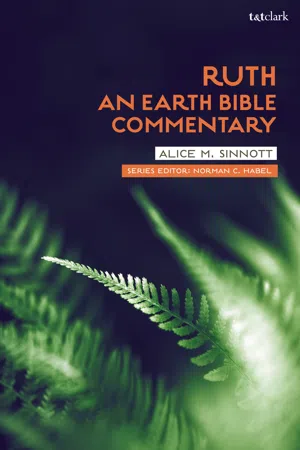
This ecological reading of the book of Ruth takes into account the power which this short story holds, speaking to the whole person by engaging each reader's emotions, imagination, memory, and reason. Alice M. Sinnott demonstrates how the story of Ruth transcends geographical, spatial and historical boundaries by appealing to all concerned with the plight of the Earth.
Sinnott highlights the ecological dimensions of the text that scholars have ignored or dismissed in the past, and explores how the narrator gives voice to the way in which the Earth functions throughout the story. Integral to her reading of the text is a concern for Earth and matters such as food, famine, death, harvests, grain, day and night and members of the Earth community. Sinnott considers non-human characters as legitimate determining factors in the structuring of the narrative, and recognizes Earth and members of the Earth community as equally valid subjects. By identifying with these aspects of Ruth, Sinnott is able to read the text with new eyes; and by placing special emphasis in how the narrator depicts the natural world, she reinforces how subjects from that world emerge as integral components.
- 160 pages
- English
- ePUB (mobile friendly)
- Available on iOS & Android
eBook - ePub
Ruth: An Earth Bible Commentary
About this book
Information
Chapter 1
INTRODUCTION
“Wherever you go, I will go … ,” an excerpt from the favourite text from the book of Ruth, has been the chosen reading at numerous weddings I have attended. Interestingly it is only at weddings that I hear sermons, homilies, and reflections on Ruth’s vow to Naomi, her mother-in-law. The Ruth story continues to be a favourite Bible story for many Jews and Christians. In the Christian canons, the book of Ruth sits among books portraying war, battles, trickery, treachery, abominable violence, bloodshed, brutal reprisals, and total disregard for the Torah. So the Ruth story, when read in this context, raises many questions about how such a human story appears in such horrific literary company. The simplicity and attractiveness of the book of Ruth as a human story masks the pivotal roles that Earth and the Earth community, day, night, land, fields, barley harvest, wheat harvest, and threshing play in the story. Over the centuries, many have read the book of Ruth as a consoling story of how human beings can treat others, outsiders, and insiders with ḥeseḏ “loving kindness.” It is the perspective of this commentary that such a reading reflects some understanding of what it means to be an Earth person and to respect and honour Earth creatures and elements. Care and concern for others demands that human beings step outside and beyond what one considers minimum, primary human responsibility, and to seek greater wholeness in the Earth community.
Scholars have generally overlooked Earth and Earth creatures in the Ruth story. Positive assessments of the story capture broad reading audiences and studies. Potentially harmful features of the narrative have created many ethical and theological difficulties for some modern readers; some have even disputed the worth of this story in contemporary society. The text itself addresses significant difficulties along the way and eventually presents a more positive assessment.
Difficulties with the story are not limited to theological and legal issues, however. They begin with debates over classic topics such as date of composition, purpose, and authorship. The presentation of these matters will be relatively brief since they are informative but finally not decisive for assessing the significance of reading the Ruth narrative from an Earth perspective.
Date and purpose
Christian traditions set the Ruth story historically by its opening line in the era of the Judges and conclusion with mentions of King David. Thus, many scholars have argued that the composition appears to be from the time of David or later. Critical scholarship in the first half of the twentieth century proposed that the book was from the time of Ezra and Nehemiah some 550 years after the reign of David. Arguments for this date rest primarily on linguistic and grammatical features such as expressions that appear to show the influence of the Aramaic language on the Hebrew of Ruth, influences that were thought to be only possible in the post-exilic period when Aramaic became the dominant spoken language. Ruth is not a polemical text. While Deut 23:4–9 and Neh 13:1–3 display hostility towards Moabites, Ruth does not. Concerns about inclusion/exclusion, genealogical purity, and inclusion of foreign women to marriage do appear. The worship of YHWH does pose concerns, particularly in Isaiah 55–66. Ruth’s vow to Naomi includes “your God will be my God, too.” However, her loyalty appears to be primarily to Naomi herself. The main argument for a post-exilic dating is that the book engages with a post-exilic issue regarding the inclusion of foreigners, while Israelites must always have struggled with the problem of “foreigners.” Their self-understanding included their history of being exiles/migrants in Egypt – the Torah commanded that they treat foreigners well (Lev 19:33–34). The narrative is independent of the references to a historical period, and its geography is similarly independent. Ruth has a self-contained landscape. The story begins in Bethlehem, moves in three verses to Moab, returns to Bethlehem of Judah, and remains there. Just because a book is relevant in the post-exilic period does not mean that was the time of its origin. Reworking already existing narratives may not have been unusual in the light of shifting realities. Earlier elements remained, but a reinterpretation gave the narrative new meaning. Many scholars date all or most of Ruth to the post-exilic period, and this study agrees with the arguments for this dating.1
Genealogies in Ruth
This commentary dates the Hebrew text well into the exilic or even post-exilic period. The original purpose of the story may have been to support claims of the Davidic line as it points to David with the mention of Ephrathah in the opening verses (1:2) and at its closing (4:11). Also there is a twofold mention of David in the narrative conclusion (4:17) and in the longer genealogy (4:18–22). Some debate the antiquity of the genealogy and the direction of likely literary dependence between the concluding genealogy in Ruth and the parallel information in 1 Chr 2. There is much to dispute concerning the two genealogies, and some scholars consider each version to have an independent primary source. Regardless of which view seems most likely, the genealogy used in Ruth is a stylized and precise form. Boaz holds the seventh place of note in traditional genealogies, and David holds the tenth and final place.2 The number of names is certainly insufficient to cover a human time frame from Perez to David in the biblical tradition. Within the genealogy, the names of Ram and Salmon are highly problematic as they lack any other attestation beyond the parallel in 1 Chronicles and have different spelling in the Hebrew Bible. Oddly, the genealogy begins with Perez rather than with his father Judah, the eponymous ancestor. Nielsen suggests that court scribes prepared the genealogy for propaganda purposes. If this is correct, why did the genealogy not begin with Judah? Ruth 4:12 names the ancestor of the tribe of Judah and omits Ram and Salmon, thus continuing the seventh and tenth places for Boaz and David. Certainly, the issues surrounding the genealogy are complex and beyond the scope of this commentary.
View of foreigners/outsiders
A starting point for this commentary is the narrator’s subtle instruction concerning the community’s view of outsiders. David is the narrator’s means of legitimating an inclusive attitude towards foreigners, especially towards foreign women. The Ruth story encourages Israelites to accept gifts of care and concern from outsiders while they likewise must extend their care and concern beyond the boundaries of the bloodlines of the covenant community. An earlier emphasis on challenging the limitations of traditional ethnic barriers might have had relevance in the eras of Ezra and Nehemiah. The community might have heard the story as a challenge to the purity perspectives of the late pre-exilic Deuteronomistic History with its warnings against relationships with the local Canaanites. It might have addressed in story form the tensions arising early in the post-exilic era between Jewish returnees from Babylon and those who had remained in the land after the fall of Jerusalem. Noting the repeated need to challenge narrow exclusivism in the life of the ancient community should remind readers that the story of Ruth addresses a perennial issue in human communities. The question put to Jesus, “And who is my neighbour?” that elicited from Jesus the story of the good Samaritan (Luke 10:29) addresses this same debate about the limits of neighbourliness. Who are the faithful ones in the community and how far should the boundaries for exercising genuine concern extend? For ancient readers/hearers of Ruth who recognized and revered the legitimacy of David’s kingship, the references to David could function as an endorsement making its controversial claims binding upon them. Perhaps the story encouraged them to recognize the need for care and concern for outsiders and how they might extend their care and concern beyond the boundaries of the bloodlines of the covenant community. While an emphasis on challenging the limitations of traditional ethnic barriers might have had relevance in the eras of Ezra and Nehemiah, it is not necessary that the story was composed only at that time in order to bear the didactic intent of a word about inclusion.
Eco-justice hermeneutic principles
Norman Habel in his preface to The Birth, the Curse, and the Greening of Earth: An Ecological Reading of Genesis 1-11 summarizes the fundamental hermeneutical principles that guide an Earth reading of the book of Ruth.3 These principles of intrinsic worth, interconnectedness, voice, purpose, mutual custodianship, and resistance offer a way of engaging the Ruth story with a hermeneutic of suspicion, identification, and retrieval. Anthropocentric texts usually ignore the Earth’s presence in the text. Readers may struggle at first to recognize Earth, Earth creatures, and Earth elements in the story of Ruth and to retrieve the Earth presences, particularly when they seem not to be the author’s explicit narrative focus. The interpretive hermeneutic of suspicion, identification, and retrieval offers a way of hearing the Ruth story afresh. The narrative involves Earth, Earth creatures, and Earth elements. The four main eco-justice principles that guide this study are intrinsic worth, interconnectedness, voice, and mutual custodianship.
Reading Ruth from an Earth perspective
A stated aim of the Earth Bible series is to “recognise Earth not simply as a topic to be explored in the text but also as a subject in the text with which we seek to relate empathetically.”4 An Earth reading of the book of Ruth requires consideration of primary literary units that scholars have traditionally identified in this short story. The study examines the literary structure of sections of the story and Earth themes and tropes throughout the complete narrative. This investigation of sections of the narrative and how the story builds to a resolution will consider the presence of Earth, Earth characters, and Earth components as legitimate determining factors in the structuring of the narrative. Appropriate references to studies by a variety of biblical scholars may illustrate recent studies of Ruth. This study recognizes Earth, Earth spaces and settings, members of the Earth community, and Earth creatures as valid subjects. The design of the narrative will highlight dimensions of the text that have been ignored or dismissed in the past, but which demand special attention in a reading of the narrative from an Earth perspective. This study will consider how the narrator represents and gives voice to how Earth, domains of Earth, and members of the Earth community function throughout the story. As Habel so emphatically states, the “preferred approach is one that moves beyond a focus on ecological themes to a process of listening to and identifying with the Earth as a presence or voice in the text.”5
Analysis of plot, characters, and text
An analysis of the plot, the characters, and the meaning of the text flows from the structural design of the narrative. Close examination of textual units as coherent units of plot demands consideration of typical anthropocentric and dualistic readings of the text by past scholars. Such a search may reveal some limitations of various approaches, but this study will not engage in lengthy dialogue with the numerous interpreters of this narrative. Integral to a study of the Ruth text will be empathy and concern for Earth as such, for domains of Earth such as famine, death, harvests, grain, day, night, water, land, human and non-human lives in the Earth community. The study seeks to identify the significance of the actions embarked on by Earth, Earth creatures, and Earth characters who are subjects but also active in the plot and the narrative. Of interest is whether the storyteller makes specific roles and characters convincing. By identifying with Earth and all its various elements, actors, and voices in the narrative, this study seeks to read the text with new eyes and to discern previously overlooked dimensions in it.
This study aims to consider and unearth nuances of meaning in word plays, rhetorical innuendoes, intertextual associations, mythic dimensions, and cultural imagery. By giving special attention to how the narrator depicts Earth and Earth creatures, the study aims to discover subjects that warrant reflexion in terms of the environment of the text. While attending to connections that scholars have traditionally made with symbols, concepts, and language from cultural contexts of the ancient Near East, their viability in terms of an ecological hermeneutic is paramount.
At crucial points, the study moves from the analysis of specific words, images, and textual units to focus on the broader ecological patterns and issues that emerge. Of paramount concern in this study is the narrative and how Earth, light, darkness, visibility, field, food, water, famine, and harvests feature in the narrative. The study focuses on reading the articulated, implied, or concealed language of the narrative from an Earth perspective. Such a reading employs an ecological hermeneutic of suspicion, identification, and retrieval.
Retrieval of Earth’s voices
Attempts to identify with and understand the Earth and elements of the Earth community require a search to retrieve dimensions of the Ruth text that earlier scholars have ignored or dismissed as irrelevant. This study seeks to identify Earth and Earth elements in the Ruth text and to attend to factors informing the meaning of the narrative. In the act of retrieval, the study seeks to hear the voices of the non-human characters in the story. The reconstruction of non-huma...
Table of contents
- Cover
- Dedication Page
- Series Page
- Title Page
- Contents
- Abbreviations
- Chapter 1 Introduction
- Chapter 2 Ruth and Naomi: Widows and migrants
- Chapter 3 Ruth: A female liberator
- Chapter 4 Ruth: A landless Moabite
- Chapter 5 Ruth: A woman of Ḥeseḏ
- Chapter 6 Ruth: Women of worth
- Chapter 7 Ruth: Earth’s voice
- Conclusion
- Bibliography
- Author Index
- Subject Index
- Biblical Index
- Copyright Page
Trusted by 375,005 students
Access to over 1.5 million titles for a fair monthly price.
Study more efficiently using our study tools.
Frequently asked questions
Yes, you can cancel anytime from the Subscription tab in your account settings on the Perlego website. Your subscription will stay active until the end of your current billing period. Learn how to cancel your subscription
No, books cannot be downloaded as external files, such as PDFs, for use outside of Perlego. However, you can download books within the Perlego app for offline reading on mobile or tablet. Learn how to download books offline
Perlego offers two plans: Essential and Complete
- Essential is ideal for learners and professionals who enjoy exploring a wide range of subjects. Access the Essential Library with 800,000+ trusted titles and best-sellers across business, personal growth, and the humanities. Includes unlimited reading time and Standard Read Aloud voice.
- Complete: Perfect for advanced learners and researchers needing full, unrestricted access. Unlock 1.5M+ books across hundreds of subjects, including academic and specialized titles. The Complete Plan also includes advanced features like Premium Read Aloud and Research Assistant.
We are an online textbook subscription service, where you can get access to an entire online library for less than the price of a single book per month. With over 1.5 million books across 990+ topics, we’ve got you covered! Learn about our mission
Look out for the read-aloud symbol on your next book to see if you can listen to it. The read-aloud tool reads text aloud for you, highlighting the text as it is being read. You can pause it, speed it up and slow it down. Learn more about Read Aloud
Yes! You can use the Perlego app on both iOS and Android devices to read anytime, anywhere — even offline. Perfect for commutes or when you’re on the go.
Please note we cannot support devices running on iOS 13 and Android 7 or earlier. Learn more about using the app
Please note we cannot support devices running on iOS 13 and Android 7 or earlier. Learn more about using the app
Yes, you can access Ruth: An Earth Bible Commentary by Alice M. Sinnott in PDF and/or ePUB format, as well as other popular books in Theology & Religion & Biblical Criticism & Interpretation. We have over 1.5 million books available in our catalogue for you to explore.