Museums of all kinds – art, history, culture, science centers and heritage sites – are actively engaging with food through exhibitions, collections, and stories about food production, consumption, history, taste, and aesthetics. Food also plays a central role in their food courts, restaurants, cafes, gardens, and gift shops.
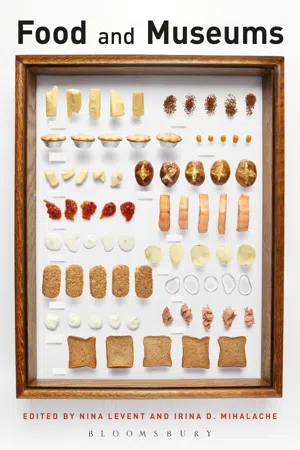
Food and Museums is the first book to explore the diverse, complex relationship between museums and food. This edited collection features theoretical analysis from cultural historians, anthropologists, neuroscientists, and food studies scholars; interviews with museum professionals, artists and chefs; and critical case studies from a wide range of cultural institutions and museums to establish an interdisciplinary framework for the analysis of the role of food in museums. Exploring the richness and complexity of sensory, cultural, social, and political significance of food today as well as in the past, the book demonstrates how food is changing the current museological landscape.
A fascinating look at contemporary museums through the lens of food, this is an essential read for students and researchers in museum studies, food studies, cultural studies, and sensory studies as well as museum and food professionals.
- 386 pages
- English
- PDF
- Available on iOS & Android
eBook - PDF
Food and Museums
About this book
Information

INTRODUCTION
17
10
Graham
Black,
The
Engaging
Museum:
Developing
Museums
for
Visitor
Involvement
(London:
Routledge,
2005);
Nina
Simon,
The
Participatory
Museum
(Santa
Cruz:
Museum
2.0,
2010);
Anne
Bergeron
and
Beth
Tuttle,
Magnetic:
The
Art
and
Science
of
Engagement
(Washington
DC,
AAM
Press,
2005);
David
Anderson,
Alex
de
Cosson,
and
Lisa
McIntosh,
eds.,
Research
Informing
the
Practice
of
Museum
Educators.
Diverse
Audiences,
Challenging
Topics,
and
Reflective
Praxis
(Rotterdam:
Sense
Publishers,
2015).
11
Constance
Classen,
ed.
The
Book
of
Touch
(Oxford
and
New
York:
Berg,
2005).
12
Donna
R.
Barnes,
and
Peter
G.
Rose.
Matters
of
Taste:
Food
and
Drink
in
Seventeenth-Century
Dutch
Art
and
Life
(Albany:
Syracuse
University
Press,
2002);
Kenneth
Bendiner,
Food
in
Painting:
From
the
Renaissance
to
the
Present
(London:
Reaktion,
2004).
13
Al
Seckel,
Masters
of
Deception:
Escher,
Dalí
&
the
Artists
of
Optical
Illusion.
(New
York:
Sterling.
2007),
200.
14
Hans
Ulrich
Obrist,
“The
Artist
as
Farmer,”
Arts
&
Foods
,
ed.
Germano
Celant
(Milan:
Mondadori,
2015),
690–700.
15
Futurefarmers,
a
collective
of
artists,
designers,
architects,
soil
scientists,
and
farmers,
founded
by
artist
Amy
Franceschini,
is
an
example
of
this
approach.
It
works
to
deconstruct
food,
farming,
and
transportation
systems,
poses
open
questions
and
considers
possibilities.
16
“Cooking
Sections,”
http://www.cooking-sections.com/
[accessed
February
25,
2016].

Table of contents
- Cover
- Half-title
- Title
- Copyright
- Dedication
- Contents
- List of Figures
- Acknowledgments
- 1. Introduction: Re-thinking Museums through Food (and Food through Museums)
- Part One: Interdisciplinary Perspectives on Food and Museums
- Part Two: Collecting and Exhibiting Food
- Part Three: Food and Audience Engagement
- Part Four: Eating in museums
- Part Five: Food and Art
- List of Contributors
- Index
Trusted by 375,005 students
Access to over 1.5 million titles for a fair monthly price.
Study more efficiently using our study tools.
Frequently asked questions
Yes, you can cancel anytime from the Subscription tab in your account settings on the Perlego website. Your subscription will stay active until the end of your current billing period. Learn how to cancel your subscription
No, books cannot be downloaded as external files, such as PDFs, for use outside of Perlego. However, you can download books within the Perlego app for offline reading on mobile or tablet. Learn how to download books offline
Perlego offers two plans: Essential and Complete
- Essential is ideal for learners and professionals who enjoy exploring a wide range of subjects. Access the Essential Library with 800,000+ trusted titles and best-sellers across business, personal growth, and the humanities. Includes unlimited reading time and Standard Read Aloud voice.
- Complete: Perfect for advanced learners and researchers needing full, unrestricted access. Unlock 1.5M+ books across hundreds of subjects, including academic and specialized titles. The Complete Plan also includes advanced features like Premium Read Aloud and Research Assistant.
We are an online textbook subscription service, where you can get access to an entire online library for less than the price of a single book per month. With over 1.5 million books across 990+ topics, we’ve got you covered! Learn about our mission
Look out for the read-aloud symbol on your next book to see if you can listen to it. The read-aloud tool reads text aloud for you, highlighting the text as it is being read. You can pause it, speed it up and slow it down. Learn more about Read Aloud
Yes! You can use the Perlego app on both iOS and Android devices to read anytime, anywhere — even offline. Perfect for commutes or when you’re on the go.
Please note we cannot support devices running on iOS 13 and Android 7 or earlier. Learn more about using the app
Please note we cannot support devices running on iOS 13 and Android 7 or earlier. Learn more about using the app
Yes, you can access Food and Museums by Nina Levent, Irina D. Mihalache, Nina Levent,Irina D. Mihalache in PDF and/or ePUB format, as well as other popular books in Art & Museum Studies. We have over 1.5 million books available in our catalogue for you to explore.