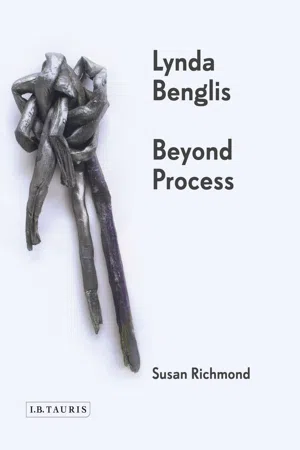
In four decades of abstract art practice, Lynda Benglis has not merely challenged the status quo. She has tied it in knots, melted it down and poured it across the floor, cast it in glass, clay and bronze. Daring and sometimes outrageous, her intense and provocative practice has produced some of the most iconic pieces of art from the late twentieth century. Richmond gives serious critical attention to work often dismissed as trivial and rootless, recovering the themes that link the different phases of the artist's quest to capture the 'frozen gesture'. Whether challenging popular tastes and definitions of art with her 1970s abstract knotwork or mocking puritanical aesthetics of gender with her colourful latex pourings and their allusions to corporeal topographies, Benglis never failed to provoke. Her sculptures commemorate and celebrate the processes of creation themselves, combining architectonic abstraction and feminized sensuality in a haunting, visceral theme of the strangeness of the body that runs through all her experiments in glass, video, metals, ceramics, gold leaf, paper and plastics.
Lynda Benglis: Beyond Process examines in depth the work and critical neglect of an artist who, perhaps more than any of her contemporaries, changed the face of American art in the 1960s and 1970s, and continues to fetishise, provoke and demand your attention.
- 208 pages
- English
- ePUB (mobile friendly)
- Available on iOS & Android
eBook - ePub
About this book
Information
1
Boundless Forms and Continuous Imagery
‘Some artists use a brush. Miss Benglis uses a pour’.1 With this simple distinction, the author of the 1971 article ‘Latex: One Artist’s Raw Material’ captured one of the most compelling aspects of Benglis’s use of liquid latex, namely, her technique of pouring the medium from cans directly onto the floor to create large and boldly coloured spills (fig. 5). Each pour was the product of a complex choreography, necessitating a balance of spontaneity and precision, not to mention physical endurance, as the artist frequently wielded five-gallon cans of the pigmented medium. Benglis had opportunities to produce some of her pours in situ, such that the condition of the gallery floor and the parameters of the architectural space became important variables in the artistic process. Indicative of the expanded definitions of materials and techniques that typified US art of the late 1960s, her latex pieces were immediately aligned with a sensibility variously identified at the time as post-minimal, anti-formal, and process art.2
Benglis did not, however, consider process to be the central conceit of the pours. Rather, she envisioned her gestural technique as a means simply to free the work from a fixed armature and, in some cases, to integrate it into a specific architectural environment. In a statement for the 1969 exhibition Art in Process IV at Finch College Museum of Art in New York, Benglis voiced a position that she would repeat over the years: ‘The image varies with the materials used. ... I am not involved with just process. I am involved in all the associations with material’.3 Significantly, the privileging of process has tended to occlude considerations of the work itself, and of the viewer’s experience of it. Indeed, the issue of spectatorship has largely fallen away as art-historical accounts instead stress what is now largely described as the ‘performative’ nature of Benglis’s pouring process. In this context, the performative encompasses the original concept of process as a physical interaction with artistic mediums while also accounting for issues of artistic identity, as enacted through the material process.

5. Lynda Benglis, Fallen Painting, 1968, poured pigmented latex, 355 x 69 ¼ in. (901.7 x 175.9 cm). Albright-Knox Art Gallery, Buffalo, NY; gift of Michael Goldberg, Lynda Benglis, and Paula Cooper, 1992. © Lynda Benglis/Licensed by VAGA, New York, NY.
I believe that this privileging of process and, in turn, of the performative dimension of Benglis’s technique is largely due to the publication and subsequent circulation of two sets of photographs documenting the artist at work: the first was taken in the context of a 1969 exhibition at the Whitney Museum of American Art, the second to accompany an article published in Life in 1970. These photographs, and notably the second set, are frequently reproduced in art-historical studies, where they serve not only to emphasise the act of making over the finished work but also, significantly, to reveal the similarities of Benglis’s procedure to Jackson Pollock’s famous dripping technique.4 Consequently, a convincing narrative of process and inheritance has developed, one dramatised by the younger artist’s status as a woman reworking the masculinist legacy of gestural abstract expressionism. The 1974 publication of Benglis’s infamous Artforum dildo advertisement, which I discuss in the introduction, further codified this art-historical narrative by placing the artist’s mobile and performative body at the centre of her practice.
In acknowledging that the performative (and the performance of gender) remains a compelling lens through which to consider Benglis’s pours, however, this chapter shifts focus to reconsider the actual works of art, their formal innovations, and the viewer’s experience of them. Beginning with the latex pieces and continuing with an analysis of the polyurethane installations that immediately followed, I examine the significance of Benglis’s dramatic staging in her work of a series of interrelated formal and conceptual tensions. These tensions, I argue, inscribe the viewer into different viewing modalities and give rise to broader artistic and contextual associations than the emphasis on artistic process, performativity, and inheritance suggests.5
fallen paintings
Benglis discovered the formal possibilities of liquid latex during a visit in 1967 to Sol LeWitt’s New York studio, where she saw a small work that Eva Hesse had executed in preparation for her larger sculpture Schema (1967). The study, comprising nine moulded hemispheres arranged in a grid on a square latex mat, impressed Benglis with its glossy suppleness and highly textured, skin-like surface, the latter an effect Hesse emphasised by painting additional coats of latex over the moulded spherical forms (fig. 6).6 The work also evidenced a fundamental tension between its geometric ordering and its labile materiality. Benglis had been exploring a similar juxtaposition in a series of encaustic relief paintings she initiated around 1966. This work, coupled with the introduction to Hesse’s latex study, contributed to her eventual dissatisfaction with the constraints of a painting armature. As Benglis recounts in her statement for Art in Process IV, ‘With the firing of the wax paintings, I realized that the idea of directing matter logically was absurd. Matter could and would take, finally, its own form. This is the reason I felt it necessary to make in pigmented latex several large paintings that were boundless in form and continuous in imagery’.7 The method of pouring latex directly onto the floor was, for Benglis, a pragmatic solution to what she considered to be an illogical attachment to a rectilinear ground. The constrictions of the conventional painting format prohibited the kinds of compositions she sought to achieve with her material processes; by attending to the interactions of colour on colour, rather than colour on canvas, she effectively dissolved the two-dimensional surface and its assertion as a physical ground. The resulting latex pieces, which the artist dubbed ‘fallen paintings’, evidenced the integration of material, process, colour, and image she had been unable to achieve with paint or wax. Thus, while Hesse continued to use latex to mould forms and paint surfaces, Benglis took advantage of its viscosity at the moment of the pouring to generate amorphous and seemingly boundless spills.

6. Eva Hesse, No title, 1967, latex, 9 ½ x 9 ½ in. (24 x 24 cm); nine hemispheres, each diameter 2 ½ in. (6.4 cm). The LeWitt Collection, Chester, CT. © The Estate of Eva Hesse. Courtesy Galerie Hauser & Wirth, Zurich. Photo: Abby Robinson, New York.
The shift to latex also involved one of scale for Benglis. Though she continued to produce smaller encaustic works in her studio (see chapter 2), the artist directed much of her artistic energy during this period to producing latex pours in large interior spaces. A single work entitled Fallen Painting (1968) demonstrates the boundless configurations to which the artist aspired with her new material (fig. 5). With a length of approximately thirty feet, the pour pools noticeably at either end in a manner that suggests extended pauses in Benglis’s movements. Like all the extant latex pieces, over the years Fallen Painting has succumbed to age and storage constraints. While it would have originally hugged the floor, with passing time the once-glossy latex has rippled and no longer lies flush. Under gallery lighting, its wavy surface and softly turned edges cast shadows and create literal depth, while an accretion of dirt and other detritus draws unintended attention to a now matte and pocked surface.
In contrast to these signs of aging, the fluorescent pigments Benglis used in Fallen Painting – a marbleised blend of bright green, dark blue, tangerine orange, canary yellow, and cherry red – have retained much of their initial saturation and offer some sense of the work’s original chromatic effect. Benglis recognised early on that her bold Day-Glo palette not only illuminated the variables of the pouring process but also defied a clear reading of spatial relations. As she once noted, her pieces may have been ‘down on the floor, but the color was up’.8 On another occasion she described the effect of the colouration in terms of ‘bouncing’, even titling a latex pour with this description in mind (plate 1).9 As it was originally installed in a corner of Bykert Gallery in New York, the vibrant Day-Glo hues in Bounce (1969) no doubt seemed to ricochet off the adjoining walls like a rubber bouncy ball. Or, as critic Peter Schjeldahl observed in writing about the Bykert show, Benglis’s colourful choices deny ‘the eye a precise reading of the work’s shape and consistency and thus heighten the confusion of painting, sculpture, and “other” to an exquisite pitch’. What most struck the critic about Bounce, however, was Benglis’s ‘nearly exact repetition’ of Pollock’s painting technique.10 Schjeldahl was not alone in this assessment: overwhelmingly, curators and critics found that the younger artist’s pours singularised gestural process in a manner highly reminiscent of the abstract expressionist’s style.
This attention to process earned Benglis an invitation to participate in Anti-Illusion: Procedures/Materials, the 1969 landmark exhibition organised by Marcia Tucker and James Monte for the Whitney Museum of American Art. The exhibition was the first in a major US museum to showcase process-oriented practices, and it helped to establish the definitive set of criteria for such work. For Monte, writing in the Anti-Illusion catalogue, the selected artists epitomised an important shift away from modernist formal aesthetics. Their commitment to investigating material procedures, proposed the curator, opened up a series of radical questions about ‘how art should be seen, what should be done with it and finally, what is an art experience’.11
Robert Morris’s artwork and writings constituted an acknowledged springboard for the Anti-Illusion exhibition. In particular, his 1968 essay ‘Anti Form’, published in Artforum, proffered a description of process-oriented art to which the Whitney curators were clearly indebted. Here Morris first observed that a number of his peers were abandoning predetermined idealised forms in favour of work arrived at through unpredictable, non-hierarchical and seemingly random configurations. Utilising unconventional materials and elemental physical procedures, they allowed such variables as gravity and chance to inflect the working process, the end results of which no longer conformed to clear-cut categories of painting and sculpture. According to Morris, an important genesis for these tendencies could be found in the work of Jackson Pollock and, to a somewhat lesser degree, Morris Louis. Each painter’s technique, he argued, retained the artistic process as ‘part of the end form’ of the artwork. Their practices demonstrated to a subsequent generation of artists that a ‘disengagement with preconceived enduring forms and order for things is a positive assertion’.12 Within the paradigm of process and anti-formal art, the object status of the works proved less significant than the highly experimental and experiential dimensions of their production.
Monte and Tucker subsequently echoed Morris’s critical emphasis on the phenomenological and situational contexts of ‘anti-formal’ artistic procedures. In...
Table of contents
- Cover
- Title Page
- Contents
- List of Illustrations
- Acknowledgments
- Introduction
- 1. Boundless Forms and Continuous Imagery
- 2. Flesh and Physicality
- 3. Video Input and Output
- 4. Questioning Taste
- 5. Iterations and Expansions
- Notes
- Bibliography
- Index
- eCopyright
Trusted by 375,005 students
Access to over 1.5 million titles for a fair monthly price.
Study more efficiently using our study tools.
Frequently asked questions
Yes, you can cancel anytime from the Subscription tab in your account settings on the Perlego website. Your subscription will stay active until the end of your current billing period. Learn how to cancel your subscription
No, books cannot be downloaded as external files, such as PDFs, for use outside of Perlego. However, you can download books within the Perlego app for offline reading on mobile or tablet. Learn how to download books offline
Perlego offers two plans: Essential and Complete
- Essential is ideal for learners and professionals who enjoy exploring a wide range of subjects. Access the Essential Library with 800,000+ trusted titles and best-sellers across business, personal growth, and the humanities. Includes unlimited reading time and Standard Read Aloud voice.
- Complete: Perfect for advanced learners and researchers needing full, unrestricted access. Unlock 1.5M+ books across hundreds of subjects, including academic and specialized titles. The Complete Plan also includes advanced features like Premium Read Aloud and Research Assistant.
We are an online textbook subscription service, where you can get access to an entire online library for less than the price of a single book per month. With over 1.5 million books across 990+ topics, we’ve got you covered! Learn about our mission
Look out for the read-aloud symbol on your next book to see if you can listen to it. The read-aloud tool reads text aloud for you, highlighting the text as it is being read. You can pause it, speed it up and slow it down. Learn more about Read Aloud
Yes! You can use the Perlego app on both iOS and Android devices to read anytime, anywhere — even offline. Perfect for commutes or when you’re on the go.
Please note we cannot support devices running on iOS 13 and Android 7 or earlier. Learn more about using the app
Please note we cannot support devices running on iOS 13 and Android 7 or earlier. Learn more about using the app
Yes, you can access Lynda Benglis by Susan Richmond in PDF and/or ePUB format, as well as other popular books in Art & Art General. We have over 1.5 million books available in our catalogue for you to explore.