eBook - ePub
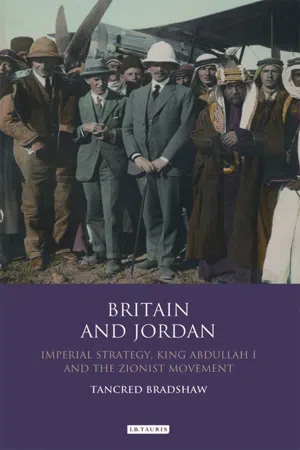
Britain and Jordan
Imperial Strategy, King Abdullah I and the Zionist Movement
- 304 pages
- English
- ePUB (mobile friendly)
- Available on iOS & Android
eBook - ePub
About this book
In the wake of the establishment of the State of Israel in 1948, it has often been alleged, King Abdullah I of Jordan and the Zionist movements colluded to partition Mandate Palestine between them, while Great Britain, the retreating imperial power, gave them tacit approval to do so. Here, Tancred Bradshaw challenges these allegations, looking at the complex and often strained relations between the emerging states of Jordan, Israel and the at first hegemonic, and then crumbling, British Empire. Using a wide range of primary sources which have previously been largely ignored, 'Britain and Jordan' offers an essential re-examination of the relationships which were to shape the Middle East as it is today. It thus contains vital analysis for anyone involved in the study of the Middle East, its politics and history, as well as the demise of Britain's empire in the region.
Information
CHAPTER 1
WARTIME DIPLOMACY AND THE ESTABLISHMENT OF THE MANDATORY REGIME IN PALESTINE AND TRANSJORDAN
The modern history of the interplay between Britain and Jordan is part of the longer and larger story of the British Empire, and unfolds within the broader and more complex story of the Empire’s involvement in the Middle East. In bringing forth the undertold story of Jordan’s founding years and its bilateral relationship with Britain, the logical place to turn for both fact and analysis is the historiography of British imperial and regional strategy.
Structural Theories of British Imperial Strategy and the Middle East
The historiography of British imperialism in the Middle East, the British imperial historian John Darwin has argued, ‘is still a poor relation’ of the literature on the Empire in tropical Africa and India.1 The most likely reason is the complexity of the subject and the decentralisation of its primary sources. The British imperial presence in the Middle East has been ignored, Darwin and other writers claim, because of the division of regional control among the Foreign Office, India Office and Colonial Office, with significant influence also from the armed services and the Treasury. This bureaucratic maze has defied and frustrated the usual categories and research protocols employed by imperial historians.
A second explanation commonly offered for the limited output on the subject has been that most historians of the Middle East have not considered themselves to be historians of the Empire and so have made a limited contribution to debates about imperial history in the Middle East.2 Peter Sluglett notes that imperial history on the Middle East has been ‘distinctly patchy’, with the Eastern Question, Egypt and Palestine receiving most attention.3
Contributing to this lack of systematic study or material is the relative speed and lack of deliberation with which Great Britain brought its hegemony to the region. One of the most striking features of British imperialism in the Middle East was its rapid expansion. Britain became the suzerain power in the Persian Gulf and Egypt only during the nineteenth century, and by the twentieth century, its influence would wax and wane with remarkable and unprecedented variety and alacrity. The breadth of the Empire in the region was also extraordinary: no other power developed a more varied and far-reaching imperial network than Britain in the Middle East.4
The First World War (1914–18) was the critical final moment in the process. After the Allies’ defeat of the Central Powers, including Ottoman Turkey (which controlled the Fertile Crescent), the British were granted control over Palestine (today Israel, Jerusalem, the West Bank and the Gaza Strip) and Transjordan (now Jordan) under the guise of a League of Nations mandate. The British were also granted a mandate in Iraq that lasted until 1930, when that country became nominally independent. The British were instrumental in establishing in Iraq the Hashemite monarchy that, in combination with a small ruling clique, dominated the politics of the country until its overthrow in 1958. In reality, the British enjoyed considerable influence in ‘independent’ Iraq as a result of an unequal treaty that guaranteed Britain’s strategic interests. Ostensibly the British were answerable to the League via annual reports on the administration of mandated territories. In practice, the mandate provided the British with a convenient pretext for the expansion of their imperial influence.
Britain now had new imperial responsibilities, rapidly acquired. While the British paid lip service to the League of Nations, imperial defence and strategy outweighed their international commitments. Understanding how Britain proceeded in this context thus requires a fuller review of the theories of the Empire as a whole.
The history of British imperialism is replete with theories that seek to explain how a small island nation came to dominate much of the world. Currently there are two competing schools of thought in that regard. The first was developed by Ronald Robinson and John Gallagher and the second by P. J. Cain and A.G. Hopkins. The Robinson-Gallagher theory applies best to the later growth of the Empire. It argues that strategic considerations were the main motive for Britain’s imperial expansion during the nineteenth and twentieth centuries.5 The extension of the Empire resulted from challenges to Britain’s interests on the periphery of the Empire rather than from changes in central interests and policies in London, or the expansionist motives of British politicians. In this regard, the First World War was the key factor expanding the Empire to its height in the Middle East.
Robinson and Gallagher also stressed the distinction between ‘formal’ and ‘informal’ imperialism. In the case of Jordan, this distinction suggests that the extent of British influence has been far greater than often assumed. Indeed, the British often avoided formal imperialism—direct overt rule over a territory—on the grounds of cost, preferring to retain an indigenous political system that they could subject to various types of influence. Michael Fisher defines indirect rule as ‘the exercise of determinative and exclusive political control by one corporate body over a nominally sovereign state, a control that must be recognised by both sides’.6 This entailed hiving off to ‘indigenous bigwigs’ responsibility for internal administration. In reality, of course, ‘independence’ was a façade because the British exerted overwhelming economic, military and political influence. This system of informal or indirect rule often relied on an unequal treaty or alliance that defined the extent of intervention in domestic affairs and constrained the rulers’ freedom of action in their foreign policy. Not only was this mechanism cheap, but it allowed the British to extract themselves from confrontations with local national feeling, thereby preventing nationalist politicians from taking advantage of local issues in order to rouse the population against the British.7
This pattern of indirect rule had its origins in the princely states of India in the form of a residency system. The British routinely drew on the Indian residency model as a means of extending de facto imperial control at the lowest possible cost throughout the Empire.8 The evolution of this ‘system’ of imperial rule was based on a small number of competent British officials who relied on coercion, collaboration with local rulers and the impression they created of benign rule through popular acquiescence. This system of low-cost imperial administration also relied on locally recruited staff, leading to the development of a imperial bureaucracy. Some historians argue that the continuation of British influence was a confidence trick based on bluff rather than force.9 Palestine during the mandate clearly contradicts this notion. The mandatory era was characterised by outbreaks of violence that seriously challenged British rule and were only suppressed by considerable force.
The nature of Britain’s informal empire has been the subject of debate. Michael Doyle argues that the difference between formal and informal imperialism was a question of degree because in reality the outcome was the same.10 James Onley observes that British officials took the concept seriously to the extent that they tended to regard the distinction between formal and informal empire in constitutional terms. The formal empire included territories where the British were fully sovereign, but the informal empire referred to foreign regions where the British exercised a degree of suzerainty via unequal treaties, mandates, and protectorates.
According to Onley, Britain’s formal empire in the Middle East at its height in the twentieth century consisted of Malta, Cyprus and the Aden Settlement, whereas the informal empire included a wide range of territories including the Aden Protectorate, the Gulf shaikhdoms, British-protected Egypt, Anglo-Egyptian Sudan, British Somaliland and the mandates of Iraq, Transjordan and Palestine. Furthermore, Onley contends that the British continued to exercise considerable informal influence in states such as ‘independent’ Egypt (1936–52), Iraq (1930–58) and Jordan (1946–56).11
Understanding imperial history in this framework also requires understanding the mentality of decision makers. An additional feature of Robinson and Gallagher’s thesis is their discussion of the ‘official mind’ of civil servants and politicians in London. The two authors study the official thinking of ministers and their advisors, as well as the wide range of moral and political influences that determined the policies they adopted. Robinson and Gallagher note that with certain exceptions, such as the formidable Lord Curzon, who served as Viceroy (1898–1905) and Foreign Secretary (1919–24), most decision makers had scant personal knowledge of the Empire. Their education and social background, combined with their detachment from the realities of Empire, led them to entertain a variety of prejudices and preconceptions about Britain’s overseas influence.12
These officials’ control over the purse strings gave them a central but understated role. The ‘official mind’ they embodied, however, was characterised by divisions between government departments, such as the Foreign and Colonial Offices, on the one hand, and the Treasury, on the other.13 British policy in Palestine and Transjordan highlights the extent to which the official mind was split, contributing to the failure to develop a coherent policy.
Robinson also introduced the notion of ‘collaboration’.14 Without the voluntary or enforced cooperation of indigenous elites Britain’s strategic interests could not be assured.15 The British could exert overwhelming force over a territory but they could not succeed without mediators within the indigenous society. Robinson contends that the success of a collaborative system was proportionate to the amount of power and wealth invested in it.16 The system established by the British in Transjordan contradicts this contention because limited financial and military resources were expended but significant strategic and political returns were achieved.
In contrast with Robinson and Gallagher, P.J. Cain and A.G. Hopkins maintain that economic factors were the primary force motivating Britain’s imperial expansion. Cain and Hopkins focus on the m...
Table of contents
- Cover Page
- Dedication
- Title Page
- Contents
- Acknowledgements
- Maps
- Introduction
- Chapter 1: Wartime Diplomacy and the Establishment of the Mandatory Regime in Palestine and Transjordan
- Chapter 2: Abdullah and the Special Relationship: The Origins of Hashemite-Zionist Relations
- Chapter 3: Diplomacy during the Arab Revolt: The British, Abdullah and the Jewish Agency, 1931–1939
- Chapter 4: The Complexity of Decolonisation: The End of the Mandate, 1944–1947
- Chapter 5: The Imagery of Collusion: From the Mandate to Statehood, 1948–1951
- Conclusion: The British Imperial Project in Jordan
- Abbreviations
- Notes
- Bibliography
- Index
- eCopyright
Trusted by 375,005 students
Access to over 1.5 million titles for a fair monthly price.
Study more efficiently using our study tools.
Frequently asked questions
Yes, you can cancel anytime from the Subscription tab in your account settings on the Perlego website. Your subscription will stay active until the end of your current billing period. Learn how to cancel your subscription
No, books cannot be downloaded as external files, such as PDFs, for use outside of Perlego. However, you can download books within the Perlego app for offline reading on mobile or tablet. Learn how to download books offline
We are an online textbook subscription service, where you can get access to an entire online library for less than the price of a single book per month. With over 1.5 million books across 990+ topics, we’ve got you covered! Learn about our mission
Look out for the read-aloud symbol on your next book to see if you can listen to it. The read-aloud tool reads text aloud for you, highlighting the text as it is being read. You can pause it, speed it up and slow it down. Learn more about Read Aloud
Yes! You can use the Perlego app on both iOS and Android devices to read anytime, anywhere — even offline. Perfect for commutes or when you’re on the go.
Please note we cannot support devices running on iOS 13 and Android 7 or earlier. Learn more about using the app
Please note we cannot support devices running on iOS 13 and Android 7 or earlier. Learn more about using the app
Yes, you can access Britain and Jordan by Tancred Bradshaw in PDF and/or ePUB format, as well as other popular books in History & Middle Eastern History. We have over 1.5 million books available in our catalogue for you to explore.