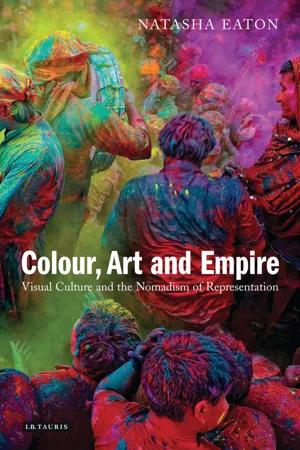
Colour, Art and Empire explores the entanglements of visual culture, enchanted technologies, waste, revolution, resistance and otherness. The materiality of colour offers a critical and timely force-field for approaching afresh debates on colonialism. This book analyses the formation of colour and politics as qualitative overspill. Colour can be viewed both as central and supplemental to early photography, the totem, alchemy, tantra and mysticism. From the eighteenth-century Austrian Empress Maria Theresa to Rabindranath Tagore and Gandhi, to 1970s Bollywood, colour makes us adjust our take on the politics of the human sensorium as defamiliarising and disorienting. The four chapters conjecture how European, Indian and Papua New Guinean artists, writers, scientists, activists, anthropologists or their subjects sought to negotiate the highly problematic stasis of colour in the repainting of modernity. Specifically, the thesis of this book traces Europeans' admiration and emulation of what they termed 'Indian colour' to its gradual denigration and the emergence of a 'space of exception'.
This space of exception pitted industrial colours against the colonial desire for a massive workforce whose slave-like exploitation ignited riots against the production of pigments - most notably indigo. Feared or derided, the figure of the vernacular dyer constituted a force capable of dismantling the imperial machinations of colour. Colour thus wreaks havoc with Western expectations of biological determinism, objectivity and eugenics. Beyond the cracks of such discursive practice, colour becomes a sentient and nomadic retort to be pitted against a perceived colonial hegemony. The ideological reinvention of colour as a resource for independence struggles make it fundamental to multivalent genealogies of artistic and political action and their relevance to the present.
- 416 pages
- English
- ePUB (mobile friendly)
- Available on iOS & Android
eBook - ePub
About this book
Trusted by 375,005 students
Access to over 1.5 million titles for a fair monthly price.
Study more efficiently using our study tools.
Information
1Alchemy, Painting and Revolution in India, c.1750–1860
The Spectre of Colour: Matter and Empire
In his short story ‘Indigo’ Bengal’s most celebrated film maker Satyajit Ray explores the spectre of colonial colour.1 His protagonist is a twenty-nine-year-old bachelor employed by an advertising agency in Kolkata. Easily bored by such work, he takes to reading anything he can about colonial indigo plantations to such an extent that indigo begins to cloud his mind. When his car breaks down in the Birbhum district one stormy night, he seeks refuge in a deserted bungalow – the neel kuthi of the notorious Mr Martin, a long-dead indigo planter. After dozing off in the bedroom, he undergoes a mysterious, Kafkaesque transformation:
I passed my right hand over my face and realized that not only my complexion but my features too had changed…there were sideburns which reached below my ears…The thing I was looking for was right in front of me: an oval mirror… By some devilish trick I had turned into a nineteenth-century Englishman with a sallow complexion…and light eyes from which shone a strange mixture of hardness and suffering.2
He had become a malevolent yet fearful planter who in spite of repeated attacks of malaria could ‘not resist the lure of indigo’.3 He was then compelled, almost against his will, to begin writing a diary entry for 27 April 1868 – the last night of his life. His final thought was for his dog Rex and what would become of him. As the dog approached the kuthi’s verandah, the planter shoots him before firing a bullet into his own head. Silence. The protagonist awakes, only to realise that he had lived and died as an indigo planter last night. Indigo is here a strange mirror: as mirror it plays with the narcissistic and alter processes of identification. Lurid and alluring, colonial colour has many afterlives. So what does it mean to occupy the space of colonial colour and how could it be resisted?
This chapter explores the nomadism of colour through the kaleidoscopic turns of painterly technique, physiology, revolution and sacred agency in Indian and British cultural encounters. Before ‘England served India as a curator serves the collection’, exemplified by the Archaeological Survey and The Great Game of Kipling’s Kim, I suggest that the palette acted as the modus operandi of early nineteenth-century colonisation.4 And this palette was variously constituted by colour forces and disharmonies of black, white, but especially gold, yellow, indigo and red. The palette acts as a force field constituted by waste, secret technology and the sacred where different concepts of matter collide. Through this trope of the imperial palette, my inquiry focuses on the three critical networks which construct its planes and matter-force: first, European attempts to imitate the appearance of the technologies of Mughal art at Hapsburg Empress Maria Theresa’s Schönbrunn Palace, Vienna, and the artistic experiments of her favourite – Johann Zoffany. Then I track what happens to this desire for material semblance in relation to global rivalry for the raw materials of pigments – focused on indigo and the squalid labour conditions that the English East India Company’s economy sought to inculcate. The ensuing modes of subaltern resistance and the tactics of de-territorialisation offer a glimpse into an alternative ontology: Sufism. Here colour becomes associated with subtle matter, or with light without matter in ways that are hermeneutic and alchemical. Through the writings of the late eighteenth- and early nineteenth-century Sufis Mir Dard and Shaykh Kirmani I explore the mystical dimensions of colour, its spiritual phenomenology, the scale of colours in the universe and its complex hermeneutics in relation to the Black Light (light without matter) and the theology of the Cosmic Throne. I suggest that Delhi- and Agra-based painters working in the Sufi milieu translated or rejected some of these concepts in their production of an aesthetic which turned to colour in relation to the subtlety and the power of the shimmer.
The molecular and spectacular movements of colour through and beyond the imperial palette involve contingent, competing definitions of matter which entangle the nomad with the monad – some of the metaphysical and ‘atomic’ stuff of which Material Culture Studies is one instance. In the period I consider artists’ understandings of what colour is or could be, worked with and sometimes against, scientific-philosophical articulations of matter in terms of plurality and flux. From the philosophy of monads, to entropy in thermodynamics, to emergent ideas of space as finite and unbounded, wrapped around itself, colour interferes with matter.5 This trajectory shuttles between Monadology, where Leibniz poses matter as an aspect of corporeal substance in terms of the infinite, the singular and a cosmos driven by the compossibility of monads and a late nineteenth-century anxiety about the complex, virtual dimensions of affect. Leibniz frequently refers to monads as atom-like structures, as ‘living mirrors’, each being endowed with internal action which expresses the universe from its own point of view.6 In addition to his radical reinscription of theories of the monad by Pythagoras and Plotinus, there is something of the mystical, alchemical and orientalist in Leibniz’s writings on matter which implicates colour.7 For Indian and British painters and writers, the concept, affects and matter of colour thought of in terms of alchemical and chemistry experiments came to be dramatically modified in this period of imperial expansion – which art historians have yet to take seriously. Outside of the ‘quasi-laboratory’ conditions of their studios, the transformation of raw materials such as cochineal and indigo by enormous subaltern workforces aimed at the transformation of matter through heat flow. This everyday practice provides the dark underside to Goethe and his ‘disciple’ J. M. W. Turner’s experiments with theories of afterimages and thermodynamics which privileged colour (in relation to heat and metamorphosis) as the primary target for phenomenological, even ontological inquiry.8
Such a construction of modernity in relation to the material practices of empire was obliquely implicated in the metaphysical and artistic practices of north Indian Sufism. In their very different ways, visions and afterimages operate through the presence of a sensation in the absence of a stimulus and its subsequent modulations which unfold over time cutting against the virtual instantaneity of optical transmission (whether intro- or extromission) so prominent in theories of vision from Aristotle to Locke.9 Goethe’s Farbenlehre performs as modern analogue to a far more powerful precedent – twelfth-century writer Najim Kobrā’s physiological, ecstatic writings.10 I propose that the legacies of these writings in the period I discuss also participated in subaltern struggles over colour.
This opening chapter explores the struggles of colour in two interlinked grass-roots cases – the perplexed agenda of colonial painters anxious at being out of the loop of metropolitan/Company strategies, and how Indian subalterns united with the elite to speak, paint and sing against empire. Here what I mean by singing is to hit that space beyond speech acts; to get at its kind of affective, performative contradiction which ‘leads not to impasse but to forms of insurgency’ for which we ‘have yet to develop a language’.11 But how does colour sing? How does colour entangle technology with enchantment to create value for Mughal artistic production in terms of the artist as ‘occult technician’ of objects desired for their ‘halo-effect of technical difficulty’?12 In spite of the degraded conditions of indigo labour in Bengal, there is in the manufacture of colour something redemptive: ghastly and yet strangely magnetic and gorgeous.
Technology, Scarcity, Waste: Mughal Colour/Colonial Mirror
In his versified Persian treatise, Qānūn us-Suvar (The Canons of Painting), c.1570–1602, Sādiqī Bek (1533–1609) describes how art became for him, a mystical vocation, a line of flight out of the subject:
My spirit now winged heavenwards…For from my heightened viewpoint everything appeared overly facile. I clung to but one profound hope; to be informed with the touch of Bihzad. And there, bare of all illusory passions I would paint the bazaar world of pictured things with the sole Idea of drawing near to their Real Nature. I was alive to the possibility that by painting, the artfully continued shape of things could yet be truly delineated.13
Sādiqī Bek explains that he composed the work to communicate the ‘alchemy’ of painting to an acquaintance whose ‘deep taste for the arts had led him astray and he had completely abandoned himself to this passion. Dreaming of nothing else night or day but art decoral and art figural he became increasingly agitated’.14 Rather than dwelling on the mystical significance of painting, Sādiqī Bek offers glimpses of the clandestine technologies of art – the use of flowers from the Judas tree and plucked violets; the grinding of pigments (verdigris, vermilion, red lake); the making of brushes and varnishes and the techniques of tinting and gilding. Although he does note in relation to the extraction of the essence of flowers that ‘the process used to do it is immaterial – you will find their inner secrets stand revealed’, throughout his narrative he stresses precision, patience and that this kind of treatise is in itself extremely rare.15
Bek exhorts artists to apply colours in sequence from background to figures, to flesh and dress – that is, one shade should be painted wherever it is desired throughout the picture and so on, the effect being the erasure of any visible brush marks.16 This wet-on-dry technique, which takes several weeks, entailed the use of pigments ground from semi-precious stones that were then bound with gum arabic and applied with a very fine Persian cat or black squirrel hair brush. As described by Sādiqī Bek, the paper was burnished with agate from the back after the application of each pigment (with the exception of gold leaf and lapis lazuli) so as to bring forth their luminosity.17 This technique requires precision from perception which privileges the artist’s intricate skills and makes it ‘impossible for the viewer to comprehend how an image has been made. It is as if the image is born into this world unmade’.18 Painting allows for an alchemic sublimation of the particles of divine light imprisoned in the matter of the picture which can be released through careful contemplation.19 Like Chinese porcelain, both Europeans and Indians admired the play of material fragility, translucency, technological secrecy and impenetrability embodied by the technology of painting. The miniature professed a discontinuity with profane space; it planes gesture towards the universe as a series of hanging forms – Sufism’s Five Divine Presences which move upwards from the physical world to the archangelic, the intermediate, the world of Divine names and Divine Essence (dhāt). Poised at the plane of the intermediate, the miniature has the potential to act as gateway to a higher state of being.20
Scarcity in relation to rarities and secrecy created the allure of Islamic panting for Europeans in the age of empire. They sporadically attempted to imitate to appropriate the appearance (and perhaps the Mughal imperial aura) of such art objects and to generate a dialectic of scarcity and emulative wastage. The combination of scarce pictures and the desire to do damage to them thus performed a critical role in European collecting. The mechanism of waste becomes an object of desire; waste operated as a defining principle in an affluent society driven by the anxiety of scarcity. To be wasteful is a competitive achievement; the desire to possess is a desire to make waste.21 What results is not so much gaspillage (the logical priority of destruction outlined by Bataille in his discussion of non-productive expenditure, dépense) as a theory of rubbish which is central to the construction of imperial value. Between waste and rubbish emerges the condition for the re-evaluation of things.
This combination of secrecy and rubbish informed the treatment of Mughal art by the widow of the Hapsburg Emperor Franz I and mother of Marie Antoinette, Maria Theresa. At Schönbrunn Palace near Vienna she reoriented the axis of power away from her recently deceased husband’s overblown state rooms with their allegories of war to a series of intricate cabinets celebrating the exotic (plate 4). Known as the Millionenzimmer because of the enormous cost of its interior décor (including rich mahogany from South America), in this intricate chamber, which functioned as both a public audience room and as the waiting room to her private apartment, Maria Theresa displayed 266 Mughal miniatures.22 Originally bound in albums (muraqqa‘), acquired from Prince Eugene of Savoy and previously ‘copied’ by Rembrandt, these seventeenth- and eighteenth-century miniatures ar...
Table of contents
- Cover
- Title Page
- Contents
- List of illustrations
- Acknowledgements
- Introduction: Chromo Zones and theNomadism of Colour
- 1. Alchemy, Painting and Revolution in India, c.1750–1860
- 2. Supplement, Subaltern Art, Design and Dyeing in Britain and South Asia c.1851–c.1905
- 3. Part 1: Still Dreaming of the Blue Flower? Race, Anthropology and the Colour Sense
- 4. Swadeshi Colour Through the Philtre/Filter of Indian Nationalism, c.1905–c.1947
- Postscript: With a Rag and a Knife
- Notes
- Index
- eCopyright
Frequently asked questions
Yes, you can cancel anytime from the Subscription tab in your account settings on the Perlego website. Your subscription will stay active until the end of your current billing period. Learn how to cancel your subscription
No, books cannot be downloaded as external files, such as PDFs, for use outside of Perlego. However, you can download books within the Perlego app for offline reading on mobile or tablet. Learn how to download books offline
Perlego offers two plans: Essential and Complete
- Essential is ideal for learners and professionals who enjoy exploring a wide range of subjects. Access the Essential Library with 800,000+ trusted titles and best-sellers across business, personal growth, and the humanities. Includes unlimited reading time and Standard Read Aloud voice.
- Complete: Perfect for advanced learners and researchers needing full, unrestricted access. Unlock 1.5M+ books across hundreds of subjects, including academic and specialized titles. The Complete Plan also includes advanced features like Premium Read Aloud and Research Assistant.
We are an online textbook subscription service, where you can get access to an entire online library for less than the price of a single book per month. With over 1.5 million books across 990+ topics, we’ve got you covered! Learn about our mission
Look out for the read-aloud symbol on your next book to see if you can listen to it. The read-aloud tool reads text aloud for you, highlighting the text as it is being read. You can pause it, speed it up and slow it down. Learn more about Read Aloud
Yes! You can use the Perlego app on both iOS and Android devices to read anytime, anywhere — even offline. Perfect for commutes or when you’re on the go.
Please note we cannot support devices running on iOS 13 and Android 7 or earlier. Learn more about using the app
Please note we cannot support devices running on iOS 13 and Android 7 or earlier. Learn more about using the app
Yes, you can access Colour, Art and Empire by Natasha Eaton in PDF and/or ePUB format, as well as other popular books in Art & Art General. We have over 1.5 million books available in our catalogue for you to explore.