eBook - ePub
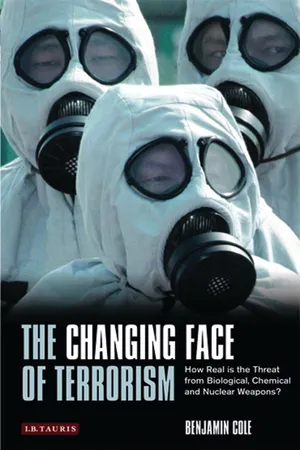
The Changing Face of Terrorism
How Real is the Threat from Biological, Chemical and Nuclear Weapons?
- 280 pages
- English
- ePUB (mobile friendly)
- Available on iOS & Android
eBook - ePub
The Changing Face of Terrorism
How Real is the Threat from Biological, Chemical and Nuclear Weapons?
About this book
Chemical, Biological, Radiological and Nuclear (CBRN), terrorism and the 'war on terror' are major features of international relations and global concern. Terrorist threats and actual violence have become increasingly dangerous and lethal since the 1970s. However, the attacks on the World Trade Center and the Pentagon on 11 September 2001 heralded a new era in terrorist action and were the culmination of a terror campaign against American targets world-wide. "The Changing Face of Terrorism" evaluates the continuing threat and counter-measures since 9/11 and into the 21st century. It is a sober and measured evaluation of the CBRN threat and argues that continuing terror attacks are inevitable and the 'war on terror' will be a continuing feature in international politics and military action. Benjamin Cole shows how effective counter-terrorist measures must be measured and based not only on effective police and military intelligence and action but on careful evaluation of the politics, motivations, scientific and technical abilities of groups - no terrorist group has made a nuclear device - and religious and personal motivation.
Information
1
CHEMICAL, BIOLOGICAL, RADIOLOGICAL AND NUCLEAR (CBRN) TERRORISM IN HISTORICAL CONTEXT
The attacks on the World Trade Centre and the Pentagon on 11 September 2001 (9/11) came as a complete surprise, but should not have been unanticipated. Throughout the 1990s terrorism analysts from both inside and outside government had been arguing that it was only a matter of time before the first act of mass destruction terrorism. Yet threat assessments had increasingly focused on acts of mass destruction terrorism involving CBRN weapons. This raises questions about why attention was focused on CBRN weapons when there was a greater potential threat from other forms of attack. The starting point in searching for the answer to that question is the history of CBRN terrorism, coupled with the nature of the public and political debates that have surrounded it. This historical narrative shows that some terrorist groups in the latter part of the twentieth century have always been interested in CBRN weapons, with the first decade of significant terrorist interest in CBRN terrorism being the 1970s.
CBRN Terrorism in the 1970s
Terrorism in the 1970s was dominated by ethno-nationalist separatist or independence groups such as the Palestine Liberation Organization (PLO) and the Irish Republic Army (IRA) in Northern Ireland. It was also the decade when radical left- and right-wing political groups in Western Europe such as the Red Army Faction (RAF) also known as the Baader-Meinhof gang, and the Red Brigades were operating at their peak. Despite the high levels of terrorist violence, particularly in the Middle East, security debates in the West were dominated by the Cold War. Concerns about terrorism and ethno-nationalist guerrilla movements assumed significance primarily because of concerns that the Soviet Union was using them as proxies to de-stabilize democratic regimes and spread communism.
Against this background of heightened terrorist activity, there was significant, albeit limited, interest among some terrorists groups in using CBRN weapons. These incidents can be divided into three broad groups: those where there was a threat to use CBRN weapons but no evidence that the group involved actually possessed them; incidents where a group possessed a CBRN weapon but it was never used; and incidents in which a CBRN weapon was actually used. In the majority of reported incidents in the 1970s there was no evidence that the group concerned actually possessed a CBRN weapon. Yet there were a small number of incidents in which a terrorist group acquired a CBRN weapon and apparently intended to use it.
A number of groups, such as the revolutionary left-wing group Weather Underground, attempted, but failed, to acquire CBRN weapons.1 But a number of groups and individuals did succeed in developing or otherwise acquiring CBW. These included left-wing groups, right-wing groups, an unspecified Arab group, and various individuals whose political affiliations are unknown. Perhaps the most significant of these incidents occurred in 1972 when members of the Order of the Rising Sun, a neo-Nazi group in the USA, were arrested in possession of 30–40kg of Typhoid bacillus and charged with conspiring to contaminate the water supplies of large cities in the USA.2 This case indicated that some terrorist groups had the technological capability to develop biological agents, and were interested in using them to indiscriminately kill large numbers of civilians. There was also one other alleged plot to indiscriminately kill civilians by poisoning water supplies, but in all of the other cases the targets were discriminate, these included President Gerald Ford, the Supreme Court and the Capitol Building in Washington.3 The threat from this small number of groups and individuals was neutralized by the success of the security forces in apprehending the culprits before they executed their attacks.
There were only three terrorist incidents involving the use of CBRN weapons in the 1970s. In November 1973 members of the left-wing revolutionary group, the Symbionese Liberation Army (SLA) killed California school superintendent Dr Marcus Foster and wounded Deputy Superintendent Robert Blackburn with cyanide-tipped bullets.4 In 1979 the Arab Revolutionary Army Palestinian Commandos injected Israeli oranges that were being exported to Western Europe with mercury. More than a dozen people were poisoned by the oranges, and a number of children were killed. The following year, the same terrorist group threatened to poison other Israeli agricultural exports to Europe,5 whilst in Italy, the Red Brigades allegedly tried seven times to poison reservoirs, but were unsuccessful because the toxins were quickly diluted.6 This last incident was particularly worrying because of the intent to cause indiscriminate mass casualties.
A number of observations can be made from these incidents. The number of incidents involving the use of a CBRN weapon or in which the terrorist group acquired a CBRN agent but did not use it, was far outweighed by the number of unsubstantiated allegations, threats and hoaxes. The ‘weapons’ involved were crude, with the terrorists being restricted to using chemical or biological agents for individual assassinations or as contaminants. The nature of the plots raised a number of significant questions that remained unanswered. Foremost amongst them was whether terrorist use of these weapons was restricted by technical considerations, or whether some groups might have been deterred from using them for a range of moral, tactical, political or religious reasons.
These incidents fostered a small but well-informed debate on CBRN terrorism in the academic and policy communities. Writing in 1977, David Rosenbaum argued that individuals with the necessary skills to develop nuclear weapons are easily found, and that ‘most revolutionaries now however seem to consider indiscriminate slaughter a primary tactic and one of which they are proud’.7 Yet the debate was reasonably balanced, with analysts such as Brian Jenkins questioning terrorists’ ability and motivations to procure CBRN weapons: ‘nuclear terrorism is neither imminent nor inevitable … simply killing a lot of people is not an objective of terrorism’.8 It was argued that serious obstacles to CBRN terrorism existed, and that the political and strategic disincentives to perpetrating WMD attacks would be high. Studies assumed that terrorists needed political and material support, and aimed to raise awareness of their cause in order to build popular support for it. The view of many observers was that the use of CBRN weapons and particularly WMD, would stiffen the resolve of governments not to accede to the terrorists’ demands, and would alienate the potential supporters of terrorist groups.
As a result of the small number of attacks, and their limited impact, the debate on CBRN terrorism in the 1970s was not driven by events. CBRN terrorism was not a significant feature of mainstream terrorist activity and neither was it a major threat to the national security of any state. For governments, it remained marginal to other more immediate national security concerns. Thinking about nuclear terrorism was merely an adjunct to broader debates about nuclear non-proliferation following India’s test of a nuclear weapon and the signature of the Nuclear Non-Proliferation Treaty (NPT) in 1974. As a consequence, the issue was lost sight of alongside the more immediate concerns of policy makers to contain proliferation and manage the Cold War. As a consequence, the issue failed to galvanize any significant response from governments. Overall, events in the 1970s served notice of emerging risks and challenges, but the spectre of WMD terrorism involving CBRN weapons still seemed to be a long way off.
CBRN Terrorism in the 1980s
Terrorist activity in the 1980s was similar to that in the previous decade. It was dominated by ethno-nationalist groups such as the PLO, the IRA, the Basque separatist group Euzkadi Ta As Katasuna (ETA), and the Ellalan Force of the Liberation Tigers of Tamil Ealam (the Tamil Tigers) in Sri Lanka. However, some of the political groups in Western Europe such as the RAF and Red Brigades were in decline by the end of the decade. The strategies and targets of many of these groups evolved as government counter-terrorism measures began to have an impact, but many of these groups still displayed an interest in perpetrating indiscriminate attacks against civilian targets.
The arguments about terrorist use of CBRN weapons that emerged in the 1970s continued to permeate the public debate in the 1980s. Grant Wardlow argued that, ‘The capability of killing on a grand scale must be balanced against the fear of widespread revulsion and alienating perceived constituents [supporters], of provoking a massive, publicly approved government crackdown’,9 whilst Konrad Kellen argued that because terrorists believe that their struggle is intended to better the human condition, mass killing is not likely to be attractive to most of them.10
At the beginning of the 1980s the main focus of governments and the policy community was on nuclear terrorism, which culminated in the convening of the International Task Force On the Prevention of Nuclear Terrorism, in 1985. The task force brought together experts from different fields to consider nuclear terrorism from the point of view of arms control, security, intelligence, civil nuclear programmes, crisis prevention and international law. Its seminal report was published in 1987.11 Chemical and biological terrorism was a much lower concern at that time, despite the fact that chemical weapons (CW) are easier to develop than nuclear weapons and most of the incidents in the 1970s involved CW. The threat of biological terrorism was downplayed because the use of biological weapons (BW) was considered to be so morally repugnant that: no one would consider using them; the technology was too difficult for all but the most sophisticated laboratories to master; and the potential destructiveness of these weapons was simply too great for terrorists to consider using them.12
There was a slight increase in the number of actual attacks involving CBRN weapons during the 1980s, including a small number of serious incidents. Arguably the most important was the first case of BW terrorism. In September 1984, followers of the Rajneeshpuram Cult in the USA, infected the salad bars of restaurants in the town of The Dalles in Oregon with salmonella, causing serious food poisoning to 751 people. This attack had been preceded by a number of other failed attacks. In August, cult members had given water laced with Salmonella typhimurium to two local government officials and the bacteria was also used to contaminate produce at a local grocery store, and was smeared onto door and urinal handles in the county courthouse. On another occasion a cult member was instructed to contaminate the food in schools and nursing homes. Cult members then made two attempts to contaminate the water supply of The Dalles. It appears that they did not have enough Salmonella typhimurium and so probably used sewage mixed with dead rats instead. None of this contamination appears to have caused any illness. There are also reports that the group attempted to aerosolize HIV-contaminated blood, and also considered using hepatitis and giardia.13
The next incident occurred in 1985 in Israel, when the nerve agent carbamate was added to the coffee at an Israeli military dining hall, but there were no reports of casualties.14 This was followed in 1987 by the killing of 19 police recruits in the Philippines in what officials believed could have been a mass poisoning by either the communist New Peoples’ Army, or one of the Muslim separatist groups operating on the island of Mindanao.15
Following the successful contamination of Israeli oranges in 1979 there was also a large increase in the number of threats by different insurgent groups to contaminate the export products of a number of states. These threats were primarily intended to damage the national economies of those states and publicize the causes of the relevant insurgent groups. Examples include Uganda (coffee and tea), Sri Lanka (tea), South Africa (wine and fruit), the Philippines (pineapples), Israel (citrus fruits), Chile (grapes), and the USA (the pain killer Tylenol).16
An equally significant development was an increased number of incidents in which groups and individuals managed to develop a CBRN agent but did not actually use it. This provided a clear indication of an increasing interest in CBRN weapons amongst terrorist groups. In 1981, a number of neo-Nazi arms caches uncovered by West German police were reported to have contained ‘various poisons including arsenic, strychnine and cyanide’.17 In 1982, it was claimed that Israel had captured a PLO representative in Lebanon, who was in possession of a CW. In 1983, the FBI seized 28g of ricin from two brothers in Springfield, Massachusetts, but it is not known why they had acquired it.18 There were also reports that in the early 1980s, French police raided a safe house in Paris belonging to a cell of the left-wing RAF (Baader-Meinhof gang), where they discovered a laboratory containing cultured Clostridium botulinum (which produces botulinum toxin), and notes about bacteria induced diseases.19
There were also a number of other incidents that served as indicators of a potential worsening of the situation in the 1990s. The first group of incidents involved the burgeoning extreme right-wing movement in the USA. This movement is comprised of a diverse mix of racist, Christian, neo-Nazi, white supremacist, and anti-government groups. In 1983 a plot was hatched at a meeting of white supremacists from the USA and Canada at the Headquarters of the Aryan Nations, in Idaho, which included the ‘polluting of municipal water supplies’. Four years later, this resulted in 14 individuals being indicted for plotting to engage in indiscriminate mass murder by poisoning the water supplies of two major US cities.20 In 1985, police in the USA raided the compound of The Covenant, the Sword and the Arm of Lord, a Christian, millenarian, neo-Nazi group, where they discovered 30 gallons of potassium cyanide that the group was intending to use to poison the water supplies of several cities.21 In 1988, members of a racist group called the Confederate Hammerskins were convicted of attacking the Jewish Temple Shalom and the Mosque of Richardson in Dallas, Texas. Former members testified that the group had planned to pump cyanide into Temple Shalom, through its air conditioning system. 22 The final CBRN te...
Table of contents
- Cover
- Title Page
- CONTENTS
- List of Abbreviations
- Acknowledgements
- Introduction
- 1 Chemical, Biological, Radiological and Nuclear (CBRN) Terrorism in Historical Context
- 2 Technological Opportunities and Constraints to using CBRN Weapons
- 3 Operational Motivations and Disincentives to using CBRN Weapons
- 4 Political Motivations and Disincentives to using CBRN Weapons
- 5 Theological Motivations and Disincentives to using CBRN Weapons
- 6 Psychological Motivations and Disincentives: The Terrorist Personality and Group Decision Making
- 7 State-sponsored CBRN Terrorism: Motivations and Disincentives
- 8 Homeland Security and Terrorist Decision Making
- 9 The Future
- Notes
- Bibliography
- Index
- eCopyright
Trusted by 375,005 students
Access to over 1.5 million titles for a fair monthly price.
Study more efficiently using our study tools.
Frequently asked questions
Yes, you can cancel anytime from the Subscription tab in your account settings on the Perlego website. Your subscription will stay active until the end of your current billing period. Learn how to cancel your subscription
No, books cannot be downloaded as external files, such as PDFs, for use outside of Perlego. However, you can download books within the Perlego app for offline reading on mobile or tablet. Learn how to download books offline
Perlego offers two plans: Essential and Complete
- Essential is ideal for learners and professionals who enjoy exploring a wide range of subjects. Access the Essential Library with 800,000+ trusted titles and best-sellers across business, personal growth, and the humanities. Includes unlimited reading time and Standard Read Aloud voice.
- Complete: Perfect for advanced learners and researchers needing full, unrestricted access. Unlock 1.5M+ books across hundreds of subjects, including academic and specialized titles. The Complete Plan also includes advanced features like Premium Read Aloud and Research Assistant.
We are an online textbook subscription service, where you can get access to an entire online library for less than the price of a single book per month. With over 1.5 million books across 990+ topics, we’ve got you covered! Learn about our mission
Look out for the read-aloud symbol on your next book to see if you can listen to it. The read-aloud tool reads text aloud for you, highlighting the text as it is being read. You can pause it, speed it up and slow it down. Learn more about Read Aloud
Yes! You can use the Perlego app on both iOS and Android devices to read anytime, anywhere — even offline. Perfect for commutes or when you’re on the go.
Please note we cannot support devices running on iOS 13 and Android 7 or earlier. Learn more about using the app
Please note we cannot support devices running on iOS 13 and Android 7 or earlier. Learn more about using the app
Yes, you can access The Changing Face of Terrorism by Benjamin Cole in PDF and/or ePUB format, as well as other popular books in Politics & International Relations & Military & Maritime History. We have over 1.5 million books available in our catalogue for you to explore.