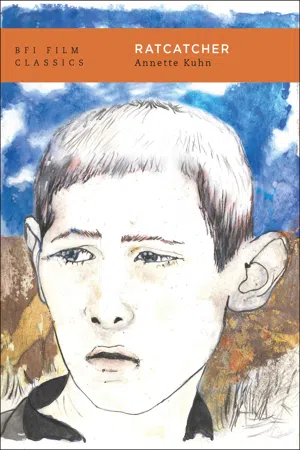
Lynne Ramsay's bleak yet beautifully photographed debut unflinchingly portrays life on a Glasgow housing estate during the 1973 refuse collectors' strike, as seen through the eyes of 12-year-old James Gillespie (William Eadie). After James's friend falls into a canal and drowns, James becomes increasingly withdrawn. As bags of rubbish pile up and rats move in, James finds solace in his friendships with Kenny, an odd boy who loves animals, and Margaret Anne,
a teenage misfit.
Annette Kuhn's study of the film, the first to offer an overarching account of Ramsay's work, considers the director's background and Ratcatcher alongside her earlier films. Kuhn traces the film's production history in the context of
Scottish media and literary cultures, and its cinematic influences, while acknowledging the distinctiveness of Ramsay's poetic, visionary style. Kuhn draws on interviews with Ramsay and others involved in the film's production, and combines this with a close reading of selected passages to provide an in-depth and illuminating analysis of the film's poetic style and its aesthetics, including an examination of its construction of a child's world through a highly distinctive organisation of cinematic space.
eBook - ePub
Ratcatcher
About this book
Information
1 Understanding Ratcatcher
I first saw Ratcatcher during its general release in late 1999. The film had premiered at Cannes in May that year, and opened the Edinburgh International Film Festival in August – to rave reviews on both occasions. All this had passed me by. Either that, or the critics’ words had been inadequate preparation for what turned out to be a powerful and intense cinematic experience. I truly felt I had discovered this film – for me, the year’s best – all by myself. Since then, I have seen Ratcatcher countless times. It is one of those rare films that open your eyes to fresh ways of seeing; equally rarely, it is a film that offers up something new on every repeat viewing. While it would be futile to attempt to list all of the memorable images and passages in Ratcatcher, a look at two sequences in the film, which for me never fail to elicit what can best be described as a serenely exhilarating sense of wonder, may begin to convey something of the film’s uniquely affecting quality.
Four or five minutes into the film, there is a long take – it runs for about thirty seconds, and is almost a sequence shot – in which one of the main characters is seen walking, screen left to screen right, along a scruffy-looking street, carrying bags of shopping. In the foreground, boys are kicking a football about, and in the background girls are chalking on the pavement. Another woman passes in the opposite direction and a few words are exchanged (p. 44, top right). The first woman turns, walks towards camera, and passes out of frame. For a few seconds, as the camera tracks back to disclose the street scene in wider view, we see the children playing in the street. Then, as the camera’s slow retreat continues, the edges of an entranceway appear on either side of the frame. The background sounds (children’s voices, a police siren, the woman’s footsteps) fade; then there is complete silence. The soundless backwards track continues for another six seconds or so until the street view, framed by the entryway, is held briefly in the middle portion of the frame.
It is those final six seconds – which in one sense are redundant, in that the shot has already done the work of introducing a key setting and character – that seem so powerfully engaging. This response certainly has something to do with the combination of the slow pace of the retreating camera and the way the edges of the screen are breached, and then gradually encroached upon, to produce a frame within a frame that at once condenses, intensifies and distances the activities on the street. This, along with the silencing of the ambient sounds, lends the moment a meditative, almost dreamlike, quality. The passage is all the more powerful in that, within a single shot, it transports the viewer from one world and one kind of consciousness into another, from the spaces of social document (children playing in a slum street) and then drama (establishing setting and character) to a space of reverie.
Then, close to halfway through the film, there is a scene in which the protagonist, a young boy, is exploring a partially built house. At a certain point, he peers into a room and sees on the far wall a view of a bright golden cornfield, framed by an opening that will one day be a window (p. 64). As the camera slowly tracks forward, the character, seen from behind, enters frame left. The forward movements of camera and character towards the view continue; the boy jumps up onto the window sill. The movement halts briefly as the boy is silhouetted against the bright field. As he jumps down to the other side, the movement resumes as, slowly, the edges of the window opening merge with, and then disappear beyond, the edges of the film frame, and the entire screen is filled with the dazzling golden field and blue sky.
Unlike the track back from the street in the earlier passage, this is marked as a point-of-view shot, and as such is more clearly tied in to the film’s narrative flow as this is figured through the protagonist’s discovery and exploration of an unfamiliar, fascinating place. At the same time, the world visible through the window opening, the slow movement towards it, and finally the trope of climbing into that world ‘with’ the character invite a bodily response that exceeds any engagement with the story or identification with the character. The light-saturated view itself, framed as it is like a picture on the wall – or more aptly, perhaps, like a film on a cinema screen – offers the vision of an intriguing, inviting – altogether different – world.1 The underscoring of the film’s haunting musical theme throughout the passage intensifies the otherworldliness of the space that is framed and contained by the window opening, and sustains the curious satisfaction that is derived from the moment when the frame of the picture melts into and beyond the film frame as we enter fully into that other world. The entire shot, involving as it does a steady, slow forward movement towards an image at a distance, an image that eventually fills the entire film frame, is formally reminiscent of Michael Snow’s rich, rigorous and relentlessly self-reflexive forty-five-minute experimental film Wavelength (1967).2 While it would be misleading to posit an equivalence between the two, the similarities are nonetheless telling in that in both, the ‘frame within a frame’ contains an elemental image – waves in the Snow film, a field of wheat in Ratcatcher – an image that contrasts in every way with each film’s surrounding ‘real’ world; and that in both films, cinema’s unique capacity to draw the viewer into the worlds that it creates is, paradoxically, both alluded to and enacted, inviting a response that combines involvement and distance.
These two shots in Ratcatcher – a slow, silent backward track into an entryway; a forward movement towards, and then into, a view seen through a window – evoke responses that engage the body and the psyche in powerful, wordless ways. The direction and pace of the camera movements direct attention towards, and build tension around, the ever-changing activity at the edges of the film frame; while the double framings simultaneously draw the viewer into, and call attention to the virtual nature of, the film’s spaces.
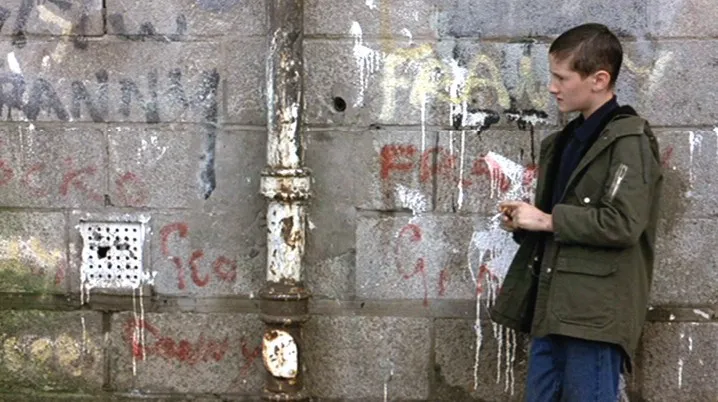
There are many moments in Ratcatcher, too, that are striking not for their movement but for their stillness. These resonate in the imagination as iconic, peculiarly memorable, images; and include a number of meticulously composed, long-drawn-out shots of characters held in stasis (top left) and moments stretched out in time in slowed-down images (top right). Certain resonant images and compositions recur, with variations, throughout the film (bottom left and right), as well as lingering close-ups of characters’ faces (p. 11). Every one of these images – beautifully composed, and stunningly lit – is pleasing in itself even when, as so often in a film that persistently seeks out the beautiful in the ugly, the content may be unsettling, even brutal.
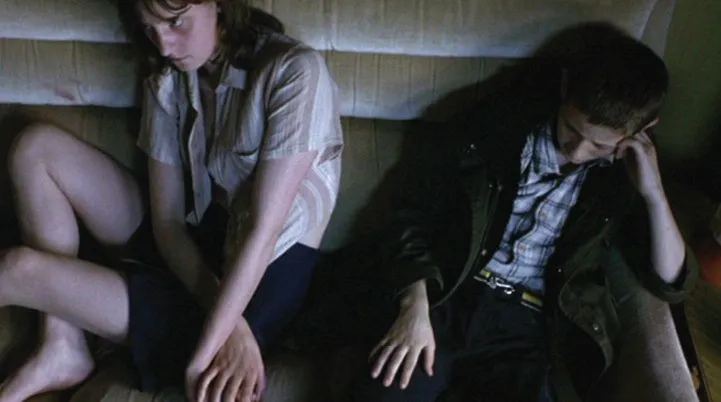
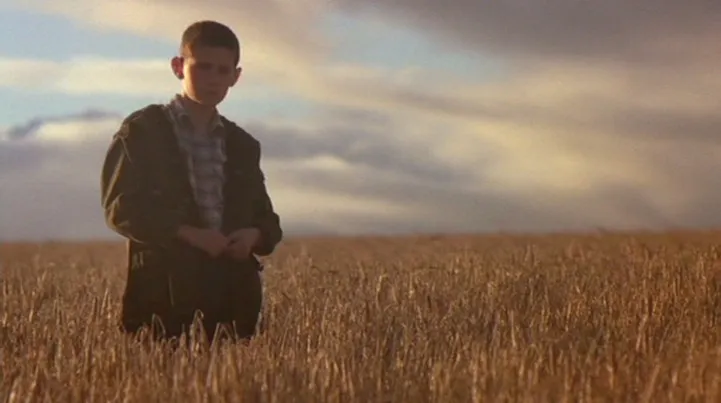
This shot, underscored with the film’s musical theme, runs for almost twenty seconds;
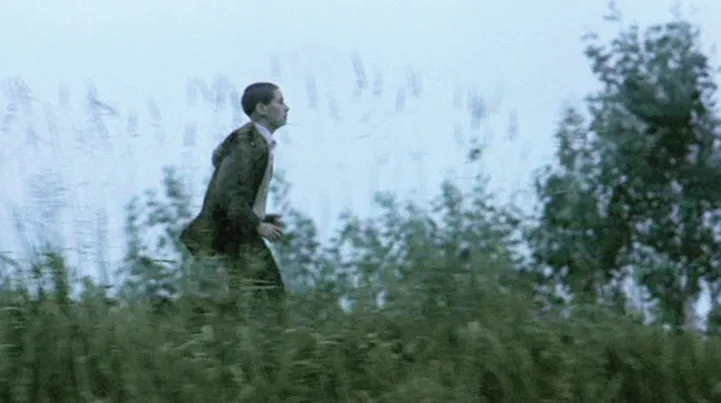
this slow-motion shot, with barely audible sound of dogs barking, runs for thirteen seconds
Looked at within the context of the film as a whole, such ‘still’ images acquire additional nuance, because in their very stasis, their silence, they insert punctuations or interruptions into a medium whose defining characteristics are motion and sound: in halting the flow of the sounds and images that surround them, they become doubly powerful. Paradoxically, perhaps, it is this very play of stillness and movement that makes Ratcatcher such an extraordinarily cinematic film. By this I mean that Ratcatcher finds fresh ways of using all of the expressive means that make cinema different from every other medium, that make cinema capable of offering a unique kind of aesthetic experience. Cinema unfolds over time; it can marry – and divorce – sounds and images; through editing it can bring together disparate spaces, and disconnect adjacent ones. And as it does all this, it also draws on the indexical qualities of the photographic image to conjure a world that resembles the one we normally inhabit, and yet is at the same time self-evidently virtual. Cinema creates paradoxical worlds, worlds that are imaginary while alluding to the (or a) ‘real’ world.3

This shot of James is held for five seconds, without sound;

the face of the drowned Ryan
It is often suggested that cinema’s many and varied expressive qualities give it a privileged relationship with, and potential for, what the experimental film-maker Maya Deren called the ‘poetic construct’. Because it can manipulate both time and space, film is particularly well equipped, suggested Deren, to conduct ‘a “vertical” investigation of a situation … that … probes the ramifications of the moment, and is concerned with its qualities and its depth’.4 In film, as in no other medium, the active forward movement that characterises narrative and drama (what Deren called the horizontal plane of development) can combine with the in-depth ‘vertical’ investigation, the exploration of a detail or a moment, that distinguishes poetry. In film, an action, an image, can be slowed down or brought to stillness; a moment can be stretched out (horizontally) in time so that it can be contemplated (vertically) in depth. In this way, film can accommodate a meditative attitude that is akin to reverie.5
There is a great deal in Ratcatcher that resonates with, and is illuminated by, these formulations on film poetry and the poetic in film: lingering, thoughtfully composed, motionless or near-motionless images; slow, silent explorations of spaces; intense, searching close-ups; visual rhymes; recurrent visual and auditory motifs. These are woven through the film, cutting across its ‘horizontal development’ and offering explor...
Table of contents
- Cover Page
- Title Page
- Contents
- Acknowledgments
- 1. Understanding Ratcatcher
- 2. Plot
- 3. Home
- 4. Around home
- 5. Margaret Anne’s
- 6. The canal
- 7. The new house
- 8. Pathways
- 9. Making Ratcatcher
- 10. ‘God is in the details’: the director speaks
- Notes
- Credits
- eCopyright
Trusted by 375,005 students
Access to over 1.5 million titles for a fair monthly price.
Study more efficiently using our study tools.
Frequently asked questions
Yes, you can cancel anytime from the Subscription tab in your account settings on the Perlego website. Your subscription will stay active until the end of your current billing period. Learn how to cancel your subscription
No, books cannot be downloaded as external files, such as PDFs, for use outside of Perlego. However, you can download books within the Perlego app for offline reading on mobile or tablet. Learn how to download books offline
Perlego offers two plans: Essential and Complete
- Essential is ideal for learners and professionals who enjoy exploring a wide range of subjects. Access the Essential Library with 800,000+ trusted titles and best-sellers across business, personal growth, and the humanities. Includes unlimited reading time and Standard Read Aloud voice.
- Complete: Perfect for advanced learners and researchers needing full, unrestricted access. Unlock 1.5M+ books across hundreds of subjects, including academic and specialized titles. The Complete Plan also includes advanced features like Premium Read Aloud and Research Assistant.
We are an online textbook subscription service, where you can get access to an entire online library for less than the price of a single book per month. With over 1.5 million books across 990+ topics, we’ve got you covered! Learn about our mission
Look out for the read-aloud symbol on your next book to see if you can listen to it. The read-aloud tool reads text aloud for you, highlighting the text as it is being read. You can pause it, speed it up and slow it down. Learn more about Read Aloud
Yes! You can use the Perlego app on both iOS and Android devices to read anytime, anywhere — even offline. Perfect for commutes or when you’re on the go.
Please note we cannot support devices running on iOS 13 and Android 7 or earlier. Learn more about using the app
Please note we cannot support devices running on iOS 13 and Android 7 or earlier. Learn more about using the app
Yes, you can access Ratcatcher by Annette Kuhn in PDF and/or ePUB format, as well as other popular books in Media & Performing Arts & Film History & Criticism. We have over 1.5 million books available in our catalogue for you to explore.