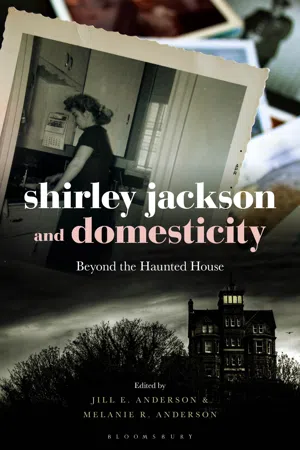
Shirley Jackson and Domesticity takes on American horror writer Shirley Jackson's domestic narratives – those fictionalized in her novels and short stories as well as the ones captured in her memoirs – to explore the extraordinary and often supernatural ways domestic practices and the ecology of the home influence Jackson's storytelling.
Examining various areas of homemaking – child-rearing and reproduction, housekeeping, architecture and spatiality, the housewife mythos – through the theoretical frameworks of gothic, queer, gender, supernatural, humor, and architectural studies, this collection contextualizes Jackson's archive in a Cold War framework and assesses the impact of the work of a writer seeking to question the status quo of her time and culture.
eBook - ePub
Shirley Jackson and Domesticity
Beyond the Haunted House
- 272 pages
- English
- ePUB (mobile friendly)
- Available on iOS & Android
eBook - ePub
Shirley Jackson and Domesticity
Beyond the Haunted House
About this book
Information
1
Hideous Doughnuts and Haunted Housewives: Gothic Undercurrents in Shirley Jackson’s Domestic Humor*
Bernice M. Murphy
It may initially seem surprising that Shirley Jackson, the author of unnerving, ruthless tales such as “The Lottery” (1948) and The Haunting of Hill House (1959) spent much of her career penning humorous anecdotes about life as an apparently conventional mother and housewife. The contrast certainly baffled contemporary critics, many of whom found themselves unable to understand the gulf between these two superficially divergent facets of Jackson’s writing. This puzzlement, as Lynette Carpenter notes, contributed to Jackson’s long-standing critical neglect: “… traditional male critics could not, in the end, reconcile genre with gender in Jackson’s case; unable to understand how a serious writer of gothic fiction could also be, to all outward appearances, a typical housewife, much less how she could publish housewife humor in Good Housekeeping, they dismissed her.”1
The relationship between Jackson’s “housewife” humor and her gothic fiction is more compelling (and revealing) than first impressions suggest. If a casual browser were to simply survey the titles of Jackson’s domestic memoirs, Life among the Savages (1953) and Raising Demons (1957), they would probably assume that the texts are concerned with subjects of a horrific nature. Though indicative of Jackson’s sardonic sense of humor, it seems odd that, as more than one previous commentator has noted, the most outwardly “gothic” and suggestive of Jackson’s eight book titles should belong not to an intense exploration of madness and multiple personality like The Bird’s Nest (1954) or family annihilation such as We Have Always Lived in the Castle (1962) but the most apparently innocuous texts in her entire oeuvre.
As Darryl Hattenhauer notes, Jackson’s money-spinners were among the most lucrative of her time: “Her novels were bestsellers. There were movie deals on two of those novels (The Bird’s Nest and The Haunting of Hill House) … Jackson got a minimum of one thousand dollars for each short story and article appearing in a mass market magazine: the average fee was probably much more.”2 Much of Jackson’s financial success arose from her frequent appearance in women’s magazines in the 1950s. “The editors … knew that Jackson’s name on the cover meant higher sales” and were willing to pay premium prices to secure her writing. Jackson’s 1949 contract with Good Housekeeping ensured her a large fixed fee for eight stories a year. The deal was so lucrative it enabled her family to move from New York to New England. It also confirmed her status as one of the decade’s leading writers of so-called housewife humor.3 As Nancy Walker has observed, Jackson’s generation of female humorists “wrote about the domestic life of the woman in terms that were strikingly similar to those of their nineteenth century counterparts.”4 The postwar suburban ideal that led many middle-class women out of the cities, “the labor saving devices that merely elevated the expectations for women as homemakers, and the virtual isolation of women from commuting husbands all helped promote that particular sub-genre of domestic humor that shows women interacting more often with girl scout cookies and matchless socks than with ideas.”5
The subgenre Walker dubs “the domestic saga” is generally characterized as “an account of a female persona in a domestic setting struggling to cope with the many demands of her role as homemaker.”6 The domestic saga originated in the early nineteenth century, in the work of Caroline Kirkland and Fanny Fern but “reached its fullest flowering in mid-twentieth century works such as The Egg and I by Betty McDonald, Jean Kerr’s Please Don’t Eat the Daisies and Shirley Jackson’s Life among the Savages.”7 In each of these memoirs the heroine and her family are transplanted from the big city to an unfamiliar rural environment. Both Jackson and Kerr begin by detailing moves from New York City to rural New England, while McDonald details her husband’s decision to swap a city existence for life as a chicken farmer. These moves away from the city paralleled the flight toward suburbia that many readers of such volumes would have themselves experienced.
Life among the Savages (1953) was bookended by two intense explorations of psychological breakdown, Hangsaman (1951) and The Bird’s Nest (1954). It is a revealing juxtaposition, demonstrating Jackson’s range and the close relationship between two of her favorite subjects: mental instability and domesticity. Savages, like Demons, is a series of extended anecdotes previously published as magazine stories. “Charles,” Jackson’s most frequently anthologized humorous piece, first appeared in Mademoiselle in July 1948 and “My Son and the Bully” debuted in Good Housekeeping in October 1949, while several other stories were initially featured in Harper’s—all popular women’s publications of the time.8 For the book, the stories were arranged chronologically, given added descriptive passages, and worked in alongside previously unpublished pieces.9
Jackson was often scathing about the literary quality of her domestic sketches: she was “appreciative of their salability, but considered them potboilers.”10 A strong note of self-deprecation frequently surfaces in her thoughts on this facet of her career. Responding to a letter from her parents that criticized the quality of these pieces, Jackson responded: “I quite agree with you … they are written for money and the reason they sound so bad is because these magazines won’t buy good ones, but deliberately seek out bad stuff because they say their audiences want it.”11 At a rate of at least a thousand dollars a story, Jackson felt that she “could not afford to try to change the state of popular fiction today, and since they will buy quite as much of it as I write, I do one story a month and spend the rest of the time working on my new novel or other stories.”12 Jackson’s self-deprecation also may have been due to her suspicion that success in this female-led field would have a negative impact upon critical responses to her “real” writing.
This suspicion was well founded. As Joan Wylie Hall notes, “Jackson’s discovery of an appealing formula and a lucrative market distracted critical attention from the balance of her short fiction, which was much more important to her.”13 For many years, it was relatively easy for critics to dismiss or ignore Savages and Demons. Yet, as Walker has demonstrated, “Women’s humor is an index to women’s roles and values; and particularly to their relationship with American cultural realities.”14 While Betty Friedan may famously have seen “housewife humor” as collaboration with a system oppressing American women (because, in her analysis, it belittled the desperation of the women who read it), David Van Leer notes, “even highly conventional literary treatments of the housewife functioned unintentionally to increase female awareness.”15 From this perspective, “housewife humor” is not, as Friedan argues in The Feminine Mystique (1963), a cynical exploitation of female desperation by women who are themselves anything but “typical”; but rather, as Walker argues, a highly significant chronicle of the American woman’s “self-perceived inability to meet a set of culturally determined standards for her role as homemaker.”16
The titles of the most popular domestic humor texts of the postwar period reflect the impossibility of meeting rigid societal expectations. Jackson implies that her own children are Savages and Demons; Jean Kerr’s H...
Table of contents
- Cover
- Half-title Page
- Dedication Page
- Title Page
- Contents
- Acknowledgments
- Introduction
- 1 Hideous Doughnuts and Haunted Housewives: Gothic Undercurrents in Shirley Jackson’s Domestic Humor*
- 2 Enemies Foreign and Domestic: Shirley Jackson’s New Yorker Stories
- 3 “You Didn’t Look Like You Belonged in This House”: Shirley Jackson’s Fragile Domesticities
- 4 “Sharp Points Closing in on Her Throat”: The Domestic Gothic in Shirley Jackson’s Short Fiction
- 5 Endless House, Interminable Dream: Shirley Jackson’s Domestic Architecture and the Matrophobic Gothic
- 6 Casting a Literary Spell: The Domestic Witchcraft of Shirley Jackson
- 7 Homemaking for the Apocalypse: Queer Failures and Bunker Mentality in The Sundial
- 8 Domestic Apocalypse in The Sundial
- 9 “I May Go Mad, but at Least I Look Like a Lady”: The Insanity of True Womanhood in The Sundial
- 10 Insisting on the Moon: Shirley Jackson and the Queer Future
- 11 Shirley Jackson’s Merricat Story: Conjugal Narcissism in We Have Always Lived in the Castle
- 12 My House Is My Castle: On the Mutually Enabling Persistence of Familial Devotion and Defunct Economies in Shirley Jackson’s We Have Always Lived in the Castle
- 13 Flipping Hill House: The Netflix Renovation of Shirley Jackson’s Landmark Novel
- Contributors
- Index
- Copyright Page
Trusted by 375,005 students
Access to over 1.5 million titles for a fair monthly price.
Study more efficiently using our study tools.
Frequently asked questions
Yes, you can cancel anytime from the Subscription tab in your account settings on the Perlego website. Your subscription will stay active until the end of your current billing period. Learn how to cancel your subscription
No, books cannot be downloaded as external files, such as PDFs, for use outside of Perlego. However, you can download books within the Perlego app for offline reading on mobile or tablet. Learn how to download books offline
Perlego offers two plans: Essential and Complete
- Essential is ideal for learners and professionals who enjoy exploring a wide range of subjects. Access the Essential Library with 800,000+ trusted titles and best-sellers across business, personal growth, and the humanities. Includes unlimited reading time and Standard Read Aloud voice.
- Complete: Perfect for advanced learners and researchers needing full, unrestricted access. Unlock 1.5M+ books across hundreds of subjects, including academic and specialized titles. The Complete Plan also includes advanced features like Premium Read Aloud and Research Assistant.
We are an online textbook subscription service, where you can get access to an entire online library for less than the price of a single book per month. With over 1.5 million books across 990+ topics, we’ve got you covered! Learn about our mission
Look out for the read-aloud symbol on your next book to see if you can listen to it. The read-aloud tool reads text aloud for you, highlighting the text as it is being read. You can pause it, speed it up and slow it down. Learn more about Read Aloud
Yes! You can use the Perlego app on both iOS and Android devices to read anytime, anywhere — even offline. Perfect for commutes or when you’re on the go.
Please note we cannot support devices running on iOS 13 and Android 7 or earlier. Learn more about using the app
Please note we cannot support devices running on iOS 13 and Android 7 or earlier. Learn more about using the app
Yes, you can access Shirley Jackson and Domesticity by Jill E. Anderson, Melanie R. Anderson, Jill E. Anderson,Melanie R. Anderson in PDF and/or ePUB format, as well as other popular books in Literature & Literary Criticism for Women Authors. We have over 1.5 million books available in our catalogue for you to explore.