John Stott was a twentieth-century pastor-theologian widely hailed for his heart for missions and expository preaching. Even today, Stott's
legacy continues to influence churches around the world. As both a faithful preacher and a thoughtful writer, Stott profoundly shaped evangelicalism's contemporary understanding of Christianity through an approach to the Christian life founded on the word, shaped by the cross, and characterized by the pursuit of Christlikeness in every area of life. Tim Chester invites a new generation of readers to experience the Christian life as John Stott envisioned it—not simply a theological puzzle to be solved, but the daily practice of humble service and compassion found in the gospel of Jesus Christ.
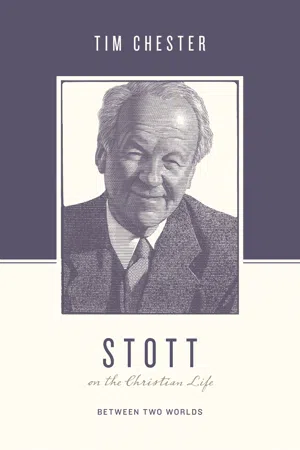
eBook - ePub
Stott on the Christian Life
Between Two Worlds
- 272 pages
- English
- ePUB (mobile friendly)
- Available on iOS & Android
eBook - ePub
Stott on the Christian Life
Between Two Worlds
About this book
Information
Topic
Theologie & ReligionSubtopic
Religiöse BiographienChapter 1
An Evangelical Life
John Stott was born on April 27, 1921, into a privileged home. His father, Arnold Stott, was a rising doctor who would go on to become physician to the royal household. Stott senior had served in the First World War and would serve again in the Second, rising to the rank of major general. John was the longed-for son with three older sisters. It was a home with servants, including a succession of nannies. The one who stuck was Nanny Golden, a devout Christian, who taught the children Christian choruses. The Stotts lived in Harley Street, the area of London traditionally associated with doctors. And, as a child, Stott was taken to the nearby church, All Souls, Langham Place.
Early in his childhood John acquired a love of the natural world, encouraged by his father. Together they would catch butterflies using traps baited with treacle and laced with beer to make their prey drowsy. But when a sibling squabble led to a cushion landing on John’s butterfly box, John shifted his attentions to what became a lifelong fascination: bird-watching. Letters and diaries ever after switched easily between accounts of his work and birds he had seen.
School Days
Arnold Stott had been educated at Rugby, the elite private school that gave its name to the sport, and Rugby School is where John was destined. But first he spent a spell at Oakley Hall prep school. John was not always happy at Oakley Hall. Perhaps the ice that formed in the wash basins during cold winter days and the occasional canings from which Stott was not immune did not help. But it was not all hardship. John was not above a prank, a habit that continued throughout his life. His school friends referred to him as “the boy with disappearing eyes” because his eyes would narrow to a squint when he laughed.1
Boarding school was a well-worn track for the children of the English upper classes. It was a route designed to instill not only a top-class education but also a stiff upper lip, a suppression of the emotions that Stott would come to lament. The first time his mother came to see him at Oakley Hall, he met her in the headmaster’s office, where he found her standing next to the headmaster and his wife. Without thinking, Stott advanced toward his mother, his hand outstretched, and said, “How do you do, Mrs. Stott?” The headmaster’s wife burst out laughing, but Emily Stott had the presence of mind to cover her son’s embarrassment by shaking his hand and replying, “How do you do, Johnny?”2 It was an incident that encapsulated the confusion of a boy taken from a happy home to the stark surroundings of boarding school dorms. Nevertheless, Stott became head boy, the UK equivalent of class president, and won a scholarship to Rugby.
Conversion
Religion of a rather formal kind was part of the life at Rugby School. There was a brief service in the chapel each day as well as “house prayers” in dormitories at night. Stott later described feeling that “if there is a God, I was estranged from him. I tried to find him, but he seemed to be enveloped in a fog I could not penetrate.” This estrangement was coupled with a sense of defeat. He could not be the person he knew he should be.3 He would creep into the school chapel to read religious books and seek God, but to no avail.
What brought change was the testimony of another schoolboy. John Bridger, a year ahead of Stott, invited him to what today we would call the school “Christian Union,” but which was simply known as “the meeting.” It met each Sunday afternoon in one of the classrooms with Bridger leading and sometimes giving a talk (which astonished Stott, because his experience of religion to date had always been clerical). Then on Sunday, February 13, 1938, a few weeks before Stott’s seventeenth birthday, they had a visiting speaker, E. J. H. Nash, or “Bash,” as he was known. A few years previously Nash had joined the staff of Scripture Union to work with schoolboys, somewhat controversially focusing on elite schools with the aim of evangelizing the future leaders of the nation. He had developed a ministry built around vacation camps supplemented by support of Christian Unions during term times. The camps became known colloquially as Iwerne Camps (after the Dorset village of Iwerne Minster, in which they were held), or simply “Bash” camps. Bridger had been converted at just such a camp two years before.
Stott later wrote of Nash’s visit: “He was nothing to look at, and certainly no ambassador for muscular Christianity. Yet as he spoke I was riveted.” Nash confronted the boys with a question posed by Pilate, “What shall I do with Jesus who is called Christ?” (Matt. 27:22), making clear that neutrality was not an option. “In a way I can’t express,” recalled Stott, “I was bowled over by this because it was an entirely new concept to me that one had to do anything with Jesus.”4 Stott would later write:
I used to think that because Jesus has died on the cross, by some kind of rather mechanical transaction the whole world had been put right with God. I remember how puzzled, even indignant, I was when it was first suggested to me that I needed to appropriate Christ and his salvation for myself. I thank God that later he opened by eyes to see that I must do more than acknowledge I needed a Saviour, more even than acknowledge that Jesus Christ as the Saviour I needed; it was necessary to accept him as my Saviour.5
After the meeting Stott approached Nash, who took him for a drive in his car to answer his questions. “To my astonishment,” says Stott, “his presentation of Christ crucified and risen exactly corresponded with the need of which I was aware.”6
As was his custom, Nash did not push for an immediate decision. But that night Stott “made the experiment of faith, and ‘opened the door’ to Christ.”
I saw no flash of lightening, heard no peals of thunder, felt no electric shock pass through my body, in fact I had no emotional experience at all. I just crept into bed and went to sleep. For weeks afterwards, even months, I was unsure what had happened to me. But gradually I grew . . . into a clearer understanding and a firmer assurance of the salvation and lordship of Jesus Christ.7
Stott’s diary entry a couple of days later reads: “I really have felt an immense and new joy throughout today. It is the joy of being at peace with the world—and of being in touch with God. How well do I know now that He rules me—and that I never really knew Him before.”8
Nash began to correspond with Stott, writing a letter once a week for at least the following seven or so years.9 Some covered the...
Table of contents
- Cover
- Newsletter Signup
- Endorsements
- Title Page
- Copyright
- Contents
- Series Preface
- Introduction
- Chapter 1 An Evangelical Life
- Chapter 2 A Christian Mind
- Chapter 3 Preaching the Word
- Chapter 4 Satisfaction through Substitution
- Chapter 5 Repudiation and Surrender
- Chapter 6 Life in the Spirit
- Chapter 7 Embedded in the Church
- Chapter 8 Reaching a Lost World
- Chapter 9 Loving a Needy World
- Chapter 10 All of Life under the Lord of All
- Chapter 11 A Vision of Christ
- Bibliography
- General Index
- Scripture Index
Trusted by 375,005 students
Access to over 1.5 million titles for a fair monthly price.
Study more efficiently using our study tools.
Frequently asked questions
Yes, you can cancel anytime from the Subscription tab in your account settings on the Perlego website. Your subscription will stay active until the end of your current billing period. Learn how to cancel your subscription
No, books cannot be downloaded as external files, such as PDFs, for use outside of Perlego. However, you can download books within the Perlego app for offline reading on mobile or tablet. Learn how to download books offline
Perlego offers two plans: Essential and Complete
- Essential is ideal for learners and professionals who enjoy exploring a wide range of subjects. Access the Essential Library with 800,000+ trusted titles and best-sellers across business, personal growth, and the humanities. Includes unlimited reading time and Standard Read Aloud voice.
- Complete: Perfect for advanced learners and researchers needing full, unrestricted access. Unlock 1.5M+ books across hundreds of subjects, including academic and specialized titles. The Complete Plan also includes advanced features like Premium Read Aloud and Research Assistant.
We are an online textbook subscription service, where you can get access to an entire online library for less than the price of a single book per month. With over 1.5 million books across 990+ topics, we’ve got you covered! Learn about our mission
Look out for the read-aloud symbol on your next book to see if you can listen to it. The read-aloud tool reads text aloud for you, highlighting the text as it is being read. You can pause it, speed it up and slow it down. Learn more about Read Aloud
Yes! You can use the Perlego app on both iOS and Android devices to read anytime, anywhere — even offline. Perfect for commutes or when you’re on the go.
Please note we cannot support devices running on iOS 13 and Android 7 or earlier. Learn more about using the app
Please note we cannot support devices running on iOS 13 and Android 7 or earlier. Learn more about using the app
Yes, you can access Stott on the Christian Life by Tim Chester, Justin Taylor, Stephen J. Nichols, Justin Taylor,Stephen J. Nichols in PDF and/or ePUB format, as well as other popular books in Theologie & Religion & Religiöse Biographien. We have over 1.5 million books available in our catalogue for you to explore.