Selection and breeding decisions have traditionally been made based on phenotypic measurements and pedigree information of selection candidates or close relatives. However, the recent availability of genomic information on a large number of markers has transformed modern dairy cattle breeding around the world. Currently, among the main uses of genomic information are the identification of Quantitative Trait Loci and candidate genes related to economically important traits, and the prediction of genetic merit of individuals for selection. In this context, several statistical methods have been developed to enable the incorporation of genomic information to achieve these goals. In this chapter we summarize the key developments in genomic prediction and selection in dairy cattle, with a focus on the tools and statistical methods proposed over time. Additionally, we also discuss the main contributions that supported such developments, and indicate potential constrains and opportunities in the use of current methods in the future of dairy cattle breeding.
eBook - PDF
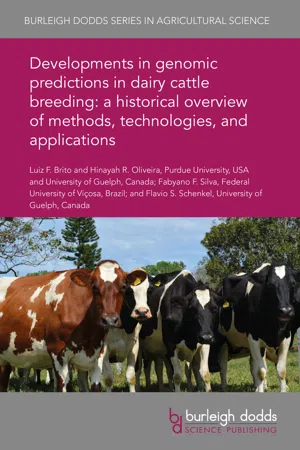
Developments in genomic predictions in dairy cattle breeding: a historical overview of methods, technologies, and applications
- 27 pages
- English
- PDF
- Available on iOS & Android
eBook - PDF
Developments in genomic predictions in dairy cattle breeding: a historical overview of methods, technologies, and applications
About this book
Information
Subtopic
Animal HusbandryTable of contents
- 1 Introduction
- 2 Traditional dairy cattle breeding
- 3 The development of genomic technologies and the single-nucleotide polymorphisms (SNP) era
- 4 Association analyses and marker-assisted selection (MAS)
- 5 Tools and parameters needed for successful implementation of genomic selection
- 6 Developments in statistical methods for genomic evaluation
- 7 Conclusion
- 8 Where to look for further information
- 9 References
Trusted by 375,005 students
Access to over 1.5 million titles for a fair monthly price.
Study more efficiently using our study tools.
Frequently asked questions
Yes, you can cancel anytime from the Subscription tab in your account settings on the Perlego website. Your subscription will stay active until the end of your current billing period. Learn how to cancel your subscription
No, books cannot be downloaded as external files, such as PDFs, for use outside of Perlego. However, you can download books within the Perlego app for offline reading on mobile or tablet. Learn how to download books offline
Perlego offers two plans: Essential and Complete
- Essential is ideal for learners and professionals who enjoy exploring a wide range of subjects. Access the Essential Library with 800,000+ trusted titles and best-sellers across business, personal growth, and the humanities. Includes unlimited reading time and Standard Read Aloud voice.
- Complete: Perfect for advanced learners and researchers needing full, unrestricted access. Unlock 1.5M+ books across hundreds of subjects, including academic and specialized titles. The Complete Plan also includes advanced features like Premium Read Aloud and Research Assistant.
We are an online textbook subscription service, where you can get access to an entire online library for less than the price of a single book per month. With over 1.5 million books across 990+ topics, we’ve got you covered! Learn about our mission
Look out for the read-aloud symbol on your next book to see if you can listen to it. The read-aloud tool reads text aloud for you, highlighting the text as it is being read. You can pause it, speed it up and slow it down. Learn more about Read Aloud
Yes! You can use the Perlego app on both iOS and Android devices to read anytime, anywhere — even offline. Perfect for commutes or when you’re on the go.
Please note we cannot support devices running on iOS 13 and Android 7 or earlier. Learn more about using the app
Please note we cannot support devices running on iOS 13 and Android 7 or earlier. Learn more about using the app
Yes, you can access Developments in genomic predictions in dairy cattle breeding: a historical overview of methods, technologies, and applications by Dr Luiz F. Brito,Dr Hinayah R. Oliveira,Dr Fabyano F. Silva,Prof Flavio Schenkel in PDF and/or ePUB format, as well as other popular books in Technology & Engineering & Animal Husbandry. We have over 1.5 million books available in our catalogue for you to explore.