Small-scale family poultry farming is practised by a large proportion of smallholder families in the rural and peri-urban areas of most of the world's developing countries. By enabling improvements in disease control, breeding and genetics, and management and nutrition through smallholder poultry development projects which incorporate a participatory farming approach, value chain assessment and appropriately focused training and extension programmes, such projects have the potential to impact very meaningfully on poverty alleviation, household nutrition and food security, the health and education of children and the empowerment of women as the principal poultry keepers. These outcomes constitute a number of the United Nations Sustainable Development Goals.
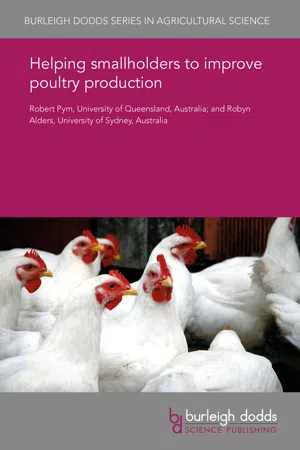
- 33 pages
- English
- PDF
- Available on iOS & Android
eBook - PDF
Helping smallholders to improve poultry production
About this book
Information
Subtopic
Allevamento di animaliTable of contents
- 1 Introduction
- 2 Types of smallholder poultry production systems
- 3 Development objectives for family poultry production
- 4 Preventing disease in poultry
- 5 Breeding and genetics
- 6 Husbandry and nutrition
- 7 Marketing and economics
- 8 Education and training
- 9 Strengthening policy environments
- 10 Case study 1: improving small-scale poultry production in Myanmar
- 11 Case study 2: contribution of village chickens to diets in Tanzania and Zambia
- 12 Acknowledgements
- 13 Future trends
- 14 Where to look for further information
- 15 References
Trusted by 375,005 students
Access to over 1.5 million titles for a fair monthly price.
Study more efficiently using our study tools.
Frequently asked questions
Yes, you can cancel anytime from the Subscription tab in your account settings on the Perlego website. Your subscription will stay active until the end of your current billing period. Learn how to cancel your subscription
No, books cannot be downloaded as external files, such as PDFs, for use outside of Perlego. However, you can download books within the Perlego app for offline reading on mobile or tablet. Learn how to download books offline
Perlego offers two plans: Essential and Complete
- Essential is ideal for learners and professionals who enjoy exploring a wide range of subjects. Access the Essential Library with 800,000+ trusted titles and best-sellers across business, personal growth, and the humanities. Includes unlimited reading time and Standard Read Aloud voice.
- Complete: Perfect for advanced learners and researchers needing full, unrestricted access. Unlock 1.5M+ books across hundreds of subjects, including academic and specialized titles. The Complete Plan also includes advanced features like Premium Read Aloud and Research Assistant.
We are an online textbook subscription service, where you can get access to an entire online library for less than the price of a single book per month. With over 1.5 million books across 990+ topics, we’ve got you covered! Learn about our mission
Look out for the read-aloud symbol on your next book to see if you can listen to it. The read-aloud tool reads text aloud for you, highlighting the text as it is being read. You can pause it, speed it up and slow it down. Learn more about Read Aloud
Yes! You can use the Perlego app on both iOS and Android devices to read anytime, anywhere — even offline. Perfect for commutes or when you’re on the go.
Please note we cannot support devices running on iOS 13 and Android 7 or earlier. Learn more about using the app
Please note we cannot support devices running on iOS 13 and Android 7 or earlier. Learn more about using the app
Yes, you can access Helping smallholders to improve poultry production by Robert Pym,Robyn Alders in PDF and/or ePUB format, as well as other popular books in Tecnologia e ingegneria & Allevamento di animali. We have over 1.5 million books available in our catalogue for you to explore.