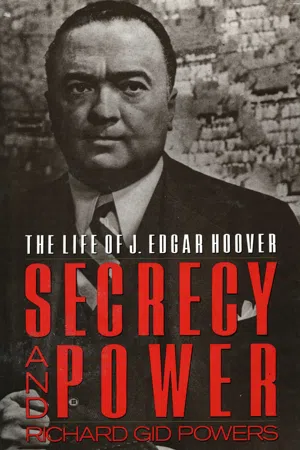
A well-researched biography about the public and private life of J. Edgar Hooverâformer FBI director and America's most controversial law enforcerâthat draws on previously unknown personal documents, a study of FBI files, and the presidential papers of nine administrations. Secrecy and Power is a full biography of former FBI director, covering all aspects of Hoover's controversial career from the Red Scare following World War I to the 1960s and his personal vendettas against Martin Luther King and the civil rights and antiwar movements.
Frequently asked questions
Yes, you can cancel anytime from the Subscription tab in your account settings on the Perlego website. Your subscription will stay active until the end of your current billing period. Learn how to cancel your subscription.
No, books cannot be downloaded as external files, such as PDFs, for use outside of Perlego. However, you can download books within the Perlego app for offline reading on mobile or tablet. Learn more here.
Perlego offers two plans: Essential and Complete
Essential is ideal for learners and professionals who enjoy exploring a wide range of subjects. Access the Essential Library with 800,000+ trusted titles and best-sellers across business, personal growth, and the humanities. Includes unlimited reading time and Standard Read Aloud voice.
Complete: Perfect for advanced learners and researchers needing full, unrestricted access. Unlock 1.4M+ books across hundreds of subjects, including academic and specialized titles. The Complete Plan also includes advanced features like Premium Read Aloud and Research Assistant.
Both plans are available with monthly, semester, or annual billing cycles.
We are an online textbook subscription service, where you can get access to an entire online library for less than the price of a single book per month. With over 1 million books across 1000+ topics, weâve got you covered! Learn more here.
Look out for the read-aloud symbol on your next book to see if you can listen to it. The read-aloud tool reads text aloud for you, highlighting the text as it is being read. You can pause it, speed it up and slow it down. Learn more here.
Yes! You can use the Perlego app on both iOS or Android devices to read anytime, anywhere â even offline. Perfect for commutes or when youâre on the go. Please note we cannot support devices running on iOS 13 and Android 7 or earlier. Learn more about using the app.
Yes, you can access Secrecy and Power by Richard Gid Powers in PDF and/or ePUB format, as well as other popular books in Politics & International Relations & Political Biographies. We have over one million books available in our catalogue for you to explore.
As a youth I was taught basic beliefs. Cynics, perhaps, may regard them with derision. For instance, I was taught that no book was ever to be placed above the Bible. Children in my youth were taught the code of the American flag and to defend it against any manner of desecration, as a symbol of life, liberty and justice.
Hoover, November 9, 1959, Austin, Texas
THREE BLOCKS BEHIND the Capitol, where North Carolina Avenue crosses Pennsylvania, is a large, open square bordered by dignified, upstandingly proper Victorian houses that recall the gentility, respectability, and concern for appearances that shaped them a century ago. But a gas station has intruded on the west side of the square now, and a modern brick-and-concrete church of vaguely Romanesque style has carved a chunk out of its southern border.1 The grass is unkempt and trampled; the trees are few and struggling. Pennsylvania Avenue, which cuts diagonally across the square, has been widened into a major thoroughfare that funnels commuters toward the Capitol in the morning and drains them away in the evening. The old-fashioned houses seem sadly exposed to the traffic that pours by in an unending stream. The square itself has been overwhelmed by mid-twentieth-century Washingtonâs incessant expansion and demand for greater efficiency, convenience, and order.
At the turn of the century, the streets that form Seward Square, Fourth and Sixth streets and the north and south branches of âCâ Street, were narrow and cobblestoned, with shade trees and brick sidewalks. Pennsylvania Avenue was a pair of narrow carriage lanes separated by a grassy walkway and lined with trees. The streetcars that ran along the avenue were hidden from the homes by the trees and shrubs, and a cast-iron post and chain fence surrounded the parkâs well-tended lawns and flowerbeds of calla lilies and dusty millers.2 It was a quiet neighborhood that had housed the same government-worker families for generations. Proud of its churches, its schools, and its niche in the civil service, it was a secure, self-satisfied community, confident that success and prosperity had proved its way of life worthy of respectâand defense.
Here, at 413 Seward Square, just a five-minute walk from the Capitol, where seventy-seven years later his body would lie in state, John Edgar Hoover was born on January 1, 1895. For forty-three years he would live in this house, to leave only when his mother died in 1938. He would be the last of the many Hoovers who had lived on Seward Square. When he left, the neighborhood, like the world he had known in his youth, had changed, but the values of the old Seward Square itself, those of Southern, white, Christian, small-town, turn-of-the-century Washington, would stay with him the rest of his life.
The vital statistics of the Hoover family were recorded by Edgar in a small notebook during the summer of 1912; he was seventeen years old and about to enter his senior year at Central High School. âOn November 21, 1857,â he began, âmy father Dickerson N. Hoover was born at No. [blank] 6th St. N.W. On Sept 12, 1861 my mother Annie M. Scheitlin was born at Wash. D.C. On Sept 17, 1879, Dickerson N. Hoover married Annie M. Scheitlin at 8.00 in the Presbyterian Church at B and 4 S.E. The day was cool & the night beautiful. Dr. Chester officiated. The church was packed to the doors & steps in fact it was the largest wedding Capitol Hill ever had. My father was 22 and my mother was 19.â3
Edgarâs father, Dickerson Naylor Hoover, grew up in Northwest Washington, about three miles from Seward Square, near the old Central High at Seventh and âOâ street N. W. that Edgar would later attend. Dickersonâs father, Edgarâs grandfather, John Thomas Hoover, worked at the printshop of the United States Coast and Geodetic Survey, where Dickerson himself would earn his living as a platemaker, eventually becoming chief of the printshop. Family tradition held that John Thomas Hooverâs father, Edgarâs great-grandfather, had worked as a mason constructing the Capitol. Dickersonâs mother, J. Edgarâs grandmother, continued to live in the Central High neighborhood with her younger son, Halstead Hoover. Halstead, like Edgar, was an unmarried younger son who lived with his widowed mother until her death.4
Annie Margaret Scheitlin, Edgarâs mother, grew up in Seward Square, where her family had been established since well before the Civil War. Her grandmother and grandfather, John and Anna Hitz, had emigrated from Switzerland around 1820. John Hitz was a mining engineer who had worked in the copper areas of Lake Superior and in the gold mines of North Carolina. In 1853, Hitz, who had settled in Washington, became the Swiss consul (at that time the ranking Swiss diplomatic post in the country). Among his three children were Edgarâs grandmother, Mrs. Margaret Scheitlin, and great-uncle, also named John Hitz, who succeeded his father as Swiss consul in 1864, at which time the post was upgraded to the rank of consul general. (Hitz and his father probably maintained dual U.S.-Swiss citizenship.) During Edgarâs boyhood, his grandmother Scheitlin lived across the square, and she and his great-uncle were frequent Sunday visitors at the Hoover household. The family often spent Sunday evenings seated around the parlor table, with the white-bearded Swiss consul general leading the Bible reading. Through the Scheitlin side of the family, Edgar was a cousin of District of Columbia Judge William Hitz and distantly related to U.S. Supreme Court Justice Harold Burton.5
After their marriage, Annie and Dickerson Hoover moved to a house on Capitol Hillâs Sixth Street S.E., near the home of Annieâs mother. It was there, according to the young Edgarâs notebook, that âOn Sept 9, 1880 at 2.30 A.M. on Thursday morning Dickerson N. Hoover, Jr. was born to my father Dickerson N. and my mother Annie M. Hoover. The day was pleasant. The doctor was McKim. He was born at No. [blank] 6th St. S.E.â6 This was Edgarâs brother Dick, fifteen years his senior, and in many personal and professional ways the model for his younger brother.
âOn Sunday Nov 12, 1882 at 10.00 A.M.,â the notebook continued, âmy sister Lillian Humphrey Hoover was born to my mother & father. It was a pretty day. The doctor was McKim. She was born at 414 Seward Sq. S.E. at her grandmotherâs [Margaret Scheitlinâs] home,â where Hooverâs parents had moved before they bought the house directly across the park. Eight years later, after the family had finally moved to its permanent home at 413 Seward Square, another child joined the ten-year-old Dickerson Jr. and the eight-year-old Lillian. âOn Sunday June 2, 1890 Sadie Margeruite [sic; actually âMargueriteâ] was born to my father & mother at 3.00 P.M. The day was hot and clear. The doctor was Mallan. She was born at 413 Seward Sq. S.E. Wash, D.C.â
Three years later, when Dickerson Sr. and Annie were thirty-six and thirty-two, and Dick and Lillian thirteen and eleven, the Hoovers lost three-year-old Sadie. âOn Aug 2, 1893 Sadie Marguerite died from Diphtheria at Atlantic City N.J. She is buried in Congressional Graveyard, Wash. D.C.â Sadieâs grave became a Hoover family shrine, and Edgarâs letters and diary mention trips to the graveyard to cut the grass at the cemetery plot.
Less than a year and a half after Sadieâs death, and, therefore, conceived just eight months after the tragedy, J. Edgar Hoover was born. Edgarâs notebook entry:
On Sunday January 1, 1895 at 7:30 A.M. J. Edgar Hoover was born to my father and mother the day was cold & snowy but clear. The Doctor was Mallan. I was born at 413 Seward Sq. S.E. Wash. D.C. I entered Brent School in First Grade at 6 yr in Sept 1901 and graduated from Brent at the age of 14 in June 1909. Never kept back once. Had a clean character & high standing in every grade. With the exception of the 7th grade I went to Brent every year. In the 7th I went to Wallack. Transferred from 8th Grade to Central High School. My best Graded [sic] teachers were Miss Dalton, 8th Gr. a fine lady who raised me morally; Miss Snowden, 7th Gr., who raised me intellectly [sic]; Miss Hinkle, 4th Gr., who raised me in discipline & intellect. I passed 5th highest in the first year high with an average of 93 8/10. I passed 3rd highest in the second year with an average of 96%. I passed first in the 3rd year with an average of 95.8%.
Edgar was the adored and achieving son of doting parents who may never have escaped their feelings of guilt over the summer vacation that had exposed their daughter, the child Edgar replaced, to diphtheria. He was the cherished brother of an older sister and brother who may also have been traumatized by the death of three-year-old Sadie. The future director of the FBI was the pet of the Hoover household, protected by its care and love.
The year Edgar was born, Washington had a population of a quarter-million people and was growing at a rate of 5,000 a year. The half of Capitol Hill that lay north of East Capitol Street was being filled with newly constructed homes, but below East Capitol, the southeast Washington of Hooverâs Seward Square, the neighborhoods had been settled for decades. With its trees and plantings, the area had a prosperous and stable appearance. The public schools and Protestant churches that served the community were well established, and, since 1890, the district had had its own high school, Eastern High, located in Hooverâs day a block from Seward Square at Pennsylvania and Seventh S.E.
On his motherâs side, Edgarâs family may have been more distinguished than most of the lower-level civil servants of the neighborhood. Judging by the Hooversâ home, however, they would not have been among the more affluent. Most Seward Square houses were brick-or stone-faced three-story buildings, but the Hoover family home, like the one Dickerson Jr. would purchase next door, was a modest two-story frame house faced with whitewashed stucco and black trim and shutters. Perched on a high bank above the square, and approached from the street by a flight of seven stone stairs, the house had a one-story front porch with scrollwork brackets. The porchâs northern exposure made it ideal for hot Washington afternoons. The sunny, southfacing backyard was filled with Annie Hooverâs roses and wisteria. The house had three bedrooms upstairs, and while his sister and brother still lived at home, Edgar slept downstairs in the rear parlor. Like most white housewives in Washington, Annie Hoover had a black maid who came each day to help with meals and cleaning.
Though entirely respectable, the Hooversâ Capitol Hill neighborhood would not have been considered particularly prestigious or wealthy. Seward Square was a microcosm of white, Protestant, middle-class America. There were within its borders few rich and no poor; except for the servants who came each day to do the cooking and cleaning, it was all white. The only religious differences were friendly rivalries among the Lutherans, Presbyterians, and Methodists. A child of Seward Square would have grown up knowing no one who was, in any essential respect, different from himself. The cityâs more solidly established middle-class families, with several generations separating them from manual labor, would have lived in Washingtonâs northwest, where the wealthy families of Washingtonâs âsocietyâ congregated. The black third of the cityâs population lived in the cityâs southwest and remote northeast ghettos, or in the nearly invisible âalleysâ in the center of white blocks, pockets of poverty scattered throughout the affluent capital city.
Washington was a Southern town where immigrants were scarce and self-abasing, and so the self-assertion of the white Protestant middle class showed itself most clearly in the growing respectability, even conventionality, of racism. The 1890s saw blacks disenfranchised and segregated throughout the South by Jim Crow legislation. It was only a short time before blacks in Washington felt the new wave of persecution and humiliation that was sweeping north. Between 1900 and 1920, from Hooverâs fifth to twenty-fifth years., the District systematically institutionalized Jim Crow. By the end of Wilsonâs administration, the only public accommodations that were not segregated were the trolleys and buses, the public libraries, and the grandstands at Griffith Stadium.7
The model for the grandiose civic improvements whose construction fascinated young Hoover during the first decade of the century was the âWhite City,â architect Daniel Burnhamâs lath-and-plaster neoclassical fantasy at the 1893 Columbian Exposition in Chicago.8 Washington, in its distribution of power and its exclusion of blacks from the conveniences and amenities of the community, was being turned into another kind of white city in a racial sense as well.
One area in which blacks had always been segregated was the public schools, but now the prejudice expanded to the churches. The few blacks in white churches were made to feel unwelcome, and were banned from white religious conventions and meetings. Black women were asked to leave the Womanâs Christian Temperance Union and many other philanthropic groups. Segregated washrooms and lockers (âJim Crow cornersâ) were established for the first time in government offices in 1904. Each year there was more pressure for antimiscegenation laws, Jim Crow cars on the streetcars, and a legal code of residential segregation. In every area of Washington life where blacks had once associated with whitesârestaurants, barbershops, theaters, charitable and social organizationsâthey were now excluded and confined to their own inferior preserves. By 1920, Washingtonâs blacks had come to occupy what historian Constance McLaughlin Green called âThe Secret City.â9
During his infancy, Edgar was largely in the care of his older sister and brother. Dick recalled, âI must have wheeled Edgar a thousand miles around Capitol Hill in one of those old-fashioned, high-wheeled baby buggies that mother bought for himâŚ. It was my daily chore to take Edgar out for an airing. Iâd tuck his bottle under the pillows of the baby carriage and sometimes we would be gone for hours.â10
At the turn of the century, the only major public buildings on Capitol Hill were the Capitol itself and the magnificent original facility of the Library of Congress. In 1902, after the publication of a new municipal plan, Washington began a colossal effort to beautify the city, and much of Edgarâs childhood was spent exploring it, first by carriage and then on foot and bicycle (in the beginning of the twentieth century, Washington, changing from a hodgepodge of encroachments on LâEnfantâs plan into a monumental sequence of public spaces, held no threats to discourage a parent from giving a child the freedom of the city). During the first decade of the century, the Senate and House office buildings were being constructed on each side of the Capitol a few steps from Seward Square. A few blocks farther from Hooverâs home, the new Union Station was being built to allow the removal of the train tracks and depots that disfigured the mall. Even more interesting to a growing boy and his dog was the reclamation of Rock Creek Park across town, with its ravines and caves and secret paths. A picture of Edgar around this time shows a husky and rugged boy in sturdy knickers, his bicycle by his side, looking somewhat annoyed at having to pose for the camera. His broad features and stocky body foreca...