Searching for Hassan
eBook - ePub

Searching for Hassan

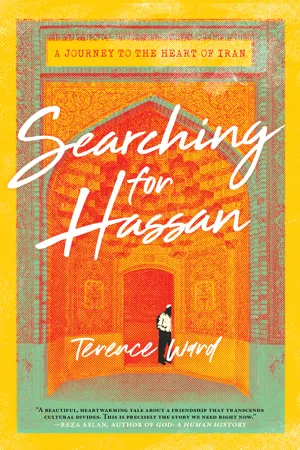
A Journey to the Heart of Iran

  1. 368 pages
  2. English
  3. ePUB (mobile friendly)
  4. Available on iOS & Android
eBook - ePub

Searching for Hassan

A Journey to the Heart of Iran

About this book

The "astonishing and deeply poignant" ( The Washington Post ) memoir of one man's search for a beloved family friend explores the depth of Iranian culture and the sweep of its history, and transcends today's news headlines to remind us of the humanity that connects us all. Growing up in Tehran in the 1960s, Terence Ward and his brothers were watched over by Hassan, the family's cook, housekeeper, and cultural guide. After an absence of thirty years and much turmoil in Iran, Ward embarks on a quixotic pilgrimage with his family in search of their lost friend. However, as they set out on this improbable quest with no address or phone number, their only hope lies in their mother's small black and white photograph taken decades before.Crossing the vast landscape of ancient Persia, Ward interweaves its incredibly rich past, while exploring modern Iran's deep conflicts with its Arab neighbors and our current administration. Searching for Hassan puts a human face on the long-suffering people of the Middle East with this inspirational story of an American family who came to love and admire Iran and its culture through their deep affection for its people. The journey answers the question, "How far would you go for a friend?"Including a revised preface and epilogue, this new and updated edition continues to demonstrate that Searching for Hassan is as relevant and timely as ever in shaping conversations and ways of thinking about different cultures both in the US and around the world.
Frequently asked questions

Yes, you can cancel anytime from the Subscription tab in your account settings on the Perlego website. Your subscription will stay active until the end of your current billing period. Learn how to cancel your subscription.
No, books cannot be downloaded as external files, such as PDFs, for use outside of Perlego. However, you can download books within the Perlego app for offline reading on mobile or tablet. Learn more here.
Perlego offers two plans: Essential and Complete
  • Essential is ideal for learners and professionals who enjoy exploring a wide range of subjects. Access the Essential Library with 800,000+ trusted titles and best-sellers across business, personal growth, and the humanities. Includes unlimited reading time and Standard Read Aloud voice.
  • Complete: Perfect for advanced learners and researchers needing full, unrestricted access. Unlock 1.4M+ books across hundreds of subjects, including academic and specialized titles. The Complete Plan also includes advanced features like Premium Read Aloud and Research Assistant.
Both plans are available with monthly, semester, or annual billing cycles.
We are an online textbook subscription service, where you can get access to an entire online library for less than the price of a single book per month. With over 1 million books across 1000+ topics, we’ve got you covered! Learn more here.
Look out for the read-aloud symbol on your next book to see if you can listen to it. The read-aloud tool reads text aloud for you, highlighting the text as it is being read. You can pause it, speed it up and slow it down. Learn more here.
Yes! You can use the Perlego app on both iOS or Android devices to read anytime, anywhere — even offline. Perfect for commutes or when you’re on the go.
Please note we cannot support devices running on iOS 13 and Android 7 or earlier. Learn more about using the app.
Yes, you can access Searching for Hassan by Terence Ward in PDF and/or ePUB format, as well as other popular books in Social Sciences & Historical Biographies. We have over one million books available in our catalogue for you to explore.

1. Fellow Travelers

The start of a journey in Persia resembles an algebraical equation: it may or may not come out.
—ROBERT BYRON, THE ROAD TO OXIANA
In early April 1998, my family began our long-awaited journey back home. Not to our ancestral Ireland, but to Iran. While most Americans still recoiled with images of ranting hostage takers and wild-eyed terrorists, we put our fears aside. My three brothers and I, with our elderly parents, would cross the vast Iranian plateau on a blind search for Hassan, our lost friend and mentor who had taken care of us in Tehran so many years ago. Our seven-hundred-mile overland trek, from the ancient southern city of Shiraz, once called the Paris of Persia, all the way north to Tehran, the metropolis of modern Iran, would be a cross-cultural odyssey to rediscover a country, its people and our much-loved adopted Iranian family.

Journeys are often conceived in a miraculous split-second flash that illuminates the purpose and route of passage. Once the embryo forms, everything else falls into place in scattered pieces—visas and plane tickets, weathered maps, oblique itineraries—a jigsaw puzzle of fact and fantasy.
In early December 1997, my youngest brother, Richard, phoned me with surprising news from his home in Saudi Arabia. In the Gulf island state of Bahrain, he said, visas for Iran could be found. His voice, broken up by a poor connection, barked and echoed.
“Just heard that ladies from Arabia-bia flew into Iran on a shopping binge. They landed in Isfahan, bought their carpets-pets and got out safely… a rug under each arm.”
“No!”
“Got their vi-sas… in Bahrain.”
“For how long?”
“Less than a week.”
“Any Americans?”
“Don’t know. Tomorrow I’ll find out. So, baba, are you ready-eady to go back-ack?”
“Mamma mia,” I stammered.
“Goo-ood. Great id-ea! Ask Mom and Dad… What about the whole family-mily?”
His question fell through the receiver with the weight of heavy granite. The entire family?
“A tough sell,” I remarked.
“No tougher-er than the Karakoram-ram.”
After living in the Persian Gulf for eight years with his wife and two young boys, Richard had developed a thick skin. His baptism in Middle Eastern turbulence began in 1991. Overnight, Saddam Hussein’s army poured across the Saudi border into Kuwait, only to be stopped by an accidental and chaotic firefight in a small village called Khafji, a few hundred miles from Rich’s green suburban lawn in Dhahran. While his kids played in their treehouse, Scud missiles rained down.
For his latest vacation—Rich was an environmental geologist—he had climbed in Pakistan’s rugged Himalayas, the infamous Karakoram Range. His hiking trip swiftly turned into a feat of endurance. Halfway into the trek, his companion fell twenty feet onto a rock ledge, fracturing his leg. Single-handedly, Rich fashioned a leg splint, lifted him onto his shoulders and hauled him down to the Hunza Valley to be airlifted out. Rich had long before earned my admiration as a fearless, no-nonsense scientist. He was in love with nature’s geological wonders and was determined to witness each one in person. But Iran seemed daunting, as remote and impassable as his snowbound Karakoram peaks.
When I asked my brother Chris whether he would be coming along, he replied, “Are you nuts?”

For years, only the odd foreign journalist had dared venture into the somber Islamic Republic. News reports were dismal: Boys used as human minesweepers on the Iraqi front. Women trapped under black chadors. Clenched-fisted zealots led by mullahs in the ritual chant “Marg bar Amrika, Death to America.” Cast as a pariah, Iran had been cut off from the world. All travelers except the foolhardy few kept a safe distance. And rightly so. This fundamentalist state had flogged offenders, covered women and defiantly thumbed its nose at the West. Yet there was reason to be upbeat: a moderate cleric had just been elected president.
Mohammad Khatami’s surprise landslide victory in August 1997 ushered in a new era. Many hailed this heady period as “Tehran Spring.” In a CNN interview with Christiane Amanpour on January 7, 1998, President Khatami welcomed cultural exchange. He offered an olive branch to Washington for the first time since the Shah’s fall in 1979 and spoke of “people-to-people” contacts with Americans. His fluency in German and English surprised world leaders, as did his penchant for quoting Kant and Tocqueville. The smiling, soft-spoken leader dared to suggest reform, democratic rights and change. Responding characteristically to his critics, he spoke of the need for a kinder, gentler Islam. Women and young voters had responded with overwhelming support. In Tehran’s bazaars, this refreshing moderate who promised to restore a “civil society with rule of law” was jokingly being called “Ayatollah Gorbachev.”
If Ping-Pong diplomacy helped normalize relations with China, could soccer and wrestling do the same for Iran? Iranian hard-liners were concerned, and for good reason. Thunderous applause and chants of “USA! USA!” echoed when American and Iranian wrestlers hugged each other after a friendly match in Tehran a month later, in February. The recently announced World Cup draw was nothing less than miraculous. Iran was scheduled to play Team USA in Lyon, France, on June 21.

A black-and-white photograph had haunted my family for years. It was a weathered picture sitting on my mother’s desk in Berkeley in which Hassan, the proud father, stood with his young wife and his mother-in-law. Both women wore scarves. Fatimeh peered sheepishly with large brown eyes through her horn-rimmed glasses. Khorshid held baby Ali, who grinned under his pointed elfish cap with drooping earflaps. Hassan beamed handsomely, and his smile bore a half-moon of white teeth under his mustache, aquiline nose and glistening eyes. Four faces shining in the living room as silent reminders.
Late at night, during spirited reunions, when our talk circled back to earlier days in Iran, my mother would always raise the same ghostly question left hanging in suspended conversation: “I wonder what happened to Hassan. I just pray he’s all right, that his family is safe.” My mother, especially, was tortured by a lingering guilt about not having done enough for the Ghasemis. Frustration and worry would swell in her eyes.
“But what more could we have done?” my father would ask.
My father’s Irishness weighed in heavily whenever my family spoke of those halcyon days. In the wee hours of the morning, after we had conversed our way back through Persian time with bittersweet memories of cherry orchards, the snow-crested Elburz and Hassan’s magical fables, my father would repeat Daniel Patrick Moynihan’s Celtic adage to remind us, “It’s no use being Irish unless you know the world is eventually going to break your heart.”

“Nostalgia” comes from the Greek word nostos, to return home, and algos, pain. The ancients used the term to describe the state of mind of Hellenic soldiers of Alexander the Great garrisoned in far-off Asia. There was only one effective cure: the journey back. André Aciman, the New York–based writer, haunted by his native Alexandria, described his sense of separation in his essay “Shadow Cities”: “An exile reads change the way he reads time, memory, self, love, fear, beauty: in the key of loss.”
Image
Hassan and Fatimeh Ghasemi in Tehran, 1963. Their son, Ali, smiles from the arms of his grandmother Khorshid, Fatimeh’s mother. With only this photograph in hand, the Ward family returned to Iran in 1998 to begin their search.
My parents’ exuberant voices were firm and fearless when I first asked them about the journey back. Playing the seer, my father chose the departure date that he felt symbolically mirrored our quest: April Fools’ Day 1998. I was elated, but also troubled.
I wondered how our search would alter our cherished memories and our nostalgia for Hassan’s “Mullah Nasruddin” tales, mint tea, buttered steamed rice and glistening eyes. Any journey of return runs that risk. Odysseus’s crew paid dearly for their homing instinct: only the captain survived. Peering through smoked glass blurs memories. Aging mirrors may reveal strangers. And what if the past were to be erased, finally and completely, no longer there? What then? Were we doomed to Chekhovian dreams of lost cherry orchards?
After the Islamic Revolution, questions haunted my family for years. Did Hassan pay a terrible price before a judge? Had he become embittered, betraying our memory, denouncing my family as crude imperialists? They were unresolved questions, a haunting abandonment, unfinished business. My mother’s worries about Hassan surfaced whenever the word “Iran” was mentioned, while in my brothers’ homes, Hassan’s storytelling antics were carefully being passed on from one generation of wide-eyed children to the next.
But what of Hassan himself? Had he survived? After two decades, the Islamic Republic’s impassable gate, long padlocked, was finally creaking open. The answer lay inside.

Yes, the time for our journey back had finally come. To arrive at his doorstep we would need Irish luck and Allah’s blessing. In the cold light of day and on close study, our search for Hassan seemed improbable. Only two clues existed. The first one was that faded black-and-white photograph taken in the spring of 1963. The second lay embedded in my mother’s memory: the name of his ancestral village, “Toodesht.” Our only hope was that he had settled there. But the multiple pronunciations of the town were daunting. Over the years, her uncertainty bred extraordinary mutations.
At dusk, as the thick San Francisco fog crept up the Berkeley hills to engulf my parents’ redwood observation deck on Grizzly Peak, my mother ran up and down her scales of names, hoping to catch the true melody of Hassan’s mysterious village, wedged somewhere in the mountains between Isfahan and Nain. It was a recurring theme, a broken record that always ended with gasps and laughs, exasperation and hopelessness.
“Think back, Mom. Now, what do you remember Hassan telling you before we left Tehran?”
“That one day he’d return to his village.”
“And it was?”
“Toodesht.”
“You’re certain?”
“Absolutely. Well, just a minute…”
“Yes?”
“Maybe it was… Tadoosht. Or… Qashtood.”
“Sure?”
“Toosquash!”
My father summed it up: “No Ithaca this, I assure you.”
No matter how upbeat we all tried to be, we were certain that Hassan hid behind clouded mists, never to be seen again.

U.S. State Department officials mouthed predictable doom. My brother Chris voiced his fears repeatedly. No visas could be obtained in America. Kevin remained skeptical. Only my parents and Richard were defiantly thrilled. When a Foreign Service officer told me, “Americans are strongly advised not to visit the country,” I countered by saying, “A moderate mullah has been elected president.” Unfazed, he snapped, “And public floggings have tapered off.”
Chris skittishly pleaded with my father over the phone, “You know, I’ve got two sons to worry about.”
Dad cut him short. “So what? I’ve got four and I’m going.”
The Ward clan’s view about the journey remained divided. It was decided that the wives would not join us, which suited them just fine. Terror and dire omens underlined our phone conversations. Friends kindly offered unsolicited advice, showering us with warnings. “It’ll be hot, dry, dangerous, dirty and scary. There’s no embassy to protect you, you’ll be taken hostage, your books will be confiscated. You’ll be confiscated. And your parents, how can you put them at such risk?” One dapper bicoastal socialite reminded me darkly, “There’ll be no fashion.”
I asked my father, “What’s the dress code?”
“Dress for a funeral,” he advised.
So, like fashionable New Yorkers, we packed black.

Riffling through my files, I found a faded piece of paper. At the top was written: “Useful Arabic Translations.” During the height of Lebanon’s civil war, in the early 1980s, it was slipped to me before I boarded a flight for Beirut. I realized only later that this sorry attempt at Arabic was gibberish mixed with a few Persian words. I faxed it to Chris and Kevin:
Meternier ghermez ahliah, Gharban.
The red blindfold would be lovely, Excellency.
Balli, balli, balli.
Whatever you say.
Shomah fuhr tommeh geh gofteh bande.
I agree with everything you have ever said or thought of in your life.
Akbar kheli kili hfir lotfan.
Thank you very much for showing me your marvelous gun.
Khrei, japahah mansh va fayeti amrikany.
I will tell you the names of many American spies traveling as reporters.
Suro arraigh davatsaman mano sepahen-hasi.
It is exceptionally kind of you to allow me to travel in the trunk of your car.
My brothers faxed back terse responses. They were not amused.

For advice, I browsed through Lonely Planet’s Iran: A Travel Survival Kit, the only serious guidebook published since the Revolution. The author, David St. Vincent, a tenacious English chap, was not one to flinch. All his tips came from firsthand experience. During one of his four trips, he was dragged before a revolutionary court on the charge of “plotting to import Salman Rushdie’s The Satanic Verses.” Wedged between the exhaustive lists of hotels and monuments lay a few unorthodox words of counsel: “Never underestimate the ruthlessness or strength of the Komiteh and its network of informers… Don’t be the first to discuss politics with a stranger.” He described the Revolutionary Guards as “a combination of Spanish Inquisition and the Gestapo.” About photography and cameras he offered further advice: “There’s still a certain amount of paranoia about foreign spies, and Iranians can get very suspicious of Westerners with cameras.” He suggested getting OKs before shooting, “if you don’t want to risk having your camera smashed or stones thrown at you—don’t think it doesn’t happen.” I especially appreciated his culturally sensitive how-to advice in dealing with authorities: “Answer your interrogators in such a way that their curiosity is satisfied, their suspicion allayed and their self-...

Table of contents

  1. Cover
  2. Title Page
  3. Map
  4. Dedication
  5. Epigraph
  6. Preface
  7. Prologue: Blood from Pomegranates
  8. Chapter 1: Fellow Travelers
  9. Chapter 2: A Second Coming
  10. Chapter 3: The Past Is a Foreign Country
  11. Chapter 4: Pasargadae’s Stones, Zoroaster’s Flame
  12. Chapter 5: Lords and Ladies of Persepolis
  13. Chapter 6: Nightingale Gardens, Sufi Poets and a Tavern
  14. Chapter 7: Every Place Is Kerbela
  15. Chapter 8: Towers of Silence, Temples of Fire
  16. Chapter 9: Appointment in Tudeshk
  17. Chapter 10: Isfahan Feasts, Bicycle Girlfriend
  18. Chapter 11: On the Banks of the Zayandeh River
  19. Chapter 12: Video Nights in Imam Khomeini’s Tomb
  20. Chapter 13: Valleys of the Assassins, Black Five Millionaires
  21. Chapter 14: The Color of God
  22. Epilogue: A New Dawn
  23. Afterword
  24. Further Reading
  25. Acknowledgments
  26. About the Author
  27. Copyright