
- 320 pages
- English
- ePUB (mobile friendly)
- Available on iOS & Android
eBook - ePub
About this book
WINNER OF THE PEN HESSELL-TILTMAN PRIZE
'Reads like something from a thriller…colourful, detailed and meticulously researched' Sunday Times
‘Gripping from start to finish' Peter Frankopan, author of The Silk Roads
Hundreds of peaceful civilians were slaughtered in the Amritsar Massacre of 13 April 1919, after British troops opened fire without warning. According to legend, Udham Singh was among the injured that day, and he vowed to take revenge. More than twenty years later, in a Westminster hall, he fulfilled that promise when he gunned down in cold blood the man ultimately responsible, Sir Michael O'Dwyer.
But what happened in the intervening years? In this sweeping narrative that takes the reader across four continents, Anita Anand separates reality from myth to reveal Singh's astonishing story. She brilliantly pieces together his movements, discovering surprising new links that take us from Jazz Age New York to the shady world of international spy rings. The Patient Assassin shines a devastating light on one of the Raj's most horrific events, but reads like a taut thriller.
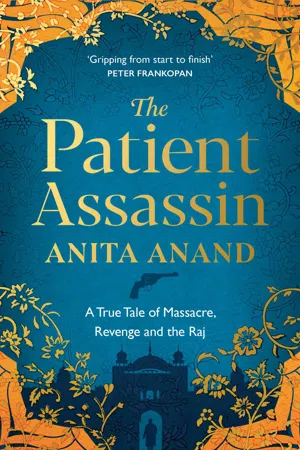
'Reads like something from a thriller…colourful, detailed and meticulously researched' Sunday Times
‘Gripping from start to finish' Peter Frankopan, author of The Silk Roads
Hundreds of peaceful civilians were slaughtered in the Amritsar Massacre of 13 April 1919, after British troops opened fire without warning. According to legend, Udham Singh was among the injured that day, and he vowed to take revenge. More than twenty years later, in a Westminster hall, he fulfilled that promise when he gunned down in cold blood the man ultimately responsible, Sir Michael O'Dwyer.
But what happened in the intervening years? In this sweeping narrative that takes the reader across four continents, Anita Anand separates reality from myth to reveal Singh's astonishing story. She brilliantly pieces together his movements, discovering surprising new links that take us from Jazz Age New York to the shady world of international spy rings. The Patient Assassin shines a devastating light on one of the Raj's most horrific events, but reads like a taut thriller.
Frequently asked questions
Yes, you can cancel anytime from the Subscription tab in your account settings on the Perlego website. Your subscription will stay active until the end of your current billing period. Learn how to cancel your subscription.
No, books cannot be downloaded as external files, such as PDFs, for use outside of Perlego. However, you can download books within the Perlego app for offline reading on mobile or tablet. Learn more here.
Perlego offers two plans: Essential and Complete
- Essential is ideal for learners and professionals who enjoy exploring a wide range of subjects. Access the Essential Library with 800,000+ trusted titles and best-sellers across business, personal growth, and the humanities. Includes unlimited reading time and Standard Read Aloud voice.
- Complete: Perfect for advanced learners and researchers needing full, unrestricted access. Unlock 1.4M+ books across hundreds of subjects, including academic and specialized titles. The Complete Plan also includes advanced features like Premium Read Aloud and Research Assistant.
We are an online textbook subscription service, where you can get access to an entire online library for less than the price of a single book per month. With over 1 million books across 1000+ topics, weâve got you covered! Learn more here.
Look out for the read-aloud symbol on your next book to see if you can listen to it. The read-aloud tool reads text aloud for you, highlighting the text as it is being read. You can pause it, speed it up and slow it down. Learn more here.
Yes! You can use the Perlego app on both iOS or Android devices to read anytime, anywhere â even offline. Perfect for commutes or when youâre on the go.
Please note we cannot support devices running on iOS 13 and Android 7 or earlier. Learn more about using the app.
Yes, you can access The Patient Assassin by Anita Anand in PDF and/or ePUB format, as well as other popular books in Politics & International Relations & 20th Century History. We have over one million books available in our catalogue for you to explore.
Information

CHAPTER 1
THE DROP

LONDON, 30 JULY 1940
Albert was in an odd state of mind. Not frightened, nor angry, nor particularly depressed, just not himself somehow â out of sorts. The 35-year-old, plain-speaking Yorkshireman had been shaken out of his habitual good humour even before he boarded the juddering train from Manchester to London. Though the job waiting for him in the capital would have turned the stomachs of his fellow passengers, it was not the cause of his mood. Albert was on his way to kill a man, and he was fine with that.
He had done it before, and, if the fates were kind to him, he would do it many times again. No, something else was troubling him, something he had no control over. He, Albert Pierrepoint, junior executioner for His Majesty, might die in the next few days. Winston Churchill had told him so.
Albert had been at home the previous day, packing his bags, when Churchillâs jowly voice crackled through the wireless. The war was going to be long and bloody, and London, Albertâs destination, was the Nazisâ imminent target. Simultaneously hectoring and seductive, Churchillâs words filled Albertâs bedroom and his head: âThe vast mass of London itself, fought street by street, could easily devour an entire hostile army.â
With his next breath, somewhat less reassuringly, Churchill addressed the potential cost to his people: âWe would rather see London laid in ruins and ashes than that it should be tamely and abjectly enslaved.â1
The words were vivid in Albertâs mind as he hauled his suitcase off the train and made his way through the press of people on the platform. London might feel like a sprawling, crawling, sooty mess to most of his fellow northerners, but Albert always found magic in the grime. Now, heading towards Pentonville Prison, he looked at his surroundings with different eyes: âNewly aware that [the war] might be fought street by street while I was in it.â2 Churchillâs words had resonated somewhere deep in his patriotism. The voice from the radio, carried on waves of static, had been clear. Britain would give no quarter: âAny traitors that may be found in our midst â but I do not believe there are many . . . will get short shrift.â3
Albert knew all about retribution. He embodied it every time he adjusted a noose.
Men like Albert, who devoted their lives to the penal system, referred to Pentonville Prison as âthe Villeâ, making it sound like a provincial hotel or a friendly local pub. A Victorian brick building of imposing size and colour-draining drabness, the Ville had taught Albert Pierrepoint all he knew about killing. He had learned his trade there eight years before, practising the hangmanâs silent walk past the condemned cells, learning the art of measuring, coiling and tightening a rope. The Ville had helped him perfect his lightning-quick âcappingâ technique, the action of whipping out a white cotton bag from a pocket and pulling it over âOld Billâsâ head before necklacing him with the noose.
Old Bill was the name given to the heavy dummy that trainee executioners used for practice: âCap noose pin lever drop. Youâve got to get it right. Thereâs no allowance for error. Haul him up and do it again.â4
Posted to Armley Gaol in Leeds, Albert showed himself to be a natural hangman. It wasnât long before people were comparing him to his uncle, the great Thomas Pierrepoint â a legend among executioners. The two became a team; âUncle Tom and Our Albertâ, as the Armley staff liked to call them. Together, uncle and nephew were responsible for most of the hangings in the north of England and in Ireland. Tom led while Albert assisted. There was much praise for the calm efficiency with which they despatched condemned men and women.
Itching to take the lead, Albert thought he might have finally got his chance when Pentonvilleâs usual executioner received his call-up papers. Many men were being yanked out of professions to fight at the Front, their spaces providing opportunity for those left at home. It was a macabre way to make your way in the world, but Albert would have seized the chance with both hands.
Much to his disappointment, Albertâs move proved to be sideways rather than up. Pentonvilleâs own regular assistant hangman was getting the job. To make matters worse, he was someone Albert knew well, and for whom he had scant regard.
Stanley William Cross had trained with Albert at the Ville. As apprentices Albert had seen Cross up close, gone to the pub with him, swapped stories and compared notes. Their friendship was never more than superficial. Albert found his fellow traineeâs temperament unsuited to the âartâ. Careless and boastful, Cross had a habit of turning âjobsâ into entertaining yarns in exchange for free drinks. That kind of behaviour made Albert wince, and for Cross to get his chance before him was galling.
It was therefore with a mixture of satisfaction and alarm that Albert greeted the scene at Pentonville Prison when he arrived. Cross was in a state of total panic, âsuffering a bad attack of nervesâ.5 Though the execution was slated for 9 a.m. the next morning, things were in total disarray. That Cross had allowed himself to get into such a mess for this of all hangings was hard to believe.
Executions were like pulses of energy through a prison population at the best of times, with a great machinery swinging into action around the intimacy of the actual killing. Hangings as important as this one required even more meticulous care than usual. Plans were in motion to move the rest of the prison population far from the condemned wing in the morning, setting inmates to work before they even had the chance to have their breakfast. This would give Albert and Cross the time and space they would need to do what they had to do.
Busy prisoners were calm prisoners, but there was an added incentive for distraction this time round. The doomed man had a habit of making speeches at the last minute â incendiary, treasonous speeches â and that was the last thing the authorities needed. They had worked so hard to keep the prisonerâs words out of the press, they did not need some dying diatribe to undo all that.
Though Albert was trained to regard every hanging with the same dispassionate professionalism, he knew the execution of Udham Singh, or âPrisoner 1010â as the chalkboard outside his cell identified him, was the most important in his career. From India to Great Britain, this man had dominated headlines for weeks. His grinning face had been splashed over countless front pages, and his crime had shaken an already unstable world.
Despite acres of coverage, analysis and condemnation, most remained incredulous that this brown-faced foreigner had, at a time of heightened wartime paranoia, simply sauntered into a meeting in the heart of Westminster, close to the Houses of Parliament, and emptied his pistol into some of the most important men of the realm. His victims had included the secretary of state for India himself, but it was the slaying of one man, a former lieutenant governor of Punjab called Sir Michael OâDwyer, that had dominated the news. Shot straight through the heart at point-blank range, there seemed to be something almost operatic about the murder.
For some, the shooting of Sir Michael was merely the callous murder of an old and defenceless man. To others, it threatened the very foundation of the British Empire. Sir Michael was a stalwart defender of the Raj, and many in Britain agreed with his hardline policies towards India.
Conversely, millions in India itself regarded the murderer as an avenging angel, who, after twenty-one long years, had settled a terrible score. Thanks to Udham Singh, the name âJallianwala Baghâ was being spoken all over the world once again. It was a name the British would rather have forgotten â a portal into a nationâs shame at a time when the country needed to be both shameless and fearless.
The Home Office, Special Branch, the Secret Intelligence Service (SIS), MI5, the Indian Political Intelligence (IPI), as well as the prison and prosecution services, all knew the importance of Prisoner 1010. They agreed he had to die quickly, with as little fuss as possible. Cross must have known all this. How had he managed to mess things up so badly?
Instead of taking his own measurements, Cross appeared to have relied heavily on the prisonerâs paperwork. According to 1010âs file, he was âstockyâ, âheavy builtâ or âwell builtâ. It described a man 5 feet 8 inches tall, âweighing 172 lbsâ and âgenerally sound and healthyâ. The man Albert saw through the spyhole in the cell door seemed like a different person entirely. Udham was thin, sallow and sickly, nothing like the iconic picture of him that had run in so many newspapers.
Udham had been held on remand at Brixton Prison for months before his transfer to the Villeâs condemned wing. There, the senior medical officer, a man called Dr Hugh Grierson, had been tasked with keeping the prisoner alive long enough to hang him. Udham had not made it easy. From the moment he arrived at Brixton, he had been trying to kill himself. When his attempts to slit his wrists or take poison were discovered, he pushed his food tray away. Udham had tried to starve himself to death. Weeks of hunger striking did terrible things to the human body.
Grierson found it objectionable that Udham refused to die the way the British had planned, and talked about him as if he were a stubborn animal or errant child in dire need of training. Udham was âuncooperativeâ and âresponded badly to authorityâ.6 In his notes, Grierson observed: âThere was always an undercurrent of antagonism to everyone, sometimes bordering on dumb insolence. He was untruthful, and I could not rely on anything he said.â7
Adamant that Udham Singh should not escape the hangmanâs noose, Grierson ordered a regime of force-feeding. Three times a day in the weeks leading up to his trial, warders entered 1010âs cell and pinned his body to a gurney. They forced a feeding tube into his mouth, down his throat and into his stomach. His teeth clenched on the rubber gag that prised his jaws apart. Denounced as a form of torture for decades, ever since harrowing accounts of the procedure had been made public by the suffragettes, force-feeding was rarely used in Britain by 1940. Prisoner 1010 was subjected to ninety-three of these brutal acts during his time at Brixton.
Grierson had been at pains to play down the impact on his prisoner, insisting that he had taken it all surprisingly well. Even if the true horror of the experience had been made known, few would have cared. Udham Singh was one of the most hated men in Britain. Most were counting the days till he dangled from the end of a rope.
Griersonâs troublesome prisoner only decided to eat again after the judge passed the death penalty on him, but by that time his weight had plummeted. As he accepted meal trays again, he slowly put the pounds back on, but Stanley William Cross had no idea what he actually weighed at this moment, on the eve of his execution. To Albertâs disgust, Cross had ignored the hangmanâs code, drilled into them both all those years ago when they had trained at this very prison. Nothing should be left to chance. Preparation was key:
Take your time all the time . . . Choose your rope the afternoon before. And thatâs the time you test that the drop works smoothly, to your complete satisfaction, when youâve got word that the prisoner is at exercise, or in the chapel, or wherever theyâve put it in his mind to go. You donât want to have him hear it, heâs only next door.8
Udham was right in front of them now, playing cribbage with a guard, passing the hours till the moment appointed for him to die. Albert knew that, at this late stage, there was no way discreet measurements could be taken. The governor and the sheriff of London were hovering outside Udhamâs cell, talking nervously among themselves, showing no sign that they were going to leave. There was no way the two executioners could now breeze in and ask the Indian to step on a set of scales. Not without disgracing themselves entirely.
Cross looked at Albert in desperation. Speaking out of the corner of his mouth, and hoping nobody else could hear, he begged for help: âEh, Albert! What drop shall we give?â9
Not entirely displeased by his colleagueâs plight, Albert replied: âYou should know. Youâre the boss.â10 A more spiteful man would have left it there, let Crossâs career go hang with the convict, but his Uncle Tom would not have approved. Besides, Albert was not a man who liked to see needless suffering. If the hangmanâs drop was too short, this man would strangle slowly, legs kicking in the space beneath the trap door. If the sandbag attached to his feet was too light, his spine would fail to sever cleanly and painlessly, and the end would also come slowly. If it was too heavy, his whole head might rip off. Albert understood that this was no time to gloat:
I took the paper out of [Crossâs] hand and a pencil from my pocket. The truth was that I had already worked out in my mind an approximate drop from the details of the prisonerâs height and weight which I had heard, and from my inspection of the condemned man. I put the paper up against the wall of the execution chamber, made a fast check that my memory of the weight was right and wrote down a figure. I didnât bother to look at the Home Office table, because I was already using my own experience.11
Congratulating himself on his superior skill, Albert took a last look at the man they were going to kill in the morning. It was hard to believe that this crumpled creature had caused so much trouble.
But people had been underestimating Udham Singh all his life. There is no record of how long it took 1010 to die. In his memoirs, Albert Pierrepoint would only say: âWe duly carried out the execution next morning, took the body down, stowed the gear and reported to the governor.â12
Confidential prison files indicate that Udham Singhâs last moments were anything but easy, suggesting that Cross either misunderstood or ignored Albertâs advice. Details, deemed so potentially embarrassing they were ordered sealed in perpetuity, ...
Table of contents
- Cover
- Dedication
- Epigraph
- Preface
- Part One
- Part Two
- List of Illustrations
- Acknowledgements
- Endnotes
- Bibliography
- Index
- Copyright