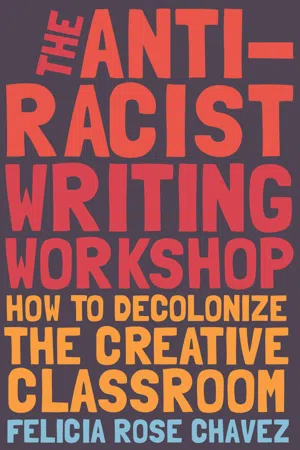
The Antiracist Writing Workshop is a call to create healthy, sustainable, and empowering artistic communities for a new millennium of writers. Inspired by June Jordan 's 1995 Poetry for the People, here is a blueprint for a 21st-century workshop model that protects and platforms writers of color. Instead of earmarking dusty anthologies, imagine workshop participants Skyping with contemporary writers of difference. Instead of tolerating bigoted criticism, imagine workshop participants moderating their own feedback sessions. Instead of yielding to the red-penned judgement of instructors, imagine workshop participants citing their own text in dialogue. The Antiracist Writing Workshop is essential reading for anyone looking to revolutionize the old workshop model into an enlightened, democratic counterculture.
eBook - ePub
The Anti-Racist Writing Workshop
How To Decolonize the Creative Classroom
- English
- ePUB (mobile friendly)
- Available on iOS & Android
eBook - ePub
About this book
Information
Topic
EducationSubtopic
Multicultural EducationCHAPTER ONE
Preparing for Change
First Impressions Matter
When I think of first impressions, I think of Qumbya Housing Cooperative. Kumbya, like the spiritual, only colonizer cute, with a Q. I was nineteen years old, the sort of age when you move to Chicago having never visited, when you apply for a room in a University of Chicago–affiliated co-op despite not being a student. I packed art supplies, an air mattress, and a few dresses into an oversized thrift-store suitcase and made my way from Albuquerque, New Mexico, to Chicago’s South Side.
It was the smell that hit me first. I’d later come to identify it as the adventurous approximation of ethnic vegetarian fare, but at the time, the door to Qumbya’s three-story brownstone swung open and I inhaled a balmy waft of displacement, that instantaneous understanding that this place was not for people of color. Fifteen white housemates greeted me by the front staircase, their hands hennaed, their hair dreaded, their liberal hubris unchecked. “An Indian princess is among us,” announced one of the young men. When I didn’t smile, he snapped, “What!? I was being nice.” Then he abandoned English altogether, indicating my second-floor bedroom with a prolonged meow.
I didn’t have the money to move out, and so I spent my first Chicago year in Qumbya’s periphery, slipping in and out of communal spaces overly crowded with caricature: kimonos on Halloween, sombreros on Cinco de Mayo. They had a nickname for me—The Liar—because a detail in my co-op application essay didn’t compute, how the desert mountains can be both sun-soaked and snowy. The house culture was calculating, disciplined, with laminated signage on proper sponge use and math problems penned on toilet paper. I didn’t add up, and so: The Liar. At the time I laughed, arguing, “No, you’ve got it all wrong,” but who was I kidding? I wasn’t even vegetarian.
To avoid house meetings, I’d go to the gym around the corner and sit in the sauna, fully clothed in my coat and boots, until someone complained, or else I’d hang out in the Boston Market across the street, famished for meat. At home, I’d do the minimum expected of me, with the exception of cleaning the second-floor bathroom, which was spotless, everyone said so, egging my anxiety about playing the stereotypical Mexican maid.
I lived in the co-op for a year, taking two buses and two trains from my white household through my Black neighborhood to a Puerto Rican high school, where I taught after-school writing workshops. When my lease was up, the house manager pulled me aside and said, “Listen, I’m sorry, but if you’re looking for a letter of rec for another co-op, I can’t write it. You were a really bad member.”
I summon this memory when a student of color fails an assignment, when a student of color drops a class, when a student of color withdraws from school because they were “bad.” Not ostracized, demoralized, exasperated, lonely, or depressed. Just “bad.”
Back then, I was indignant, both at the prospect of living in a second co-op—Oh hell no!—as well as the house manager’s assumption that I’d ever been a member of the first. I was The Indian Princess, The Liar, The Maid. I was me as seen through their eyes. Membership necessitates mutual participation, but there wasn’t vacancy in Qumbya’s Cooperative for my authentic self.
“But how did you know,” white allies have asked, “that you didn’t belong? Was it something someone said, or did?” In other words, wasn’t my intuition that “place x is not for people of color” just a prejudicial snap judgement?
The truth is, people of color have been doing this our whole lives, surviving by intuition, navigating spaces safe and unsafe. We knock at a door. The door opens, if we’re lucky. And just as quickly, it closes, not because of bruised egos, but because the collective infrastructure is not built to accommodate our bodies, histories, experiences, and opinions. Sometimes the infrastructure reinforces hostility and violence, sometimes it’s stares and silence, sometimes it’s “colorblind” meritocracy. Other times, like at Qumbya, it’s cultural appropriation, free of accountability. White colonialism takes up all the air, so much so that we’re forced to step outside to breathe. It doesn’t matter if we play-act at home, as many of us do. The fact still remains, we’re outside looking in.
Like when teenagers Kanewakeron Thomas Gray and Skanahwati Lloyd Gray tour their dream college of Colorado State University, and campus police sequester and harass them because a white parent felt “they don’t belong.”1
Like when Smith undergraduate Oumou Kanoute eats lunch on break from her on-campus job, and a white staff member summons campus police because the girl “seem[ed] to be out of place.”2
Like when Yale graduate student Lolade Siyonbola falls asleep in her dorm’s common room while working on an essay, and a white student calls campus police to “verify you belong here.”3
Like when University of Massachusetts–Amherst staff member Reginald Andrade arrives at his office, and campus police search his gym bag, interrogating him about his whereabouts after an anonymous claim that an “agitated African-American” was on the premises.4
Like when Emory University professor George Yancy publishes an op-ed about his research on race in the New York Times, and receives hundreds of hate messages from white readers calling him “another uppity Nigger.”5
Membership necessitates mutual participation. How can we possibly achieve membership when our presence—the feat of occupying space in brown skin—is deemed illegitimate? We’re non-people, exploited for our optics, meant to be seen and not heard. The infrastructure cannot, will not, contain us.
The writing classroom is no exception. English classes, in particular, position people of color as “Other” in order to satisfy a meticulously curated white supremacist agenda: a “classical” education. Kiese Laymon wrestles with the magnitude of racial bias in his early education in Heavy: An American Memoir:
… even before I actually met white folk, I met every protagonist, antagonist, and writer of all the stories I ever read in first, second, third, fourth, fifth, sixth, seventh, and eighth grade. At the same time, I met Wonder Woman, the narrator on the The Wonder Years, Ricky from Silver Spoons, Booger from Revenge of the Nerds, Spock from Star Trek, Mallory from Family Ties, damn near all the coaches and owners of my favorite teams … I met all the Jetsons, all the Flintstones, all the Beverly Hillbillies, the entire Full House, damn near everyone in Pee Wee’s Playhouse, all American Presidents, the dudes they said were Jesus and Adam, the women they said were the Virgin Mary and Eve, and all the characters on Grandmama’s stories … That meant we knew white folk. That meant white folk did not know us.6
This is what systematic institutional and cultural racism looks like. By the time people of color hit high school, we’re experts on the intricacies of real and imagined whiteness. And yet secondary and post-secondary English classes insist on an in-depth study of “the classics,” a learning standard that privileges white narratives and reinforces white superiority. The fact that English Departments so often house creative writing programs proves problematic, for the infrastructure inherently biases workshop curriculum.
People of color know this, which is why so many of us opt out of enrollment. One glance at a creative writing course poster featuring a bust of Shakespeare or a white hand gripping a quill tells us all we need to know about the workshop leaders’ allegiances; a Visiting Writers Series flyer featuring majority white authors illustrates an overt devaluing of writers of color; a quick skim of a workshop syllabus with a majority white reading list attests to the oppressive infrastructure in place. These details matter, communicating to participants whether or not our classrooms are safe places for people of color.
First impressions matter.
Anti-racist workshop leaders, ask yourselves, if a person of color were to knock at my workshop door, would it slam shut in their face?
This chapter examines the implicit values embedded in our workshop course descriptions and syllabi, with the end goal of recruiting writers of color. A targeted redrafting of our core principles—principles we often fail to see—coupled with the active recruitment of people of color, can result in a multicultural writing collective, one that appeals to writers and non-writers alike. Because whether or not participants identify as creative, their experiences are crucial to our collective narrative.
A Safe Space for Creative Concentration
When people of color receive an invitation to write, to exercise voice in public space, naturally we’re wary. Our lives are an exercise in repression—the everyday denial of voice—so as to safeguard our bodies. By not speaking out, we reassure white people that we are inoffensive, nondisruptive, not at all how they see us, be it consciously or subconsciously; that is, as imbeciles, criminals, clowns, or whores. And we deny ourselves voice in order to avoid losing our shit. Because once we open our mouths, who knows what’ll come out, and when it’ll stop. Our welfare depends on a cultural imperative of silence.
That’s why I just come out and say it: “Take my class! I teach an anti-racist writing workshop.”
I e-mail this message to student-led organizations and influential faculty members that support people of color, first-generation college students, feminists, activists, and queer and questioning students. The title of my e-mail? “A Safe Space for Creative Concentration.” I define “safe” as a student’s right to retain their own authority, integrity, and personal artistic preferences throughout the creative writing process without fear of free-reining bigotry.
In the message, I share the story of my past frustrations in workshop, and then counter that narrative with my own approach. Mainly, that I believe that writing is a political act, and in order to honor that offering, we must consciously work against traditions of dominance and control in the creative writing classroom, curating safe spaces for participants to explore race, class, gender, and sexual orientation. Don’t worry about being creative, I plead. It’s not about that. It’s about sharing our stories. We must be heard.
The first time I sent this e-mail, I was nervous as hell. I imagined the collective eye roll of my white colleagues: An anti-racist writing workshop? What does that even mean? It didn’t help that I was new to campus. I couldn’t rely on reputation to substantiate me. I felt vulnerable, wary of the backlash I might encounter.
But then I got that first response from a student, a quick-fire e-mail in all caps: “YES! I’M IN!” I didn’t know this person, had never worked with him before, yet he understood without me even having to explain. At that moment I knew that I was on to something.
I wasn’t crazy. It wasn’t just me.
People of color need a collaborative artistic community to which they belong and feel safe; they need it, but they don’t always know how to ask for it and are often unaware that alternatives exist. It’s our responsibility as workshop leaders to verbalize our anti-racist agenda for them, in clear, unapologetic language, language that opens doors instead of closes them. We must reach out to people of color, openly differentiate our approach to the writing workshop, and then welcome them into our collective.
As opposed to the norm—recruiting, exploiting, and then wholly disregarding a few token writers of color in an otherwise all white workshop—the anti-racist approach demands that we dismantle the traditional infrastructure first, and then go about recruitment second.
To recruit writers of color, we’ve got to be about it.
Being about it isn’t easy, because we’re forced to articulate our writing workshop principles independent of the old infrastructure. Suddenly the way it’s always been done feels like a crutch; without it, we might stumble. That crutch is the “monument of white ideology” of which Claudia Rankine writes in her essay, “In Our Way: Racism in Creative Writing”:
To maintain our many writing departments with their majority white faculty has, we often forget, taken conscious work, choice, and insistence. The perpetuation of white orientation, wh...
Table of contents
- COVER
- COPYRIGHT
- CONTENTS
- PREFACE
- INTRODUCTION Decolonizing the Creative Classroom
- CHAPTER ONE Preparing for Change
- CHAPTER TWO Fostering Engagement, Mindfulness, and Generosity
- CHAPTER THREE Instituting Reading and Writing Rituals
- CHAPTER FOUR Completing the Canon
- CHAPTER FIVE Owning the Language of Craft
- CHAPTER SIX Teaching Writers to Workshop
- CHAPTER SEVEN Conferencing as Critique
- CHAPTER EIGHT Promoting Camaraderie and Collective Power
- APPENDIX ONE Platforming Writers of Color: A Twenty-First-Century Reference Guide
- APPENDIX TWO Sample Lesson Plans
- ACKNOWLEDGMENTS
- ENDNOTES
- BACK COVER
Trusted by 375,005 students
Access to over 1.5 million titles for a fair monthly price.
Study more efficiently using our study tools.
Frequently asked questions
Yes, you can cancel anytime from the Subscription tab in your account settings on the Perlego website. Your subscription will stay active until the end of your current billing period. Learn how to cancel your subscription
No, books cannot be downloaded as external files, such as PDFs, for use outside of Perlego. However, you can download books within the Perlego app for offline reading on mobile or tablet. Learn how to download books offline
Perlego offers two plans: Essential and Complete
- Essential is ideal for learners and professionals who enjoy exploring a wide range of subjects. Access the Essential Library with 800,000+ trusted titles and best-sellers across business, personal growth, and the humanities. Includes unlimited reading time and Standard Read Aloud voice.
- Complete: Perfect for advanced learners and researchers needing full, unrestricted access. Unlock 1.5M+ books across hundreds of subjects, including academic and specialized titles. The Complete Plan also includes advanced features like Premium Read Aloud and Research Assistant.
We are an online textbook subscription service, where you can get access to an entire online library for less than the price of a single book per month. With over 1.5 million books across 990+ topics, we’ve got you covered! Learn about our mission
Look out for the read-aloud symbol on your next book to see if you can listen to it. The read-aloud tool reads text aloud for you, highlighting the text as it is being read. You can pause it, speed it up and slow it down. Learn more about Read Aloud
Yes! You can use the Perlego app on both iOS and Android devices to read anytime, anywhere — even offline. Perfect for commutes or when you’re on the go.
Please note we cannot support devices running on iOS 13 and Android 7 or earlier. Learn more about using the app
Please note we cannot support devices running on iOS 13 and Android 7 or earlier. Learn more about using the app
Yes, you can access The Anti-Racist Writing Workshop by Felicia Rose Chavez in PDF and/or ePUB format, as well as other popular books in Education & Multicultural Education. We have over 1.5 million books available in our catalogue for you to explore.