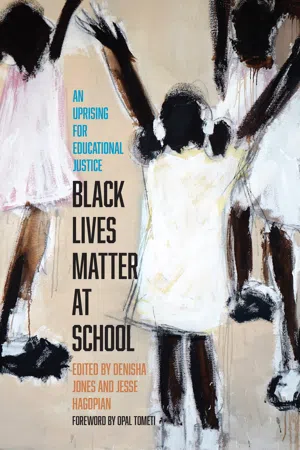
After a powerful webinar that included educators from ten cities explaining the many incredible actions they took in support of the national Black Lives Matter at School week of action, Denisha Jones, contacted Jesse Hagopian to propose that they collect these stories in a book. Black Lives Matter at School sucinctly generalizes lessons from successful challenges to institutional racism that have been won through the BLM at School movement. This is a book that can inspire many hundreds or thousands of more educators to join the BLM at School movement.
- English
- ePUB (mobile friendly)
- Available on iOS & Android
eBook - ePub
Black Lives Matter at School
About this book
Trusted by 375,005 students
Access to over 1.5 million titles for a fair monthly price.
Study more efficiently using our study tools.
Information
Subtopic
Political EconomyInequity and COVID-19
By Jesse Hagopian
The global COVID-19 pandemic has devastated Black communities and had a dramatic impact on public education. As of May 2020, Black people are dying of COVID-19 at three times the rate of white people. As the Guardian reported in May 2020:
Across the country, African Americans have died at a rate of 50.3 per 100,000 people, compared with 20.7 for whites, 22.9 for Latinos and 22.7 for Asian Americans. More than 20,000 African Americans—about one in 2,000 of the entire black population in the US—have died from the disease. At the level of individual states, the statistics are all the more shocking. Bottom of the league table in terms of racial disparities is Kansas, where black residents are dying at seven times the rate of whites.1
These disparities are the result of the many manifestations of institutional racism. There is growing evidence that Black people are disadvantaged in terms of access to diagnostic testing and treatment for the disease.2 Black people are more likely to have preexisting health conditions. As Dr. Rashawn Ray wrote in April 2020 for the Brookings Institution:
Blacks, relative to Whites, are more likely to live in neighborhoods with a lack of healthy food options, green spaces, recreational facilities, lighting, and safety. These subpar neighborhoods are rooted in the historical legacy of redlining. Additionally, Blacks are more likely to live in densely populated areas, further heightening their potential contact with other people. They represent about one-quarter of all public transit users. Blacks are also less likely to have equitable healthcare access—meaning hospitals are farther away and pharmacies are subpar, leading to more days waiting for urgent prescriptions. So, health problems in the Black community manifest not because Blacks do not take care of themselves but because healthcare resources are criminally inadequate in their neighborhoods.3
Additionally, Black people are more likely to be employed in workplaces deemed essential during the COVID-19 pandemic. For example, Black people represent nearly 30 percent of bus drivers and nearly 20 percent of all food service workers, janitors, cashiers, and stockers.4
As I write these words, COVID-19 is becoming a defining crisis that will create new challenges for the Black Lives Matter at School movement. With nearly all the public schools in the United States closed at the time of this writing, our movement will have to find ways to organize remotely. It is quite possible that schools will still be shut down during the first week of February 2021, and we will have to find ways to organize a remote week of action.
One of the primary challenges the Black Lives Matter at School movement now faces is organizing a struggle to ensure that Black students’ physical, social, and emotional needs are prioritized by the school system during the time they are out of school.
COVID-19 has exposed the crucial role that schools play in the lives of low-income, disproportionately BIPOC families and communities. Schools often provide two meals, special education servi...
Table of contents
- Cover
- Copyright
- Contents
- Foreword by Opal Tometi
- Introduction
- The Start of a Movement
- Securing Union Support: Successes and Struggles
- Educators Doing the Work
- Voices of Students
- Epilogue
- Back Cover
Frequently asked questions
Yes, you can cancel anytime from the Subscription tab in your account settings on the Perlego website. Your subscription will stay active until the end of your current billing period. Learn how to cancel your subscription
No, books cannot be downloaded as external files, such as PDFs, for use outside of Perlego. However, you can download books within the Perlego app for offline reading on mobile or tablet. Learn how to download books offline
Perlego offers two plans: Essential and Complete
- Essential is ideal for learners and professionals who enjoy exploring a wide range of subjects. Access the Essential Library with 800,000+ trusted titles and best-sellers across business, personal growth, and the humanities. Includes unlimited reading time and Standard Read Aloud voice.
- Complete: Perfect for advanced learners and researchers needing full, unrestricted access. Unlock 1.5M+ books across hundreds of subjects, including academic and specialized titles. The Complete Plan also includes advanced features like Premium Read Aloud and Research Assistant.
We are an online textbook subscription service, where you can get access to an entire online library for less than the price of a single book per month. With over 1.5 million books across 990+ topics, we’ve got you covered! Learn about our mission
Look out for the read-aloud symbol on your next book to see if you can listen to it. The read-aloud tool reads text aloud for you, highlighting the text as it is being read. You can pause it, speed it up and slow it down. Learn more about Read Aloud
Yes! You can use the Perlego app on both iOS and Android devices to read anytime, anywhere — even offline. Perfect for commutes or when you’re on the go.
Please note we cannot support devices running on iOS 13 and Android 7 or earlier. Learn more about using the app
Please note we cannot support devices running on iOS 13 and Android 7 or earlier. Learn more about using the app
Yes, you can access Black Lives Matter at School by Jesse Hagopian,Denisha Jones in PDF and/or ePUB format, as well as other popular books in Politics & International Relations & Political Economy. We have over 1.5 million books available in our catalogue for you to explore.