The memoir of Gwendolyn Midlo Hall offers today's activists and readers an accessible and intimate examination of a crucial era in American radical history.
Born in 1929 New Orleans to left-wing Jewish parents, Gwendolyn Midlo Hall's life has spanned nearly a century of engagement in anti-racist, internationalist political activism. In this moving and instructive chronicle of her remarkable life, Midlo Hall recounts her experiences as an anti-racist activist, a Communist Party militant, and a scholar of slavery in the Americas, as well as the wife and collaborator of the renowned African-American author and Communist leader Harry Haywood. Telling the story of her life against the backdrop of the important political and social developments of the 20th century, Midlo Hall offers new insights about a critical period in the history of labor and civil rights movements in the United States.
Detailing everything from Midlo Hall's co-founding of the only inter-racial youth organization in the South when she was 16-years-old, to her pioneering work establishing digital slave databases, to her own struggles against cruel and pervasive sexism, Haunted by Slavery is a gripping account of a life defined by profound dedication to a cause.
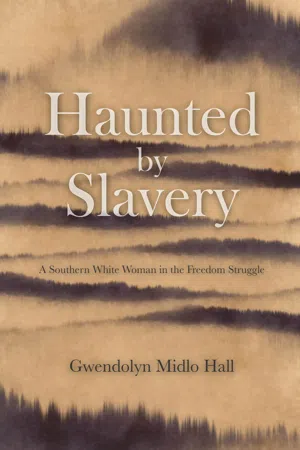
eBook - ePub
Haunted by Slavery
A Memoir of a Southern White Woman in the Freedom Struggle
- English
- ePUB (mobile friendly)
- Available on iOS & Android
eBook - ePub
About this book
Information
PART ONE
GROWING UP IN NEW ORLEANS
I was born in New Orleans on June 27, 1929, and was blessed with a calm, happy temperament. Like many other creative people from New Orleans, I am also a skeptic. We learn to be free-thinking rebels: musicians, writers, graphic artists, independent-minded scholars, political activists.
Why? Because it’s hard for us to believe in a stable world. Nature never lets us forget who is boss. Our lives revolve around tropical downpours, hurricanes, winds, floods, and sometimes even tidal waves. Heavy rains turn our streets into rivers. We never know where the land begins and the water ends. Native and migrating waterfowl embrace us with color and song. Woodpeckers hammer away at our tall longleaf pines. Spanish moss hugs our huge oak trees. Tropical gardens, lush with flowers, explode from the rich topsoil washed ashore by the mighty Mississippi River long before we “tamed” her. Now, the levee system for flood control stops the silt from building up along her banks and drops it uselessly into the Gulf of Mexico. Oil refineries and pipelines erode the shoreline, destroying our already weak protection from hurricanes and floods. Our engineering feats have greatly increased the instability of our world.
When I was growing up in New Orleans, the long, five-month summer crushed us with extreme heat and humidity. Air conditioning? Unheard of. Window fans were a new luxury, and attic fans were high tech. Only rich people had refrigerators. The rest of us were lucky if we had iceboxes. Big trucks delivered the blocks of ice, and their drivers also made snowballs of various flavors. We would hop up on the ice trucks, watch them scrape the ice, and pick out our syrup flavors.
Despite the heat, there was an active street life. Vendors walked around singing their messages: “Blackberries! Five cents a carton. Get your fresh blackberries!” Farmers rode around the streets in mule-drawn carts, selling great piles of fresh fruits and vegetables. At every major intersection, Mexicans sold delicious hot tamales out of hand-pushed wooden carts, adding their voices to the street cries: “Hot tamales! Get your hot tamales! Fresh-cooked!”
To get us to fall asleep despite the heat, my parents would drive us around the city with the car windows wide open. We stopped at Brown’s Velvet Dairy ice cream shop on Carrollton Avenue and at a watermelon stand next to it when melons were in season. After we fell asleep, my parents drove home and carried us upstairs to our beds. I still tend to fall asleep in moving vehicles.
New Orleans is a port city, and that has made our culture unique. During the nineteenth century and well into the twentieth, it was the second-biggest port in the country, thanks mainly to the maritime slave and international cotton trades. It is still an oil refining and shipping center. The port has declined, but New Orleans is still the most cosmopolitan city of the Deep South. Our culture—with its powerful Chitimacha, Choctaw, and Senegalese foundation and its tangled French, Canadian, German, Spanish, Cadjun, Haitian, Mexican, Cuban, Canary Island, Yankee, Irish, Sicilian, Jewish, Chinese, Central American, and Vietnamese roots—is a gumbo of richly blended ethnic and religious diversity. New Orleans never loses her powerful grip on her children, wherever we live. Our city is an embodiment of our diverse, creolized regional cultures—our nation’s true greatness.
My Social Democratic Yiddish Family
My father was a first-generation immigrant from a large Yiddish-speaking Jewish family from Sosnowiec in Upper Silesia, now Poland. When the family lived there, it was part of the Russian Empire under the czar. My mother was a third-generation immigrant from a family with roots in Slonim, Belarus. My family identified with Yiddish culture but was not religious. They viewed the world from the perspective of the internationalist, wandering, persecuted Jews who identified with the poor and oppressed wherever they lived.
My father was born in 1902 in Sosnowiec. As far as I know, his family members were all tailors. But the word mydlo means “soap” in Slavic languages, so the Midlos probably were soap makers at the time Jews were given the honor of having surnames, usually based on the kind of work they did. My paternal grandmother’s maiden name was Granitman, so her family probably worked in the granite quarries of Upper Silesia. Both soapmaking and quarry labor were hard, dangerous work.
Sosnowiec was no little rural shtetl like Anatevka in Fiddler on the Roof. The region of Upper Silesia is rich in coal, iron, and other important industrial minerals. By 1859, a branch line of the Warsaw–Vienna Railway stopped in Sosnowiec, making it a cosmopolitan communications and industrial hub. There was a Jewish workers’ movement in Sosnowiec, which started its first major strike in 1894.
Poor Jews like my family all worked hard but starved. All the Midlos were short, no doubt from malnutrition. My father was the fourteenth of the sixteen children of Gittel and Shapsa Midlo. Only six of them survived childhood. The family lived in cramped quarters with their sons-in-law, a few grandchildren, and apprentices who were also their boarders—and, for some of them, eventually their sons-in-law. The family kept chickens under the table. When a chicken laid an egg, it was boiled and divided into four pieces that were given to those family members lucky enough to get a piece.
As a small child, I remember how proud my father and his siblings were of their oldest brother, Joseph Wolf Midlo, who as a teenager was active in the 1905 Revolution to overthrow the Russian czar. A family story was passed down that revolutionary literature was hidden in my father’s diapers and crib. He was born with rickets, a condition caused by vitamin D deficiency: a mark of starvation among the Eastern European Jewish working class. He couldn’t walk until he was four years old. His mother gave up on him. She saved the little food they had for her other children, who had a better chance of surviving. His sister, my aunt Mena, told me she saved him by sneaking him some of her food. He limped badly all his life, could hardly walk without a cane, and was likely in constant agony. Although he never complained, he sometimes had fits of rage, no doubt from his pain.
By 1907, the anti-czarist revolution had been crushed, and intense oppression roiled the entire empire. The whole Midlo family moved to Offenbach, Germany, near Frankfurt, where there was a large, influential Jewish community, including wealthy Jews like the Rothschilds. My father went to elementary school and became literate in German. His older brother, my uncle Charles, fared even better. Although still a young child, Charles showed great aptitude for medicine. When the Midlos were about to emigrate to America in 1913, his teacher begged them to leave Charles behind, promising to provide for him, educate him, and treat him like his brother. The family refused, which probably saved his life.
Uncle Charles went to Johns Hopkins Medical School, where he did cutting-edge research on inherited body markings such as fingerprints. In 1943, he coauthored the book Finger Prints, Palms and Soles, which is still a standard work in the field. He taught neuroanatomy at both Louisiana State University and Tulane Medical School. Aspiring Jewish doctors, excluded from medical schools in the Northeast by the Jewish quotas enforced at the time, enrolled at the southern schools. Charles was a devoted and inspiring professor who taught some of the most renowned physicians to emerge after World War II. When I consulted a physician anywhere in the United States, I was often asked in awe if I was related to Dr. Charles Midlo. When my first book was published by his alma mater, Johns Hopkins University Press, Uncle Charles asked me to use my maiden name, Midlo. I have used it ever since.
The Midlos’ life in Offenbach came to an end in 1913, when World War I was about to begin and the German government started checking immigration papers. The family had none, of course. This bad luck saved the entire family from the Holocaust. The Midlos were among the more than two million Yiddish-speaking Ashkenazi Jews who emigrated to the United States before 1924, when a new immigration law tightened the quotas for Eastern European Jews. The entire family left for America in December 1913, in three separate steamship voyages on the Hamburg America Line. Almost all Ashkenazi Jews landed at Ellis Island, and most remained in the New York metropolitan area. Some moved to the industrial Midwest. In Chicago, they created a large and influential Jewish working-class trade union enclave where my mother, Ethel Samuelson (née Glassovitzki), was born.
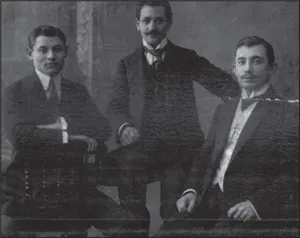
Meyer Mendelvitz, Joseph Midlo, and Reuben Gaethe, circa 1910
The Midlos did not believe that the United States was the promised land. Joseph Wolf Midlo and his son-in-law Reuben Gaethe had already gone to New York City in 1910 to pave the way for the rest of the family, and when they returned, they reported that life in the New York garment district was so awful that they should aim to move elsewhere. As a result, the Midlos were among the few Yiddish-speaking Jews who landed and lived in the Deep South, where they were forced to respond to its virulent anti-Black Jim Crow apartheid.
The Midlos arrived in New Orleans in January 1914—just in time to avoid the outbreak of World War I in Europe, but not a good time for Jews in the Deep South. In Atlanta, the Jewish businessman Leo Frank had just been wrongfully convicted of the murder of a thirteen-year-old girl and was sentenced to death by hanging. Frank spent two years appealing his case from prison. After his death sentence was commuted by the governor, a mob instigated by some of Georgia’s leading politicians and jurists led an invasion of the state prison in 1915. These prestigious gentlemen and other members of the community kidnapped Frank from prison and lynched him. About half the Jews living in Georgia moved out.
The Midlos likely lost their enthusiasm for the Deep South because of the Leo Frank lynching. They moved to Chicago, where for several years the entire family—men, women, and children—worked in the miserable conditions of the Chicago garment district for five dollars a week. But during the early 1920s they returned to New Orleans and opened Universal Tailors in the 500 block of South Rampart Street.
The Midlo family identified with the Yiddish community and belonged to Chevra Tilum Synagogue on Lafayette Street, but they were not observant Jews. My father never made a bar mitzvah. He wore a yarmulke and a prayer shawl when he went to synagogue, but I have no memory of his praying at home. We only attended services on the high holidays, mainly to show off our new clothes. Nobody in my family kept kosher. We all loved New Orleans’ spicy seafood: boiled, stuffed, and soft-shell crabs; shrimp; oysters; seafood po’boys.
My relationship with the Jewish community has been strained all my life because I have never been a Zionist. I am clearly not a conformist, and my distrust of groupthink and all institutions, especially religious ones, is profound. I went to one Zionist meeting at Tulane University when the state of Israel was born. All I heard there was contempt for the Palestinians. That was the last Zionist meeting I ever attended. But I always identified myself as a Jew, and my sense of Jewish identity, like Albert Einstein’s, increased with the Holocaust. Above all else, I am an internationalist, which is rooted in fellow feeling with the persecuted and oppressed—something that hypernationalist, xenophobic Zionism can never destroy.
I only recently learned that my profound attachment to socialist internationalism stems from the Jewish Labor Bund of Poland’s influence on my father and his family. When I was a child, I heard my aunt Mena speak reverently of “the Bund.” Nobody told me what it was, and I didn’t ask. In fact, the General Jewish Labor Bund, founded in Vilnius, Lithuania, in 1897, campaigned for a “socialist revolution that would link the struggles of Russian Jews with the general struggles of workers throughout Russia,” according to the YIVO Institute for Jewish Research.1 Its outlook was internationalist, socialist, secular (in fact, anti-religious), and anti-Zionist. It defended Jewish cultural autonomy, with Yiddish as the national language. The Bund played a prominent role in the 1905 and 1917 revolutions to overthrow the czar. The new Soviet government outlawed all forms of discrimination against Jews and made antisemitism a crime.
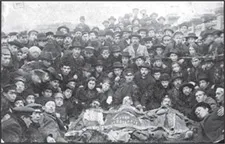
Jewish Labor Bund Self-Defense Group with three dead members in Odessa, 1905
In Poland before World War II, the Bund organized much of the Jewish community, teaching and practicing socialist ideals, not individualistic capitalist greed. Before the Holocaust, Jews were 10 percent of Poland’s population and one-third of the population of Warsaw. They voted as a bloc, sometimes with the Polish Socialists. The Bund’s well-organized communities maintained kitchens that provided food to those in need, health centers, women’s groups, youth groups emphasizing sports, and armed self-defense units that fought czarist pogroms but rejected political terror. While the Zionists supported immigration to Palestine, the Bund encouraged its members to stay where they lived in Central and Eastern Europe, maintain Jewish strength and voting power, and fight for their rights and equality.
The Bund was the first to organize the Warsaw ghetto population to fight the Nazi extermination squads. It published underground newspapers, created widespread community organizations to smuggle food and other goods from outside the ghetto walls, and organized dis...
Table of contents
- Cover
- Copyright
- Contents
- Preface
- Part One: Growing Up in New Orleans
- Part Two: A Revolutionary in the Deep South
- Part Three: Black Reds, Revolutionary Nationalists, and Black Power
- Part Four: A Public Intellectual in the Black Freedom Struggle
- Part Five: Making a Better World with Creative History
- Notes
- Index
- Back Cover
Trusted by 375,005 students
Access to over 1.5 million titles for a fair monthly price.
Study more efficiently using our study tools.
Frequently asked questions
Yes, you can cancel anytime from the Subscription tab in your account settings on the Perlego website. Your subscription will stay active until the end of your current billing period. Learn how to cancel your subscription
No, books cannot be downloaded as external files, such as PDFs, for use outside of Perlego. However, you can download books within the Perlego app for offline reading on mobile or tablet. Learn how to download books offline
Perlego offers two plans: Essential and Complete
- Essential is ideal for learners and professionals who enjoy exploring a wide range of subjects. Access the Essential Library with 800,000+ trusted titles and best-sellers across business, personal growth, and the humanities. Includes unlimited reading time and Standard Read Aloud voice.
- Complete: Perfect for advanced learners and researchers needing full, unrestricted access. Unlock 1.5M+ books across hundreds of subjects, including academic and specialized titles. The Complete Plan also includes advanced features like Premium Read Aloud and Research Assistant.
We are an online textbook subscription service, where you can get access to an entire online library for less than the price of a single book per month. With over 1.5 million books across 990+ topics, we’ve got you covered! Learn about our mission
Look out for the read-aloud symbol on your next book to see if you can listen to it. The read-aloud tool reads text aloud for you, highlighting the text as it is being read. You can pause it, speed it up and slow it down. Learn more about Read Aloud
Yes! You can use the Perlego app on both iOS and Android devices to read anytime, anywhere — even offline. Perfect for commutes or when you’re on the go.
Please note we cannot support devices running on iOS 13 and Android 7 or earlier. Learn more about using the app
Please note we cannot support devices running on iOS 13 and Android 7 or earlier. Learn more about using the app
Yes, you can access Haunted by Slavery by Gwendolyn Midlo Hall in PDF and/or ePUB format, as well as other popular books in Politics & International Relations & African American History. We have over 1.5 million books available in our catalogue for you to explore.