eBook - ePub
Available until 23 Dec |Learn more
The Ordained Women Deacons
of the Church's First Millennium
This book is available to read until 23rd December, 2025
- 262 pages
- English
- ePUB (mobile friendly)
- Available on iOS & Android
eBook - ePub
Available until 23 Dec |Learn more
About this book
A new, enlarged edition of the groundbreaking 'No Women in Holy Orders?', gathering historical evidence to show that women were ordained as deacons in the first ten centuries of the Church, and identifiying over 120 known female deacons.
Frequently asked questions
Yes, you can cancel anytime from the Subscription tab in your account settings on the Perlego website. Your subscription will stay active until the end of your current billing period. Learn how to cancel your subscription.
No, books cannot be downloaded as external files, such as PDFs, for use outside of Perlego. However, you can download books within the Perlego app for offline reading on mobile or tablet. Learn more here.
Perlego offers two plans: Essential and Complete
- Essential is ideal for learners and professionals who enjoy exploring a wide range of subjects. Access the Essential Library with 800,000+ trusted titles and best-sellers across business, personal growth, and the humanities. Includes unlimited reading time and Standard Read Aloud voice.
- Complete: Perfect for advanced learners and researchers needing full, unrestricted access. Unlock 1.4M+ books across hundreds of subjects, including academic and specialized titles. The Complete Plan also includes advanced features like Premium Read Aloud and Research Assistant.
We are an online textbook subscription service, where you can get access to an entire online library for less than the price of a single book per month. With over 1 million books across 1000+ topics, we’ve got you covered! Learn more here.
Look out for the read-aloud symbol on your next book to see if you can listen to it. The read-aloud tool reads text aloud for you, highlighting the text as it is being read. You can pause it, speed it up and slow it down. Learn more here.
Yes! You can use the Perlego app on both iOS or Android devices to read anytime, anywhere — even offline. Perfect for commutes or when you’re on the go.
Please note we cannot support devices running on iOS 13 and Android 7 or earlier. Learn more about using the app.
Please note we cannot support devices running on iOS 13 and Android 7 or earlier. Learn more about using the app.
Yes, you can access The Ordained Women Deacons by John Wijngaards in PDF and/or ePUB format, as well as other popular books in Theology & Religion & Christianity. We have over one million books available in our catalogue for you to explore.
Information
1. Enigma at Constantinople
In the classrooms and discussion chambers of theologians and church historians alike a battle has raged for over half a century. It has escaped the attention of most Catholics. And yet, the outcome of this clash has serious consequences for the continuing health of the Catholic Church. The debate concerns women deacons during the first millennium. Were they real deacons, or were they not? I call it the Olympias enigma. This book is a report on the state of the discussion. Bear with me as I sketch the historical background and outline the views of the two opposing camps.
Imagine the vestibule of Hagia Sophia, the cathedral of Constantinople, at 9.00 a.m. on a normal Sunday morning in the year AD 400.1 High and low enter through the gate, officials of the imperial court with their retinue, wealthy businessmen and their wives, skilled workers and slaves with their families. They wash their hands in the basin at the centre of the vestibule. They have to be pure, for they will take part in the ‘divine liturgy’ and receive holy communion. Now they are received by deacons, the men by male deacons, the women by women deacons.
The senior woman deacon, Olympias, comes forward to greet Anastasia, who is accompanied by her twenty-year-old daughter. Olympias leads them to the women’s section in the central nave. Catechumens are taken to a special enclosure at the back of the church, for they will be asked to leave the assembly when the sermon and the offertory prayer have been concluded. If Olympias meets a woman she does not know, she welcomes her, but not without diplomatically checking on her credentials: ‘What is your name? Where are you from? Are you a Christian? Have you been baptized?’ At this time Olympias will also hear from relatives about any woman who may be sick and who needs to be visited at home. Perhaps she will make arrangements for the final rites to be administered to the sick person at home, at the end of the liturgy some two hours later. If a priest cannot go, she will take the blessed sacrament herself and perform the anointing of the sick.
The main task of a woman deacon like Olympias was the pastoral care of women. The deacon built up a personal relationship with every woman entrusted to her responsibility. She would instruct her before baptism, often in her own home. During the baptismal ceremony she would undress her and anoint her with the sacred oil of catechumens all over her body. It was she who would immerse her three times in the water of the baptismal font, and rub her body dry. She would continue to guide her through various stages of Christian life, provide material help when needed and nursing when she fell ill. The woman deacon became as intimate a friend as a good neighbour, a social worker, a nurse, a spiritual counsellor all rolled in one.
The Church acknowledged this crucial role of women in the ministry. Bishop, male deacon and woman deacon should work together as the Blessed Trinity, with the woman deacon fulfilling the healing, soothing, steering and mediating task of the Spirit:
Let the bishop preside over you as one honoured with the authority of God, which he is to exercise over the clergy, and by which he is to govern all the people.
But let the deacon minister to him, as Christ does to his Father; and let him serve him unblameably in all things, as Christ does nothing of himself, but does always those things that please his Father.
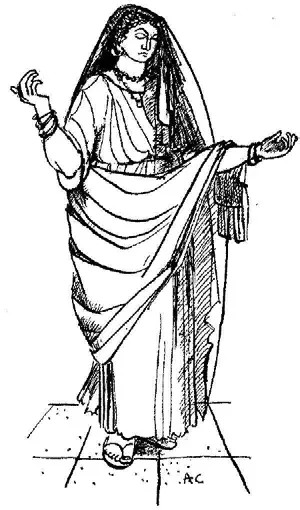
Let also the woman deacon be honoured by you in the place of the Holy Spirit. Let her not do or say anything without the male deacon; as neither does the Comforter say or do anything of himself, but gives glory to Christ by waiting for his pleasure. And as we cannot believe in Christ without the teaching of the Spirit, so let not any woman address herself to the male deacon or bishop without the woman deacon (Apostolic Constitutions II, 26, AD 380).
The Olympias we are talking about in this sketch is St Olympias. The patriarch of Constantinople at the time was St John Chrysostom. The patriarch used to consult her on important ecclesiastical business. At her request he ordained Elisanthia, Martyria and Palladia as ‘deacons of the holy church’.2 When John was exiled by emperor Arcadius in 403, he took leave of her in the baptistry of the cathedral. He wrote many letters to her from exile, many of which were addressed: ‘To my lady, the most reverend and divinely favoured deacon (διακονος) Olympias.’3
Women like St Olympias served in the Greek-Byzantine churches for at least six centuries (200–800). From the ninth century onwards the diaconate of women declined in the East, for a combination of reasons which I will discuss later. In the West it never really caught on. As a result, the memory of it was largely lost, except in vague references. Medieval theologians such as Bonaventure, Richard of Middleton, Durand of St Pourçain, John Duns Scotus and Thomas Aquinas described it as a mere blessing given to nuns, to authorize them to read out the Gospel in their convents. It was with some surprise, therefore, that in 1695 Jean Morin of Antwerp, while researching Greek liturgical manuscripts, stumbled on ancient ordination rites of women deacons. He noted that they were amazingly similar to the ordination of male deacons. But it was only in the beginning of the twentieth century that scholars seriously re-examined his discovery.
The liturgist Adolf Kalsbach (Germany 1924, 1956) drew attention to the issue. His colleague Cipriano Vagaggini (Italy 1974) expressed it to be his considered opinion that the women deacons of the Greek-Byzantine era had received a full sacramental ordination. Roger Gryson (Belgium 1972), a church historian, concurred, reporting also that women deacons had been treated as clergy in major orders. Meanwhile the Orthodox theologian Evangelos Theodorou (Greece 1954) had independently arrived at a similar conclusion. Since then an avalanche of scholarship in the East and the West has come to support these findings. But not everyone has fallen into line.
Academic objections
Nicolae Chitescu (Bulgaria 1964) and Aimé-Georges Martimort (Rome 1982) strongly contested the emerging re-appraisal. They were backed by like-minded theologians. At face value these scholars are making a good case for their position, which I will attempt to summarize here.
Though women deacons were ordained in some kind of manner, they say, it was certainly not to receive a major holy order. This can be seen from significant differences in the ordination rite. While male deacons were dedicated to service at the altar, women were barred from any form of sacramental ministry. Male deacons assisted the bishop and priests throughout the eucharist. They read the Gospel, intoned litanies of intercession, prepared the bread and wine for the sacred vessels, and distributed holy communion. None of these actions was permitted to a woman deacon.
Women deacons performed subsidiary functions at baptism, they admit. But these were purely additional to, not part of, the substance of the sacrament itself. For instance, women deacons helped with anointing female catechumens, but it was the bishop or priest himself who imposed the sacramental anointing on the forehead, who immersed the catechumens and who spoke the trinitarian formula: ‘I baptize you in the name of the Father, the Son and the Holy Spirit.’ What women deacons did, any woman could do in the case of need. For this no specific ordination was actually required.
The so-called ‘diaconate of women’, they continue, was in fact no more than a special blessing as the medieval theologians already taught, a blessing that imparted a spiritual status. It amounted to nothing else than an honorary title, a dignity bestowed on upper-class ladies who had made generous donations to the church or who merited recognition as superiors of religious communities. All these titles fit Olympias to perfection, they say. She hailed from a patrician family, supported the local church financially and was prioress of a convent of nuns.
And this is not all. If we look at the wider picture, they say, it is obvious that these women did not receive a sacramental order. For all major orders are part of the one sacrament: the eucharistic priesthood. The same patristic sources that attest to the existence of women deacons, emphatically state that women could never be priests. For Jesus Christ chose only men for this ministry and the Church has always honoured this tradition. The Church has consistently excluded women from teaching or from any position of authority in spiritual matters. The deeper ground for all this, they contend, lies in God’s decision to become incarnate as a man, so that only men can adequately represent the incarnate Son of God.
For all these reasons the women deacons of the past were not real deacons in today’s sense of the term, even though the title ‘deacon’ was applied to them in ancient documents. Their ordination did not confer the real diaconate, even though the rite resembled that of male deacons superficially. The ordaining bishop simply did not have the intention, nor could he have had the intention, of imparting to women the full sacramental ordination.
Why does the discussion matter?
Why should we bother about the value of the title ‘deacon’ given to women like Olympias and other women in the past? It seems the kind of thing academics quibble about, like whether a particular prehistoric heel-bone belonged to an Iguanodon, a Triceratops or a Struthiomimus. Of historical interest sure, but hardly a conundrum that will keep us awake at night. However, the comparison fails.
The real issue at stake behind this seemingly obtuse jousting by university professors is a question that rocks the Catholic Church of our time: ‘Can women be ordained priests?’ In spite of the quite legitimate distinction between diaconate and priesthood as separate ministries, the women deacons of the past are inextricably linked with a wider inquiry about holy orders themselves. For if the diaconate of women was a true diaconate, if it was one valid expression of the sacrament of holy orders, then women did in fact receive holy orders and the priesthood too is open to them.
I am aware that some theologians disagree with me. They contend that it would be perfectly possible for the Catholic Church to separate the two ministries in such a way that women could be given the sacrament of the diaconate, even though the priesthood was withheld from them. This is, for instance, the opinion of the Orthodox Bishop Kallistos Ware4 and the Catholic theologian Phyllis Zagano.5 I believe that they are mistaken for two important reasons: a historical one and a church-political one. The admission to the diaconate and the priesthood will not so easily be separated in the Catholic Church.
On 15 July 1563 the Council of Trent declared that ‘in the Catholic Church there exists a hierarchy by divine ordination instituted, consisting of bishops, priests, and deacons’. The implication is that the Council considered all three major orders, including the diaconate, as fully sacramental, without fully resolving their inner connection.6 On account of this and of th...
Table of contents
- The Ordained Women Deacons
- The Ordained Women Deacons
- Copyright information
- Contents
- Dedication
- THE ARGUMENT
- 1. Enigma at Constantinople
- 2. The evidence for women deacons
- 3. The manuscripts that preserved the rite
- 4. The rite of ordaining a woman deacon
- 5. The ritual for men and women compared
- 6. Is talk of ‘sacrament’ an anachronism?
- 7. Excluded from ‘any sacred service’?
- 8. Just a minor role at baptism?
- 9. No anointing of the sick?
- 10. Merely nuns, and not true deacons?
- 11. Only a rare and local phenomenon?
- 12. Did the bishops not intend to ordain real deacons?
- 13. Tackling the underlying assumptions
- 14. How certain are our conclusions?
- 15. Facing up to the past, for the sake of the future
- Illustrations
- THE TEXTS
- THE SEARCH GOES ON
- 1. Research on the function of deacons
- 2. Identifying women deacons by name
- 3. Rome wrapped in fog?
- Glossary
- Select bibliography