eBook - ePub
Available until 23 Dec |Learn more
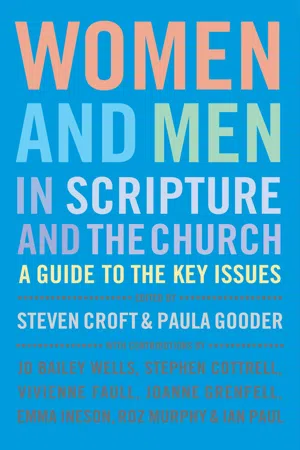
Women and Men in Scripture and the Church
A Guide to the Key Issues
This book is available to read until 23rd December, 2025
- 120 pages
- English
- ePUB (mobile friendly)
- Available on iOS & Android
eBook - ePub
Available until 23 Dec |Learn more
Women and Men in Scripture and the Church
A Guide to the Key Issues
About this book
This accessible guide will enable readers to look at what the Bible says about the roles of men and women in family life, in ministry and in society. Ideal for individual reading or group study, each chapter contains a Bible study, insights from current scholarship, an exploration of contemporary application, questions for reflections and prayers.
Frequently asked questions
Yes, you can cancel anytime from the Subscription tab in your account settings on the Perlego website. Your subscription will stay active until the end of your current billing period. Learn how to cancel your subscription.
At the moment all of our mobile-responsive ePub books are available to download via the app. Most of our PDFs are also available to download and we're working on making the final remaining ones downloadable now. Learn more here.
Perlego offers two plans: Essential and Complete
- Essential is ideal for learners and professionals who enjoy exploring a wide range of subjects. Access the Essential Library with 800,000+ trusted titles and best-sellers across business, personal growth, and the humanities. Includes unlimited reading time and Standard Read Aloud voice.
- Complete: Perfect for advanced learners and researchers needing full, unrestricted access. Unlock 1.4M+ books across hundreds of subjects, including academic and specialized titles. The Complete Plan also includes advanced features like Premium Read Aloud and Research Assistant.
We are an online textbook subscription service, where you can get access to an entire online library for less than the price of a single book per month. With over 1 million books across 1000+ topics, we’ve got you covered! Learn more here.
Look out for the read-aloud symbol on your next book to see if you can listen to it. The read-aloud tool reads text aloud for you, highlighting the text as it is being read. You can pause it, speed it up and slow it down. Learn more here.
Yes! You can use the Perlego app on both iOS or Android devices to read anytime, anywhere — even offline. Perfect for commutes or when you’re on the go.
Please note we cannot support devices running on iOS 13 and Android 7 or earlier. Learn more about using the app.
Please note we cannot support devices running on iOS 13 and Android 7 or earlier. Learn more about using the app.
Yes, you can access Women and Men in Scripture and the Church by Croft, Gooder, Steven Croft,Paula Gooder in PDF and/or ePUB format, as well as other popular books in Theology & Religion & Christianity. We have over one million books available in our catalogue for you to explore.
Information
1. Women and Men in the Creation and Fall Stories
Introduction
In the opening three chapters of the Bible we find the classic accounts of God’s creation of the world, of God’s purpose for humanity and of humanity’s wilful disobedience of God. The focus begins with God – the all-powerful Creator, the origin of all things, who delights in the work of creating (and believes in taking rest too!). Most of all, God delights in the creation of humankind, with whom there is a special relationship.
Chapter 2 of the Bible focuses on that relationship, describing the many gifts and expectations God invests in humanity. Alas, chapter 3 follows with the tale of how these are tragically marred by the fall. The special relationship is not destroyed, but it is damaged – as is the relationship of man and woman to each other.
Here we explore these relationships before and during the fall: the ‘vertical’ relationship of humanity before God, and the ‘horizontal’ relationship of ‘man’ and ‘woman’ in the figures of Adam and Eve. These named individuals fulfil a representative function, both before and after the fall. Think of them as ‘Every man’ and ‘Every woman’, irrespective of individual identity, historical circumstance or geographical location. In that sense, they helpfully frame the debate concerning the place of men and women in contemporary society.
Bible study: Genesis 1.26–31
26 Then God said, ‘Let us make humankind in our image, according to our likeness; and let them have dominion over the fish of the sea, and over the birds of the air, and over the cattle, and over all the wild animals of the earth, and over every creeping thing that creeps upon the earth.’ 27So God created humankind in his image, in the image of God he created them; male and female he created them. 28God blessed them, and God said to them, ‘Be fruitful and multiply, and fill the earth and subdue it; and have dominion over the fish of the sea and over the birds of the air and over every living thing that moves upon the earth.’ 29God said, ‘See, I have given you every plant yielding seed that is upon the face of all the earth, and every tree with seed in its fruit; you shall have them for food. 30And to every beast of the earth, and to every bird of the air, and to everything that creeps on the earth, everything that has the breath of life, I have given every green plant for food.’ And it was so. 31God saw everything that he had made, and indeed, it was very good. And there was evening and there was morning, the sixth day.
Bible study: Genesis 2.15–25
15 The Lord God took the man and put him in the garden of Eden to till it and keep it. 16And the Lord God commanded the man, ‘You may freely eat of every tree of the garden; 17but of the tree of the knowledge of good and evil you shall not eat, for in the day that you eat of it you shall die.’
18 Then the Lord God said, ‘It is not good that the man should be alone; I will make him a helper as his partner.’ 19So out of the ground the Lord God formed every animal of the field and every bird of the air, and brought them to the man to see what he would call them; and whatever the man called each living creature, that was its name. 20The man gave names to all cattle, and to the birds of the air, and to every animal of the field; but for the man there was not found a helper as his partner. 21So the Lord God caused a deep sleep to fall upon the man, and he slept; then he took one of his ribs and closed up its place with flesh. 22And the rib that the Lord God had taken from the man he made into a woman and brought her to the man. 23Then the man said, ‘This at last is bone of my bones and flesh of my flesh; this one shall be called Woman, for out of Man this one was taken.’ 24Therefore a man leaves his father and his mother and clings to his wife, and they become one flesh. 25And the man and his wife were both naked, and were not ashamed.
Reflection together
- Read the passage a second time with different voices, perhaps reading a verse each.
- Invite everyone to say aloud a word or phrase that strikes them.
- Read the passage a third time.
- Share together what this word or phrase might mean and what questions it raises.
After reading and reflecting on both passages above:
- What differences and developments concerning the creation of humanity do you notice between Genesis chapter 1 and chapter 2?
Notes on some details of the passage
These chapters are the prologue to the story of the beginnings of the people of God. In Genesis 12, Abraham, the father of faith, is called by God. It is his response to God that begins the long journey towards the formation of God’s own people. Genesis 1—11 sets up the ‘pre-story’ to Abraham’s call, a story in which time and time again people failed to live well in the world God had made.
- We are used to calling the man and woman in Genesis 2 ‘Adam and Eve’, but doing so muddies the picture somewhat. The Hebrew word ‘Adam’ is used both in Genesis 1 and Genesis 2. So in Genesis 1.26–27, where God declares his intention to make ‘humankind’ in his image, the Hebrew word there is ‘Adam’. As a result, Genesis 1.27 says that God created Adam in his image, ‘male and female he created them’. This suggests that Adam is not a specifically gendered term but a description of all human beings.
- This is supported by Genesis 2. There Adam is created but is only called a man (the Hebrew word ’is) after the creation of the woman (’issa) from the rib of Adam. Thus Adam only becomes a ‘man’ in response to the ‘woman’ brought to him by God. After Eve’s creation the man continues to be called Adam, but a new name is needed for his companion.
The name ‘Adam’ is closely related to the Hebrew word for ground or soil, ‘Adamah’; the name ‘Eve’ is also interesting. This is the name given to the woman by Adam in Genesis 3.20. The Hebrew means life. As a result, each name tells us something important about each: Adam was formed from the dust of the ground; Eve was the source of life.
Men and women in the creation narratives
Genesis 1
God’s magnificent work follows a carefully ordered progression from day to day. Each day offers increasing differentiation and sophistication, from the inanimate to the animate. The excerpt above describes the sixth day of creation – the final day of God’s work – in which ‘humankind … male and female’ is brought into being.
Think of each day of this creation account like one verse of a seven-verse hymn. Each day – each verse – builds from the one before and repeats its pattern, beginning with God’s word and ending with God’s delight. The effect is to demonstrate the elegant simplicity and the overwhelming power with which the God-of-the-whole-universe produces beauty out of chaos and meaning out of nothingness. The testimony of praise reaches its crescendo in verse 6. We conclude that the creation of humankind is the summit of God’s remarkable work and the cause of much delight. The last verse completes the picture with God resting, enjoying the fruits of six days of labour.
Note, first and foremost, how humankind is referenced and celebrated for the way in which ‘it’ (in the singular) bears the image of God. In this aspect, humankind is marked out as unique, underlining how special is the divine–human relationship. God is invested in the human condition and the human is entrusted with divine responsibility and authority. This is revolutionary! God is not remote, nor is humanity insignificant. From the outset, humankind is declared an agent of God; that is, it is given a key role in the purpose of God’s creation.
Now this role – to exercise a ministry of responsibility over God’s creation – is given to all humanity. All human persons are made in the image of God. The single entity of humanity is only subsequently described in the plural, as a community of male and female. There is no suggestion that male is created before female. Rather the opposite: ‘humankind’ is made in one single stroke – which, almost incidentally (as if to suggest ‘of course!’), includes both genders. The responsibility to lead and rule is given to both – as part of the one community called humankind – and may not legitimately be separated according to maleness or femaleness. What matters is ‘createdness’ that acknowledges the Creator and ‘humanness’ that bears the image of God.
Yet the aspect of gender is not separable from the creation of humankind. Sexual differentiation is part of the created order and purpose from the beginning. That is to say, on the one hand, it is not part of the nature of God (unlike in the mythology of some of Israel’s ancient neighbours). On the other hand, the two sexes exist from the moment humankind exists. The sexual distinction is fundamental to what it means to be human. Verse 27 (‘he created them’) is followed immediately by God blessing and commanding them to be fruitful and multiply, to fill the earth and subdue it – commands given to both parties, with no hint of hierarchy in their relative importance or differentiation in terms of role. Procreation can only be fulfilled by both parties functioning together! Equally, man and woman function together in ruling over the rest of creation, thus excluding the possibility of one gender claiming power over the other.
In conclusion, from the outset of Scripture we find Genesis 1 proclaiming the foundational equality and complementarity of the sexes.
Genesis 2
Beginning at Genesis 2.5 a rather different account of creation is given. This one does not present a cosmic liturgy focused on the grandeur of God, but an intense street-level reflection on the human condition. Whereas previously God created with a remote control – by his word – now God’s sleeves are rolled up and the gloves removed. The potter’s hands mould an ‘Adam’ out of soil and an ‘Eve’ from a rib.
At first glance it may seem that Genesis 2 is incompatible with Genesis 1. God appears to create ‘man’ before sending rain or establishing plants. God’s charge to this man relates to the soil and the plants – not to the fish, birds and animals as before. Finally, God is concerned with man’s isolation and looks for a helper – creating ‘woman’ subsequent to ‘man’, following a scan for partners among the rest of animate creation. For many the priority of man’s creation denotes a hierarchical pattern in which man is in some way superior to, or in leadership over, the helper he names ‘woman’.
God declares, ‘It is not good that the man should be alone; I will make him a helper as his partner’ (2.18). In Hebrew the term translated ‘helper’ does not suggest an assistant or subordinate, as in the English, but an ally, a benefactor, a companion. Most often in the Old Testament it is God who is described as the ‘helper’ of Israel (for example, in Exodus 18.4). This helper will be his ‘partner’ in the sense of being a counterpart or an opposite. She corresponds to him as his equal, both in being and function. In no way can this phrase be understood to imply male leadership or female submission as part of the created order.
Some have suggested that since the first woman was formed out of the man’s rib, she is derivative, existing in a dependent and subordinate status. But Adam was also derived – from the ground – without any suggestion that the ground is superior to him. Every subsequent human is derived from woman, in the sense of birth. The notion expresses integration and solidarity, not superiority and subordination. The word ‘rib’ itself carries symbolic connotations of mutuality, given that it can mean ‘side’ as well as ‘rib’.
When the man exclaims ‘she shall be called woman, for out of man this one was taken’ (2.27), there is a wordplay between ‘woman’ and ‘man’ (’issa and ’is in the Hebrew). These two words represent the masculine and feminine form of the same root, underlining the recognition of identity and similarity – as sexual counterparts – between these two beings. Prior to this the man has been referred to as Adam, which carries the more generic, old-fashioned sense of man as ‘mortal’.
Like Genesis 1, chapter 2 contains no statement that denote...
Table of contents
- Title Page
- Copyright Information
- Contents
- The Lord is Risen!
- The Authors
- Introductory Notes for Group Leaders
- The Opening Prayers
- 1. Women and Men in the Creation and Fall Stories
- 2. Humanity Redeemed in Christ
- 3. The Women of the Early Church
- 4. Women, Teaching and Authority
- 5. Women and Men in Family Life
- 6. Women and Men in Ministry Today
- The Story of the Recognition of the Ministry of Women in the Church of England
- Frequently Asked Questions
- Further Reading
- Afterword