eBook - ePub
Available until 23 Dec |Learn more
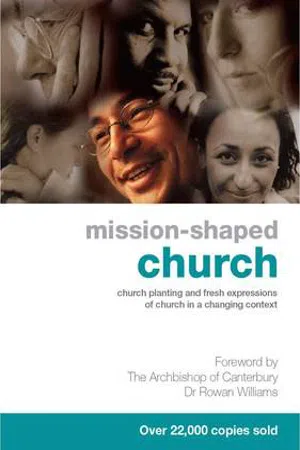
Mission-Shaped Church
Church Planting and Fresh Expressions of Church in a Changing Context
This book is available to read until 23rd December, 2025
- 192 pages
- English
- ePUB (mobile friendly)
- Available on iOS & Android
eBook - ePub
Available until 23 Dec |Learn more
Mission-Shaped Church
Church Planting and Fresh Expressions of Church in a Changing Context
About this book
An overview of recent developments in church planting. This detailed, practical and well-researched book describes the varied and exciting 'fresh expressions' of church being created. This edition includes a new foreward by the Rt Revd Graham Cray.
Frequently asked questions
Yes, you can cancel anytime from the Subscription tab in your account settings on the Perlego website. Your subscription will stay active until the end of your current billing period. Learn how to cancel your subscription.
No, books cannot be downloaded as external files, such as PDFs, for use outside of Perlego. However, you can download books within the Perlego app for offline reading on mobile or tablet. Learn more here.
Perlego offers two plans: Essential and Complete
- Essential is ideal for learners and professionals who enjoy exploring a wide range of subjects. Access the Essential Library with 800,000+ trusted titles and best-sellers across business, personal growth, and the humanities. Includes unlimited reading time and Standard Read Aloud voice.
- Complete: Perfect for advanced learners and researchers needing full, unrestricted access. Unlock 1.4M+ books across hundreds of subjects, including academic and specialized titles. The Complete Plan also includes advanced features like Premium Read Aloud and Research Assistant.
We are an online textbook subscription service, where you can get access to an entire online library for less than the price of a single book per month. With over 1 million books across 1000+ topics, we’ve got you covered! Learn more here.
Look out for the read-aloud symbol on your next book to see if you can listen to it. The read-aloud tool reads text aloud for you, highlighting the text as it is being read. You can pause it, speed it up and slow it down. Learn more here.
Yes! You can use the Perlego app on both iOS or Android devices to read anytime, anywhere — even offline. Perfect for commutes or when you’re on the go.
Please note we cannot support devices running on iOS 13 and Android 7 or earlier. Learn more about using the app.
Please note we cannot support devices running on iOS 13 and Android 7 or earlier. Learn more about using the app.
Yes, you can access Mission-Shaped Church by Graham Cray in PDF and/or ePUB format, as well as other popular books in Theology & Religion & Christianity. We have over one million books available in our catalogue for you to explore.
Information
chapter 1
changing contexts
This chapter outlines some aspects of the cultural, social and spiritual environment in which the Church of England ministers in the new millennium. It explores how we are called to be and to do church, and the benefits and disadvantages of existing Anglican expressions of church.
We face a significant moment of opportunity. Western society has undergone a massive transition in recent decades. We all live in a fast-changing world. As the Church of England aims to be a Church for everyone in the country, being truly among them as Jesus was with the people of his day (the ‘incarnational principle’), the Church needs to respond to the changes in our culture. Thus it is important for us to see what our culture now looks like, so we can see the possible shape, or shapes, of church to which God is calling us. This look at culture now will also help connect church and gospel with the variety of people across England, and identify where, under Christ’s lordship, we should live counter-culturally.
social trends in the last 30 years
Each year the Government publishes Social Trends. Social Trends brings together the conclusions from a variety of statistical surveys.1 Some headlines from the 2003 version are outlined here.
housing changes
• While the population of the UK has risen by 5 per cent since 1970,2 the number of households has increased by 31 per cent.3 There are now more households, but they are smaller in size. The average size of a household is now 2.4 people, in 1971 it was 2.9.4 This is mainly due to divorce, and delay in marrying. The implications of this for the housing market are dramatic, particularly in some parts of the country. For example, the number of owner-occupied dwellings increased by 38 per cent between 1981 and 2002.5
• People are paying more in real terms for their houses. The rise in owner occupation means that repairs and improvements are the responsibility of the occupier, rather than a landlord. This has led to the rise of DIY in the last three decades, which is often a Sunday activity.
employment changes, including the increase of women’s employment
• Most people in their middle years work outside the home. In 2002, 91.8 per cent of men aged 35 to 49 were in work, and 78.16 per cent of women in the same age group. There has been a significant increase in the number of lone parent women working outside the home. In 1992, 18 per cent of lone women with dependent children were working full-time, but in 2002 it was 23 per cent. The change for lone women with children under the age of five is most dramatic: in 1992, 21 per cent worked; in 2002, 34 per cent were working either full-or part-time.7
• The hours worked have also changed. In 2002 most men worked about 40 hours a week, and most women in full-time work worked about 38 hours a week.8 However, about 25 per cent of working men and 11 per cent of working women worked more than 50 hours a week. Fourteen per cent of those aged 35 to 49 would like to work fewer hours for less pay each week.9
• This means that many people have less ‘free time’ than in 1970. Weekends, especially Sundays, are now seen as family time. This is a big tension for Christian partners of non-Christians.
mobility
• Today people are vastly more mobile than they were even 30 years ago. Since 1971 the distance travelled each year on roads in cars or vans has almost doubled from 313 billion to 624 billion kilometres.10 The average length of trips varies significantly by household income – 15.3 km for the richest 20 per cent and 6.7 km for the poorest.11 We are all more mobile, but a number of factors – where we live, where we work and how well off we are – influence how far and how often we travel.
• These statistics are matched by the number of vehicles on the road. In 1971 there were just under 12 million vehicles on the roads; in 2001 it was just under 26.5 million.12
• Most families, apart from the poorest, have access to a car, and are ready to use it. This means that people are able to work further from home, at the expense of having a longer commuter journey. It also means that at weekends people are able to do things at a distance from where they live. In churches this can be seen in the phenomenon of ‘church shopping’. Someone who moves to an area will check out several churches, not just the nearest.
• Another aspect of mobility is the way in which some people move in connection with their jobs. Increased mobility means that people are less likely to live in the same area throughout their lifetime, and now tend to live further from their relatives than previously.13
• However, more than half of adults see their mother at least once a week,14 and 61 per cent of grandparents see their grandchildren weekly.15 Visits to relatives are most likely at weekends, due to school and work commitments in the week.
• The distance from relatives varies with social class. People in the professional social class were least likely to have a satisfactory network of relatives.16
divorce and changes in family life17
• The divorce rate has gone up significantly in the last 30 years (62,857 divorces in 1970, 154,628 in 2001).18 The proportion of separated and divorced people now stands at 10.6 per cent of the population of England and Wales.19 In 1971, 1 per cent of men and 1 per cent of women were divorced, but by 2000 it was 8 per cent men and 9 per cent women.20 Additionally, about 8 per cent of families were stepfamilies with dependent children21 – the parents no longer appeared in statistics as ‘divorced’ because they had married again. Combined with the rise of cohabitation and the birth of children to never-married mothers, in 2001 the Census showed that 22 per cent of children in England and Wales live in lone-parent families, usually looked after by their mother. More than 1 in 10 other children live in stepfamilies, mainly with their mother.22 The average age of women at the birth of their first child has increased by 11½ years since 1990 to 27 years in 2000.23
• The number of single people has risen dramatically – because of not marrying, or marrying later. In 1971, 24 per cent of the male population were single, in 2000 it was 34 per cent.24 Some of this change can be accounted for by cohabitation but, even taking cohabitation into account, there is a real rise in the number of single people. In particular, the number of single men has risen from 3 per cent of households in 1971 to 10 per cent in 2000.25 This is due to the later age of marriage, and the rise in separation and divorce.
• The implications of these changes in family life are that very many families will be involved in visiting absent parents, usually fathers, often at the weekend. This will inevitably make Sunday church attendance problematic.
• The rise in the number of single people, and the delay in having children,26 means that there is a significant group of people in their twenties who do not have children, and so child-friendly activities (and, indeed, morning activities at the weekend) may not be something they can relate to.
free time and television
• Taking part in sporting activities, whether alone or as a member of a team or a club, is a popular way of spending leisure time.27 Walking and swimming are the most popular, with 20 per cent and 15 per cent of the population participating.28 These are often Sunday activities, and in particular children’s sport often occurs on Sundays as well as Saturdays and midweek.
• The biggest change in leisure time in the past 50 years has been in the hours spent watching television. In the year 2000, adults spent an average of nearly 20 hours a week, just under 3 hours a day.29
a fragmented society
One key conclusion from these snapshots of British society is that we are living increasingly fragmented lives. People who have had a longer education are more likely to live away from their parents, and are more likely to be civically engaged (i.e. involved in community groups or local politics).30 People from the manual sections of the community are more likely to live near family and less likely to join local groups. Young adults may not join local groups, but will have an active friendship network. In any particular town there are many people who will never meet, even though they live nearby. They get in the car to travel to see the people they know and so do not meet the people who live close to them.
When they do have time, those who live away from their relatives, or who have children who live with ex-spouses, will visit them. People no longer view Sunday as special, or as ‘church time’. Children are much more likely to be playing sport than being in Sunday school or church.
the power of networks31
The Western world, at the start of the third millennium, is best described as a ‘network society’. This is a fundamental change: ‘the emergence of a new social structure’.32 In a network society the importance of place is secondary to the importance of ‘flows’.33 It is the flows of information, images and capital that increasingl...
Table of contents
- Cover
- Title page
- Copyright
- Contents
- foreword by the Archbishop of Canterbury
- the Mission-shaped Church working group
- preface to the second edition
- introduction by the Chair of the Working Group
- a note on the discussion questions
- chapter 1 changing contexts
- chapter 2 the story since Breaking New Ground
- chapter 3 what is church planting and why does it matter?
- chapter 4 fresh expressions of church
- chapter 5 theology for a missionary church
- chapter 6 some methodologies for a missionary church
- chapter 7 an enabling framework for a missionary church
- chapter 8 recommendations
- notes
- appendix – useful resources
- general index
- index of biblical references
- Adverts