eBook - ePub
Available until 23 Dec |Learn more
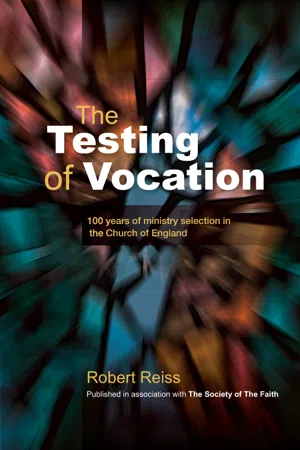
The Testing of Vocation
100 years of ministry selection in the Church of England
This book is available to read until 23rd December, 2025
- 448 pages
- English
- ePUB (mobile friendly)
- Available on iOS & Android
eBook - ePub
Available until 23 Dec |Learn more
About this book
The Testing of Vocation is a comprehensive study that will provide an essential reference volume for historians and all students of the vocation and ministry in today's Church. It explores in detail the Church of England's concept of vocation and how it has developed over the century in response to changes in society and in the church.
Frequently asked questions
Yes, you can cancel anytime from the Subscription tab in your account settings on the Perlego website. Your subscription will stay active until the end of your current billing period. Learn how to cancel your subscription.
No, books cannot be downloaded as external files, such as PDFs, for use outside of Perlego. However, you can download books within the Perlego app for offline reading on mobile or tablet. Learn more here.
Perlego offers two plans: Essential and Complete
- Essential is ideal for learners and professionals who enjoy exploring a wide range of subjects. Access the Essential Library with 800,000+ trusted titles and best-sellers across business, personal growth, and the humanities. Includes unlimited reading time and Standard Read Aloud voice.
- Complete: Perfect for advanced learners and researchers needing full, unrestricted access. Unlock 1.4M+ books across hundreds of subjects, including academic and specialized titles. The Complete Plan also includes advanced features like Premium Read Aloud and Research Assistant.
We are an online textbook subscription service, where you can get access to an entire online library for less than the price of a single book per month. With over 1 million books across 1000+ topics, we’ve got you covered! Learn more here.
Look out for the read-aloud symbol on your next book to see if you can listen to it. The read-aloud tool reads text aloud for you, highlighting the text as it is being read. You can pause it, speed it up and slow it down. Learn more here.
Yes! You can use the Perlego app on both iOS or Android devices to read anytime, anywhere — even offline. Perfect for commutes or when you’re on the go.
Please note we cannot support devices running on iOS 13 and Android 7 or earlier. Learn more about using the app.
Please note we cannot support devices running on iOS 13 and Android 7 or earlier. Learn more about using the app.
Yes, you can access The Testing of Vocation by Robert Reiss in PDF and/or ePUB format, as well as other popular books in Theology & Religion & Christianity. We have over one million books available in our catalogue for you to explore.
Information
1
Introduction: Vocation in the Twentieth Century
The ordained ministry in the Church of England changed dramatically during the twentieth century. In 1900 there were over 25,000 clergy serving a population of about 32 million in England and Wales.1 By 2000 there were fewer than 12,0002 within the diocesan structures of the Church of England, serving a population of just under 50 million in England. In 1900 the vast majority of the clergy were in stipendiary parochial ministry, but by 2000 a sixth of the serving clergy were non-stipendiary, a category created and developed in the second half of the century.
At the beginning of the century there was near universal agreement within the Church of England that it was responsible for providing a ministry of pastoral care based on the parochial system that would cover the whole of the nation. By the end of the century, while many still held to that ideal, there were other voices who stressed that the Church was by then in a missionary situation, with a far higher proportion of the population ignorant of the Christian faith, and which required a very different approach to ministry.
The social background from which the clergy came also broadened over the period, largely as a consequence of World War One and then the gradual development of a grants system that enabled ordinands to meet the cost of their training. Finance was, and remains, a critical issue.
The styles and manner of training also broadened. The hope of the bishops at the beginning of the century that all clergy would have a university degree was never realized, and in the first half of the century the ways of training expanded from university degrees only for some to an increasing use of residential theological colleges. In the second half of the century, however, there was also the development of non-residential part-time training that was available across the whole of England alongside the residential colleges.
While there were voices in the nineteenth century advocating better relations between different denominations, by the beginning of the twentieth century it very rarely translated into real ecumenical co-operation. Ecumenism developed throughout the twentieth century, and by the end much clergy training was done in ecumenical partnerships. But the nature of ordained ministry and the ways of reconciling the different understandings of it between different denominations remained a stumbling block. Within the Church of England, while most warmly welcomed the possibility, from 1994, of women being ordained, there remained a minority who were opposed, and handling the consequences of that was and remains a divisive issue in parts of the Church.
In 1912 the bishops agreed to the creation of a body to deal with many of the issues surrounding ordained ministry, although to start with it was largely concerned with training, as reflected in the first title of the body, the Central Advisory Council of Training for the Ministry (CACTM). Towards the end of World War Two it was also given oversight of selecting candidates for the ministry and then, in 1959, its title was changed to reflect yet wider responsibilities and it became the Central Advisory Council for the Ministry. In 1966 it was changed again to the Advisory Council for the Church’s Ministry (ACCM); then, in 1991, to the Advisory Board of Ministry (ABM). Following the creation of the Archbishops’ Council in 1999, it changed its name again to the Ministry Division.
Although the name changed and responsibilities were added in various ways and, after the creation of the Archbishops’ Council in 1999, its accountability was slightly different, at each change the staff remained essentially the same and there was historical continuity. The core of this book is the history of that body told, wherever possible, in the words of some of those involved at each stage. While the Ministry Division continues to this day, and 2012 sees the 100th anniversary of the creation of its predecessor, CACTM, this book essentially ends at the end of the twentieth century as the changes that are going on now inevitably need the perspective of a few more years to judge what is finally significant.
Vocation
Throughout the period one word was regularly used about the ordained ministry: it was a vocation. Vocation as a concept is a multifaceted and, some might argue, even a muddled one.3 At the most basic level there is the call to respond to Jesus’ summary of the law, to love God and to love your neighbour. That is a call directed to the whole human race if they have the ears to hear. More specifically there is the call to respond to Jesus’ request to follow him. That is directed to the Church as a whole and there is always a communal dimension to vocation in that sense; the call is to the Church to be the Church. That call is accepted implicitly by all who are baptized, and is the subject of some of the major writing about vocation in the twentieth century. Indeed it could be said that in thinking about its changing role in society the Church of England has been addressing the question of its corporate vocation, although the question has rarely been posed in that way. As this book will show, the Church of England is essentially a pragmatic body, responding to cultural and social changes less by detailed theological examination than by practical considerations of what might work. Those from other theological traditions might approach the matter differently.
Karl Barth included a substantial section on vocation in his Church Dogmatics,4 although his concern there was far broader than any decision about what a person might do for his or her career, but more about all people receiving the divine call to become a Christian and to be faithful within that calling. Hans Urs von Balthasar’s reaction to Barth5 placed more emphasis on human response, but he did not address the issue of how the concept applied in terms of any personal career choice. Yet that is the third area where vocation is often used.6 There has been surprisingly little by way of a thorough theological assessment of the concept of vocation as applied to individuals making a career choice written in the context of the Church of England in the twentieth century. As this book will show, from time to time it was addressed in books on other broader issues or in brief articles. F. R. Barry addressed it in Vocation and Ministry7 published in 1958, as did Michael Ramsey, albeit briefly, in 1972, in Christian Priesthood Today8 and Francis Dewar in 1991 Called or Collared?: An Alternative Approach to Vocation.9 ACCM initiated a report on the subject entitled Call to Order, published in 1989, and there have been various articles in theological journals; and a lecture given by Mary Tanner to a conference of Diocesan Directors of Ordination and Lay Ministry Advisers in 1986 entitled Towards a Theology of Vocation10 was often quoted, but otherwise there has been no careful and detailed theological examination of the notion in a Church of England context in the twentieth century. For the historian, that creates a problem, because much of what was said about vocation was probably said in private conversation, and subtle changes in the understanding of what was meant by the word may have happened over the century without it being made explicitly clear in the literature, or even clearly passed on from one generation to the next.
The word is also used in a wider sense than simply to holding a religious office, as in ‘vocational training’, which might apply to any preparation for a career. As early as 1785, when Samuel Johnson’s Dictionary of the English Language was published, while vocation could certainly mean a calling by the will of God, it was already being used in the more general sense of a trade or employment. Partly this followed Martin Luther’s discussion of vocation. Prior to the Reformation in medieval Europe, vocation would have been used almost exclusively in connection with a calling to a religious office, either as a priest or as a member of a religious community. Luther protested against such a narrow usage, especially if it were believed to be one that gave a person a privileged position with respect to God. He believed that the essential call of Christ to follow him was directed to all Christians and not just to those in some exclusive religious category, and the call was to love God and love one’s neighbour. Also, in protest at the requirement of celibacy, Luther believed that someone could equally be called to marriage, which he also saw as a vocation. A person’s vocation was the life they lived in terms of Christian service in whatever outward form that might be, which might well include a Christian man or woman having a vocation to marriage and pursuing a task that was not exclusively Christian as long as it was consistent with loving one’s neighbour.
In Luther’s time many people’s occupation was determined by what he described as their station in life, so, for example, a person born into a farming community would almost certainly have had little choice but to work on the land, which Luther saw as their vocation. Those who had the opportunity of choosing a profession, which would have been only a fairly small proportion of the population, had to go through the process of application, passing whatever the examination requirements were for that profession and then being offered some sort of post; it is no accident that in German the word for profession (Beruf ) means literally ‘calling’, but the ‘calling’ was done by those responsible for recruiting into the particular profession or career as well as by the inclinations given by God to the individual concerned.11
The wider application of vocational language was developed by Troeltsch in his The Social Teaching of the Christian Churches (1911). Troeltsch noted that in the first three centuries of the Christian Church it saw itself as a beleaguered minority in a society under the control of the devil, and so had no theological framework against which to develop a positive understanding of work. But in a post-Constantinian world, that began to change and society began to be seen as an organism established by the will of God. Any work that maintained or contributed towards the good ordering of society could be seen as fulfilling the will of God, and could be seen as the fulfilling of a vocation. Vocation in that wider sense raises large issues and has been the subject of extensive literature both from theological and sociological perspectives. It does, however, go well beyond the bounds of this particular book.
Vocation as a guide to a career choice
The narrower question of personal career choice obviously turns on one very fundamental question, the nature of God and the consequential issue of how God’s relationship to the believer is seen. How specific is God’s will? It is interesting to note that two clear but rather different views on that emerge from theological traditions that might have been expected to take opposite points of view.
One approach is in a booklet from a Roman Catholic perspective entitled Vocation written as recently as 1975. The author states:
The one who is calling is God. He has a specific plan for every man and woman who will ever exist and, in each plan, his own divine will and human freedom of action are wonderfully bound up with one another … Everything that happens to us is part of the plan, whether it seems to be just chance or the result of our own careful deliberation. We belittle the whole idea of divine vocation if we see it as nothing more than the religious equivalent of what we call vocation in the professional field or in society. God’s call is not, when we really come down to it, something that arises from whatever aptitudes we happen to have, or whatever our natural inclinations suggest to us, nor is it a matter of being strongly drawn to some particular job. The call from God is something more than this. It is something quite objective, which arises from the eternal plan of God, and it cannot be reduced to a mere human choice.12
That is one approach, and no doubt there are Anglican clergy who would see their lives in that light, but apart from the difficulties of sustaining such a view of God’s plan for every individual in the face of such events as the Holocaust or eart...
Table of contents
- Cover
- Title
- Copyright
- Dedication
- Acknowledgements
- Contents
- Foreword
- List of Abbreviations
- Some Key Dates
- A Note on the Governance of the Church of England in the Twentieth Century
- 1 Introduction: Vocation in the Twentieth Century
- 2 The Establishment of the Central Advisory Council of Training for the Ministry from the Beginning of the Century to 1913
- 3 The New Council Starts Work from 1913
- 4 World War One
- 5 The Inter-War Years 1919–39
- 6 The Archbishops’ Commission on Training, 1937–44
- 7 World War Two and the Establishing of Selection Conferences, 1939–45
- 8 The Fisher Years
- 9 The Pendulum Years, 1960–70
- 10 Keeping Up to Date: Revisions to the Selection Procedures, 1945–98
- 11 The Search for a Strategy 1970–2000
- 12 In Retrospect
- Appendix A Correspondence between Randall Davidson, Bishop of Rochester, and C. H. Waller, Principal St John’s, Highbury
- Appendix B Chairmen and Secretaries of CACTM/ACCM/ABM/Ministry Division
- Appendix C Constitution of CACTM/ACCM/ABM/Ministry Division
- Appendix D Working-class Candidates
- Appendix E Earl Grey’s Letter to The Times, 4 June 1927, on the Sponsorship Scheme
- Appendix F Sources of Grants for Candidates for Ordination 1918–37
- Appendix G The Awarding of Grants from 1933
- A Appendix H From the Papers of the Archbishops’ Commission on Training
- Appendix I Memorandum (1942) from the Service Candidates Committee to the Archbishop of Canterbury (Temple) for Him and the Archbishop of York to Send to all Service Chaplains towards the End of World War Two
- Appendix J War Office Selection Boards
- Appendix K Extract from Archbishop Fisher’s Presidential Address to the Church Assembly on CACTM, 11 October 1945
- Appendix L Correspondence Between George Clay Hubback, Bishop of Calcutta and Metropolitan of India, and the Archbishop of Canterbury Regarding Worship at Selection Centres
- Appendix M From ABM Policy Paper 3A, Report of a Working Party on Criteria for Selection for Ministry in the Church of England, October 1993
- Appendix N (i) Numbers Ordained
- Appendix N (ii) Selection Conference Statistics
- The Society of the Faith
- Bibliography
- Index