eBook - ePub
Available until 23 Dec |Learn more
Moving On in Ministry
Discernment for times of transition and change
This book is available to read until 23rd December, 2025
- 224 pages
- English
- ePUB (mobile friendly)
- Available on iOS & Android
eBook - ePub
Available until 23 Dec |Learn more
About this book
While the Church of England provides practical resources for clergy as they make changes in their 'careers', very little theological reflection has been done around this subject. Not all change is welcome and driving factors differ from those in secular employment. This important volume explores key questions to consider at points of transition.
Frequently asked questions
Yes, you can cancel anytime from the Subscription tab in your account settings on the Perlego website. Your subscription will stay active until the end of your current billing period. Learn how to cancel your subscription.
No, books cannot be downloaded as external files, such as PDFs, for use outside of Perlego. However, you can download books within the Perlego app for offline reading on mobile or tablet. Learn more here.
Perlego offers two plans: Essential and Complete
- Essential is ideal for learners and professionals who enjoy exploring a wide range of subjects. Access the Essential Library with 800,000+ trusted titles and best-sellers across business, personal growth, and the humanities. Includes unlimited reading time and Standard Read Aloud voice.
- Complete: Perfect for advanced learners and researchers needing full, unrestricted access. Unlock 1.4M+ books across hundreds of subjects, including academic and specialized titles. The Complete Plan also includes advanced features like Premium Read Aloud and Research Assistant.
We are an online textbook subscription service, where you can get access to an entire online library for less than the price of a single book per month. With over 1 million books across 1000+ topics, we’ve got you covered! Learn more here.
Look out for the read-aloud symbol on your next book to see if you can listen to it. The read-aloud tool reads text aloud for you, highlighting the text as it is being read. You can pause it, speed it up and slow it down. Learn more here.
Yes! You can use the Perlego app on both iOS or Android devices to read anytime, anywhere — even offline. Perfect for commutes or when you’re on the go.
Please note we cannot support devices running on iOS 13 and Android 7 or earlier. Learn more about using the app.
Please note we cannot support devices running on iOS 13 and Android 7 or earlier. Learn more about using the app.
Yes, you can access Moving On in Ministry by Tim Ling in PDF and/or ePUB format, as well as other popular books in Theology & Religion & Christianity. We have over one million books available in our catalogue for you to explore.
Information
1. Approaching Transitions
‘Can you live with what you’ve delivered?’ The Managing Director’s question could only be answered in one way if I expected my career to develop at the company where I had just completed three tough years at the head of a corporate change programme. The elation of delivering on time, if slightly over budget and not quite complete, was followed by a refreshing family holiday. It was my first day back at work when I was invited to the MD’s office. Later that morning, I forsook my corner office and PA – and my place in the company’s organization chart – to drive down the M4 to a new, undefined, role. The months and years that followed were to prove the most hellish, and ultimately most satisfying, of my working life.
Our consideration of transitions begins by introducing a framework for change, S-curves, based on observations in the natural world. It examines different attitudes to change, then moves on to look at continuous and discontinuous transitions, and what might trigger them. A consideration of individual and organizational transitions leads to a focus on the transitional, or liminal, space between S-curves. This raises questions about the extent to which we can control our situation, and highlights our differing needs for security in times of uncertainty. The chapter concludes by considering some implications for the minister, who may be moving on.
Introducing S-curves
If a well-meaning consultant had told me, as I struggled to come to terms with my new company role, that I had just tipped off the top of one S-curve and was in the maelstrom trying to get a foot on a new one, I might well have decked them. Yet now, with the benefit of hindsight and an accumulation of community wisdom, I recognize that is what was going on. Would it have helped if I had known such a framework in advance? Possibly. Would it have made the transition any less painful? Probably not. Yet we only have to look at the natural world to see such patterns all around us. The rhythm of the seasons – spring, summer, autumn, winter – can be expressed in the shape of an ‘S’: slow initial growth, blossoming and healthy development, followed by slow decline, even death. We see such curves of growth and decay not only in our lives, but in history, from civilizations to companies and churches.
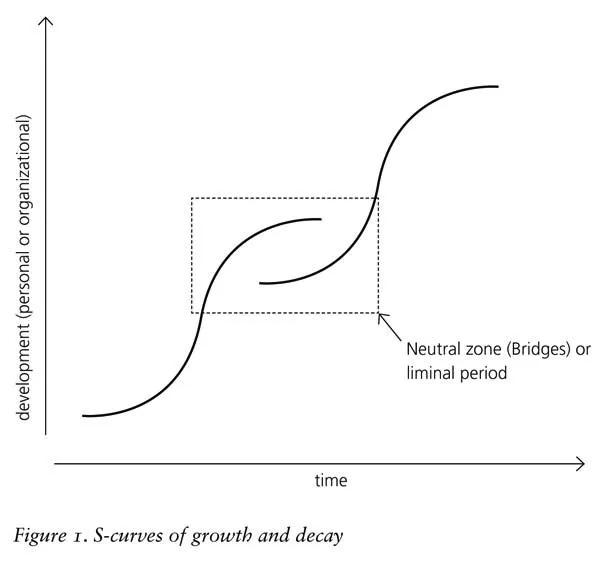
In my experience, the S-curve framework is hugely helpful to many people, including ministers from different denominations, and we will use it in this chapter. But we need to note three aspects, which need to be drawn out in the context of transitions.
First, S-curves can encourage a view of growth being considered as good in itself. As current debates about the economy and the very future of our planet show, there are profound questions to address. We need to be careful about how we consider growth: growth in depth, in understanding, in community, in relationships, may be more significant – and satisfying – than growth according to traditional measures.
Second, S-curves may encourage a linear approach to time. The idea of kairos time, a moment to be embraced, may well be more helpful in the context of a transition than chronos time, measured by our clocks and calendars.
Lastly, there is the question of where to focus our attention. As we will see below, and as my opening example demonstrated, we often concentrate on the period between the top of one curve and the bottom of another. A perspective that encourages natural growth should celebrate the continuing transitions that occur within an S-curve.
Learning from nature
In the natural world, transitions are a sign of health. They may involve slow, even hidden, growth. They may involve more obvious transformation, as in a caterpillar to a butterfly. They often involve growing pains. Yet they are wondrous. The perspective of this chapter is that transitions are entirely natural, and should be embraced. It seeks to weave together the warp of the organizational ecologist with the weft of the practical theologian.
I once met a bishop who asked what my work involved. ‘I work with people going through change’, I replied. The bishop paused for a moment of episcopal reflection before responding, ‘Ah, change and decay.’ Whatever the pastoral benefits of the hymn, ‘Abide with me’, H. F. Lyte’s inclusion of the line ‘change and decay in all around I see’ was hardly felicitous. For many people, change has negative connotations. And yet change is going on all the time, whether we realize it or not. As Cardinal Newman wrote, ‘To live is to change.’
Our attitude to what we see as unchangeable was brought home to me by a member of a group I was working with. To illustrate an image of changelessness, I shared a picture of a local rural parish church with its solid tower. This person, who knew far more than me about ecclesiastical architecture, pointed out a fifteenth-century original, with additions up to the Victorian era. What we think of as unchanging has, in fact, changed. We see something similar reflected in the growing interest in more dynamic perspectives of God, such as a view of the Holy Trinity characterized by mutual indwelling, where images such as dance are applied in reaction to earlier, more static, models.1
Another lesson from nature is that disturbance is vital for health. This is encapsulated in the Benedictine vow of conversion of life, beautifully described by a former abbot of Ampleforth as ‘a vow to change, to never remain still either in self-satisfied fulfilment or self-denying despair’.2 Rosie Ward highlights the point at an institutional level: ‘In an Anglican context (and it’s the same for most of the denominations), unless we change, we will die. We face the choice between a comfortable death – if that is not a contradiction in terms – and an uncomfortable life.’3 We will consider the importance of healthy disturbance, and the implications for our security, later in the chapter.
I wonder how much time executive coaches, counsellors and spiritual directors spend on transitions that have become a crisis. Words written about organizational change draw attention to the possibility of avoiding a crisis by embracing an attitude of renewal: ‘Enormous managerial energy… [has] been devoted to turnarounds, rescues, and massive “change” programs, yet isn’t the real goal to avoid a crisis-sized transformation problem by creating a capacity for continuous renewal deep within the company?’4 A ‘capacity for continuous renewal deep within’ (ourselves … our churches …) resonates with the Christian gospel and provides us with an opportunity for considering life’s transitions, whether they are ongoing or take the form of one-off changes.
Continuous and discontinuous change
Saul’s experience on the road to Damascus may be the exception to prove a rule. An understanding of evangelism in process terms accords with a view of continuous transitions. The Hebrew and Christian Scriptures offer us examples of both continuous and discontinuous change. The Exodus and Exile were epic national events, where a return to a previous life was not possible. ‘By the waters of Babylon there is no way back to the old Jerusalem.’5 Paul’s writings offer examples of discontinuity: ‘If anyone is in Christ, there is a new creation: everything old has passed away; see, everything has become new!’ (2 Cor. 5.17). In contrast, the Book of Revelation offers a vision where renewal is continuous: ‘The one who was seated on the throne said, “See, I am making all things new”’ (Rev. 21.5). The Hebrew understanding of the breath of God also offers a picture of ongoing renewal: ‘When you send forth your spirit, they are created, and you renew the face of the earth’ (Ps. 104.32).
Kurt Lewin contributed a great deal to the discipline of social psychology. But I am not sure his ‘unfreeze-change-refreeze’ model, and especially subsequent simplistic applications of it, are helpful. They emphasize the idea that change is something that happens between periods of stability, and that it can be controlled. Instead, we need an approach that helps us to understand both the continuing nature of change, and the fact that it can rarely be controlled. ‘Change management’ is one of the great oxymorons of our time, and complexity theory is helping us understand the implications of this.
If there is one discipline that has transformed my attitude to change in the past decade, it is the amalgam of scientific discoveries popularly known as chaos, or complexity, theory.6 Some of its language has entered our popular vocabulary – pe...
Table of contents
- Copyright information
- Contents
- Foreword
- Contributors
- Introduction
- 1. Approaching Transitions
- 2. ‘Who shall I be?’ Putting On Priesthood in the Church of England
- 3. Growing into Responsibility
- 4. Understanding and Enabling Clergy Careers
- 5. ‘Still in Saigon?’ Ministry, Movies and Moving On
- 6. A Pilgrimage to My Own Self? R. S. Thomas and the Poetic Character of Reflective Ministry
- 7. Body Building and Moving On with Liturgy
- 8. From Parish to Chaplaincy
- 9. Letting Go and Holding On
- 10. Affirmation and Accountability: Moving On Through Ministerial Development Review
- 11. Moving On in the ‘Mixed-Economy Church’