eBook - ePub
Available until 23 Dec |Learn more
The Transition Movement for Churches
A prophetic imperative for today
This book is available to read until 23rd December, 2025
- 128 pages
- English
- ePUB (mobile friendly)
- Available on iOS & Android
eBook - ePub
Available until 23 Dec |Learn more
About this book
The Transition Town Movement is a fast growing social movement with hundreds of local groups which aims to prepare communities for the impact of peak oil and climate change. Many Christians are involved already, but this is the first book to equip local churches to engage with the movement towards greater simplicity.
Frequently asked questions
Yes, you can cancel anytime from the Subscription tab in your account settings on the Perlego website. Your subscription will stay active until the end of your current billing period. Learn how to cancel your subscription.
At the moment all of our mobile-responsive ePub books are available to download via the app. Most of our PDFs are also available to download and we're working on making the final remaining ones downloadable now. Learn more here.
Perlego offers two plans: Essential and Complete
- Essential is ideal for learners and professionals who enjoy exploring a wide range of subjects. Access the Essential Library with 800,000+ trusted titles and best-sellers across business, personal growth, and the humanities. Includes unlimited reading time and Standard Read Aloud voice.
- Complete: Perfect for advanced learners and researchers needing full, unrestricted access. Unlock 1.4M+ books across hundreds of subjects, including academic and specialized titles. The Complete Plan also includes advanced features like Premium Read Aloud and Research Assistant.
We are an online textbook subscription service, where you can get access to an entire online library for less than the price of a single book per month. With over 1 million books across 1000+ topics, we’ve got you covered! Learn more here.
Look out for the read-aloud symbol on your next book to see if you can listen to it. The read-aloud tool reads text aloud for you, highlighting the text as it is being read. You can pause it, speed it up and slow it down. Learn more here.
Yes! You can use the Perlego app on both iOS or Android devices to read anytime, anywhere — even offline. Perfect for commutes or when you’re on the go.
Please note we cannot support devices running on iOS 13 and Android 7 or earlier. Learn more about using the app.
Please note we cannot support devices running on iOS 13 and Android 7 or earlier. Learn more about using the app.
Yes, you can access The Transition Movement for Churches by Timothy Gorringe in PDF and/or ePUB format, as well as other popular books in Theology & Religion & Religion. We have over one million books available in our catalogue for you to explore.
Information
1. Transition Towns
The slogan of the World Social Forum for the past decade has been ‘Another World is Possible’. The Indian novelist Arundhati Roy says of this, ‘Not only is it possible, I can already hear it growing …’1
The World Social Forum networks the movements of almost 1,500 people and NGOs from around the world. It represents the hopes, aspirations and protests of what anthropologist David Graeber calls ‘the 99%’. The Transition Town Movement is part of this great movement for hope and change, which seeks to articulate and realize another vision of the world than that proposed by the World Bank, the IMF, the great corporations, and most governments.
The Transition Town Movement now has nearly 400 initiatives in Britain and more than 900 worldwide, based in cities, towns and villages in 34 countries including the United States, Australasia and Japan. All over the world Transition groups are organizing practical projects to grow food, start renewable energy projects, build local homes, and re-think local economies. Examples are the Community Energy project in Lewes, East Sussex, which has covered the roof of the local brewery with photo voltaics (Solar PV), and will plough back profits into more renewable energy; and the Bath and West Community Energy group, which has done the same to local schools and is raising £5 million for more projects. Among groups working on food is a Community Supported Agriculture project in Norwich, growing food locally for local people; and the community-owned local food shop in Slaithwaite, West Yorkshire, which aims to ‘declare independence from the global food system’. And in terms of the economy, there is the introduction of local currencies in Brixton, London and Bristol, which helps keep cash in the local economy, instead of leaching out to the big corporations, to be invested in tax havens.
The Transition story started in Kinsale in Ireland, when Rob Hopkins, a permaculture teacher, showed his students a film called ‘The End of Suburbia’, which queries the sustainability of North American suburban, car-based living, given predictions (rehearsed in detail in the film) about the likely end of cheap and easily available oil. In the 1950s North America was self-sufficient in oil, but to the incredulity of many, an oil geologist called M. King Hubbert predicted that the oil would run out by the early 1970s. His predictions were spot on – the United States now produces only 2 per cent of its own oil. He and other oil geologists then predicted that this would happen to other major oil fields in due course, and there is currently a lively debate on whether oil has already ‘peaked’ or whether vast resources still remain, perhaps in the Arctic. The government of George W. Bush took this sufficiently seriously to mandate that 40 per cent of the US maize crop should be processed for fuel, while in Canada it has been economically viable to produce oil from tar sands (naturally occurring bitumen deposits), although it is an immensely costly and ecologically damaging process.
The problem is that contemporary civilization is completely dependent on oil, especially for food, and as economies like China and India develop, the demand for oil will continue to rocket. If China continues developing at its present rate, it is calculated that by 2020 it alone will use the equivalent of current worldwide annual consumption.
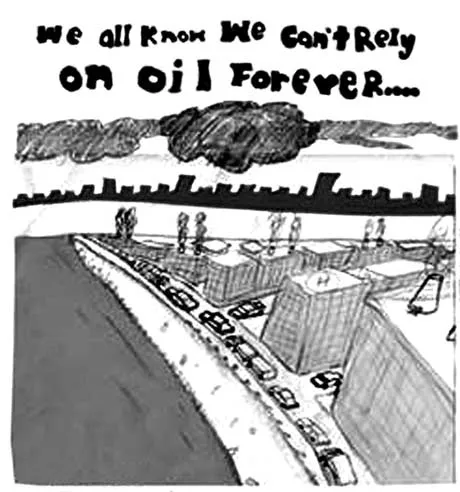
The implications are considerable. Most of us rely on cars or buses. Many of us commute. How would we work if we could not take oil for granted? What work would we do, and how would it be organized?
The implications for food are more serious still because oil is used at virtually every level of food production, from machinery to fertilizers, from processing to delivery. Could we feed 7 billion people, or 9 billion, as is predicted for 2050, without present levels of oil? At present all but 3 per cent of the food we eat in the global North is dependent on oil.
Similarly, oil is used in the production of almost everything we use in the home and now take for granted, such as mobile phones, computers and so forth, and this is even more true for hospitals and medicine. As soon as we start asking the questions we realize that oil depletion is a threat to our way of life.
In Kinsale, Rob Hopkins asked his students to draw up an ‘Energy Descent Plan’ which would map out how the town would manage to feed itself, and what work it would do, post peak-oil. Together, they began to envision the transition from a world in which oil-based energy was seemingly inexhaustible to one where other resources would have to take the lead. When their work was complete they held an open meeting called ‘Kinsale in 2021: Towards a Prosperous, Sustainable Future Together’. Lots of practical information was provided to show people that a series of small steps would allow them to re-design their economy without too much expense or outside intervention. The town council accepted the plan and Kinsale became the first Transition Town. Rob then moved to Totnes in Devon, and with one or two others started a Transition movement there, which has now spread around the world.
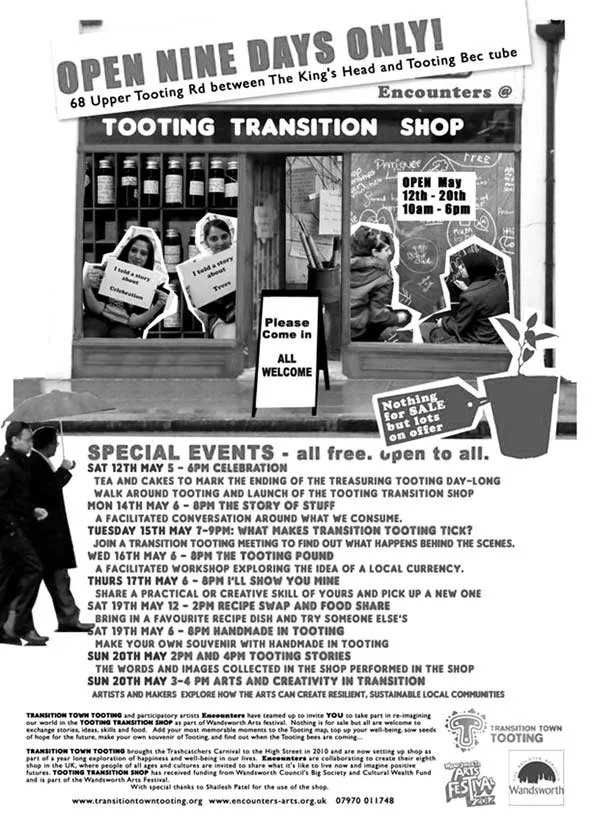
The attraction of the Transition movement is that it rests on practical and local initiatives to meet the challenge not only of peak oil,2 but also of climate change and of the ongoing financial and economic crisis. Whether you are threatened by increasingly violent storms in North America, by rising sea levels in the Pacific (where many island communities are already dispossessed), by unemployment in southern Europe, or disturbed by rising levels of inequality in Europe or North America, a great many people sense that ‘business as usual’ is not an option but do not know how to go about doing things differently. Transition offers a way of thinking with others about these issues and taking action at a local level.
As Transition Edinburgh puts it, a Transition group ‘connects and supports community groups, and initiates practical projects that strive for a greener, fairer, healthier and more resilient town, city or village’. More broadly, in the words of Transition Manchester, the aim of a Transition group is to
- drastically reduce carbon emissions (in response to climate change)
- significantly rebuild resilience (in response to peak oil)
- greatly strengthen our local economy (in response to economic instability).
The Transition Town Movement takes the challenges of peak oil, climate change, and the faltering of the present economic model not as a threat but a promise. Hopkins talks not only of energy descent (becoming less dependent on oil) but of energy ascent, as the community mobilizes, finds its creativity and learns to work together for the common good. The assumption is that the future can be shaped so that it is preferable to the present. Each step down the oil dependent hill, he argues, could be a step towards sanity, towards a greater recognition of the value of the place we find ourselves in (city, town or village) and towards wholeness.
The Transition movement is not primarily a campaigning movement but a community building movement. At an early meeting of the movement in Totnes a speaker was asked what the single most important thing was that someone could do to respond to these challenges, and the answer was, ‘Join the choir!’ It works on the premise that:
- If we wait for governments, it will be too little too late.
- If we act as individuals, it will be too little.
- If we act as communities, it might be just enough, just in time.
All over the world this premise is energizing and appealing because all over the world (not just in Britain) there is widespread disenchantment with mainstream politics and its power to deliver. The ‘P’ word (politics) is more or less absent from Transition literature and discussion, but in fact Transition is about citizens shaping their world (their ‘polis’). Transition is not about retreat to some imagined rural past but envisages a future where the local, national or international are better balanced than at present. So, for example, at the international level it certainly wants strong worldwide climate change protocols, and a moratorium on biodiesel production. But at the same time it wants much more power devolved to local communities. Not aligned to any political party, Transition works to change the cultural story, to make unelectable policies electable, to lead by example and action rather than by hectoring. Rooted in permaculture, it seeks practical, realizable steps here and now which ordinary people can take to make society more resilient. It is not anti-technology, but pro appropriate technology. Recently it has enthusiastically embraced social entrepreneurship – the idea that all the energy, imagination and drive of the entrepreneur can be harnessed not to make profits for an individual or a company but for the good of the community.
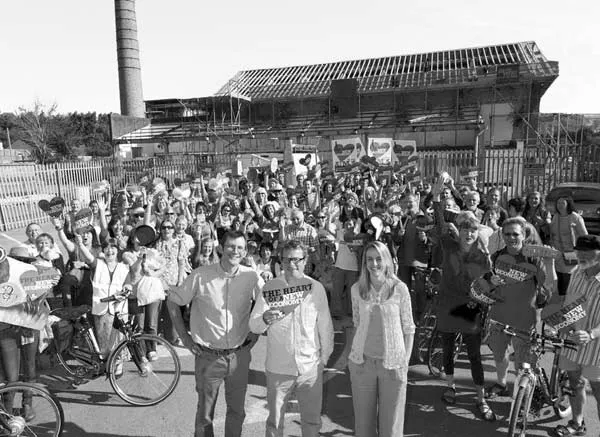
Although it does not accept that economic growth is the answer to all our problems, it is not a hairshirt, tighten your belts, ‘let’s do without’ movement, but believes that a more satisfying, creative and community oriented way of life can be found than we currently experience.
In terms of process it is profoundly democratic, aiming at consensus decision making, and using ‘technologies’ like open space and world café, in which there is the minimum of centralized control. It seeks to be inclusive, and to deal with the potential sense of powerlessness people feel in the face of large problems by celebrating both success and failure. It wants to create safe spaces for people to talk, think and act. The ethos is respectful but with an emphasis on enjoyment and creativity. Key to the ethos is the idea that Transition should provide a vision of a society so enticing that people will want to join in.
Since we can only get somewhere if we know where we are going, Transition asks people to imagine where they would like their place or community to be in five, ten, 20, 50 years’ time. It tries to steer a course between the apocalyptic (social chaos, local warlordism) and the starry eyed (a hi tech, zero carbon future). This means it has an ‘earth steward’ perspective: given the renewable resources we have at our disposal and given the creative power of communities, what might the world look like? The focus is resilience – the ability to adapt and thrive in the face of changes. Transition groups explore the practical creation of possible resilient futures in many dimensions. Most Transition groups have sub-groups that focus particular people’s energies and enthusiasms. As Transition Lancaster puts it, the interest groups are what makes Transition buzz.
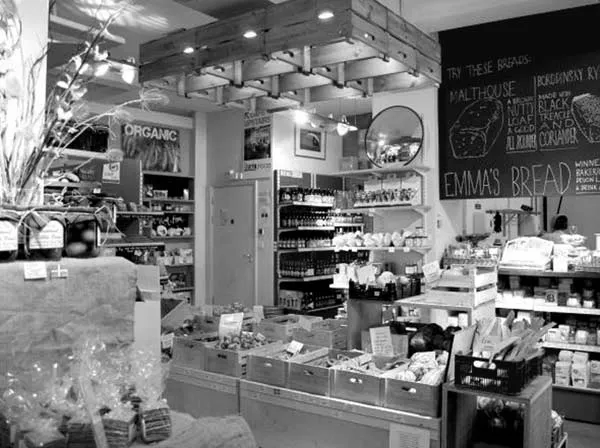
So, for example, all Transition groups are concerned about energy and look for ways to set in place local energy schemes in their locality. Probably the most popular and most successful area is food, a...
Table of contents
- Copyright information
- Contents
- Foreword
- List of Illustrations
- 1. Transition Towns
- Broadland Winter Afternoon
- 2. The NAME
- Taunton Transition Town
- 3. The Way
- Community garden in Oakland, California
- 4. Serving Creation
- Transition Worthing
- 5. The Human One
- Transition Crystal Palace
- 6. A Domination Free Order
- Transition India
- 7. The Long Road to Freedom
- Transition Canterbury poster
- 8. Praise
- Transition Pittsburgh
- 9. Hope and Despair
- Resources