This book is available to read until 23rd December, 2025
- 144 pages
- English
- ePUB (mobile friendly)
- Available on iOS & Android
eBook - ePub
Available until 23 Dec |Learn more
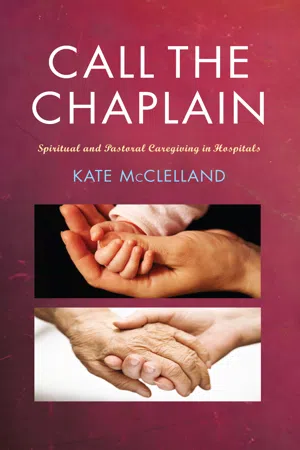
Call the Chaplain
About this book
This warm-hearted and practical handbook for hospital-based pastoral care considers the pastoral sensitivities surrounding patient encounters. It explores the essential skills needed for this kind of ministry: the importance of ritual, difficult pastoral tasks, deflecting anger, caring for the carers, working in multi-faith contexts and more.
Tools to learn more effectively

Saving Books

Keyword Search

Annotating Text

Listen to it instead
Information
1. Expectations of a pastoral encounter
Introduction
Having established who you are and why you’re visiting someone, you are ready to understand what makes a good pastoral visit. This chapter considers three models of pastoral visitors: the family member, the friend and the professional visitor. Most of the skills are interchangeable and some are specific to the role that you are embracing. It explores the practical skills of good pastoral visiting, the understanding of spiritual care, caring for others and knowledge of other faith traditions. The purpose of the chapter is to show how to make a good pastoral encounter into an excellent one.
What makes a good visit
It was on my first day as a chaplain, in an acute hospital trust visiting my first ever patient, that I learnt the hard way that good preparation is everything to a successful visit. I went to visit a lady who had had an amputation. She was already wheelchair-bound and paralysed from the waist down. She had thought that her leg had looked infected and had been treated in the community by the district-nurse team who had insisted it was all right. It was when she was out shopping that members of the public had made comments about the smell of her leg, and a group of young men had made cruel jokes at her expense. This had obviously been a distressing experience for her and she desperately needed to tell someone about it. Her need of me was not of a practical nature, but to sit, listen and empathize. As she was a long-term patient, she had accumulated many possessions in her room and the one chair normally available to visitors was filled with a cacophony of equipment. The room was very hot, as it usually is in a hospital, and the window was not open. The smell from the catheter bag and wound was incredibly potent. I set the scene because if you are intent on hospital visiting, this is exactly the kind of situation you are likely to encounter. Aware of how upset she’d been at the young men’s cruel jibes, it was vital that I made no reference at all to the smell by asking to open a window, and that my face did not betray any feeling of disgust, even when she insisted on showing me her wound.
Now unfortunately my family has a trait of being unable to listen to gruesome or detailed medical information without passing out. I know – why chaplaincy? Why me? God, I guess, and God’s sense of humour! Most of us in my family have it apart from my son, who is a nurse, and my niece, who is a physiotherapist. The rest of us only have to hear the soundtrack of Casualty and we’re gone, completely passed out! So needless to say, on this fateful day, after listening empathically to the entire saga, looking with forced interest at the amputation area, with all the surrounding smells, I passed out. To my credit, I did somehow manage to pray with the patient and get out of the room before I slid down the wall in the middle of the busy ward!
Needless to say I learnt a great many things from that encounter. Here are some tips to help make your encounter a positive experience for both you and the person you are visiting.
Identify yourself
When entering a patient environment the first thing you should do is identify yourself. Hospital, care homes and hospices are sometimes confusing environments. Patients are at different levels of recovery. Do not presume that they will recognize you, even if you are visiting a family member. Therefore it is wise to state clearly who you are when approaching the patient. This can be as simple as ‘Hello, Mum, it’s me, Maureen’ to the more formal ‘Hello, Mrs Smith, my name is Kate. I am the hospital chaplain. I have come to see how you are today.’ This will help put the patient at ease and relieve any anxiety that may have built up within them. One of the main fears found in older people is that they are ‘going mad’, or getting dementia. Often something as simple as a urine infection can create confusion in patients, which may only be temporary but may mean that they do not recognize someone familiar. Some people can get into such a state of anxiety that it temporarily blocks out any rational thoughts. There have been many occasions when, after identifying myself, a patient has asked me if they are dying. Just seeing me and the collar can bring on thoughts that we may not have anticipated. Also I often get mistaken for either a social worker or a nurse, if I am wearing a blue clerical shirt rather than a black one. Again I learnt the hard way. On one occasion early on I entered a room expecting the patient to know who I was from my collar. She greeted me warmly as if she knew who I was, but clearly did not. I went to pull up a chair and when I turned round she had taken her nightdress completely off and was standing naked in front of me. She thought I wanted to examine her. I was shocked and embarrassed, but more importantly, she was mortified. No one wants the vicar to see them naked; it’s an unspoken taboo. Starting your visit with clear introductions, including an explanation of why you are there, gets the visit off on the right foot and enables a more engaging and worthwhile encounter.
Gain consent for the visit
Do not presume that the person you are visiting wants to be visited. The autonomy of a person is often stripped away in institutions. They may have had a terrible night’s sleep, had procedures before your arrival and had a stream of interruptions that has left them tired or irritable and upset. After identifying yourself, ask if it is convenient to visit and if they actually want you to stay. Remember that there is often very little choice available to them at this time. You are offering a vital and important service by giving them that choice. Be prepared for them to ask you to go away. It won’t be personal! Chaplains, like other professionals dealing with often tragic and emotionally stressful situations, find they need a weird sense of humour! I had not been in the post long when my initiation came in the form of a meeting with Mr X. My colleague had suggested that he might like a visit from me. Perhaps, he said, he might like communion. I dutifully prepared my things and trotted off full of righteousness. As I approached the bed, Mr X smiled. ‘Oh,’ he said, ‘you’re a new one.’ ‘I wondered if you’d like me to give you communion today,’ I said very seriously. ‘Did you, dear?’ he said and followed it with, ‘No, I wouldn’t. Now **** off!’ Interestingly, the following Sunday he attended the chapel and was completely different! You never can tell. Nor should you presume that people will be pleased to see you.
Fetch a chair
If you are invited to stay, before anything else, fetch a chair to sit on. Never sit on a bed. This increases the chance of cross-infection to the patient. It’s not good practice to start a conversation that might get deep or emotional then for you to break the momentum and have to say, ‘Oh, hold that thought, I just need to go and find a chair,’ or worse. Get it at the start. If it turns out to be a short visit it doesn’t matter. If you are sitting down it has two effects. The first is that it looks to the patient that you are actually interested in engaging with them, at their level. Most professionals stand and speak down to them, often briskly while they are doing a procedure to them or filling in a form. This gives the impression that they are too busy to engage with the patient or that they are only half listening. When you draw up a chair you are saying, ‘You are important to me. I want to listen to what you have to say. I have time to be with you.’ Also, if like me you are of a sensitive nature, it’s easier not to faint if you are sitting down with your feet firmly planted on the floor.
Be practical
Horrifying news stories of patients waiting on trolleys and dying of starvation and dehydration will not have passed you by. Such incidents are rare, but the reality is that often in a healthcare environment the staff are overstretched and things get missed. Many times when I visit a patient, their biggest concern is that they need the toilet and have been pressing their buzzer for a long time. One practical thing you can do in that situation is go to fetch a member of staff, or you may be able to assist someone to the toilet. There can be little more dehumanizing than needing the basic facilities and not being able to go. The same applies to food and drinks. On arrival, and before leaving, check if there is anything that is needed. Pour a drink; help them to drink it. Feed them if necessary.
I remember one incident where I had a referral from my own church. He was a lovely man in his nineties who had been a stalwart of the church, a local preacher and Sunday school leader, whom I had always respected and admired. I will never forget him weeping when I held his hand and told him who I was. It was pitiful. He had had numerous hospital admissions, usually in the middle of the night, from the care home where he lived. Young, inexperienced staff panicked in the night when his breathing became shallow. He sometimes had to wait hours in corridors while a bed was found, only to be discharged a few days later. His family had all died and there was no one to speak up for him. He had all but lost his sight and he told me that he had not eaten or had anything to drink because no one had fed him and he could not see to feed himself. The tray arrived and was taken away again because he could not see where the food was. He was too proud to ask for help and did not want to bother the staff. I spoke to them and was reassured that he would be helped. I did not have much confidence in that, so every day I timed my visit to coincide with lunch. Most wards have ‘protected mealtimes’ where they ask family and staff not to visit to ensure that all the patients have a proper chance of eating peacefully. If you identify to the staff that you would like to aid your loved one/friend to eat, this can usually be negotiated. I fed this gentleman while we chatted about the old days. It was such a humbling experience. We shared so much over food in those last days. It reminded me of Jesus, who always seemed to be eating with someone or other. I realized that the sharing of food allowed for a levelling of identities while meeting a basic human need. In the sharing of bread there was a sharing of stories, lives and experiences. My gentleman talked of John’s Gospel and how it had guided his life. We talked about death and his desire to be left alone to die, his desire to be reunited with his wife and son and his faith which had upheld him through the trials of life. From those conversations I was able to explain to the care home where he lived and explained that he was in fact ready to die and asked them to stop calling for an ambulance every time they thought he was nearing the end. He just wanted to die at home, in peace, not being left on a trolley or resuscitated in A&E. They respected his wishes and that was the last time he was admitted. He died a week later peacefully at the care home which had been his home for the past 15 years.
Care of others
When visiting a patient, family member or friend, be aware of your surroundings. When we visited my dad in the care home we noticed that, as in a lot of care homes, many of the residents sat in the community lounge. One of the care assistants would bring in two large jugs of juice and some tumblers and then leave the room again to attend to someone in need. Many of the residents, including my dad, were not actually able to walk or pour themselves a drink. When you help one person and get them a drink, check the other residents and patients in the room. Not every client gets regular visitors, so be as generous as you are able with your attention. Be aware of your environment. The same can be said when visiting and saying prayers or giving bedside communion. Often there can be other people, perhaps not identified as religious or from other faith backgrounds, that are keen to join in with what you are doing. If it is appropriate include others. It also helps patients and service-users to bond with each other. Once I was visiting a lady and taking her regular communion when another patient asked if she could join us. My lady was delighted and together we shared a very precious service. They were a great support to each other during their stay in hospital and afterwards they became firm friends.
Other faiths
Knowledge of other faiths is essential when pastoral visiting in a healthcare environment. If you are a professional pastoral visitor, you will inevitably find yourself visiting someone, either patient or resident or relative, who is from a different faith background from yourself. Understanding other religions is vital to understanding the other person. The six major world faiths are Christianity, Islam, Hinduism, Sikhism, Buddhism and Judaism. Rather than focus on the difference between religions, I prefer to focus on the similarities. Most religions worship one God. Most people of religion acknowledge some kind of worship which includes prayer. Most religions have festivals and times of celebration, and most people following a faith are respectful of other people’s beliefs and practices. There is nothing to fear from other religions and other faith practices. There is nothing more moving for me than when our Sikh volunteers at the hospital ask if they may join in our prayers. They are very respectful; it is not a requirement of the Sikh faith to attend regular prayer times (Sikhs can pray individually when it is appropriate to do so, unlike Islam, for example, in which Muslims follow set prayer times). I have learnt a great deal about other faiths and practices from my colleagues over the years and have enjoyed sharing my Christian faith with them. There is an infusion of Spirit when we share our traditions with our brothers and sisters. When we explain to someone outside our own tradition why we do something, we remind ourselves of its importance to us.
I remember explaining to our Hindu chaplain about Lent and it reawakening in me its importance and meaning, which sometimes gets lost among the familiarity of our traditions. We often sit together and he’ll ask me questions about my faith and beliefs and I ask him about his. I think sometimes people are frightened of engaging with those of other faiths for fear they will try to convert them. This is not going to happen. The different faiths are rooted in their own history, traditions and cultures. When someone has a belief in God, there is no need for them to convert to another form of God worship, unless they desire to do so. There are plenty of people in the world that have yet to experience the love and knowledge of God without trying to convert people. So when you are visiting and are asked to pray for a person from another faith background, see this as a privilege. When I do so, which is often, I use God-centred language rather than Jesus-centred. I ask them what they would like me to pray for. I don’t presume that I know what they want. You will often find that the shared humanity is enriching and humbling.
I had such an experience with a mother who had triplets, one of whom had died. I had taken the baby’s funeral and, the following week, had called in on the other two neonates to check their progress and to catch up with their mum and dad, who were Hindu. Mum was really pleased to see me and we spoke at length about the baby she had lost. Her husband did not want to discuss the baby and seemed to want his wife to forget that she had had three children. According to Hindu belief the baby would be reincarnated into a better life, but the mum still thought her husband felt ashamed that the baby had died. Despite the difference in cultures and beliefs, we talked together about her baby and how much she missed him and how she felt to blame for his loss. That was just two women sharing in a story of loss and love a common humanity as a bond. At the end she asked me to pray for her and her baby. When I asked what she wanted me to pray for, the focus was on peace for herself and her husband, hope for the two remaining children and wisdom to handle the future. That I could do and I did. Who I was praying to almost seemed irrelevant; it was the verbal acknowledging of the need and another person’s desire to share in her pain that was important in that encounter.
Spiritual care
When we are visiting someone in a healthcare environment, it is in the knowledge and understanding that we are providing spiritual care of the person. When we are inside a church, ‘spiritual’ is intrinsically linked with ‘religious’, but in a healthcare environment ‘spiritual’ means something that m...
Table of contents
- Copyright information
- Dedication
- Acknowledgements
- Contents
- Foreword
- Preface
- Introduction
- 1. Expectations of a pastoral encounter
- 2. Understanding the person
- 3. Complexities of family relationships that serious illness highlights
- 4. Communicating in difficult circumstances
- 5. The importance of rituals
- 6. Ministering to the care-giver
- 7. Helping people face difficult truths – whose truth is it?
- 8. Dying matters
- 9. The challenge of mental health
- 10. Sustaining oneself in the face of suffering
- Resources
- 1 Blessing of a still-born baby
- 2 Naming of a baby
- 3 Blessing of a couple when one is terminally ill
- 4 Blessing of a room
- 5 Prayers before someone dies
- 6 Prayers before surgery
- 7 Confession
- 8 Communion
Frequently asked questions
Yes, you can cancel anytime from the Subscription tab in your account settings on the Perlego website. Your subscription will stay active until the end of your current billing period. Learn how to cancel your subscription
No, books cannot be downloaded as external files, such as PDFs, for use outside of Perlego. However, you can download books within the Perlego app for offline reading on mobile or tablet. Learn how to download books offline
Perlego offers two plans: Essential and Complete
- Essential is ideal for learners and professionals who enjoy exploring a wide range of subjects. Access the Essential Library with 800,000+ trusted titles and best-sellers across business, personal growth, and the humanities. Includes unlimited reading time and Standard Read Aloud voice.
- Complete: Perfect for advanced learners and researchers needing full, unrestricted access. Unlock 1.4M+ books across hundreds of subjects, including academic and specialized titles. The Complete Plan also includes advanced features like Premium Read Aloud and Research Assistant.
We are an online textbook subscription service, where you can get access to an entire online library for less than the price of a single book per month. With over 1 million books across 990+ topics, we’ve got you covered! Learn about our mission
Look out for the read-aloud symbol on your next book to see if you can listen to it. The read-aloud tool reads text aloud for you, highlighting the text as it is being read. You can pause it, speed it up and slow it down. Learn more about Read Aloud
Yes! You can use the Perlego app on both iOS and Android devices to read anytime, anywhere — even offline. Perfect for commutes or when you’re on the go.
Please note we cannot support devices running on iOS 13 and Android 7 or earlier. Learn more about using the app
Please note we cannot support devices running on iOS 13 and Android 7 or earlier. Learn more about using the app
Yes, you can access Call the Chaplain by Kate McClelland in PDF and/or ePUB format, as well as other popular books in Theology & Religion & Christian Ministry. We have over one million books available in our catalogue for you to explore.