This book is available to read until 23rd December, 2025
- 160 pages
- English
- ePUB (mobile friendly)
- Available on iOS & Android
eBook - ePub
Available until 23 Dec |Learn more
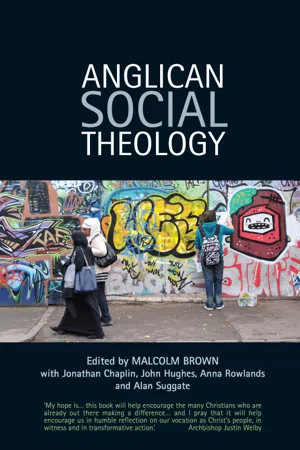
Anglican Social Theology
About this book
This volume, commissioned by a group of Bishops in hard-hit dioceses, looks to develop strong theological foundations for local social action initiatives by churches, especially for activists who are not familiar with the Church of England's tradition of social theology, developed by William Temple and others a century ago.
Frequently asked questions
Yes, you can cancel anytime from the Subscription tab in your account settings on the Perlego website. Your subscription will stay active until the end of your current billing period. Learn how to cancel your subscription.
No, books cannot be downloaded as external files, such as PDFs, for use outside of Perlego. However, you can download books within the Perlego app for offline reading on mobile or tablet. Learn more here.
Perlego offers two plans: Essential and Complete
- Essential is ideal for learners and professionals who enjoy exploring a wide range of subjects. Access the Essential Library with 800,000+ trusted titles and best-sellers across business, personal growth, and the humanities. Includes unlimited reading time and Standard Read Aloud voice.
- Complete: Perfect for advanced learners and researchers needing full, unrestricted access. Unlock 1.4M+ books across hundreds of subjects, including academic and specialized titles. The Complete Plan also includes advanced features like Premium Read Aloud and Research Assistant.
We are an online textbook subscription service, where you can get access to an entire online library for less than the price of a single book per month. With over 1 million books across 1000+ topics, we’ve got you covered! Learn more here.
Look out for the read-aloud symbol on your next book to see if you can listen to it. The read-aloud tool reads text aloud for you, highlighting the text as it is being read. You can pause it, speed it up and slow it down. Learn more here.
Yes! You can use the Perlego app on both iOS or Android devices to read anytime, anywhere — even offline. Perfect for commutes or when you’re on the go.
Please note we cannot support devices running on iOS 13 and Android 7 or earlier. Learn more about using the app.
Please note we cannot support devices running on iOS 13 and Android 7 or earlier. Learn more about using the app.
Yes, you can access Anglican Social Theology by Malcolm Brown in PDF and/or ePUB format, as well as other popular books in Theology & Religion & Christian Theology. We have over one million books available in our catalogue for you to explore.
Information
1. The Case for Anglican Social Theology Today
This book is about marshalling the resources of today to avoid some of the mistakes of the past. The Church of England has a long and honourable record of involvement in the wider life of the nation, its people and its communities. Whether engaging with government on issues of moral significance or through small acts of kindness and solidarity with people in the parish (or, indeed at many intermediate levels), the Church seeks to live out its Christian vocation, to demonstrate the love of God for all and to hasten the coming of God’s kingdom on earth. But the Church has never been especially good at articulating a theological rationale for this social engagement. As a result, support for much good work by the Church has been weakened by an inability to say why such work is a part of a truly Christian vocation.
The established Church’s need for a coherent social theology is, perhaps, a particularly modern problem connected with the rise of the centralized state and the creation of structures for social welfare which are no longer simply aspects of an organic, local and stable community. The shift from a ‘tribal’ society, in which morality was, basically, what you had grown up with and for which alternatives were almost unthinkable, to what Jeremy Bentham celebrated as a ‘society of strangers’ meant that the Church’s role in securing the welfare of the community was no longer unique and no longer taken for granted.2 With the growing assumption that religion belonged essentially in the private sphere, the Church was required to explain – not least to itself – why pursuing the welfare of the whole community was an authentic Christian calling. But time and space for this kind of reflection has often been eclipsed by action and deeds – activists and theologians have, it seems, inhabited different worlds within the Church.
We believe that the time is ripe for a renewed approach to Anglican social theology. Given the capacious nature of Anglicanism, this is unlikely to be a single theological model, strand of thinking or practice. But a number of trends appear to be coming together, in the Church and in the academy, which suggest a need for (and perhaps a desire to see) a theological foundation for the Church’s social witness formulated in terms that work for the Church and society of today.
It is worth expanding a little on what we mean by ‘Anglican’ in this context. The background to our reflections and indeed to our personal contexts is the life of the churches in Britain and particularly England. Anglican, here, means especially the Church of England, although we are well aware that the other Anglican provinces in Wales, Scotland and Ireland share a great deal of the same political, social and theological context. Nor have we forgotten that the Church of England’s life, theology and practice is shaped by its particular place within the global Anglican Communion and by ecumenical relationships, not least at grass-roots level, in England. These relationships have helped shape the Church of England’s engagement through the decades in political and social affairs, and something of the way they have done so may have played back into the Anglican Communion as part of a shared sense of what it is to be Anglican. But our main focus is on the social theology of Anglicanism in England.
We have chosen to speak of an Anglican social theology with a deliberate intention of echoing the concept of Catholic social teaching because we recognize that the latter is much better known as a theological school or tradition that informs practice. Our contention, which will unfold as the book progresses, is that a distinctively Anglican tradition of social engagement can be discerned through most of the twentieth century and the twenty-first century so far, that it has developed and continues to develop in interesting ways, and that it has periodically fallen out of sight such that a renewed attention to it as a theological tradition becomes an important corrective influence, calling the Church back to a vital area of its witness, ministry and mission. From time to time the Church has sensed a renewed vocation to action and witness in wider social and political relationships, not just within its own structures and membership, and the need arises for a deeper enquiry into the theological foundations of that sense of vocation.
The prompt for such theological enquiry has often been economic hardship. Cycles of prosperity and recession are endemic in a market economy, and in each downturn those with fewest resources tend to experience serious hardship or even near destitution. At such moments the pastoral heart of the Church has frequently led to hugely impressive ameliorative actions, sometimes small scale and unsung, sometimes highly organized and businesslike.
But the pastoral imperative has never been quite enough to enable these laudable ventures to withstand criticism from within and beyond the Church to the effect that the Church’s job is to save souls, not to alleviate poverty or seek social changes that would secure the position of the vulnerable. In prolonged recessions, when needs can be deeply entrenched, there can be the well-known phenomenon of ‘compassion fatigue’ – the apparent inability of the Church to secure rapid change for the better leading to a sense of fruitlessness. Criticism from without and weariness from within both cry out for a clear theological response – this is why Christians do what they do; this is why such action is the proper responsibility of the church; this, rather than the success criteria of managerial politics, is what we believe we are achieving. And yet, despite the good work done by William Temple and others between the First and Second World Wars, a serious social theology for the Church of England, in the sense of a living tradition that can evolve with the changing context while continuing to be informative, has been elusive.
So the Church’s social action has proved fragile. Excellent work and passionate engagement have come to the fore during each economic downturn, only to prove ephemeral and often defensive when critics become vocal. This lack of a sustained theology is, perhaps, not the only factor determining the robustness of Christian social action, but it is an important one.
As noted already, we address ourselves here to the Church of England in particular. For many years, and especially since the 1980s, some Anglican activists have looked with a degree of envy at their Roman Catholic colleagues who draw consciously on the rich resource of Catholic social teaching (CST). Catholics, it is implied, know why they do what they do and can locate their actions within a developed tradition that both guides engagement and justifies it to others. But Roman Catholicism and Anglicanism only share some aspects of their history in these Isles – the resources of CST draw, at least some of the time, on a tradition and a methodology that is not fully accessible to Anglicans. So our task here is to ask: Is there such a thing as an authentic Anglican social theology for today, and if so, what might it look like? We have not set out to write a handbook on Anglican social theology as if it were a clearly delineated school of thought with tight boundaries, but to put on record our belief that it is, in fact, possible to discern a tradition of social theology within twentieth- and twenty-first-century Anglicanism and, by exploring what it might look like from a variety of positions within the Anglican inheritance, to prompt a continuing and exploratory conversation, among theologians, practitioners and church people, that will answer the question of whether the tradition is sufficiently robust to support the demands now being made upon it by the Church’s evolving response to society in a period of rapid change.
Recession, society and the Church
This question is now a pressing one. The recession that began in 2008 is deep and prolonged. It has damaged the reputation of many political and economic institutions, not least the banks, to the extent that it seems unlikely that normal relationships between citizens and key social structures will be restored to the former status quo. Material inequality, which has been widening through each turn of the economic cycle for over 30 years, is exacerbating the decay of social bonds and creating widening gulfs of experience and expectation between different social groups. In terms of economic geography, the nation’s capital, London, is becoming more and more a separate entity from the rest of the country; a place where the markets for housing and labour, and the melting-pot experience of human diversity, are being played out, seemingly on a different canvas from other cities and regions. It becomes increasingly problematical to use words like ‘us’ and ‘we’ without very careful delineation of terms. Margaret Thatcher’s famous epigram that there is no such thing as society may have been misquoted and misunderstood, but it remains that a substantive meaning of ‘society’ is less and less possible to pin down in a way most people will recognize. Numerous overlapping trends and subcultures, new knowledge in various fields and conflicting ideologies combine to make social relationships hard to interpret, to discourage the use of the past as a template for the present and to make the future look uncertain and unsettling. We live in interesting times and are more aware than ever that this is at least as much a curse as a blessing.
Through all this, the Christian churches retain an instinctive concern that human relationships of all kinds should flourish and that the vision of the kingdom of God, bidden to come on earth as in heaven, is a gift that every generation needs to perceive. The Church of England in particular, defined by geography and deeply moulded by its historic mission to be the Church for all the people of the country, tends to react with anxiety to widening social divisions, even though its members inhabit most of the diverging sectors. For decades, times of economic hardship have prompted the Church to respond in practical terms to alleviate poverty and hardship and intellectually in trying to articulate a better social vision. Thought and action are also accompanied by political engagement. The industrial unrest of the 1920s and the slump of the 1930s were among the spurs that prompted Anglicans such as William Temple, Joseph Oldham and others to develop the wide-ranging conversations that shaped the Church of England’s approach to social issues for decades. Temple’s famous Penguin paperback, Christianity and Social Order, opens with the experience of a group of bishops who attempted to intervene with the Prime Minister (Stanley Baldwin) at the time of the miners’ strike of 1925, and much of his argument is designed to counter Baldwin’s rebuff, which echoed the popular assumption that Church and politics inhabited separate spheres.3 And then, as the political and social consensus that followed the Second World War disintegrated, unemployment soared and the economy contracted in the early 1980s, it was the Church of England’s report on inner cities, set up in the aftermath of rioting across several conurbations, that formed a kind of focus for national concern at the divisive impact of the politics of Margaret Thatcher’s governments.4 For a brief period, thanks to Faith in the City, the Church of England was seen by some as the most effective opposition to the monetarist and market-led policies that set social groups and classes against one another.5 Now, as the economy falters again, living standards drop and the unemployed and vulnerable face harsh restrictions on state support, the churches’ concerns are once again being articulated in the political sphere.
Yet the churches’ commitment to engage with social affairs is itself subject to cycles and trends. Periods of prosperity, even when enjoyed unevenly across the regions and classes, have seen the churches take a relatively low profile in matters political, economic or social. But perhaps more tellingly, the 100 years or so since the First World War have seen the numerical decline of the Church of England (indeed, of most mainstream denominations), and this weakening of support has been felt most acutely. Whereas Temple, in the 1940s, could write as if the Church’s role as one of the estates of the realm was taken for granted (even if its teaching was widely misunderstood), and Faith in the City could adopt the style and methods of a Royal Commission to address confident recommendations to the government, today’s Church stands on shakier ground, its active membership ageing and diminishing and its place in the national consciousness often pushed to the margins. Not surprisingly the years around the turn of the millennium saw the Church focusing on its own growth, indeed on its survival, with less to say about its relationship to the society it is set within. While it was usually acknowledged in formal contexts that ‘growth’ meant something more profound than just numerical increases in membership, so much turned on reversing the downward trend in church attendance and participation that the numerical agenda was clearly dominant.
But if the churches’ experience over many decades was of a pendulum swinging between an outward looking, socially concerned, Church and a more introspective Church concentrating on its own expansion, that picture is now much more complicated. John Atherton gives some support to the pendulum metaphor in his book, Public Theology for Changing Times, when he speaks of an age of atonement that lasted through to the 1920s, giving way to an age of incarnation for the rest of the twentieth century.6 In other words, the dominant doctrinal motif shifted from one that emphasized the Church as a vehicle to draw people away from a wicked world into the arms of a loving God, to one that stressed instead a world Christ had affirmed by his presence among us and in which the Church’s task was to discover and celebrate a God who was at work already. Atherton notes how the age of atonement celebrated voluntarism, care for others being part of the responsibility of the elect whereas fallen structures could not mediate the kingdom of God. The age of incarnation, on the other hand, tended to look to the state as a legitimate vehicle for bringing forward God’s kingdom on earth since the Holy Spirit could inhabit the mundane, ...
Table of contents
- Copyright information
- Contents
- Foreword
- Acknowledgements
- The Authors
- 1. The Case for Anglican Social Theology Today
- 2. The Temple Tradition
- 3. After Temple? The Recent Renewal of Anglican Social Thought
- 4. Evangelical Contributions to the Future of Anglican Social Theology
- 5. Fraternal Traditions: Anglican Social Theology and Catholic Social Teaching in a British Context
- 6. Anglican Social Theology Tomorrow
- Praise for Anglican Social Theology