eBook - ePub
Available until 23 Dec |Learn more
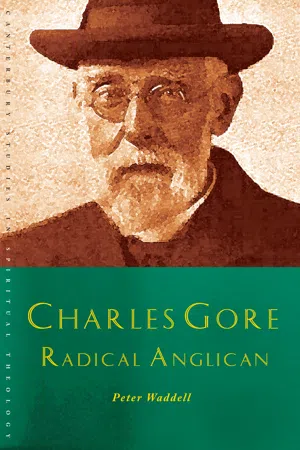
Charles Gore: Radical Anglican
Charles Gore and his writings
This book is available to read until 23rd December, 2025
- 224 pages
- English
- ePUB (mobile friendly)
- Available on iOS & Android
eBook - ePub
Available until 23 Dec |Learn more
About this book
Charles Gore (1853-1932) is a towering figure in Anglicanism whose writings and lectures shaped theological discussion for decades. They still offer a comprehensive vision of the Christian faith and provide a platform for exploring key issues in social and economic justice. This collection of his writings draws on published and unpublished works.
Frequently asked questions
Yes, you can cancel anytime from the Subscription tab in your account settings on the Perlego website. Your subscription will stay active until the end of your current billing period. Learn how to cancel your subscription.
At the moment all of our mobile-responsive ePub books are available to download via the app. Most of our PDFs are also available to download and we're working on making the final remaining ones downloadable now. Learn more here.
Perlego offers two plans: Essential and Complete
- Essential is ideal for learners and professionals who enjoy exploring a wide range of subjects. Access the Essential Library with 800,000+ trusted titles and best-sellers across business, personal growth, and the humanities. Includes unlimited reading time and Standard Read Aloud voice.
- Complete: Perfect for advanced learners and researchers needing full, unrestricted access. Unlock 1.4M+ books across hundreds of subjects, including academic and specialized titles. The Complete Plan also includes advanced features like Premium Read Aloud and Research Assistant.
We are an online textbook subscription service, where you can get access to an entire online library for less than the price of a single book per month. With over 1 million books across 1000+ topics, we’ve got you covered! Learn more here.
Look out for the read-aloud symbol on your next book to see if you can listen to it. The read-aloud tool reads text aloud for you, highlighting the text as it is being read. You can pause it, speed it up and slow it down. Learn more here.
Yes! You can use the Perlego app on both iOS or Android devices to read anytime, anywhere — even offline. Perfect for commutes or when you’re on the go.
Please note we cannot support devices running on iOS 13 and Android 7 or earlier. Learn more about using the app.
Please note we cannot support devices running on iOS 13 and Android 7 or earlier. Learn more about using the app.
Yes, you can access Charles Gore: Radical Anglican by Peter Waddell in PDF and/or ePUB format, as well as other popular books in Theology & Religion & Religious Biographies. We have over one million books available in our catalogue for you to explore.
Information
1
God
Gore always maintained that belief in God was thoroughly rational. In order to truly understand this claim, however, a deeper and broader conception of reason than that frequently entertained by the scientific culture of the modern West is required.
[The capacity for reaching decision about God] will need a frank recognition of the manifold grounds and methods of certainty. The methods of arriving at conclusions which is specially characteristic of science – what Darwin called “the grinding of general laws out of observed instances” – is a part of the operations of the human mind in gaining truth which it would be impossible to ignore and difficult to overestimate, but we cannot recognize in it the whole of our resources.
Consider the great artists. They convey to us truth about the universe which we are maimed beings if we do not recognize, but which is apprehended and conveyed and appreciated through methods wholly different from the methods of scientific reasoning, and which scientific reasoning can neither reach nor communicate. William de Morgan describes in a wonderful passage the effect of a sonata of Beethoven on a man without special musical gifts or knowledge in an hour of desolation and despair. It reasoned with him, after its manner. It conveyed to him reassurance which nothing else could convey. “I have ever since regarded the latter [Beethoven] as not so much a Composer as a Revelation.” “How often have I said to myself after some perfectly convincing phrase of Beethoven, ‘Of course, if that is so, there can be no occasion to worry’? It could not be translated, of course, into vulgar grammar or syntax; but it left no doubt on the point, for all that.” Those who have any appreciation of music, however deficient in musical science, must feel after long listening to Beethoven what this means. He conveys to us a temper of mind, almost a philosophy – though not such as can be made directly articulate in intellectual propositions. It is by feeling or intuition that this supreme artist gains his profound vision of experience and of God. But it seems to me quite impossible to deny that it is insight into reality, the sort of insight which at bottom involves a philosophy of rational meaning or purpose in the universe. “The rest may reason and welcome: ’tis we musicians know.”
The same claim must be made on behalf of the intuitions of the poets, the prophets, and the mystics in the most general sense – I mean the religious souls who have a clear intuition of God and live in communion with Him. All these classes of persons, who have played so vast a part in the history of mankind, are convinced of some kind of reality – some law or aspect or controlling spirit of the universe which is to them the most certain of realities; and this conviction of theirs has been reached often in utter scorn of reasoning, or at any rate not by its methods . . .
. . . All that I am now contending for is what artists and prophets and mystics have always insisted upon, and what the rising science of psychology is pressing upon us, not without perilous excess – viz. that if we want to reach the whole truth, so far as we can, concerning the world we live in, we must trust the whole of our faculties – not our powers of abstract reasoning, only, or only our powers of scientific discovery higher or lower, but also the more emotional and active powers of our nature – its capacities for intuition and feeling and willing. Anyone, in fact, who examines himself must almost certainly reach the conclusion that a great proportion of the convictions of his own mind, such as he would find it impossible to repudiate without repudiating his humanity, and impossible even to doubt without being self-convicted of treason against the good, have been arrived at by feeling; whether it be by a moral or religious tradition being verified and approved in his own conscience and experience, or by some feeling being aroused in himself individually and acted upon, and not by any process of reasoning.
Belief in God, pp. 35–40
To emphasize ‘feeling’, however, is not to deny or denigrate the place of reason in the knowledge of God. Rather, it is to offer an adequate account of reason, as involving more than empirical observation and logical deduction. In this passage, Gore offers a rational, philosophical argument for the reality of God (leaning heavily on the Idealist philosophy of T. H. Green, so influential in early twentieth-century Anglicanism) – but in a revealing aside, cautions that ‘argument’ is perhaps not the best word to describe where the real force making for intellectual conviction lies.
Reason is that in us which demands sequence, regularity, and order in things. It resents mere accident and chance occurrence. It could, in fact, only exist in a cosmos, i.e. an orderly world. And such a cosmos it finds from the first in sun and moon, in plant and animal, but mixed as it appears with what is incalculable and purely capricious – that is, irrational. But the more it knows, the more ground it finds for confidence that the appearance of capriciousness is due only to its ignorance. Nature, it grows to believe, is, in this sense, rational through and through, that it corresponds to this fundamental demand of reason for law and order in all things. This faith in a universal order – a faith continually more and more fully justified – is what makes science possible; and philosophy accompanying or anticipating science finds in this response of nature to the demand of reason the irresistible evidence of a universal reason or mind, ensouling nature, of which the reason or mind in us is the offspring or outcome, participating in and co-operating with the universal reason. This belief in the universal reason, with which our reason holds communion, was the Theism or belief in God of the educated world into which Christianity came. This, it was recognized, is the divine Being in which “we live and move and are.” Of this divine Being we, as rational beings, are in a special sense “the offspring” (Acts 17.28).
This argument (if it is to be called an argument, or this almost irresistible impression made upon us by the world) is the more popular form of what is called the epistemological argument – the argument, that is, from the analysis of knowledge. If we are at pains to analyse the most elementary kind of knowledge, our knowledge of external objects, trees and houses, chairs and tables, we discover, to our surprise and perhaps annoyance, that it is not the case, as we had supposed, that the world of objects is presented to us through our senses of touch and taste and sight and hearing, as it were, ready-made. To constitute an object in a world of objects there is needed a mind to hold together in permanent relation the materials of colour, pressure, sound, and smell which come to us through our sense. Only for such a perceiving, relating, remembering mind can a concrete object or world of objects exist. Mind, it appears, is necessary for its constitution. What sort of world a dragon-fly sees we cannot tell. But whatever it sees is, we must suppose, what its special soul or mind constitutes for it out of the materials which its senses supply to it.
This fact (for such it appears to be) has sometimes been represented by “subjective idealists” as if it meant that my mind is the maker of my world. But this is plainly contradictory to the ultimate certainty of common sense, which assures me that the world is presented to me, not made by me. The very suggestion of the opposite has made philosophy ridiculous. Also it is not what the analysis of the rudimentary act of knowledge would really suggest. Whatever the mind in me does, it does in absolute dependence upon and subordination to what is supplied to it in sensations – not only the sensations as isolated facts, but their impact upon us in a certain regularity of succession or simultaneity. The constructive work of my mind is absolutely dependent upon what it receives – the subjective process upon the data supplied.
Thus I need have no fear that philosophy is so absurd as to suggest a doubt that the external world is independent of me or the myriad other individual minds. But what it does suggest to me, or even force upon me, is that the reality of an ordered world can exist only for mind and in terms of mind. There seems to be no way of escaping this conclusion. The real world of a fly or a dog – whatever it may be – requires the mind of a fly or a dog for its existence. The man’s world of fuller reality requires the man’s mind. The whole of the world-reality in all its fullness and complexity postulates a universal and perfect mind, which (whether it be represented as its Creator or as its soul) would be instinctively called divine. And it is this divine mind which is communicating with me through all the process of sensitive experience. In knowing more about the world I am learning about God.
At least since the great days of Greece the philosophers and the poets of the human race have been, on the whole, constantly engaged in reinforcing this conviction, that you must interpret the material world in terms of mind or spirit, and not mind or spirit in terms of matter or physical force. Mind has the making of things, and without creative mind they could not be.
. . . I must profess that the epistemological argument does seem to me irresistible when it claims our recognition of Mind as necessary for a world; and when it bids us feel ourselves, in the mere act of perceiving a world of ordered objects, brought into some sort of communion with this Mind which is in all things.
Belief in God, pp. 49–52
An even greater force belongs to the closely related argument from the experience of beauty.
How shall we account for the beauty of inorganic nature – for the glory of the sea, for the majesty of mountains, for the exquisite beauty of nature’s lines, for the splendour and delicacy of sunsets, for the loveliness of clouds, for the music of sounds, for the fascination of motions and colours and shapes? On the largest scale we must confess that “nature all the time that it is working as a machine is also sleeping as a picture.” All this has no connexion with utility or survival value. And certainly, if any other quality in things is objective – in whatever sense the reality and qualities of natural objects are prior to the perceiving mind in man – beauty is so. It forces itself and impresses itself upon us.
And we cannot conceive it to be accidental. Our reason insists that there is in nature an intention of being beautiful – we cannot call it anything else – long prior to the existence of man in the world, which man first had the faculty to appreciate; or, in other words, that there is a spirit of beauty in the universe which communicates with and corresponds with the faculty of beauty in man. And if this argument is irresistible in inorganic nature, then it extends itself inevitably over the field of vegetable and animal life, whatever the methods by which beauty there develops. This argument also, in one form or another, seems to me overwhelming. I cannot resist this –
“. . . sense sublime
Of something far more deeply interfused
Whose dwelling is the light of setting suns
And the round ocean and the living air
And the blue sky, and in the minds of man –
A motion and a spirit which impels
All thinking things, all objects of all thought,
And rolls through all things.”
Belief in God, pp. 53–4
However, the supreme argument for the reality of God is from reflection not on rationality or beauty, but on (the related field of) morality.
. . . in some degree beauty lays on us, as free agents who have to do with the making of nature, a sense of duty. We ought to cultivate beauty. To deface nature is, we feel, an outrage. But this sense of absolute value and the accompanying sense of purpose and duty are conveyed far more strongly by our moral experiences. For most of us the strongest argument for God is the argument from conscience to a righteousness which is absolute and divine.
The moral sense, individual and social, in mankind – the sense of right or wrong – exhibits as varied and in many respects as obscure a history as any element in civilization or any mental or spiritual quality in man. But the rudeness of early beginnings, the gross misdirections, the strange perversions, the extra-ordinary variations, observable in the moral sense, as it appears in history, are equally observable in the faculty of reasoning and the sense of beauty. Whether the selfish instinct of self-preservation, coupled with the group instinct, which is altruistic, in the animals no less than in man, can account for the beginnings of morality is a question which at present we may pass by. For we are absolutely certain that in the highest specimens of our race, and under their leadership in the average good man of our experience, the sense of right or wrong has grown distinct from the sense of individual interest or social pressure, and has become what finds classical expression in the Antigone of Sophocles, or in the meditations of the Stoics, or in the minds of the Jewish prophets, or in the philosophy of Kant, or in Wordsworth’s Hymn to Duty – the consciousness of being in the presence of a something of absolute value, an authoritative and superhuman law of righteousness, a categorical imperative – “thou shalt” or “thou shalt not” laid upon man, which makes a peremptory claim upon his obedience, whatever be the pleasure or pain consequent to him upon the performance of his obligation.
It is, I claim, an irresistible conclusion that here, where this is recognized, that is, in the higher regions of human experience, whatever may have been the dark animal or tribal origins of this majestic faculty lies its real meaning and interpretation. It is incontestable that the glory and dignity of humanity depend upon, and are bound up with, the recognition of the supremacy of the moral ideal or law at a point where it has risen above, or distinguished itself from, social exigencies or personal advantages. Here, first, and here alone, where conscience recognizes its spiritual subordination to an eternal righteousness, claiming its glad obedience and co-operation, is the home of the moral freedom in which we recognize our true being . . . It involves the recognition of the morally right as a quality of absolute value, which imposes itself on man absolutely because he is rational and spiritual. It cannot be interpreted as a merely human quality. Thus we are bound to conclude that the ordered world, of which man is only a part, contains or involves this quality of eternal righteousness. Like reason itself, of which it is an aspect, like beauty, so righteousness belongs to the universal and eternal Being, and, because this is so, men have called this Being God, and worshipped it.
Belief in God, pp. 54–6
Gore was confident enough to claim that we could be taken thus far by the general trend of the philosophy of his day. Of course, as the use of Wordsworth suggests, the belief in God thus established was but a species (Gore said) of ‘higher pantheism’. It was not to be despised as such: ‘if this belief and accompanying worship is no more than pantheism, let us at least be pantheists’.1 Yet it is surpassed by Christian faith, on account of both the moral power of the latter and how it comes to us.
The pantheistic or philosophic conception of God as the universal being of whose substance we all form a part, of whom we know nothing except his expression of Himself in nature, is destitute of moral power. It leads to a kind of moral indifferency. Physical nature is apparently altogether indifferent to moral distinctions. It can be explained indeed as the handiwork of the good God, and as representing a stage in His self-revealing and educative purpose, if once we have got from somewhere beyond nature the disclosure of His person and character. But if we are left to draw conclusions from nature we shall arrive at no clear conception of divine righteousness; and if we include human nature, we shall still be bewildered by the strange mixture of good and evil, which seem to wage an uncertain struggle, or, very often, a struggle in which the good appears to be defeated. If manhood be identical with godhead, we must ask, is God more good than bad? or is He becoming better as the generations pass? And if the human spirit be only an element in the All which is God, is it the element which is d...
Table of contents
- Charles Gore
- Contents
- Acknowledgements
- Vignettes
- Charles Gore: Outline of a Life
- Select Bibliography
- Introduction
- 1 God
- 2 Jesus Christ
- 3 The Church and the Sacraments
- 4 Being Anglican
- 5 The Bible
- 6 Ethics and Politics
- 7 Spirituality