eBook - ePub
Available until 23 Dec |Learn more
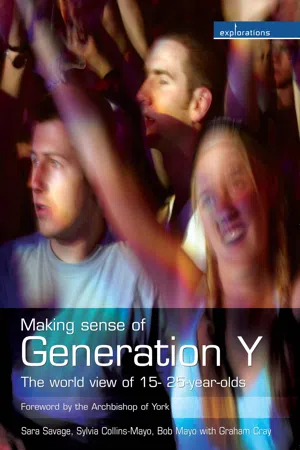
Making Sense of Generation Y
The World View of 16- to 25- year-olds
This book is available to read until 23rd December, 2025
- 224 pages
- English
- ePUB (mobile friendly)
- Available on iOS & Android
eBook - ePub
Available until 23 Dec |Learn more
About this book
For Generation Y, born after 1982, relationships happen over the Internet and music marks their territory. How does this generation think about the world? What does their spirituality look like? And what implications does this have for the Church? This book addresses the need for the Church to reconnect and communicate with young people.
Frequently asked questions
Yes, you can cancel anytime from the Subscription tab in your account settings on the Perlego website. Your subscription will stay active until the end of your current billing period. Learn how to cancel your subscription.
No, books cannot be downloaded as external files, such as PDFs, for use outside of Perlego. However, you can download books within the Perlego app for offline reading on mobile or tablet. Learn more here.
Perlego offers two plans: Essential and Complete
- Essential is ideal for learners and professionals who enjoy exploring a wide range of subjects. Access the Essential Library with 800,000+ trusted titles and best-sellers across business, personal growth, and the humanities. Includes unlimited reading time and Standard Read Aloud voice.
- Complete: Perfect for advanced learners and researchers needing full, unrestricted access. Unlock 1.4M+ books across hundreds of subjects, including academic and specialized titles. The Complete Plan also includes advanced features like Premium Read Aloud and Research Assistant.
We are an online textbook subscription service, where you can get access to an entire online library for less than the price of a single book per month. With over 1 million books across 1000+ topics, we’ve got you covered! Learn more here.
Look out for the read-aloud symbol on your next book to see if you can listen to it. The read-aloud tool reads text aloud for you, highlighting the text as it is being read. You can pause it, speed it up and slow it down. Learn more here.
Yes! You can use the Perlego app on both iOS or Android devices to read anytime, anywhere — even offline. Perfect for commutes or when you’re on the go.
Please note we cannot support devices running on iOS 13 and Android 7 or earlier. Learn more about using the app.
Please note we cannot support devices running on iOS 13 and Android 7 or earlier. Learn more about using the app.
Yes, you can access Making Sense of Generation Y by Sara Savage in PDF and/or ePUB format, as well as other popular books in Theology & Religion & Christianity. We have over one million books available in our catalogue for you to explore.
Information
PART ONE:
THE WORLD VIEW OF GENERATION Y
1
Young people and the Church
Take a walk down any high street and you will find the supernatural on sale. You can buy glow-in-the-dark crosses, Kabbalah bracelets, Harry Potter books. Read a newspaper for your daily horoscope; turn on the television for celebrity endorsements of yoga: popular culture is oozing with spirituality. Yet enter a church on an average Sunday and chances are it will be at least half empty. This is particularly so if the church lacks young people in their teens or early twenties.
Young people are a litmus test for a church’s viability. In 1998, only 7 per cent of 15- to 19-year-olds, and 5 per cent of 20- to 29-year-olds went to church on a Sunday.1 Meanwhile, church decline continues. Does the spiritual sensibility of young people now lie outside the Church and inside the cinemas and nightclubs of popular culture?
Our task was to discover to what extent young people make sense of themselves and their world through the popular arts – that milieu in which youth live, move and have their being. We wondered what young people’s world view and spirituality look like. We wondered whether – a wild hope! – the popular arts could resource the Church to ‘do’ theology in meaningful ways.
To try to answer these questions we began a research project into the world view of Generation Y, those aged 15 to 25. Three researchers, a Christian psychologist (Sara Savage), a sociologist of religion (Sylvia Collins-Mayo) and a theologian and expert in youth and community work (Bob Mayo), together analysed young people’s conversations as they responded to music, clubbing, films, TV soaps and culturally iconic images.
The next chapters describe the socially shared world in which these young people are immersed, unveiling a large mismatch between the Church’s and young people’s world view. Our aim, from the outset, was to help the Church listen to young people in order to regain an authentic relationship with them.
This book presents the findings and conclusions of our study. In Part One we set out the broad picture of young people’s world view, the general significance of popular art and culture to them, and their religious and spiritual sensibility. We present our research method and an overview of our findings. In Part Two we look more closely at young people’s world view arising from their interaction with specific aspects of popular culture. In Part Three we discuss principles for youth work that emerge as a result of our research and Bishop Graham Cray reflects on the implications that the world view of Generation Y has for the Church.
We begin by setting out the background to our study and defining the terms we will be using.
Young people and generations
Let us clarify what we mean by ‘young people’ and ‘Generation Y’. The terms ‘youth’ and ‘young people’ conjure up many images. Young people are seen as creative, beautiful, enthusiastic, carefree, passionate, energetic, fun, full of potential and hope for the future. The Anglican Church’s report, Youth A Part reminds us of the way young people’s accomplishments contribute to society.2 At the same time, young people are also seen as moody, rebellious, vulnerable, troubled, troublesome and dangerous. Newspaper headlines draw attention to the high rate of teenage pregnancies, young male suicides, teenage drug and alcohol problems, youth homelessness, and violence committed by and upon young people. All of these views are true of some young people, some of the time. The diversity of images indicates how difficult it is to pin down ‘young people’ as a single group.
Age as a marker of youth is itself subject to increasing flexibility. In our study we were primarily interested in young people in their late teens and early twenties. But if youth is regarded as a period of transition between dependent childhood and independent adulthood then, due to changes in social structures and attitudes, a person can be described as ‘young’ right up to their thirties. Traditional markers of adulthood such as entering the labour market, establishing a settled partnership or marriage, having children and setting up a home, are generally occurring later in life than they were 20 or 30 years ago. At the lower end of the age range, the ‘tweenage’ group (10- to 13-year-olds) seems to have much in common with older teens in terms of consumer interest and spending power. Young people can therefore be anything from 11 to 30 years old.
Given such social diversity, how can we talk about young people as a coherent social group? It is here that we find the idea of generations particularly helpful. Generations can be understood in a number of ways,3 but here we draw on Karl Mannheim’s4 view that a ‘generation’ refers to a group of people who experience and respond to specific socio-historical conditions in common ways, depending in part on age. In other words, people growing up, living through and responding to particular historical events, political structures, dominant ideologies and technical developments together form a generation with a shared world view that distinguishes them from other generations. For Mannheim, it is the events, ideas and experiences encountered by young people between the ages of 17 to 25 that particularly shape their generation. Writers differ in terms of the labels and birth year boundaries they apply to particular generations, but they are usually periods of about 20 years. For the twentieth century, Hilborn and Bird use the names and characteristics below.5
• The World War Generation (also known as the GI Generation in the United States – born 1901–24). This generation’s self-understanding and view of the world was shaped by their experience of two world wars separated by a period of economic depression and reconstruction. It has been argued that the World War Generation was characterized by confidence, having witnessed advances in science, medicine and technology, but it was also essentially a conformist generation where young people joined movements such as the Boy Scouts and Girl Guides and traditional patterns of social order were preferred. Prominent ideologies for the World War Generation were ‘modernism, scientific progressivism, Marxism, socialism, Freudianism, existentialism and capitalism’.6
• Builder Generation (also known as the Silent Generation – born 1925–45). Builders had much in common with their parents and in many ways consolidated their parents’ achievements and continued building the future after World War II. It has been suggested that Builders tended towards conservative tastes, but at the same time they were also the first generation to have a recognizable ‘teen age’, marked by the development of a youth market in the 1950s based on music, fashion and entertainment – a market that has grown into the popular arts and culture we are interested in today, and a market which has helped define ‘youth’ as a concept ever since. Post-war affluence was key to this development of youth consumerism. It enabled the rapid expansion of the popular music industry, the invention of ‘teenpics’ in cinemas and the development of youth-orientated television. Like the generation before, the prominent ideologies for the Builder Generation were ‘modernism, scientific progressivism, Marxism, socialism, Freudianism, existentialism and capitalism’.7
• Boomer Generation (so called because the birth rate increased after World War II creating a ‘baby boom’ – born 1946–63). Boomers are usually characterized by the counter-culture of the 1960s. Disillusioned with traditional institutions and authorities (including the Church), young Boomers began to look for new, authentic ways of living. Their focus was on the immediacy of experiences, and the values of freedom, self-realization and autonomy. They were a liberal, idealistic and optimistic generation; politically active, looking forward to a future of peace, love and prosperity without the constraints society imposed on their parents. They were the first young people to have access to the contraceptive pill, and (the middle class at least) to benefit from the expansion of higher education. Later they would also make use of the relaxation of the divorce laws in the 1960s. It has been observed that the Boomers were the first to be generationally conscious and aware of a gap between their values and ways of living compared to that of their parents. This generation gap was primarily expressed through popular music. Prominent ideologies for the Boomer Generation included ‘modernism, scientific progressivism, Marxism, socialism, secularism, free-market capitalism, free expression, individualism, and “DIY” spirituality’.8
• Generation X (sometimes called the Buster Generation because there was a small dip in the birth rate after the Boomers – born 1964–81). Generation X picked up the legacy of the Boomers and in some ways paid the price of their experimentation with the counter-culture. Generation X were the latchkey kids who saw the divorce rate rise among their parents and the AIDS epidemic spread among their peers. Generation X also grew up through an economic recession where unemployment was a reality faced by many young people. Conseque...
Table of contents
- Cover
- Title
- Acknowledgements
- Contents
- Foreword
- Preface
- Part One: The World View of Generation Y
- Part Two: A Closer View
- Part Three: Implications for Youth Work and the Wider Church
- Appendix
- Bibliography
- About the Authors
- Copyright