eBook - ePub
Available until 23 Dec |Learn more
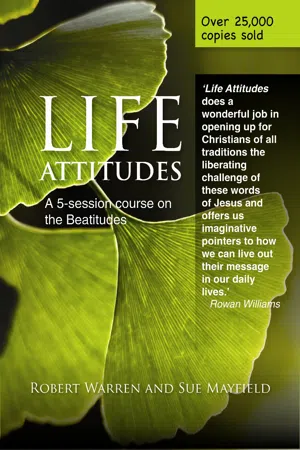
Life Attitudes
A Five-session Course on the Beatitudes for Lent
This book is available to read until 23rd December, 2025
- 64 pages
- English
- ePUB (mobile friendly)
- Available on iOS & Android
eBook - ePub
Available until 23 Dec |Learn more
About this book
A five part course for small groups encouraging Christians to examine their lifestyle in the light of Jesus' radical teaching in the Beatitudes and to live out these kingdom values – now.
Frequently asked questions
Yes, you can cancel anytime from the Subscription tab in your account settings on the Perlego website. Your subscription will stay active until the end of your current billing period. Learn how to cancel your subscription.
No, books cannot be downloaded as external files, such as PDFs, for use outside of Perlego. However, you can download books within the Perlego app for offline reading on mobile or tablet. Learn more here.
Perlego offers two plans: Essential and Complete
- Essential is ideal for learners and professionals who enjoy exploring a wide range of subjects. Access the Essential Library with 800,000+ trusted titles and best-sellers across business, personal growth, and the humanities. Includes unlimited reading time and Standard Read Aloud voice.
- Complete: Perfect for advanced learners and researchers needing full, unrestricted access. Unlock 1.4M+ books across hundreds of subjects, including academic and specialized titles. The Complete Plan also includes advanced features like Premium Read Aloud and Research Assistant.
We are an online textbook subscription service, where you can get access to an entire online library for less than the price of a single book per month. With over 1 million books across 1000+ topics, we’ve got you covered! Learn more here.
Look out for the read-aloud symbol on your next book to see if you can listen to it. The read-aloud tool reads text aloud for you, highlighting the text as it is being read. You can pause it, speed it up and slow it down. Learn more here.
Yes! You can use the Perlego app on both iOS or Android devices to read anytime, anywhere — even offline. Perfect for commutes or when you’re on the go.
Please note we cannot support devices running on iOS 13 and Android 7 or earlier. Learn more about using the app.
Please note we cannot support devices running on iOS 13 and Android 7 or earlier. Learn more about using the app.
Yes, you can access Life Attitudes by Robert Warren in PDF and/or ePUB format, as well as other popular books in Theology & Religion & Christianity. We have over one million books available in our catalogue for you to explore.
Information
>>1 Living Well/Beforehand
Introducing the Beatitudes (Matthew 5.3-10)
>>Aim
This session aims to introduce the Beatitudes, giving an overview of all eight sayings as a prelude to the rest of the course.
What you will need
> flipchart and marker pens;
> A4 paper and pens;
> copies of this book (preferably one each);
> candle, objects or images of Christ (optional – see here and here).
>>Background
What are ‘Beatitudes’?
The sayings of Jesus that we call the Beatitudes (Matthew 5.3-10) come at the beginning of the three chapters in Matthew’s Gospel (Chapters 5-7) that are referred to as the Sermon on the Mount. There is another version of the sayings in Luke 6.17-49.
The Oxford English Dictionary gives the meaning of the word ‘Beatitude’ as ‘1. Supreme blessedness or happiness. 2. An ascription of special blessedness, especially those pronounced by Christ in the Sermon on the Mount.’
Most versions of the Bible use the word ‘Blessed’, although some versions, such as the Good News, translate the word as ‘Happy’.
For some, the word ‘Blessed’ has become so overfamiliar and wellworn that Jesus’ words lose their impact. As Philip Yancey puts it: ‘Blessed is far too sedate … to carry the percussive force Jesus intended. The Greek word conveys something like a short cry of joy, “Oh you lucky person!”’ (The Jesus I Never Knew, p. 105).
Unlocking the Beatitudes
The Beatitudes are a closed book to many of us. We struggle to understand them and when we glimpse their meaning we aren’t sure if we agree with them! To some they appear to be a ‘charter for wimps’. They can seem to be so other-worldly and unattainable – impossible to practise in real life.
Throughout history, the Beatitudes have suffered serious misinterpretation. Church, history, and society itself, have often distorted their meaning. Sometimes they have been confined to a purely personal, privatized spirituality when – though certainly life-changing for the individual believer – they embrace communal, global and political agendas too. Some people have suggested that the Beatitudes simply reflect different personality types; with the shrinking violets practising meekness and the aggressive ones among us being those who suffer persecution.
So how can we know what Jesus meant by the Beatitudes? There is a simple answer. The Beatitudes are about the characteristics of the children of the kingdom, children of the heavenly Father. And the supreme role model for such a calling is Jesus Christ himself.
How Jesus lived is the key to the interpretation of the Beatitudes. He is the living embodiment of these truths. His whole life is therefore a commentary on them.
The shape of the Beatitudes
There is a wonderful beauty, order and rhythm in the eight Beatitudes.
> Each one begins with the assurance of God’s blessing.
> Each one describes a kingdom characteristic or value, which Jesus says is foundational to living as a child of the heavenly Father.
> Each one ends with a promise of what lies ahead for those on this particular path.
All the promises refer to blessings – some of which are promised in the future and some of which are promised now. This balance of ‘now’ and ‘not yet’ expresses the paradox in the teaching of Jesus that the kingdom has come among us, yet we are to pray for its coming.
A further symmetry is that the fourth and eighth Beatitudes are both about righteousness. One is about hungering for it, the other about suffering persecution because of it. Maturity in God’s sight is about eagerly seeking after righteousness but also being willing to suffer for it. This suggests that the interpretation of the Beatitudes as a ‘charter for wimps’ cannot stand. Working and fighting for righteousness do not fit with a weak approach to life – things certainly did not work out like that in the life of Jesus.
The significance of the Beatitudes
In some ways, the Beatitudes are to the New Testament what the Ten Commandments are to the Old Testament. Both outline a lifestyle desirable to God. The Beatitudes, however, are not laws – rather they are statements of grace. They overflow with affirmation, accepting love and reassurance. Blessing, gift, hope, encouragement, grace; these are the foundations on which the kingdom announced by Jesus is built. This speaks to the depths of who we are, for so often we are actually more at home ‘trying hard to be good’, than we are in receiving the goodness and gift of God’s love. The Beatitudes take us into a whole new realm of living by and in the grace of God.
>>Living Well/The Session
>>Welcome (10 minutes)
Introductions

Make sure members of the group know each other’s names and are made to feel welcome. If this is a new group meeting for the first time, invite members of the group to introduce themselves. You could divide everyone into pairs, give the pairs five minutes to introduce themselves to each other, then ask each person to introduce their partner to the rest of the group.
Pray
Create a still atmosphere. You might like to light a candle, play some music or encourage people to focus on a visual resource such as a cross or image of Christ (see suggestions here and here).
Either pray in your own words, asking God to help you as you begin your course of study, or use the Course Prayer. One person could read it out or you could say it corporately.
Course Prayer
Almighty God
Thank you that you meet us where we are
And beckon us into your kingdom.
As we journey together
May we en...
Table of contents
- Cover
- Title
- Acknowledgements
- Contents
- The Beatitudes
- Introduction
- 1 Living Well/Beforehand
- 2 Living Openly/Beforehand
- 3 Living Purposefully/beforehand
- 4 Living Lovingly/Beforehand
- 5 Living Differently/Beforehand
- Bibliography and Further Resources
- Copyright