This book is available to read until 23rd December, 2025
- 160 pages
- English
- ePUB (mobile friendly)
- Available on iOS & Android
eBook - ePub
Available until 23 Dec |Learn more
About this book
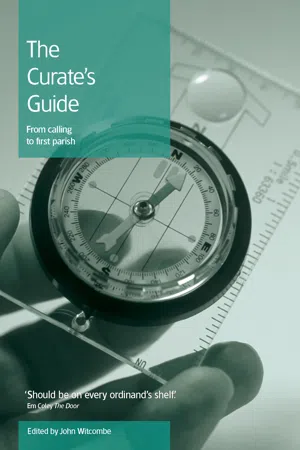
An accessible and informative guide for curates combining essential information, practical survival tips and theological reflection grounded in experience of the highs and lows of ministry.
Frequently asked questions
Yes, you can cancel anytime from the Subscription tab in your account settings on the Perlego website. Your subscription will stay active until the end of your current billing period. Learn how to cancel your subscription.
No, books cannot be downloaded as external files, such as PDFs, for use outside of Perlego. However, you can download books within the Perlego app for offline reading on mobile or tablet. Learn more here.
Perlego offers two plans: Essential and Complete
- Essential is ideal for learners and professionals who enjoy exploring a wide range of subjects. Access the Essential Library with 800,000+ trusted titles and best-sellers across business, personal growth, and the humanities. Includes unlimited reading time and Standard Read Aloud voice.
- Complete: Perfect for advanced learners and researchers needing full, unrestricted access. Unlock 1.4M+ books across hundreds of subjects, including academic and specialized titles. The Complete Plan also includes advanced features like Premium Read Aloud and Research Assistant.
We are an online textbook subscription service, where you can get access to an entire online library for less than the price of a single book per month. With over 1 million books across 1000+ topics, we’ve got you covered! Learn more here.
Look out for the read-aloud symbol on your next book to see if you can listen to it. The read-aloud tool reads text aloud for you, highlighting the text as it is being read. You can pause it, speed it up and slow it down. Learn more here.
Yes! You can use the Perlego app on both iOS or Android devices to read anytime, anywhere — even offline. Perfect for commutes or when you’re on the go.
Please note we cannot support devices running on iOS 13 and Android 7 or earlier. Learn more about using the app.
Please note we cannot support devices running on iOS 13 and Android 7 or earlier. Learn more about using the app.
Yes, you can access The Curate's Guide by John Witcombe in PDF and/or ePUB format, as well as other popular books in Theology & Religion & Christianity. We have over one million books available in our catalogue for you to explore.
Information
1
Vocation, discernment and selection
John Witcombe
There are many forms of ministry. Everyone who is a church member has a ‘ministry’ – a role, or a part to play, in the life, ministry and mission of the Church. Some see the beginnings of a recognized ministry in a Christian life as early as baptism, others think it starts at confirmation. Whether ‘officially’ recognized or not, any response in faith to Jesus will involve a call to live a new life – and part of this new life will be to play a part in the life of the Church as it witnesses to Jesus in the world.
Discerning the role to which we are called is an important part of maturing as a Christian.There are many excellent books to help with this process, and it cannot be seriously undertaken without consultation with a local church community and its ministers.The particular calling to ordained ministry needs to be seen within the context of the kaleidoscope of all the possible callings upon the lives of Christians, all of which are necessary in order for the Church to fulfil its calling to be the Body of Christ.
‘I don’t know if this sounds crazy, but have you ever thought of being ordained?’
It is often friends or family who first suggest ordination – but recognition of a call to ordained ministry may come in a variety of ways. My own call to ordination crystallized in the middle of a stewardship sermon. As I listened to the preacher speak about how giving money symbolizes the giving of our lives, I just knew that I should offer my life to God in this particular way. I started to talk to my own minister, and to friends – both those who were Christians and those who weren’t – and everyone seemed to think it was a great idea. The only ones who weren’t too sure were my family – perhaps they knew me too well!
What were my motivations? Commitment to God? – probably.A desire to make a difference? – certainly. I had little idea of what vicars, or curates, actually did – and any attempts I made to find out led me down an increasingly frustrating path where I got the same response from those who were already ordained of extreme busyness, but without their being able to put into words exactly what they were so busy with.
‘What is it that you do, then, as a curate?’
The word ‘curate’ was originally a general term for all parish clergy – it is used in this way in the Book of Common Prayer in both its 1549 and its 1662 versions, where it means all those who share the ‘cure of souls’ in a particular parish. In later years, the identification of rectors and vicars as those carrying responsibility for parishes led to the associated identification of all other clergy in a parish as ‘curates’ – of which there were sometimes large numbers.The use of the term to mean clergy in training posts – its current meaning – emerged only fairly recently. A curacy is now, however, the starting place for almost all those who are ordained, and indicates an assistant position in a parish under the supervision of a training incumbent.The life and work that this entails will be described in more detail in subsequent chapters.
‘How do I decide? How do they decide?’
The process of ‘discernment’ (seeking to recognize God’s will) can be lengthy. The role of an ordained person is to represent the Church, and in so doing to represent God in a special, authorized way. It is a demanding job, which at times will be beyond anyone’s natural abilities – but with a calling from God comes also an equipping from him. Candidates are reminded in the ordination service:
Because you cannot bear the weight of this ministry in your own strength but only by the grace and power of God, pray earnestly for his Holy Spirit.
The testing of a call is very important, for the sake of the individual, their family and friends, the church that they will serve, and the world in which the Church exercises its ministry. It can be a frustrating process, and will demand patience and a good sense of humour! It is curiously akin to pregnancy, where there is both the desire to tell everyone what’s going on, and a certain caution, especially in the early stages, arising from an uncertainty as to the possible outcome.
If the initial explorations of discernment take place in the privacy of the candidate’s own heart and mind, and then with the closest circle of family and friends, the next stage sees a ‘rippling out’ through the local church, the local diocese and lastly the whole Church of England, through the Ministry Division. This progression enables a wider reflection upon God’s calling, and for it to be seen within the wider context of God’s work in the Church at a national, and not simply a local, level.
Decisions, decisions … and dioceses
Before we go any further, a word about dioceses in the Church of England. In the organization of the Anglican Church, the primary unit is the diocese. Each diocese contains a number of parishes and is led by a bishop.The bishop ‘shares’ responsibility for each parish with the incumbent, usually known as the vicar or rector. (This sharing is expressed in the institution service for a new parish priest in the words: ‘Receive the cure of souls for [this parish], which is both yours and mine.’)
Dioceses are gathered together into provinces, and each province has its own archbishop; in England there are two provinces, Canterbury and York. Although the members of the Church in a province may come together for synods – governing bodies – to discuss important policy matters, practical matters within dioceses are under the direction of each individual bishop.This means that bishops are able to discern and act on what God is calling his Church to in each particular diocesan area – what can be called contextualization – rather than needing to follow a nationally imposed agenda. It also means, however, that there is no one single pattern for how the Church makes decisions, or carries those decisions out, across the country. For those sensing a call to ordination, this can be confusing, as one diocese’s approach may vary significantly from another’s.
The role of the DDO
It is your local minister who will, with your permission (reluctant or enthusiastic!), set the ball rolling, by arranging at an early stage for you to see the Diocesan Director of Ordinands (the DDO). Each diocese has a DDO who is responsible for helping anyone exploring a call to ordination to think through what it means, and whether it may be right for them. Several dioceses have more than one person sharing this responsibility, and you may find yourself meeting with a number of different people to talk about why you think God may be calling you in this way. The DDO may decide to work with you over a period of several months or even years before recommending that you attend a selection conference.
During this time, there will be opportunities for you to reflect further on your own Christian life and ministry, your understanding of ordination, and especially on your experience and understanding of the Church. A priest carries the authority of, and represents, the whole Church – not just that flavour of which they have been a part. As the Church of England is so diverse, it is important for those offering for ministry to be able, with integrity, to recognize God’s work across all traditions, and to be able to work across a variety of ‘churchmanships’ (a way of describing the ‘style’ of a church’s pattern of life and worship). It can come as a surprise to those who have been Christians for many years that there are many different ways of expressing faith and discipleship in the Church of England!
High church, low church, not very sure church
The Church of England has existed since the Reformation in the sixteenth century, with historical and theological roots reaching back before this through the medieval Roman Church to the original Roman and Celtic missions to this country. It has always been a diverse Church because it provides for the needs of a diverse population, identified primarily by geography rather than doctrinal position. It has also experienced successive waves of renewing movements, including the Wesleyan revivals of the eighteenth century, the evangelical and Tractarian (Anglo-Catholic, or ‘high church’) movements of the nineteenth century, and the liberal and charismatic movements of the twentieth century. All these have brought new life and hope to the Church, and all have left their mark – particularly on the history and contemporary life of individual parishes. Even dioceses will bear the distinctive marks of one or other of these life-bearing movements – so one diocese may have a predominantly evangelical (or ‘low church’) feel, whilst its neighbour may be more Catholic. The outward signs of these traditions may be in the style of clothes worn by the clergy, both ‘everyday’ and in the robes chosen for services. Like sacraments, these are indications of some real divergence in understanding of the nature of ministry and the Church’s life. There isn’t space here to describe the way in which some of these emphasize the significance of Scripture, others the tradition of God’s work in the Church, others the human responsibility and solidarity that we are called to exercise, and still others the renewing contemporary work of the Spirit. A prospective minister will be ordained to represent the whole Church, and needs to be able to understand the distinctive contribution that each part brings, without which the whole would be impoverished.
The period of discerning your call in the diocese may thus include a placement in a church of a different tradition from your own. This is to give you the opportunity to discover for yourself how God may be at work in patterns of church life that you have not previously experienced – and of which you may have been quite critical.
In some dioceses, the discernment period will also include a requirement to test and develop your understanding of the role of a priest, and your reflective skills, through written assignments. As with the other parts of the process, it is unwise to view these as hoops to be jumped through, or obstacles to be negotiated with as little pain as possible. Instead, they are opportunities to think more deeply about your vocation, and to ensure that you are in tune with the Church and the Spirit as you explore the possibilities for your life.
Other pieces in the discernment jigsaw
The task of discernment is twofold: as well as seeking to establish your suitability for the ordained ministry, it also needs to build up as accurate a picture of you as possible, reflecting realistically upon your strengths and weaknesses and your particular gifts. It needs to look both to the past, and to the potential of the future, searching always for a thorough integration in your life.
Family, friends and parish
It will be important for you to take notice of the views of those who know you in as many different contexts as possible – friends, family, colleagues.You will also be asked to provide referees prior to going to a selection conference (see below) who will be able to speak about your faith, your relationships with colleagues and others, your pastoral and academic strengths, and your character. It will often be useful to sit down with your referees to help them complete the forms, which are very detailed (this information may be found on the Ministry Division website which you will find extremely useful.1
The support of your local parish is a vital part of the jigsaw. Some churches choose to interview candidates before adding their support to a minister’s reference. Others should at the least have a discussion at the church council to reflect together on their experience of a candidate’s ministry, to assist the discernment process.
Sometimes a candidate does not have the support of their local church or minister.This is not necessarily a barrier to moving on in the process, as it is recognized that there may be many reasons for a person to be looked upon in one way by a particular parish or minister whilst the wider Church would value them in a different way. Nevertheless, lack of support from a home parish or minister would of course be a cause for concern, and would need to be carefully explored.
Candidates from parishes under Alternative Episcopal Oversight – those who do not recognize or receive the ministry of ordained women priests – follow the same route for selection as other candidates.The Church of England remains committed to recognizing the diversity of beliefs about ordination, and seeks to maintain good relationships throughout the Church.The ordination of candidates from such parishes may take place in a different context from that of those from other parishes.
Divorce and remarriage
The Church of England’s view on remarriage is, like many of its views, complex – it is made up of a variety of different and sometimes contradictory attitudes held together in what one hopes may be a godly tension. It is not, therefore, a bar to ordination for a candidate or a candidate’s spouse to have been divorced and remarried (or to be married to a divorcee), but it is a cause for investigation.This process is detailed, and can take some time. It will involve revisiting the history of the breakdown of the former marriage(s), including perhaps seeking statements from the former partner(s), with the hope of ascertaining that the present relationship did not cause the breakdown of the earlier marriage. Attitudes to this process will vary, and it will seem to some that matters that had been thought to have been consigned to history will be needlessly reopened. As with other parts of the discernment process, the candidate may choose to approach this process with resentment or with an attitude which welcomes the opportunity to ensure that real wounds really have been healed, ...
Table of contents
- Cover
- Title
- Contents
- Introduction
- 1 Vocation, Discernment and Selection
- 2 The Context of Ministry
- 3 Getting Started: Training and Finding a Curacy
- 4 Inner Self: the ‘Being’ of Being a Curate
- 5 Public Ministry
- 6 Maturing Into Your Vocation
- 7 Self-Management
- 8 Moving On
- Epilogue
- About the Authors
- Copyright