This book is available to read until 23rd December, 2025
- 224 pages
- English
- ePUB (mobile friendly)
- Available on iOS & Android
eBook - ePub
Available until 23 Dec |Learn more
About this book
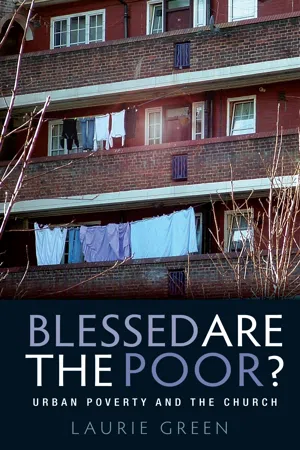
Laurie Green considers a number of key biblical texts as well as recent research on poverty in the UK and asks what the Church's ministry among the poor would need to look like in order to be true to the gospel. The book ends with practical outcomes for pavement-level ministry.
Frequently asked questions
Yes, you can cancel anytime from the Subscription tab in your account settings on the Perlego website. Your subscription will stay active until the end of your current billing period. Learn how to cancel your subscription.
No, books cannot be downloaded as external files, such as PDFs, for use outside of Perlego. However, you can download books within the Perlego app for offline reading on mobile or tablet. Learn more here.
Perlego offers two plans: Essential and Complete
- Essential is ideal for learners and professionals who enjoy exploring a wide range of subjects. Access the Essential Library with 800,000+ trusted titles and best-sellers across business, personal growth, and the humanities. Includes unlimited reading time and Standard Read Aloud voice.
- Complete: Perfect for advanced learners and researchers needing full, unrestricted access. Unlock 1.4M+ books across hundreds of subjects, including academic and specialized titles. The Complete Plan also includes advanced features like Premium Read Aloud and Research Assistant.
We are an online textbook subscription service, where you can get access to an entire online library for less than the price of a single book per month. With over 1 million books across 1000+ topics, we’ve got you covered! Learn more here.
Look out for the read-aloud symbol on your next book to see if you can listen to it. The read-aloud tool reads text aloud for you, highlighting the text as it is being read. You can pause it, speed it up and slow it down. Learn more here.
Yes! You can use the Perlego app on both iOS or Android devices to read anytime, anywhere — even offline. Perfect for commutes or when you’re on the go.
Please note we cannot support devices running on iOS 13 and Android 7 or earlier. Learn more about using the app.
Please note we cannot support devices running on iOS 13 and Android 7 or earlier. Learn more about using the app.
Yes, you can access Blessed are the Poor? by Laurie Green in PDF and/or ePUB format, as well as other popular books in Teología y religión & Ministerio cristiano. We have over one million books available in our catalogue for you to explore.
Information
1
Blessed Are the Poor?
A minister friend of mine who has lived on a very poor estate for some years describes his environment in the following way:
The estate has many open spaces and was clearly designed to be an above average place to live. However, rents were too high for many ordinary people, and so the situation developed whereby people on housing benefit tended to be moved in. The estate has become one of the dumping grounds of the town. By one well-used statistical index it is the sixtieth most deprived area in England. Murders tend to be particularly violent, and quite a few are carried out by women. A recent arson attack saw a house completely destroyed, but fortunately the family were not injured. SRB [the Government’s Single Regeneration Budget] funding has been a big help. The last beat manager had excellent results, but now one beat manager is responsible for the whole estate and another difficult patch together. While there was money for estate caretakers, they made a big difference. One local activist made an impact over 15 years, but she died a few months ago. The local CSV [Community Service Volunteers] have two part-time workers on the estate as a result of a successful Lottery bid. That project has two years to run. The school achieves amazing results and employs many extremely dedicated staff. Many of the kids are poorly nourished and arrive hungry at school. They may not have a coat even for sub-zero conditions. A large percentage have to be self-reliant from an early age. Some even have parents who sell their kids’ Ritalin prescriptions. A number born on the estate are never taken anywhere, even into the town centre.
There has been a small congregation on the estate for about 33 years. It has never had a church building and alwaysworshipped in community facilities. One vicar stayed for about 20 years and was a bit like their mother. People who worship here tend to be very poorly educated with some almost on the special needs level, but one of those disabled worshippers has a faith to shame us all, and I am very grateful she is here. Another estate, local to us, boasts a churchwarden with Down’s syndrome. A group of evangelists who are connected with the Church of England has started work with local women and are running an Alpha club for kids after school. They are in the process of applying for CCF [Church and Community Fund] money. We are still looking for a way to work together. It’s Jesus or bust on this estate.
There is no romanticism or glamour in his description, and yet he would not choose to live or work anywhere else. He later explained to me that after many years of committed, embedded experience in this deprived estate, he has grown so much to love the people he meets every day that he believes in his heart that Jesus is right to say they are blessed, but he is at a loss to articulate quite why. He certainly senses that the Jesus he meets in the Gospels would feel very much at home with these people.
Poverty in Galilee
The Galilee of Jesus’ day was not, relatively, a poor region – indeed it was considered by the Romans to be an economically wealthy province due to its very fertile plain, the agricultural skills of its people and its advances in food technology, not least in the fish processing industry. But this wealth was not evenly distributed. Herod Antipas, in order to support his huge building programme, was taxing at a rate of between 25 and 40 per cent of both income and produce, which forced farmers to grow less crops for local consumption and produce instead crops that would raise a cash return. This left many local people hungry and drove many small farmers into debt, so that wealthy investors from abroad were easily able to buy out local farms. That meant that farm workers were now often labouring on land that they themselves had once owned, but which was now in the hands of absentee landlords. It was against this deeply felt sense of injustice that Jesus told such parables as that of the Vineyard Tenants and the Absent Landlord (Matt. 21.33–43). Likewise, while fishing on the Sea of Galilee had once been able to support lucrative family businesses like that of Zebedee and his sons (Mark 1.19–20), as a result of the eager competitiveness of the semi-globalization of the Roman Empire, the fish stocks were now being ruthlessly exploited and over-fished by foreign entrepreneurs using local day labourers. The fish were taken to the local factories in Magdala and other lakeside cities to manufacture salt-fish products, especially the Garum sauce which sold so well in Rome. Many Galilean fishermen were forced to sell up under such pressure and therefore had good reason to feel disaffected. As Jesus had occasion to observe, from the poor was taken what little they had, while the rich accrued even greater wealth (Luke 8.18).
Even from these few examples it becomes clear that many of Jesus’ followers would therefore have been carrying the burden of significant poverty in relation to the comparative wealth of the region, their poverty resulting from the injustice and selfishness of the ruling wealthy elites. So when, in Luke 6, Jesus lifted up his eyes, towards them (v. 20) to tell them how the poor are blessed, he would have been gazing on people who could see wealth all around them but knew the injustice of having their share of that wealth only recently wrenched from their grasp. It would not have been difficult for them to discern the connections between wealth, poverty and injustice. By comparing much of Jesus’ teaching with what we now know about the socio-economic conditions prevailing at the time, it is plain to see that he had deep and intimate knowledge of some of the motors that were generating the poverty around him, and he had personal experience of what that poverty could do to those being trapped within it. We see shades of this in his question to the crippled beggar who had lain by the Pool of Bethesda for 38 years. Here was a man who evidently could not afford assistance to help him into the health-giving waters. Before he heals him, Jesus asks him a telling question: ‘Do you want to be healed?’ (John 5.6 RSV) – Jesus was well aware that long-term destitution can make us apathetic and depressed, no longer able to take initiatives – even those that would be to our best advantage. Similarly, when four friends lower a paralysed man into the crowded room where Jesus was teaching, he is aware of all the issues of dependency that surround the situation. He heals the man and tells him it is time to take his life into his own hands and to take up his bed and walk (Mark 2.9–12). Jesus knew that the man should no longer be dependent on those who had always carried him. He needed empowerment as well as freedom from the immediate problem of his disability. And we too will be learning from Jesus that poverty entails a great deal more than the disabling absence of cash.
What exactly is poverty?
In order to listen attentively to the voices of poor people themselves, first let us clear the ground of some misunderstandings about the term ‘poverty’. In today’s world, there is often a distinction made between ‘absolute’ and ‘relative’ poverty – that is, the absolute poverty of those who are without the means of eking out even a bare existence, and the relative poverty of those who do not starve but are without the means to play a full part in their own society. Some believe that there is no real poverty in Britain, because only absolute poverty is of real consequence. They claim that only in places like India will you find absolute poverty, and I know to my shame what it is to walk past beggars on the streets of Delhi who have had both hands removed, so that they might attract the generosity of alms-givers! Around the world a child dies of poverty every four seconds, and almost a third of the population of our planet’s population scrape a living on less than two dollars a day – the equivalent of about £1.20. But what makes the dire poverty of those Indian beggars so inexcusable is the complex relationship that their poverty has with the extreme wealth of others in that country. That wealth interconnects with their destitution. In other words, even their poverty is relative in that if the inequalities of the country were addressed, their abject poverty would subside and what is described by some as ‘absolute’ poverty would at last be recognized as relative poverty at its most cruel.
Similarly, sociologists here in the West recognize that while the UK is also assuredly a rich nation, here also there is a disproportionate distribution of that wealth to such a degree that many are unable to participate properly in society. At present five families in the UK together own more than the poorest fifth of the whole population. This leads us to realize that in fact all poverty is relative in so far as the wealth of the world is sufficient to support all its inhabitants if only it were shared justly. There is enough to fulfil everyone’s need, but not to fulfil our greed. As we shall see, it becomes clear by studying the dynamics of poverty and wealth that poverty is more a measure of inequality than merely the absence of an income. We will see that this injustice was fully understood by Jesus when he observed it in Galilee, and it was this relational aspect of poverty that made it for him not only a matter of material concern but an affront to the justice that was essential to the Kingdom of God that he was inaugurating.
Social commentators have long talked of poverty as a dynamic and relational phenomenon. As far back as 1776 the economist Adam Smith argued that poverty is the inability to afford ‘not only the commodities which are indispensably necessary for the support of life, but whatever the custom of the country renders it indecent for creditable people, even of the lowest order, to be without’ (Smith 1776). By 1979 Peter Townsend was expressing what, 200 years after Smith, had become the consensus of Western opinion that individuals ‘can be said to be in poverty when they lack the resources to obtain the types of diet, participate in the activities and have the living conditions and amenities which are customary, or are at least widely encouraged or approved, in the societies to which they belong’ (Townsend 1979, p. 31). For all practical purposes therefore, we can say that because economic development has progressed through the years in the UK, the problem at issue for us is not usually poverty in any absolute sense, although many cases of starvation and hypothermia do still come to light, but the constraining and debilitating effects of the inequality of opportunity, care and income which so contrasts with what the majority of our people would consider as basic and essential.
In recent years, the situation here in the UK has considerably worsened for the poor, because as our society has changed from a production-led economy into one where consumption dominates, those who do not have the wherewithal to engage fully in the consumer market because of lack of cash, find themselves becoming increasingly irrelevant to our consumer society. In a consumer society, promises are made of more and more choices for its citizens, but those choices rely increasingly on a person’s ability to purchase what’s on offer. Similarly, in a consumer society even transport, education, health, housing and fuel are placed at the mercy of the market place, leaving the poor at a clear disadvantage, as they struggle more than most to find the money for basic essentials like prescription charges, heating and lighting, rent or the exorbitant interest charged by the credit companies who target the poor.
Calculating poverty
Once having realized that poverty is of this relational quality, governments have set about calculating where to draw the line between the poor and the non-poor. Here in Britain, this is usually done by calculating 60 per cent of the national average wage and counting those who fall below that marker as poor. In schools, we calculate that a child is in poverty if she or he has to be in receipt of free school meals for a period of more than six years. The weakness of a calculation of that sort is that when we talk about ‘the poor’ we fail to recognize that the reality is much more fluid, with families and individuals moving in and out of poverty as their circumstances improve and worsen. So for a child to be below the poverty line for six consecutive years means that that child is very impoverished indeed! Others therefore prefer to calculate how much income a household would currently require in order to meet a ‘low cost but acceptable’ budget for a selection of household goods. Campaigns are now well-established arguing that in order to protect against unforeseen events, if we add a margin of 15 per cent to that ‘low cost but acceptable’ budget, we arrive at a figure we can call a ‘living wage’ – an income sufficient to keep a family from slipping back into poverty.1 It was as long ago as 1889 that Pope Leo XIII called for a similar calculation for what he called a ‘just wage’, justifying the calculation not simply on grounds of economic justice but on the basis of our shared humanity under God.2 But now all these years later, for the first time in recent British history we find that although government figures indicate an upturn in the overall wealth and average income of our population, half of those living in poverty live in families where there is paid employment. They are working hard, but there is no justice in the amount they are paid. In other words, poverty is not just a problem for the poor but an indictment of us all.
We shall see evidence in this study that most of those in Britainwho are poor enough to deserve welfare benefits are far too proud to claim them, which means that many are living even further below the calculated poverty line than statistics reveal. But it is also arguable that our system of welfare benefits and the way that system is administered is now unfit for purpose, and we also might ask if the benefits presently come anywhere near keeping beneficiaries above the poverty level. Given that the UK is still the fifth largest economy on earth, the astronomical rise in the numbers having to turn to foodbanks for survival proves that something is sadly amiss.
One of the things that we will quickly learn from our study of the Gospels and from coming alongside and listening carefully to the voices of the poor is that this lack of income is actually only one element in a whole combination of factors that truly make a person poor. The stories that they will tell will be of exclusion, loss of motivation and personal pride, of being made to feel guilty and ashamed, as well as lack of access to services like education, employment and health care. Poverty is a syndrome encompassing many symptoms and born of many causes.
For all the reasons I have described in my Introduction to this book, if we are to gain deeper insights into what constitutes poverty and why on earth Jesus called the poor blessed, it is best to do as Jesus did and get alongside poor people and learn directly from their experience rather than merely juggle statistics and think abstractly. And in Britain a very obvious place for us to look and learn from the poor is on our poorer housing estates, or housing ‘schemes’, as the Scots prefer to call them, for it is here that we will find all these issues writ large.
A distinctive shape
Housing estates are not like other urban areas and are very distinctive in many ways. To begin with, each estate is given its own name, either formally such as the Lansbury Estate in Poplar – named after its famous MP – or sometimes informally, such as the...
Table of contents
- Blessed Are the Poor?
- Contents
- Acknowledgements
- Introduction: The Crucial Question
- 1 Blessed Are the Poor?
- 2 Listening to the Poor
- 3 The Story Unfolds
- 4 Praying the Kingdom Prayer
- 5 Kingdom Living
- 6 The Challenge of the Beatitudes
- 7 Blessed with Insight
- 8 Incarnational Church?
- 9 The Vanguard of the Kingdom
- Conclusion: Blessed are You who are Poor
- Bibliography