eBook - ePub
Available until 23 Dec |Learn more
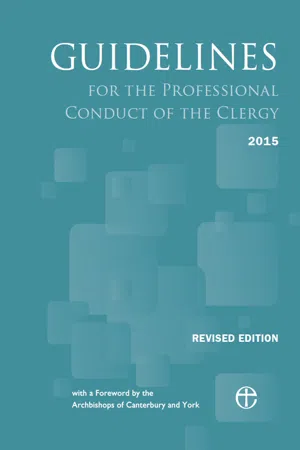
Guidelines for the Professional Conduct of the Clergy 2015
Revised edition
This book is available to read until 23rd December, 2025
- 48 pages
- English
- ePUB (mobile friendly)
- Available on iOS & Android
eBook - ePub
Available until 23 Dec |Learn more
About this book
This new edition of the Guidelines for the Professional Conduct of the Clergy is a revised and extended version of the first edition, which was published in 2003. It is not a formal code of conduct, but instead seeks to share the church's wide experience and accrued wisdom with all engaged in the mission and ministry of the church.
Frequently asked questions
Yes, you can cancel anytime from the Subscription tab in your account settings on the Perlego website. Your subscription will stay active until the end of your current billing period. Learn how to cancel your subscription.
No, books cannot be downloaded as external files, such as PDFs, for use outside of Perlego. However, you can download books within the Perlego app for offline reading on mobile or tablet. Learn more here.
Perlego offers two plans: Essential and Complete
- Essential is ideal for learners and professionals who enjoy exploring a wide range of subjects. Access the Essential Library with 800,000+ trusted titles and best-sellers across business, personal growth, and the humanities. Includes unlimited reading time and Standard Read Aloud voice.
- Complete: Perfect for advanced learners and researchers needing full, unrestricted access. Unlock 1.4M+ books across hundreds of subjects, including academic and specialized titles. The Complete Plan also includes advanced features like Premium Read Aloud and Research Assistant.
We are an online textbook subscription service, where you can get access to an entire online library for less than the price of a single book per month. With over 1 million books across 1000+ topics, we’ve got you covered! Learn more here.
Look out for the read-aloud symbol on your next book to see if you can listen to it. The read-aloud tool reads text aloud for you, highlighting the text as it is being read. You can pause it, speed it up and slow it down. Learn more here.
Yes! You can use the Perlego app on both iOS or Android devices to read anytime, anywhere — even offline. Perfect for commutes or when you’re on the go.
Please note we cannot support devices running on iOS 13 and Android 7 or earlier. Learn more about using the app.
Please note we cannot support devices running on iOS 13 and Android 7 or earlier. Learn more about using the app.
Yes, you can access Guidelines for the Professional Conduct of the Clergy 2015 by in PDF and/or ePUB format, as well as other popular books in Theology & Religion & Christian Denominations. We have over one million books available in our catalogue for you to explore.
Information
APPENDIX 1
GS Misc 1085
The Ministry of Absolution
General Synod
1. At its meeting on 30 September the Archbishops’ Council considered what advice to offer to the Convocations on its treatment, in the proposed revision of the Guidelines for the Professional Conduct of the Clergy, of the ministry of absolution for which provision is made in Canon B 29. The Annex to this paper sets out the background to the revision process.
2. The Working Party preparing the revised draft of the revised Guidelines on behalf of the Convocations proposed that the section dealing with “Reconciliation” should, amongst other matters, describe the current legal position in relation to the formal ministry of absolution.
3. The legal position in that respect is governed by the unrepealed proviso to Canon 113 of the Code of 1603, which reads as follows:
“Provided always, that if any man confess his secret and hidden sins to the minister, for the unburdening of his conscience, and to receive spiritual consolation and ease of mind from him; we do not in any way bind the said minister by this our Constitution, but do straitly charge and admonish him, that he do not at any time reveal and make known to any person whatsoever any crime or offence so committed to his trust and secrecy (except they be such crimes as by the laws of this realm his own life may be called into question for concealing the same), under pain of irregularity.”
4. This is the one provision of the 1603 Code which was not repealed as part of the complete overhaul of the Canons of the Church of England in the 1950s, which led to the present Code being enacted by the Convocations in 1964 and 1969.
5. The effect of the proviso is that, where the formal ministry of absolution as described in Canon B 29 is sought, if the penitent makes a confession with the intention of receiving absolution, the priest is forbidden to reveal or make known to any person what has been confessed. That requirement of absolute confidentiality applies even after the death of the penitent.1
6. The Archbishops’ Council recognized that the practice of the ministry of absolution has a well-established place in the life of the Church of England, playing an important part in the spiritual life of some of its members and representing a significant aspect of the ministry of some of its clergy.
7. However, the Council also recognized the responsibility of the Church to protect children and vulnerable adults from harm, and the force of the argument that the legal framework of the Church should accordingly, in all respects, be such as to enable those who present a risk to children and vulnerable adults to be identified – both so that they can be held to account for past wrongs and be prevented from doing further harm. The Council is also aware that there has been some wider debate as to whether Parliament should legislate to make it an offence not to report evidence of child abuse to the statutory agencies.
8. The Council therefore decided to commission further theological and legal work to enable it to review, in consultation with the House of Bishops, the purpose and effect of the unrepealed proviso to the Canon of 1603, with a view to enabling the Synod to decide whether it wished to legislate to amend it. At their November meeting the Council will consider the terms of that review and who should conduct it, with a view to putting their proposals in those respects to the House of Bishops when it meets in December.
9. In the light of its decision, the Council invited the Working Party undertaking the revision of the Guidelines to consider further the section on “Reconciliation”. It has now been amended to make clear that the present law, which is explained there, is now to be the subject of a review.
William Fittall
SECRETARY GENERAL
22 October 2014
1 As is apparent from the text, the Canon allowed for an exception to the duty of confidentiality where nondisclosure could have rendered the priest himself vulnerable to prosecution for a capital offence. This provision was, however, never operative since by 1603 parliament had already legislated to abolish the common law capital offence for a person who had knowledge of a treasonous plot not to reveal the plot to the Crown. instead, it had created a statutory offence of misprision of treason, with a maximum sentence of life imprisonment.
APPENDIX 2
Documents referred to in the text
Preface
Common Worship Ordination Services 2007 (Known as The Ordinal)
Clergy Discipline Measure 2003
Ecclesiastical Offices (Terms of Service) Measure 2009
Safeguarding
2.17 Protecting All God’s Children The Child Protection Policy of the Church of England 4th edition, 2010 (House of Bishops)
Reconciliation
3.2 The Canons of the Church of England
Note: GS Misc 1085 is included in this document here
Note: GS Misc 1085 is included in this document here
Ministry at times of deepest need
5.2 Guidelines for Good Practice in the Healing Ministry – House of Bishops
5.4 Guidelines for Good Practice in the Deliverance Ministry 1975 (revised 2012) – House of Bishops
Trust
12.9 The Data Protection Act 1998
12.11 Anglican Marriage in England and Wales: A Guide to the Law for the Clergy (published by the Faculty Office, 1 The Sanctuary, Westminster, SW1P 3JT)
Care for the Carers
14.1 Dignity at Work (2008) – Ministry Division publication
14.3 The Parochial Expenses of the Clergy (2002) – Ministry Division publication
Clergy Terms and Conditions of Service (Common Tenure) Parsonages: A Design Guide (The Green Guide) – Church Commissioners publication
Clergy Terms and Conditions of Service (Common Tenure) Parsonages: A Design Guide (The Green Guide) – Church Commissioners publication
APPENDIX 3
Safeguarding and relevant documents
Child Protection
The Church of England, in all aspects of its life, is committed to and will champion the protection of children and young people both in society as a whole and in its own community.
Safeguarding Adults
All church workers involved in any pastoral ministry will be recruited with care including the use of the Criminal Records Bureau disclosure service when legal or appropriate. Workers will receive training and continuing support.
Table of contents
- Cover
- Title
- Contents
- Foreword by the Archbishops of Canterbury and York
- Preface
- Guidelines for the Professional Conduct of the Clergy
- Postscript
- A Theological Reflection by the Very Revd Dr Francis Bridger
- Appendix 1: The Ministry of Absolution: GS Misc 1085 (October 2014)
- Appendix 2 Documents Referred To In the Text
- Appendix 3 Safeguarding And Relevant Documents
- Copyright