This book is available to read until 23rd December, 2025
- 256 pages
- English
- ePUB (mobile friendly)
- Available on iOS & Android
eBook - ePub
Available until 23 Dec |Learn more
Buildings for Mission
About this book
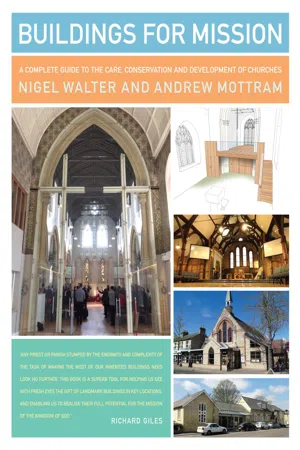
A money-saving handbook for all who care for and maintain church buildings, this practical and comprehensive guide provides expert advice from a leading church architect and an experienced heritage buildings specialist. They also show how church buildings can be tools for contemporary mission, packed with potential for community engagement.
Frequently asked questions
Yes, you can cancel anytime from the Subscription tab in your account settings on the Perlego website. Your subscription will stay active until the end of your current billing period. Learn how to cancel your subscription.
At the moment all of our mobile-responsive ePub books are available to download via the app. Most of our PDFs are also available to download and we're working on making the final remaining ones downloadable now. Learn more here.
Perlego offers two plans: Essential and Complete
- Essential is ideal for learners and professionals who enjoy exploring a wide range of subjects. Access the Essential Library with 800,000+ trusted titles and best-sellers across business, personal growth, and the humanities. Includes unlimited reading time and Standard Read Aloud voice.
- Complete: Perfect for advanced learners and researchers needing full, unrestricted access. Unlock 1.4M+ books across hundreds of subjects, including academic and specialized titles. The Complete Plan also includes advanced features like Premium Read Aloud and Research Assistant.
We are an online textbook subscription service, where you can get access to an entire online library for less than the price of a single book per month. With over 1 million books across 1000+ topics, we’ve got you covered! Learn more here.
Look out for the read-aloud symbol on your next book to see if you can listen to it. The read-aloud tool reads text aloud for you, highlighting the text as it is being read. You can pause it, speed it up and slow it down. Learn more here.
Yes! You can use the Perlego app on both iOS or Android devices to read anytime, anywhere — even offline. Perfect for commutes or when you’re on the go.
Please note we cannot support devices running on iOS 13 and Android 7 or earlier. Learn more about using the app.
Please note we cannot support devices running on iOS 13 and Android 7 or earlier. Learn more about using the app.
Yes, you can access Buildings for Mission by Nigel Walter in PDF and/or ePUB format, as well as other popular books in Theology & Religion & Christian Church. We have over one million books available in our catalogue for you to explore.
Information
A8 The Church in Numbers
Lies, lies and statistics
As the established Church in England, the Anglican Church retains an important place and role in the life of the country. We are all familiar with news stories about the decline in church attendance, and in the popular imagination the Church is now nothing more than baptisms, weddings, funerals and an occasional ‘Thought for the Day’. There is lots to support this view in the statistics that are collected, and you might think that all is lost and the organization is failing faster than it can cope with the changes. Certainly if you interpret the figures using a business model, it makes for uncomfortable reading.
Because of this uncomfortable reading it can sometimes be difficult to get hold of sufficient statistical information to make a sensible judgement. Depending on which agenda is being pursued, bad news may be buried while signs of life and hope are exaggerated in order to generate enthusiasm; conversely good news may be ignored in favour of another juicy scandal.
The Church of England does publish some very useful statistics showing that across the dioceses cathedral congregations are growing while overall parish church congregations (with exceptions in some areas) are shrinking. Over the course of time this will impact on our ability to look after the parish church buildings. The inescapable fact is that the Church of England needs to change if it is to survive.
The other inescapable fact is that the Church of England, along with most other denominations, has continually developed and adapted to changes in society. Currently it is going through yet another phase of change, and we should not be surprised that this is accompanied by the usual difficulties and distress of the ‘change cycle’. Just web search ‘change cycle’ and see what you find.
Current statistics
According to Peter Brierley in his UK Church Statistics 2: 2010−2020, across the UK as a whole there are over 50,000 church congregations; of course, not all of these have their own buildings.9
In England, as of 2015 there are 42 Anglican dioceses, each a geographical area that may or may not correlate to county boundaries. Across these dioceses there are over 16,000 church buildings currently in use as ‘places of worship’. Of these, approximately three-quarters are listed because of their special architectural or historic interest, and the remaining quarter are unlisted. There are three grades of listed building:
- Grade 1 are buildings of exceptional interest.
- Grade 2* are particularly important buildings of more than special interest.
- Grade 2 are buildings of special interest, justifying every effort to preserve them.
Some 45 per cent of Grade 1 listed buildings are churches or cathedrals. Two cathedrals (Canterbury and Durham), Westminster Abbey and three parish churches are included in English World Heritage Sites.
According to research published by the Church of England,10 68 per cent consider their local church building an important part of their local community. Those who consider churches important include 45 per cent of people with no religion and 62 per cent of adherents of other faiths. Some 70 per cent believe the local church provides valuable social and community facilities and 57 per cent believe church buildings should be more actively used by the local community. Around 85 per cent of the population visit a church or place of worship each year.
The majority of the church buildings are looked after by volunteers who are members of individual church congregations.
In 2006 necessary repairs to all listed places of worship in England were valued at £925 million in the coming five years, equating to around £185 million per year. The current annual spend on repairs to Church of England churches is £112 million; since the great majority of listed places of worship are Anglican, there is a significant shortfall, which means that year on year there is a progressive deterioration in the condition of our church buildings.
Funding for church building repairs has to be raised by the individual churches – there is no central government or central Church of England fund...
Table of contents
- Title page
- Copyright information
- Contents
- Acknowledgements
- List of Abbreviations
- Welcome!
- Section A: Context
- A1 Here We Stand
- A2 Church Buildings − the Essentials
- A3 Whose Building is it Anyway?
- A4 Specially for Clergy
- A5 Buildings at Risk
- A6 ‘Buildings, Blooming Buildings’
- A7 Viable and Sustainable Churches
- A8 The Church in Numbers
- A9 ABC of Church Structures
- A10 What Can We Do About It?
- Section B: Practicalities
- B1 What Sort of Old?
- B2 Rubble Sandwiches – Traditional Wall Construction
- B3 Dry Hat and Boots
- B4 Damp and Moisture Control
- B5 The Wonderful World of Seating
- B6 Fonts and Baptistries
- B7 Multimedia
- B8 Heating Basics
- B9 Energy Efficiency
- B10 New Heating Systems
- B11 Lighting – Strategies and Issues
- B12 Routes for Services
- B13 Kitchens and WCs – the Essentials
- B14 Bats
- B15 Timber Decay
- B16 Maintenance
- B17 Asset Management Plans
- B18 The Church-Carer’s Calendar
- B19 Accessibility
- B20 Health and Safety − General
- B21 Health and Safety for Building Projects
- B22 Mr FixIt or Mr BodgeIt
- Section C: Principles
- C1 Future Survival
- C2 Sacred Place, Holy Ground
- C3 Working with Places of Worship
- C4 The Moment of Truth
- C5 Serving People − Four Modes of Operation
- C6 Conservation
- C7 Open, Welcoming and Accepting
- C8 Interpretation
- C9 God and Community
- Section D: Process
- D1 Making Changes
- D2 How to Write a Statement of Significance
- D3 Public Engagement
- D4 Consensus Building − Some Resources
- D5 Needs Analysis
- D6 How to Write a Statement of Needs
- D7 How to Organize Yourselves
- D8 Ecclesiastical Exemption
- D9 They Think It’s All Over …
- D10 Friends’ Groups
- D11 Fundraising
- Section E: Projects
- E1 Practical Examples
- E2 Re-orderings
- E3 Extensions
- E4 Community Use
- E5 Kitchens and WCs
- E6 New Churches
- Section F: And Finally …
- F1 Afterword – Our Heritage
- F2 Organizations and Contacts
- F3 Bibliography
- Section G: Appendix
- G1 Healthcheck
- G2 Pizzamat
- G3 Church Buildings Audit