This book is available to read until 23rd December, 2025
- 256 pages
- English
- ePUB (mobile friendly)
- Available on iOS & Android
eBook - ePub
Available until 23 Dec |Learn more
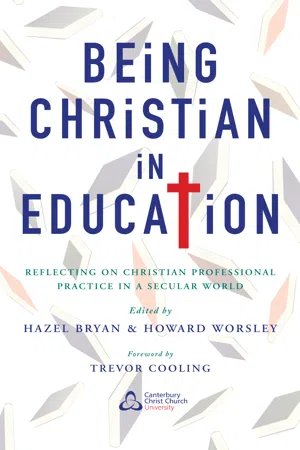
Being Christian in Education
About this book
Experienced practitioners, theologians and academics reflect on the Christian voice as it engages in education today. At a time of national uncertainty for RE, questions about faith-based schools and the place of religious belief in the public arena, this volume offers a creative exploration of the future for Christian engagement in education.
Frequently asked questions
Yes, you can cancel anytime from the Subscription tab in your account settings on the Perlego website. Your subscription will stay active until the end of your current billing period. Learn how to cancel your subscription.
At the moment all of our mobile-responsive ePub books are available to download via the app. Most of our PDFs are also available to download and we're working on making the final remaining ones downloadable now. Learn more here.
Perlego offers two plans: Essential and Complete
- Essential is ideal for learners and professionals who enjoy exploring a wide range of subjects. Access the Essential Library with 800,000+ trusted titles and best-sellers across business, personal growth, and the humanities. Includes unlimited reading time and Standard Read Aloud voice.
- Complete: Perfect for advanced learners and researchers needing full, unrestricted access. Unlock 1.4M+ books across hundreds of subjects, including academic and specialized titles. The Complete Plan also includes advanced features like Premium Read Aloud and Research Assistant.
We are an online textbook subscription service, where you can get access to an entire online library for less than the price of a single book per month. With over 1 million books across 1000+ topics, we’ve got you covered! Learn more here.
Look out for the read-aloud symbol on your next book to see if you can listen to it. The read-aloud tool reads text aloud for you, highlighting the text as it is being read. You can pause it, speed it up and slow it down. Learn more here.
Yes! You can use the Perlego app on both iOS or Android devices to read anytime, anywhere — even offline. Perfect for commutes or when you’re on the go.
Please note we cannot support devices running on iOS 13 and Android 7 or earlier. Learn more about using the app.
Please note we cannot support devices running on iOS 13 and Android 7 or earlier. Learn more about using the app.
Yes, you can access Being Christian in Education by Hazel Bryan in PDF and/or ePUB format, as well as other popular books in Theologie & Religion & Religion. We have over one million books available in our catalogue for you to explore.
Information
Part One
‘Travelling with Faith: reflections upon Christian professional practice in a secular world’
1
Engaging love: A Teacher of Nurses’ Tale
MARTIN BEDFORD
Christ has no body now but yours, no hand, no feet on Earth but yours.
Yours are the eyes with which He looks with compassion on the world.
Yours are the feet with which He walks to do good.
Yours are the hands with which He blesses all the world.
Teresa of Avila (Attributed)
Abstract
This chapter considers (with a nod to Chaucer’s Canterbury tales) a journey of faith for a nurse teacher and the impact of faith on nurse preparation. It explores the state of nurse education today and offers a commentary upon the educational reforms in nursing over the past 30 years. Discerning an identity crisis in nursing, the chapter undertakes a reappraisal of nursing’s roots including Nightingale and her virtue ethics. The synthesis of Aristotelian virtue ethics with the early Christian care ethos is examined and contextualized with the current dialogue on the foundations for moral philosophy.
Love-centred virtue ethics is proposed as the basis for nurse preparation, concluding with a sketch of some of what this might look like.
Keywords
Love; faith journey; nurse education; Christian nursing; virtue ethics.
Introduction
One of features of Chaucer’s Canterbury tales is the pervasive social stratification and the way in which each pilgrim is defined by their occupation, set within a functional divide of estates (status) of those who fight (bellatores), those who contemplate and preach (oratores) and those who work (laborares) (Knox, 1999). Although Chaucer’s satire often hints at the decline of chivalry and of worldly corruption in the church, his is a world where each knows their place. When they challenge this order, like the crude Miller changing the prescribed order of story-telling, it is more Saturnalia than threat to the status quo.
Our Canterbury tales at this university is comprised of oratores – teachers, lecturers and clergy with the common purpose of exploring what it means to profess and live their faith in a range of different educational settings and contexts. In our commonwealth of equals there may be no social ordering, but each of us in our work will be affected in some way by it.
Although there are many religious references within Chaucer’s Canterbury Tales, most of the pilgrims (including the clerical characters) are markedly worldly (Br. Anthony, 1994). Unlike these largely secular tales in the God-centric medieval world of Chaucer’s Canterbury tales, our tales are of faith in a seemingly secular world (Armstrong, 2004) coming from rather than going to Canterbury.
Prologue
My journey into faith was an unusual one. My mother, born into a devoutly Catholic Irish/Manx family was the daughter marked to become a nun. She was happy with this pathway until she met my father, from a non-practising, nominally Anglican background. They married before World War Two, during which my father served in the Italian campaign and was shocked at the wealth of the church in the midst of the poverty and near starvation of wartime Italians. This removed any vestiges of faith he had in churches but he retained a belief in a Supreme Being.
My family upbringing was in a house filled by the love of my parents for each other and for us children. My mother was able to convince each of us into believing that we were her favourites – we were.
I was not brought up in the church other than family weddings, baptisms and funerals and largely accepted my father’s disbelief in organized religion. By my late teen years I identified with the peace and love of the Hippy movement and later, at University studying Politics, became a radical socialist taking a Marxian materialist view of man making God, and of religion being ‘the sigh of the oppressed creature, the heart of a heartless world, and the soul of soulless conditions … the opium of the people’ (Marx, 1844).
I was happy in my unexamined atheist certainty, but I was becoming aware of the contradiction between my core ideals of peace and love and the aggression of much radical politics and increasingly disillusioned with sectarian in-fighting between different socialist groups, and the dogmatic interpretations of Marx’s writings as credo. Looking back, I had evolved into Graham Greene’s socialist lieutenant from the Power and the Glory, a ‘littler dapper figure of hate carrying his secret of love’ (Greene, 2001, p. 55). After university I remained politically orientated but this became a private belief rather than an organized activity.
Entering nursing and enjoying caring for people removed any vestiges of belief in heroic revolutionary violence. Here I would love to be able to say that I had an incredible epiphany during which I had personal experience of Christ – but this did not happen. Instead, I learned my trade, became good at it and felt it allowed me to express who I am. My conversion came later in a more subtle manner, following discussion with my wife about whether we should have our children christened.
On a superficial level we wanted a family celebration, but this raised the question of why would we wish the endorsement of an institution as faulty as the church, and a naming of our children for a superstition? This led me to consider the evidence for my atheism and the conclusion that ironically, atheism is actually a belief that cannot be proven or refuted by systematic enquiry. As such it is no more ‘scientific’ than belief in God. This was quite challenging for me as it undermined the foundation of many of my premises. At the same time it was a liberating paradigm shift. If there was no irrefutable evidence either way, individuals must choose atheism, God or being an agnostic. As someone who has never sat on the fence, the last of these did not seem an option so I felt I had to consider the former two. Ultimately my decision rested upon the question of whether I would prefer to live in a world with or without God. Having never really considered the possibility of God, the ripples from this what if? pebble reframed my perspectives. By the time I enrolled in an Alpha course I had pretty much decided and started believing in God with Jesus as my saviour and was grappling with the challenge of living as if.
This change was by any reckoning a fundamental shift, but in relation to my core ideals there was actually a much better fit than with Marxism. Reading the Gospels, their message of social justice and inclusion founded on a love of neighbour and fellowship (Acts 2.42) was a radical and uncompromising as anything written by socialists – arguably, with the injunction to love our enemies (Matthew 5.44), more so. Any attempts to avoid this interpretation of the Gospels seems especially wilful in the face of the clear dichotomy drawn between God and money (Matthew 6.24–26).
Although there is an abundance of very clever theology, the activity that has most deepened by knowledge of Christ has been preparing junior church lessons, and from this has grown the understanding that love is the central organizing principle of Christianity.
For me the most important moment was when I decided to look for God, rather than attempt to disprove his existence. I may not have seen my God with my physical eyes, but have perceived him with the eyes of my heart (Ephesians 1.18)
The Nurse Teacher’s Tale
This tale is that of the teacher of nurses. I have chosen the term teacher over the job description ‘university lecturer’ as teacher, from the Old English tæcan, is a broader description of role than is lecturer with its emphasis on the act of reading.
Similarly, although the preparation of nurses is most commonly called nurse education, I shall refer to nurse training (the older term) as this is most inclusive of the breadth and physicality of this preparation and also hints at the broader socialization and inculcation of students into nursing that largely happens in the workplace.
The combination of nurse and teacher engenders a degree of identity challenge: for years I considered myself a nurse who happens to be working in education, but reflecting on my osmotic move from practice to university as a lecturer practitioner then as a full-time lecturer, I am, at the moment, despite continued engagement with practice, more of an educationalist than a practitioner.
As a vocational teacher, I focus more on the development of nurses than on excellence in a particular subject. While it is wonderful to come across a student nurse who is also a scholar, my goal in teaching is to facilitate the development of excellent and resilient nurses. This may to some degree alleviate accusations of living in an ivory tower isolated from the real world that is sometimes levelled at subject-based lecturers.
The dualistic model implicit in this perspective owes much, as Arendt (1998) reminds us, to classical Greek thought and the division between necessity and freedom where the greatest good is to be able to choose how you wish to spend your time (the mores of a slave economy): as she terms it the vita activa in contrast to the vita contemplativa. The Platonic take on this in the Republic proposes the tripartite division of function between the Guardians, subdivided into philosopher rulers and soldiers, and the remainder the people, i.e. those who work (Plato, 2001), although distorted to the needs of feudal hierarchy, this principle is the logic of the estates.
Arendt’s innovation was to further subdivide the vita activa into labour, work, and action with each containing greater degrees of autonomy and engagement (Arendt, 1998). Arendt also points out that there is no scriptural foundation for superiority of the vita contemplativa; indeed she proposes that the gospels indicate that Jesus embodies action (ibid., p. 318).
These divisions have been further altered by the development of the information age, specifically with the notion of ‘information is physical’ (Gleick, 2001, p. 355) in a digital economy and where thought itself has become a category of labour.
The challenge for freedom is therefore no longer the move from physical activity to mental, but rather the degree of autonomy and purposefulness that i...
Table of contents
- SCM_Being-Christian-in-Education_FM
- SCM_Being-Christian-in-Education_Ch01
- SCM_Being-Christian-in-Education_Ch02
- SCM_Being-Christian-in-Education_Ch03
- SCM_Being-Christian-in-Education_Ch04
- SCM_Being-Christian-in-Education_Ch05
- SCM_Being-Christian-in-Education_Ch06
- SCM_Being-Christian-in-Education_Ch07
- SCM_Being-Christian-in-Education_Ch08
- SCM_Being-Christian-in-Education_Ch09
- SCM_Being-Christian-in-Education_Ch10
- SCM_Being-Christian-in-Education_Ch11
- SCM_Being-Christian-in-Education_Ch12
- SCM_Being-Christian-in-Education_Ch13
- SCM_Being-Christian-in-Education_Ch14
- SCM_Being-Christian-in-Education_Ch15
- SCM_Being-Christian-in-Education_intro