This book is available to read until 23rd December, 2025
- 272 pages
- English
- ePUB (mobile friendly)
- Available on iOS & Android
eBook - ePub
Available until 23 Dec |Learn more
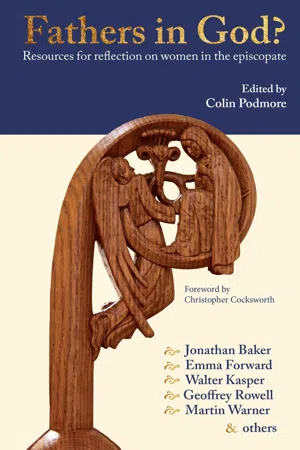
Fathers in God?
About this book
This volume sets out, in a non-polemic way, the understanding of priestly and episcopal ministry from the biblical, historical and theological viewpoints of those who defend a traditional view of priesthood as male, while being fully a part of the Church of England.
Frequently asked questions
Yes, you can cancel anytime from the Subscription tab in your account settings on the Perlego website. Your subscription will stay active until the end of your current billing period. Learn how to cancel your subscription.
At the moment all of our mobile-responsive ePub books are available to download via the app. Most of our PDFs are also available to download and we're working on making the final remaining ones downloadable now. Learn more here.
Perlego offers two plans: Essential and Complete
- Essential is ideal for learners and professionals who enjoy exploring a wide range of subjects. Access the Essential Library with 800,000+ trusted titles and best-sellers across business, personal growth, and the humanities. Includes unlimited reading time and Standard Read Aloud voice.
- Complete: Perfect for advanced learners and researchers needing full, unrestricted access. Unlock 1.4M+ books across hundreds of subjects, including academic and specialized titles. The Complete Plan also includes advanced features like Premium Read Aloud and Research Assistant.
We are an online textbook subscription service, where you can get access to an entire online library for less than the price of a single book per month. With over 1 million books across 1000+ topics, we’ve got you covered! Learn more here.
Look out for the read-aloud symbol on your next book to see if you can listen to it. The read-aloud tool reads text aloud for you, highlighting the text as it is being read. You can pause it, speed it up and slow it down. Learn more here.
Yes! You can use the Perlego app on both iOS or Android devices to read anytime, anywhere — even offline. Perfect for commutes or when you’re on the go.
Please note we cannot support devices running on iOS 13 and Android 7 or earlier. Learn more about using the app.
Please note we cannot support devices running on iOS 13 and Android 7 or earlier. Learn more about using the app.
Yes, you can access Fathers in God? by Colin Podmore in PDF and/or ePUB format, as well as other popular books in Theology & Religion & Christian Denominations. We have over one million books available in our catalogue for you to explore.
Information
Part One: Prospect and Retrospect (2015)
In Love and Charity with your Neighbour
Martin Warner
Feminism in a Post-Feminist Age
Emma Forward
Catholic Contributions to the Theological Debate, 2004–06
Colin Podmore
In Love and Charity with your Neighbour
Introduction: Living in historic times
Following the decision by the Church of England to ordain women to the episcopate, York Minster witnessed within the span of eight days across January and February 2015 the episcopal ordination and consecration of Libby Lane as Bishop of Stockport and of Philip North, a traditionalist catholic, as Bishop of Burnley. Both were present at both occasions, for which the Minster was full to capacity. This merging of two events, out of conflict and into a single timespan, was an important landmark statement, thoughtfully and skilfully shaped by John Sentamu, Archbishop of York, in order to illustrate what it means to live in love and charity, keeping our eyes fixed on Jesus.
Women will now enter the College and House of Bishops (the ‘College’ refers to all diocesan and suffragan bishops; most suffragans are not members of the synodical House), with considerable support from across the Church of England. They face the same challenges as their male colleagues when it comes to exercising jurisdiction within a household of faith that is committed to living under the same roof but with particular dispensations in its sacramental life. Memorable though the events in York Minster were, they do not, sadly, guarantee a future free from clamour.
Trust demands shape and depth in order to be the seedbed in which love and charity grow and bear fruit. It is with the intention of setting some clear and spacious boundaries that the House of Bishops has made a formal Declaration on the Ministry of Bishops and Priests. This Declaration is a bit like the Declarations made in America in 1776 and in France in 1789. They stated more than an opinion: they were the pledge of a way to live. A Declaration by the House of Bishops is that sort of pledge. It is an instrument that cannot be changed without wider reference to the Church of England. It is a self-binding document that outlines how bishops will exercise their ministry in the task of building trust in God and in each other as we enter this new era of our life.
At the heart of the Declaration is the statement of five guiding principles. The five principles are:
- Now that legislation has been passed to enable women to become bishops the Church of England is fully and unequivocally committed to all orders of ministry being open equally to all, without reference to gender, and holds that those whom it has duly ordained and appointed to office are the true and lawful holders of the office which they occupy and thus deserve due respect and canonical obedience;
- Anyone who ministers within the Church of England must be prepared to acknowledge that the Church of England has reached a clear decision on the matter;
- Since it continues to share the historic episcopate with other Churches, including the Roman Catholic Church, the Orthodox Church and those provinces of the Anglican Communion which continue to ordain only men as priests or bishops, the Church of England acknowledges that its own clear decision on ministry and gender is set within a broader process of discernment within the Anglican Communion and the whole Church of God;
- Since those within the Church of England who, on grounds of theological conviction, are unable to receive the ministry of women bishops or priests continue to be within the spectrum of teaching and tradition of the Anglican Communion, [and] the Church of England remains committed to enabling them to flourish within its life and structures; and
- Pastoral and sacramental provision for the minority within the Church of England will be made without specifying a limit of time and in a way that maintains the highest possible degree of communion and contributes to mutual flourishing across the whole Church of England.8
These principles do not have the status of the Thirty-Nine Articles of Religion or of the Catechism, for example. They do, however, act as common signposts that point all of us alike to areas of serious theological conviction and challenge.
In this chapter, I want to explore some of the implications of these principles for traditionalist catholics and how we use them to shape our future life and contribution within the Church of England. Every member of the traditionalist constituency has a part to play in living to the full our discipleship within this household of faith.
As Christians we respond to the question of gender and ordination at a variety of levels: spiritual, doctrinal, ecclesiological, cultural. The issue of gender is not, therefore, simply one of ecclesiastical, General Synod politics: it is about holy housekeeping for here and hereafter. It touches on the sacramental life that fundamentally shapes and nourishes our character as Christians. It determines how we live in charity within this household of faith, the extent of our cheerfulness at being here, relating to Christians with whom we suffer the pain of separation, and the tough stuff of intentional evangelism and service to the world that we have to address with renewed urgency and realism. These concerns confront all of us who are Christians in the Western world today, and not simply traditionalist catholics in the Church of England.
But to begin this particular exploration, I want to consider the spiritual, emotional and ecclesiological issues that the issue of gender and ordination raises distinctively for traditional catholics. And a good place to start is in the diary of Samuel Pepys.
Corporate life: commonality and communion
The Book of Common Prayer mattered to Pepys, who was wayward in his appetites but not without conscience. On Sunday 24 August 1662 it vexed him that the ambitious, fat and lazy Dr Daniel Milles, Vicar of St Olave’s, Hart Street, where Pepys attended, could preach so badly about auricular confession. This ministration to the sick, as the Prayer Book provided it, was something known and commonplace in an age that faced death through routine disease and the scourge of widespread plague.
Healing of mind and soul, together with the binding up of physical and social wounds, was a ministry England had great need of in 1662, following years of intense and bloody warfare that divided families at every level of society. The Prayer Book was a major statement about the restoration of peace and order within society and Church. Its Communion service directed a broadly churchgoing people, as England then was, to live ‘in love and charity with your neighbours’ in order to live in the presence of God as ‘very members incorporate in the mystical body’, which is life in the Church of Jesus Christ.
A prayer added to the Accession Service, celebrating the anniversary of the Sovereign’s accession to the throne, in 1714 (another time of potential division in the Church as in wider society) would underline the themes of repentance, baptism, unity and worship:
Take away all hatred and prejudice, and whatsoever else may hinder us from godly Union and Concord: that, as there is but one Body, and one Spirit, and one Hope of our Calling, one Lord, one Faith, one Baptism, one God and Father of us all, so we may henceforth be all of one heart, and of one soul, united in one holy bond of Truth and Peace, of Faith and Charity, and may with one mind and one mouth glorify thee; through Jesus Christ our Lord.
On the Sunday in August 1662 when Pepys was so vexed with Dr Milles’s poor preaching, he was further distressed to learn at supper that evening of a disturbance in St Matthew’s church, just off Cheapside. A group of young hotheads had seditiously shouted ‘Porridge’ (a dissenters’ term of abuse for prayer-book worship) in church, taken a Common Prayer Book away from church, ‘and some say [they] did tear it; but it is a thing which appears to me very ominous’.
Love and charity are at the heart of the invitation to the corporate act of confession that is the prelude to receiving Holy Communion. The nature of our common life as an expression of that communion is something that we urgently have to face today with clarity and confidence.
The first principle that is outlined in the House of Bishops’ Declaration invites us to recognize the reality of the fabric of the Church of England as defined by law and practice, with women and men admitted to all three orders of ministry, encouraged by huge swathes of support. The inescapable implication of this principle is that we seek love and charity with those who are incorporate with us in this expression of the body of Christ, even though we might disagree with them profoundly in our theological view. This is about more than courtesy; it is commitment to a degree of communion that respects the fabric of our church life, its ordained members, women and men, as much as we might respect its material fabric – font, altar, lectern, tabernacle or icon.
But here is something else to recognize about the five principles. They cannot be read in isolation from each other. We also have to read the first two principles in conjunction with the third. This is where we recognize a statement that sets our communion in a wider perspective.
Corporate life: torn but not dismembered
Pepys uses a phrase about the Common Prayer Book that is useful for us in describing the fabric of our life within the newly reordered household of the Church of England: ‘And some say [they] did tear it; but it is a thing which appears to me very ominous.’
We also experience communion as something that now has a tear in it. This is implied in the third principle, which states that we share the historic episcopate with ‘the Roman Catholic Church, the Orthodox Church and those provinces of the Anglican Communion which continu...
Table of contents
- Copyright information
- Contents
- Acknowledgements
- Foreword
- Introduction
- Part One: Prospect and Retrospect (2015)
- In Love and Charity with your Neighbour
- Feminism in a Post-Feminist Age
- Catholic Contributions to the Theological Debate, 2004–06
- Part Two: Women Bishops in the Church of England? (2004)
- Presentation to the General Synod
- Arguments from a Catholic Anglican perspective
- Forward in Faith’s Submission to the Rochester Commission on the Theology of the Ordination of Women to the Episcopate, 17 October 2001
- Part Three: Consecrated Women? A Contribution to the Women Bishops Debate (2004)
- Women Bishops: A Theological Enquiry
- 1. Introduction
- 2. The Breadth of the Task
- 3. The Fatherhood of God
- 4. Incarnation and Headship
- 5. Bridegroom and Bride
- 6. Priesthood and Sacrifice
- 7. Ministry in the Early Church
- 8. The Episcopate and the Church of England
- 9. Some Commonplace Arguments
- 10. Conclusion
- Some Papers Submitted to the Working Party
- 1. The Bishop as Bridegroom of His Church: A Roman Catholic Contribution
- 2. The Gender and Number of Bishops
- 3. Fatherhood, Headship and Tradition
- Appendices
- Bibliography
- Part Four: The Mission of Bishops in the Mystery of the Church (2006)
- The Mission of Bishops in the Mystery of the Church