This book is available to read until 23rd December, 2025
- 464 pages
- English
- ePUB (mobile friendly)
- Available on iOS & Android
eBook - ePub
Available until 23 Dec |Learn more
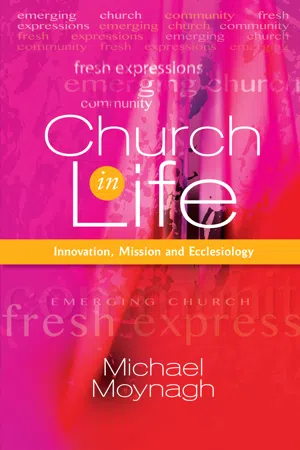
Church in Life
About this book
Taking account of the significant developments in practice and thinking around the emerging church, this book will quickly establish itself as a key text for all interested in pioneer ministry, fresh expressions, church planting, church growth and ecclesiology.
Frequently asked questions
Yes, you can cancel anytime from the Subscription tab in your account settings on the Perlego website. Your subscription will stay active until the end of your current billing period. Learn how to cancel your subscription.
No, books cannot be downloaded as external files, such as PDFs, for use outside of Perlego. However, you can download books within the Perlego app for offline reading on mobile or tablet. Learn more here.
Perlego offers two plans: Essential and Complete
- Essential is ideal for learners and professionals who enjoy exploring a wide range of subjects. Access the Essential Library with 800,000+ trusted titles and best-sellers across business, personal growth, and the humanities. Includes unlimited reading time and Standard Read Aloud voice.
- Complete: Perfect for advanced learners and researchers needing full, unrestricted access. Unlock 1.4M+ books across hundreds of subjects, including academic and specialized titles. The Complete Plan also includes advanced features like Premium Read Aloud and Research Assistant.
We are an online textbook subscription service, where you can get access to an entire online library for less than the price of a single book per month. With over 1 million books across 1000+ topics, we’ve got you covered! Learn more here.
Look out for the read-aloud symbol on your next book to see if you can listen to it. The read-aloud tool reads text aloud for you, highlighting the text as it is being read. You can pause it, speed it up and slow it down. Learn more here.
Yes! You can use the Perlego app on both iOS or Android devices to read anytime, anywhere — even offline. Perfect for commutes or when you’re on the go.
Please note we cannot support devices running on iOS 13 and Android 7 or earlier. Learn more about using the app.
Please note we cannot support devices running on iOS 13 and Android 7 or earlier. Learn more about using the app.
Yes, you can access Church in Life by Michael Moynagh in PDF and/or ePUB format, as well as other popular books in Theology & Religion & Christian Ministry. We have over one million books available in our catalogue for you to explore.
Information
PART 1
Emerging Communities
Part 1 supports the contention that the church is being called to put a new form of mission near the heart of its life. This involves taking church-growth influenced church planting in new directions. Fundamental to this is innovation. Part 1 introduces new ecclesial communities using an innovation framework of dissatisfaction, exploration, sense-making, amplification, edge of chaos and transformation.
Chapter 1 sets this framework sociologically within complexity thinking and theologically within the horizon of God’s promised kingdom. Chapter 2 describes ‘A serving-first journey’, which new ecclesial communities typically travel, and suggests that the processes of the innovation framework propel the journey. Chapters 3 to 5 provide case studies of founders helping to bring ecclesial communities to birth, local churches being transformed through the introduction of new ecclesial communities and the spread of these communities in two British denominations. In each instance, the same six innovation processes are involved. Chapter 6 locates these processes and the emergence of new ecclesial communities in the context of changes in society.
The repetition of the processes at different levels of the ecclesial system has resonances with what some complexity thinkers describe as fractals. These depict the recurrence of patterns at different levels of a system, particularly in the physical world. Some writers have used fractals as a metaphor in relation to organizations (Harle, 2011, pp. 18−19), but this is controversial: in a strict scientific sense, how fractal-like are such repetitions? However the softer idea, that the innovation framework repeats itself, should not be surprising. If the framework accurately describes innovation, we should expect to see it whenever innovation occurs. Repetition of the framework can encourage founders and church leaders to look for this repeating pattern and use it as a prompt: ‘Does it contain aspects that I am in danger of overlooking?’
1
The Nature of Emergence
New types of church are arising bottom-up. When Lucy Moore led the first Messy Church in a Church of England parish, she was not responding to the ideas of a bishop (Moore, 2006). When Barbara Glasson helped start the ‘Bread church’ in Liverpool, England she had not been recruited to a Methodist Church grand plan (Glasson, 2006). When Paul Unsworth worked with others to start Kahaila Cafe in London’s East End, he was not moving forward a Baptist Union initiative.1 These and thousands of other new ecclesial communities have emerged relationally, through step-by-step improvisation, and have come as surprising gifts to their contexts.
New ecclesial communities are very different from model-based forms of church planting. Typically, the latter have a clear end in mind: a church with a specific style and ethos. The planting team devises detailed plans to achieve this result. Sometimes a standardized manual is used to help with the planning. This approach can feel a little mechanical, but it has borne fruit in a number of contexts. It is a far cry, however, from the birthing of many new ecclesial communities. These tend to emerge organically, on a trial-and-error basis. The core team starts with some idea of what it hopes to achieve, but this idea crystallizes as the team goes along. The approach is more improvise-and-learn than predict-and-plan.
This chapter lays the foundations on which to describe the innovation dynamics of these communities. On the basis that theory helps you describe, it introduces complexity thinking, proposes an innovation framework from a complexity standpoint and undergirds the framework with a theological rationale. If innovation involves modifying the ‘rules of the game’, as suggested in the Introduction, how does it work? Take café church for example. What made it new? Many would say that it was the joining together of two concepts previously kept apart: café and church. Radical innovation in particular (as opposed to incremental innovation) occurs through the unexpected combination of different elements. Goldstein, Hazy and Silberstang quote Kary Mullis, Nobel Laureate in chemistry: ‘In a sense, I put together elements that were already there, but that is what inventors always do. You can’t make up new elements, usually. The new element, if any, it was the combination, the way they were used’ (2010, p. 111). This chapter sets out a framework for understanding how these new combinations, these radical innovations, emerge and spread within the church.
From ‘Newtonian’ to ‘emergent’ organizations
For much of the twentieth century, the Newtonian model of science dominated management thinking (Wheatley, 2006). Organizations were seen as machines and employees like cogs in tightly defined roles. Organizations were understood by analysing their component parts – measuring them and quantifying their behaviour (Kernick, 2004c, p. 89). Questions centred on how one part impacted another. How does the behaviour of this department affect that department? How can all the departments be coordinated to produce the desired results?
Cause-and-effect thinking ruled. Causation was linear. It moved in one direction – from the environment to the organization, for example. So if you took an action here, through cause-and-effect you would achieve what you wanted there. Management was about pulling the right levers, understanding how one part of the organization ‘moved’ another, and acting on one part to influence the others. Management action could secure, or cause, the desired responses. Management fiat, therefore, could make an innovation spread.
Management sought stability. Information systems told managers when the organization was straying from its management-determined course. Managers then intervened to bring the organization back on track – to the original equilibrium. To avoid unexpected actions that might destabilize the whole, managers detailed procedures, prescribed processes and restricted local autonomy.
Managers assumed that the future was broadly predictable – at least that the future would be much the same as today. Senior managers were best placed to scan this knowable horizon, see the challenges ahead and determine the appropriate response. In a predictable future, goals were assumed to be achievable. Any changes needed to reach these goals must be controlled from the top and planned in advance.
In a church context, this model would lie behind a minister’s belief that the way to lead change is to share his vision, work with the church council to translate the vision into achievable goals, break these goals down into concrete steps and find the right people to take each step. Control lies with the top, change is planned in advance, the direction of change is linear (towards agreed goals) and cause-and-effect rules: each step will lead to (or cause) the next step, which will bring about (or cause) the goal.
From machines to conversations
Complexity thinking, a term covering the variety of complexity theories (Davis and Sumara, 2008, p. xii), is very different. It challenges this mechanical view of organizations. Influenced by developments in twentieth-century science, complexity thinkers see organizations less as machines and more like organisms (Waldrop, 1993). Many draw on the concepts and language of complexity thinking in the natural sciences, but there are large differences between the physical and social worlds. So when social scientists adopt complexity ideas and terms used by natural scientists, usually they do so analogously rather than as strict equivalents.
Complexity thinking differs from ‘Newtonian management’ in a number of ways. First, rather than seeing organizations as machines, some complexity thinkers (e.g. Shaw, 2002) regard them as networks of conversations. These conversations may be face to face, online or inside people’s heads. Imagine a denomination. Strip out the conversations within it and what is left? Some buildings, legal documents and the like, but the institution’s life will have died. Organizations live through their conversations. So if you imagine how conversations work, from a complexity standpoint you will get some idea of how organizations generate novelty. Organizations are best understood not by breaking them down mechanically into their component parts, but by studying their multiple interactions.
Secondly, novelty emerges not in an orderly, mechanical way but often by chance, through conversations. Machines, which are a sum of their parts, tend towards ‘linearity’. You get out of them what you expect. But complex organizations are ‘non-linear’. The whole is greater than the sum of the parts. It gives rise to novelties that could not have been predicted, or to a whole new level of being that ends up in the causal driving seat. Thus in a conversation different ideas may come together. ‘How can we thank Betty for all she has done?’ a group wonders. One person suggests giving her a spectacular box of chocolates, another throwing a party. ‘Why not have chocolate party!’ a third person exclaims, an idea that spurs the group to arrange it. Unexpected combinations are a hallmark of new ecclesial communities. Church is combined with café, mess (‘Messy Church’), felt-making, being in a forest (‘Forest Church’) and much more. All these communities began when concepts previously kept apart were joined together in conversation.
This means that novelty can emerge through the contribution of anyone in an organization. Think of a committee meeting. The chair takes the lead by introducing a topic. Others bat ideas around in a kind of brainstorm, during which leadership hangs in the air. Then one person makes a firm proposal. At that point, she assumes the lead. The leadership passes to a second person, who says ‘I agree, but to get this moving I suggest we talk to so-and-so.’ Leadership again hangs in the air as the discussion meanders round whom to consult. A third person takes the lead by urging the committee to adopt the proposal, consult the people who have been mentioned and review the situation in a month’s time. The chair finally resumes the lead by summarizing the discussion and checking everyone is agreed. During the discussion, leadership has emerged in different parts of the group.
Hazy, Goldstein and Lichtenstein refer to leadership that is less one individual exercising power over another and more a dynamic involving groups of people in interaction (2007, p. 13). Thus within organizations leadership of an innovation can emerge in many different places, on the periphery rather than in head office for example. This is what happened in Britain with ‘fresh expressions of church’. Rowan Williams, who as Archbishop of Canterbury did much to encourage these new ecclesial communities, first encountered them as Bishop of Monmouth in Wales. He had committed himself to spending time on the edge of the church. While doing so he came across these new communities.2 ‘Fresh expressions’ were not led by a bishop; they were discovered by a bishop. Senior management may be more about fanning desirable innovation than producing it.
From causation to feedback
Thirdly, rather than one-way, linear causation in the mechanical model, the non-linearity of complex organizations owes much to feedback, which moves back and forth. In a conversation, someone speaking does not merely influence the others. The hearers influence the speaker by their reactions, such as a look of incomprehension or a nod of agreement. Similarly in organizations, causation is back and forth rather than one way. For example, the environment does not only spark changes in a system (one-way causation), the system also produces changes in the environment. So a room’s size, temperature and the comfort of its chairs will influence the conversation of a group within it, but the group’s conversation may also affect the room: ‘Let’s open a window.’ Coevolution – the context and the organization evolving together – replaces the notion that one entity has a simple effect on another.
Causation is multilinear particularly because interactions within an organization create continual feedback loops. ‘The effects of an element’s action are fed back to the element and this in turn affects the way the element behaves in the future’ (Kernick, 2006, p. 387). Again, consider a conversation. Negative or ‘dampening’ feedback, such as the expression of disapproval, discourages repeat behaviour. He drops the subject. Positive or ‘amplifying’ feedback, like praise, encourages more of the same behaviour. She warms to the subject. Organizational change occurs similarly: positive feedback amplifies novelty. An idea birthed in one conversation is discussed in another, then another and then another, till it gathers unstoppable momentum. Small inputs eventually magnify into large-scale transformation. Managing change, therefore, is more complicated than pulling cause-and-effect levers. It involves fanning helpful feedback to scale up small yet desirable ideas and behaviours. Feedback is the means by which innovation spreads.
From being predictable to being unpredictable
Fourthly, it follows from all this that rather than being tidy and predictable as in the mechanical model, complex organizations are messy and unpredictable. Feedback often brings surprises. In a conversation, a throwaway comment, ‘Why don’t we go to Paris for the weekend?’ might be ‘amplified’ by someone else, who uses her phone to discover a special hotel offer. A third person checks the times of Eurostar. A few minutes later, trains and hotel have been booked. ‘Well,’ someone remarks, ‘I never expected that when I agreed to meet up!’
Likewise, because organizations are sequences of conversations, you can never be entirely sure what will happen next. Perhaps a team has been tasked by a church’s leadership to start a new ecclesial community. They explore various ideas like café church or an initiative among teenagers. Someone comments, ‘I must go in a few minutes. I’m on duty at the luncheon club.’ ‘That’s it!’ someone else exclaims. ‘Why not start a community among the guests of the luncheon club?’ Everyone agrees. A church initiative is born almost by accident.
Change cannot be designed, planned and enforced from the top, however hard some leaders try. It would be like trying to control the outcome of a conversation. You might dominate the discussion and force the other person to ‘agree’. But it would be a Pyrrhic victory. The person would disagree behind your back. Your controlled conversation would spawn other conversations you cannot direct, and potentially fruitful ideas generated in those conversations might not flow into the decision-making process. Top-down plans are often altered or even sabotaged as people lower down amplify, reinterpret or ignore instructions from above. That is one reason why church leaders can find it so hard to lead organizational change. Feedback in all the different parts of the church is beyond their control. It is unpredictable.
From central planning to self-organization
Fifthly, it follows that complexity thinkers shift the emphasis from the top-down planning of the mechanical model to bottom-up emergence. Again, imagine a conversation that ‘self-organizes’ into a radically new direction. Friends are chatting about what they have done recently, including films they have seen. Someone mentions a film about assisted suicide. Another person responds, ‘I think assisted suicide is completely wrong.’ A third person disagrees, and an animated discussion follows about the ethics involved. The topic becomes amplified as individuals respond to each other’s contributions. Half an hour later someone exclaims, ‘How did we get on to that!’ The d...
Table of contents
- Commendations
- Church in Life
- Contents
- Acknowledgements
- Introduction
- Part 1 Emerging Communities
- 1 The Nature of Emergence
- 2 How Do New Ecclesial Communities Emerge?
- 3 Founding New Ecclesial Communities
- 4 Reinventing the Local Church
- 5 Introducing Blended Denominations
- 6 Why Are New Ecclesial Communities Emerging?
- Part 2 Theological Foundations
- 7 Missional Gifts
- 8 Following Jesus
- 9 Reimagining the Local Church
- 10 Church on the Inside
- 11 Affinity Group Theology
- 12 Are They Church?
- 13 What Is Maturity?
- 14 A Liturgical Hermeneuticfor Church in Life
- Part 3 Perspectives on Method
- 15 Dissatisfaction: The Vocational Voyage
- 16 Exploring: How to Have a Great Idea
- 17 Sense-Making: Meaning-Full Teams
- 18 Amplification: Partnerships
- 19 Edge of Chaos: Pressing On
- 20 Transformation: Making Disciples
- 21 Conclusion: Three Themes
- Bibliography
- Index of Modern Authors
- Index of Subjects