This book is available to read until 23rd December, 2025
- 188 pages
- English
- ePUB (mobile friendly)
- Available on iOS & Android
eBook - ePub
Available until 23 Dec |Learn more
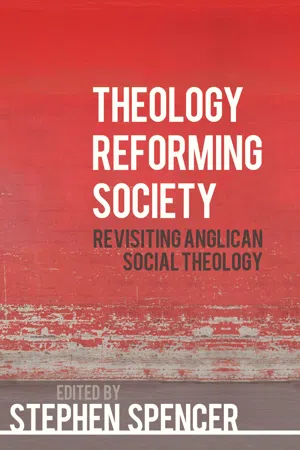
Theology Reforming Society
About this book
Theology Reforming Society tells the story of Anglican social theology from its roots in the writings and work of F.D. Maurice and the Christian Socialists, including Charles Kingsley and John Ludlow, and on to the work of William Temple. It also looks beyond Temple to the work of the Board for Social Responsibility, and to some of the theologians and church leaders who have continued its witness since then. Referring to the wider ecumenical context in order to draw out the distinctive features of the tradition of Anglican Social Theology, the book provides an important and comprehensive account for all those interested in Anglican theology, social and political theology and Christian ethics.
Frequently asked questions
Yes, you can cancel anytime from the Subscription tab in your account settings on the Perlego website. Your subscription will stay active until the end of your current billing period. Learn how to cancel your subscription.
At the moment all of our mobile-responsive ePub books are available to download via the app. Most of our PDFs are also available to download and we're working on making the final remaining ones downloadable now. Learn more here.
Perlego offers two plans: Essential and Complete
- Essential is ideal for learners and professionals who enjoy exploring a wide range of subjects. Access the Essential Library with 800,000+ trusted titles and best-sellers across business, personal growth, and the humanities. Includes unlimited reading time and Standard Read Aloud voice.
- Complete: Perfect for advanced learners and researchers needing full, unrestricted access. Unlock 1.4M+ books across hundreds of subjects, including academic and specialized titles. The Complete Plan also includes advanced features like Premium Read Aloud and Research Assistant.
We are an online textbook subscription service, where you can get access to an entire online library for less than the price of a single book per month. With over 1 million books across 1000+ topics, we’ve got you covered! Learn more here.
Look out for the read-aloud symbol on your next book to see if you can listen to it. The read-aloud tool reads text aloud for you, highlighting the text as it is being read. You can pause it, speed it up and slow it down. Learn more here.
Yes! You can use the Perlego app on both iOS or Android devices to read anytime, anywhere — even offline. Perfect for commutes or when you’re on the go.
Please note we cannot support devices running on iOS 13 and Android 7 or earlier. Learn more about using the app.
Please note we cannot support devices running on iOS 13 and Android 7 or earlier. Learn more about using the app.
Yes, you can access Theology Reforming Society by Spencer, Stephen Spencer in PDF and/or ePUB format, as well as other popular books in Theology & Religion & Christian Theology. We have over one million books available in our catalogue for you to explore.
Information
1
JEREMY MORRIS
I
F. D. Maurice’s status as virtually the founding father of Anglican social theology and even, in many people’s minds, of Christian Socialism itself, is surely incontestable, at least to judge from the verdict of many of those who have written on it in the last half-century or so. Maurice Reckitt argued that significant figures in Christian Socialism in the late nineteenth and early twentieth centuries knew themselves to derive from Maurice ‘in varying measure’. (Reckitt, 1968, p. 1). To Ronald Preston, Maurice’s name was ‘inseparably linked with the recovery in this country of an explicit Christian social theology’ (Preston, 1979, p. 3). Donald Gray, in his study of the relationship between liturgical renewal in Anglicanism and Christian Socialism, gave pride of place to Maurice in his account of origins (Gray, 1986, pp. 74–83, 110–14). Alan Wilkinson echoed this in his discussion of the background to the history of Christian Socialism in the twentieth century (Wilkinson, 1998, pp. 15–22). And Chris Bryant, in a work of popular history that is, nonetheless, critical and fair, picked out Maurice’s theological influence as his abiding legacy: ‘Maurice’s work meant that for all who followed, the foundations were already dug’ (Bryant, 1996,p. 71).
Yet this pre-eminence is curious, given the evident difficulty many historians and theologians have had in trying to understand what Maurice really intended to say. For all the many appreciative testimonies from people who knew him, or were directly influenced by him or by his writing, there is plenty of countervailing testimony from people whose powers of discernment should not be underestimated. John Henry Newman was perplexed by Maurice, who, he thought, could not shake off a pervasive but misty rationalism:
He is of the Cambridge School – and from the little I have seen of those men, they seem to me never satisfied to take things as they find them, but … to believe sacred doctrines, not because they have received them, but because they can prove them from philosophy. (Gornall, 1981, p. 180)
The Tractarian theologian J. B. Mozley, writing to Richard Church, claimed that Maurice ‘has not a clear idea in his head. It is a reputation that, the instant it is touched, must go like a card-house’ (Mozley, 1885,p. 222). A philosopher of lasting significance, John Stuart Mill, who knew Maurice well, both highly valued his abilities and regretted the way he had not used them ‘for putting something better into the place of the worthless heaps of received opinions on the great subjects of thought, but for proving to his own mind that the Church of England had known everything from the first’ (Mill, 1969, p. 92). Another great contemporary who also knew him well, Thomas Carlyle – who is paired with Maurice as one of the two intellectual observers of the workmen in Ford Madox Brown’s famous painting Work2 – shared Mill’s contempt for the Church of England, and equally despaired of Maurice’s waste of his intellectual abilities: ‘I met Maurice in the Strand yesterday. He is growing broader, thicker, and gets a clerical air…His vehement earnestness in twisting such a rope of sand, as I take that to be...’ ( A. Carlyle, 1923 ).
These and other assessments suggest that Maurice’s apparent pre-eminence as an Anglican social theorist was not widely recognized by contemporaries, but only by those who stood in his stream as followers and, so to say, fellow-travellers. Many outside that stream had difficulty recognizing his theological merits at all. Maurice polarized opinion. His followers were many and influential, as we shall see, but so were those who were bewildered or appalled by him. That may help to account for the apparent decline in his reputation in the last 30 or 40 years, as other theological perspectives in Anglicanism have come to the fore than the moderate High Churchmanship and liberalism with which he was associated for so long.
We also have to reckon with his marginalization by the main stream of Labour history, however. This is striking, but almost universal. It is something that I hope will become more explicable by the end of this chapter. I will take just two telling examples, some 70 years apart. In his popular classic British Working Class Politics 1832–1914 (1941), published for the Labour Book Service, one of the founding fathers of Labour history, G. D. H. Cole, a close associate for a time of Maurice Reckitt, and influenced by the Anglican theologian Neville Figgis, nonetheless paid only passing attention to Maurice and the Christian Socialism of the mid-nineteenth-century. But recently, too, Malcolm Chase’s extensive history of Chartism makes no reference to F. D. Maurice, and only passing reference again to Christian Socialism, despite the many connections we know existed between the Christian Socialists inspired by Maurice and the latter-day history of Chartism.3 There is not even any mention of Walter Cooper, the London tailor and Chartist with whom Maurice, and Charles Kingsley and others, worked closely in the early establishment of a tailors’ co-operative.
These varied assessments of Maurice’s work and significance point, I would argue, to an uncomfortable truth, or at least a truth that is hard to receive for those brought up on the common narrative of modern Anglican social theology, and that is that Maurice’s impact may have been less extensive, and less lasting, than is often assumed, and that in any case his apparent commitment to Christian Socialism is much more difficult to identify than has often been assumed. In this chapter I cannot of course hope to give a comprehensive assessment of Maurice’s role in the history of Christian Socialism, nor of the place of social theology in his work overall. As I have hinted elsewhere, mid-nineteenth-century Christian Socialism still awaits satisfactory analysis and evaluation.4 But I can aim to do three things in summary – firstly, to give a brief summary of Maurice’s social theology, secondly to indicate the nature of its impact on some of his contemporaries (and I will examine Charles Kingsley and Octavia Hill particularly), and thirdly to account for the mutation of his reputation in the late nineteenth century, in other words for the ‘founding father’ myth.
II
‘Christian Socialism’ was not a term invented by Maurice or his associates. It can be found in the Communist Manifesto (‘Christian Socialism is but the holy water with which the priest consecrates the heart-burnings of the aristocrat’), and in radical Christian circles in France in the early months of the revolutionary year of 1848 (Fernbach, 1973, p. 89). In Britain it had echoes of the ‘sacred socialism’ espoused by the eccentric and now neglected figure James Pierrepont Greaves, who fused a form of Owenite co-operative socialism with mysticism, but had died in 1842.5 In fact, Maurice and his associates did not use the term until a couple of years into their various initiatives, and then its deployment was almost certainly the result of the intervention of John Malcolm Ludlow, a follower of Maurice who had lived in France and seen at first hand various experiments in social action. Ludlow had followed with interest the theories of the Catholic, ex-Saint-Simonian Philippe Buchez (1796–1865), who was instrumental in the attempt to develop workers’ associations and to ‘Christianize’ republicanism in the short and turbulent period of the Second Republic (1848–51).6
Essentially, then, the description ‘Christian Socialism’ followed action, rather than preceding it, and this implies not so much the espousal by Maurice and others of a new ideological commitment, but rather the appropriation of a handy term for a view he had already formed. Maurice, Kingsley and others were stirred up by the combination of revolution in France and across the continent, by the climax of Chartism, the working class movement for democracy and parliamentary reform, and also by general public concern about the condition of England which ran through the ‘hungry forties’, as they came to be called. The collapse of Chartist agitation in the wake of a disastrous meeting on Kennington Common on 10 April 1848 – it poured with rain, instead of half a million people there were just 20,000 (there were 170,000 special constables), and the Executive of the National Charter Association abandoned thoughts of marching on Parliament, to cries of betrayal – prompted Kingsley, drawing on Maurice and Ludlow’s support, to issue a proclamation to working men appealing to them to work with sympathetic churchmen to remedy social ills. This sense of imminent social crisis really galvanized the movement, drawing together a group of young men and women (mostly men, mostly professional) to undertake a series of initiatives aimed at addressing particular local problems. The language (especially of Kingsley) was often fierce and intemperate, the action rather conservative. Weekly Bible meetings for working men at Maurice’s house, a night school for men, and a ragged school for children, were the main examples at first. This was all rather paternalistic, and not very different from conventional church activity. What was different, but short-lived, was the journal Maurice and Kingsley founded, Politics for the People, a rag-bag fusion of radical politics, liberal churchmanship and social conservatism.
All of this happened essentially within a half-mile radius of Lincoln’s Inn, where Maurice was Chaplain and Preacher, an area of West London that at that time was not the haven of affluence it is now, but rather a very mixed area, with sweated shops serving the luxury trade, and pockets of slum housing. This was the economic and social background to the ambitious craft co-operatives, or ‘workers’ associations’, that Ludlow in particular, with Maurice’s explicit support, formed in 1850 and 1851.7 Again, there were models elsewhere: Ludlow was influenced by the workers’ associations he’d seen in France, and the principle of co-operation was already well-known in the form of consumers’ co-operatives following Owenite, the Rochdale and other precedents. It was in relation to these associations that Maurice first used the term ‘Christian Socialism’; as he said in a letter to Ludlow, it was ‘the only title which will define our object, and will commit us at once to the conflict we must engage in sooner or later with the unsocial Christians and the unchristian Socialists’. (Maurice, 1884, p. 35). But what did Maurice mean by the term? And what did he think were its objects?
The ‘Prospectus’ of Politics for the People, published on 6 May 1848, can give us a way in to answering those questions. What is striking in it is the almost complete absence of any concept of practical action – indeed Maurice positively rejects what he evidently thought would be the presumption of putting forward specific policies (‘it is not our purpose to put forth ready-made theories upon [the questions which are most occupying our countrymen], or vehement opinions upon one side or the other’) (Politics for the People, p. 1). Instead his emphasis is essentially discursive and educational – these questions are to be ‘considered’, for they deserve ‘earnest reflection’ and should be ‘studied in the light of present experience and past history’. Central to this reflection was cultivating sympathy, which would enable people such as Maurice to reconnect with his suffering countrymen. Indeed separation was in a sense the sub-theme, or negative theme, running through much of Maurice’s social theology. God is a God of unity, but human sin divides – class from class, men from women, interest group from interest group, church from church, and so on. Maurice’s constant emphasis on union with God in faith, an emphasis which can be interpreted in terms of participation in God, as some such as Donald Allchin have realized, also predicated the possibility of a renewed union amongst humankind.8 A true ‘Politics for the People’ would be a politics of reconnection – to ‘what is human and universal’, to ‘whatever concerns man as a social being’ (Politics for the People, p. 1). Above all, it had to reconnect people to religion. Either, Maurice said, politics starts from atheism, in which case (he assumed) it led to division and conflict, or it begins in ‘the acknowledgment that a Living and Righteous God is ruling in human society not less than in the natural world’ (Politics for the People, p. 1).
Despite Maurice’s professed lack of interest in ‘vehement opinion on one side or other’, in fact this desire for reconnection, for unity, did – at least in his thinking – in the end produce a quite specific proposal, and that was his advocacy of co-operation. Here much of what he said bore comparison with a wide range of other voices, from those of the apparently conservative Robert Southey in his late writing on the Church, for example, to John Ruskin, and its sharp point was criticism of competitive individualism, a disintegrative philosophy that prioritized acquisition and the accumulation of wealth at the cost of human community.9 This principle, the ‘selfish principle’, started from the assumption ‘that the possession of material things is the end for which men…must be striving’. (Maurice, 1851a, pp.13,15). Its converse was co-operation, the organization of society around genuine human fellowship, which to Maurice was implied in...
Table of contents
- Cover
- Title
- Contents
- Preface William Jacob
- Contributors
- Introduction Stephen Spencer
- 1 F. D. Maurice and the Myth of Christian Socialist Origins
- 2 Maurice as a Resource for the Church Today
- 3 Octavia Hill: From Theology to Action
- 4 Anglican Social Thought Encounters Modernity: Brooke Foss Westcott, Henry Scott Holland and Charles Gore
- 5 William Temple and the ‘Temple tradition’
- 6 The Temple Legacy Today: Beyond Neoliberalism
- 7 Anglican Social Theology: Today and Tomorrow
- 8 Public Theology or Ecclesial Theology?
- Afterword: Whither Anglican Social Theology?
- Copyright