This book is available to read until 23rd December, 2025
- 160 pages
- English
- ePUB (mobile friendly)
- Available on iOS & Android
eBook - ePub
Available until 23 Dec |Learn more
Everyday Public Worship
About this book
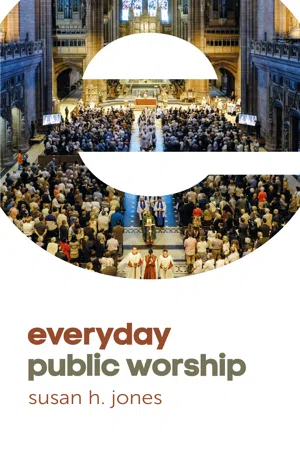
Everyday Public Worship has been designed to engage with the ordinary experience and ordinary theology of Christian disciples as they work to develop and deepen their discipleship learning.
Frequently asked questions
Yes, you can cancel anytime from the Subscription tab in your account settings on the Perlego website. Your subscription will stay active until the end of your current billing period. Learn how to cancel your subscription.
At the moment all of our mobile-responsive ePub books are available to download via the app. Most of our PDFs are also available to download and we're working on making the final remaining ones downloadable now. Learn more here.
Perlego offers two plans: Essential and Complete
- Essential is ideal for learners and professionals who enjoy exploring a wide range of subjects. Access the Essential Library with 800,000+ trusted titles and best-sellers across business, personal growth, and the humanities. Includes unlimited reading time and Standard Read Aloud voice.
- Complete: Perfect for advanced learners and researchers needing full, unrestricted access. Unlock 1.4M+ books across hundreds of subjects, including academic and specialized titles. The Complete Plan also includes advanced features like Premium Read Aloud and Research Assistant.
We are an online textbook subscription service, where you can get access to an entire online library for less than the price of a single book per month. With over 1 million books across 1000+ topics, we’ve got you covered! Learn more here.
Look out for the read-aloud symbol on your next book to see if you can listen to it. The read-aloud tool reads text aloud for you, highlighting the text as it is being read. You can pause it, speed it up and slow it down. Learn more here.
Yes! You can use the Perlego app on both iOS or Android devices to read anytime, anywhere — even offline. Perfect for commutes or when you’re on the go.
Please note we cannot support devices running on iOS 13 and Android 7 or earlier. Learn more about using the app.
Please note we cannot support devices running on iOS 13 and Android 7 or earlier. Learn more about using the app.
Yes, you can access Everyday Public Worship by Susan H. Jones in PDF and/or ePUB format, as well as other popular books in Theology & Religion & Christian Rituals & Practice. We have over one million books available in our catalogue for you to explore.
Information
1
What is Public Worship?
Worship and liturgy are at the heart of the Christian community. Christian men, women and children have come together over the centuries to worship God. The aim of this book is to help the disciples of today discern and reflect upon their own call to follow Christ and to worship God. The book draws on the experience of three people, but worship of God is more complex than the interpretation given by three people. So readers are encouraged to bring to the text their own experience and to reflect on their understanding of what it means to worship God.
The book listens to the voices of Paul, a member of a Methodist church, Beth, a cradle Anglican, and Maggie, a member of an evangelical Anglican church who began her Christian journey in a Baptist church. The book reflects on their experience of worshipping in different contexts and through different liturgies and services. It explores why worship is led in a particular way and where different forms of liturgy come from.
Paul worships in a Methodist chapel built at the end of the nineteenth century. Paul is used to the Methodist liturgy. Beth worships in a medieval building that has been altered and added to over the centuries. Beth has been brought up in the Anglo-Catholic tradition. Maggie worships in a multi-purpose Anglican evangelical church built on a housing estate in the sixties. Maggie is used to ‘free-worship’ of a charismatic nature.
As Paul, Beth and Maggie talk, they begin to recognize that each of them has different ways of worshipping, and use different forms of liturgy. They reflect on these differences and begin to realize that there are many different ways of worshipping God and that the whole idea of worship is complex.
Paul, Beth and Maggie begin their reflections by asking what is meant by Christian worship. White (2000) suggests that Christian worship is not an easy expression to define. Richardson (1993) in A New Dictionary of Christian Theology defines worship as:
Worship is thus essentially thanksgiving and praise. It may be offered formally according to fixed rites: ritual is the fixed form of words ordered by authority for specified days or times. Or it may be offered in ‘free’ worship, i.e. without fixed forms, and perhaps with extempore prayer, in which individuals in the congregation may participate. It may be offered with full ceremonial, i.e. accompanying actions, processions, vestments, genuflection and with choirs and music, as a High Mass or Sung Eucharist. Or it may be offered with a minimum of ceremonial, or in corporate silence as in a Quaker meeting. But the purpose of all worship is the same: to offer praise to God for his grace and glory. (pp.605–6)
White (1997, pp. 2–16) defines worship as service to God, mirror to heaven, affirmation, communion, proclamation, the arena of transcendence. White (2000) suggests that ‘the best way to determine what we mean by Christian worship is to describe the outward and visible forms of worship by Christians’ (pp. 18–19). Burns (2006) suggests that worship is much more than words. It is more than the text on the page of a service book. Worship is about a gathering of people.
The preface to The Methodist Worship Book (Methodist Church, 1999) sees worship as ‘a gracious encounter between God and the Church … Worship is the work of the whole people of God’ (p. vii). It states: ‘The Church is called to offer worship to the glory and praise of God. From the earliest days of the Church Christian people have gathered together for this purpose’ (p. vii).
The Church of England’s Common Worship (Church of England, 2000) also talks of the ‘challenge to draw the whole community of the people we serve into the worship of God’ (p. ix).
Perham (2000), in his New Handbook of Pastoral Liturgy, suggests that it is the whole congregation, people and ministers, who come together to worship God.
The worshippers come, in all their variety, individual people with their own needs and expectations, but as the liturgy begins they become a congregation. They discover their corporate identity as they give glory to God who is the Father of them all. The key to true worship is the participation of the whole congregation. (p. 19)
All three begin to realize that defining worship is not always easy. However, Paul, Beth and Maggie recognize that there are a number of components to worship and various different ways to worship. When looking at the liturgies of the Church they see a structure and that structure suggests that worship includes prayer, praise and adoration, thanksgiving, petition, confession, intercession and exhortations. There is the affirmation of faith spoken through the creeds. There is music expressed in hymns, songs, instrumental music, canticles and psalms. There is the notion of time as developed through the Christian year, the Christian week, the lectionary and the rituals of birth, marriage and death. There is art and architecture.
Burns (2006), in his book Liturgy, suggests that ‘Scripture and sacrament provide the essential framework of Christian liturgy, the skeleton, which other aspects of liturgy then enflesh, wrap around and form the shape of Christian worship’ (p. 13). Paul begins to talk about worship and liturgy being about more than words and he quotes from the preface of The Methodist Worship Book (Methodist Church, 1999): ‘Worship is not a matter of words alone. It involves not only what we say but also what we do’ (p. viii). Beth, on the other hand, quotes from the Church of England’s (2002) New Patterns for Worship which has these opening words: ‘Worship is not worship till you do it’ (p. x).
As they continue to explore the idea of worship, they look at where different forms of service come from and what role the churches played throughout the centuries in the development of worship and liturgy (Chapters 2 and 3). They reflect on the role of the Church in the life cycle and how the Church developed liturgies to celebrate the important stages in life, like birth, marriage and death (Chapters 4, 5 and 6). They explore the cycle of the Christian year and the important festivals of Advent, Holy Week, Easter, Ascension and Pentecost (Chapter 8). They reflect on the development of the worship space, its layout and furniture, and what it says about God and about the worshippers. They reflect on the architecture of buildings (Chapter 8). For all three of them worship and liturgy is about more than service books and words. It is about the environment, and about the senses: hearing, sight, smell, taste and touch (Chapters 7 and 9).
2
Exploring the Eucharist
Paul, Beth and Maggie are having a conversation about worship. For Paul worship is about the offering to God of praise, glory and honour in reverence and in love. For Beth worship is the subtle blend of word, song, movement, gesture and silence offered through the Church’s liturgies. For Maggie worship is shared with others and is a corporate act of praising God. Paul’s understanding of worship has been influenced by his journey in the Methodist Church; Beth’s has come through her experience of being in the Anglo-Catholic tradition; and Maggie has been influenced in worship by her conversion to faith in the Baptist Church and now lived out in the local Anglican church.
Paul, Beth and Maggie attend churches where the Eucharist (known by different traditions as the Lord’s Supper, the Holy Eucharist, the Divine Liturgy, the Holy Mysteries, and the Mass) is celebrated regularly. White (2000) in his chapter on the Eucharist suggests that:
The Eucharist is the most distinctive structure of Christian worship. It is also the most widely used form of worship among Christians, being celebrated daily and weekly in thousands of congregations and communities all over the world. (p. 229)
TO DO
Draw a map or note down:
What is your experience of worship in church?
What is important to you in worship?
How have you come to worship in the way you do?
In Beth’s church they have a daily communion and she tries to make it her discipline to attend as often as she is able to. Paul, on the other hand, receives communion less frequently in his Methodist chapel and only when the minister of word and sacrament is present, which is usually twice a month. Maggie receives communion once a month when the local priest attends the multi-purpose church on the housing estate where she worships.
Paul, Beth and Maggie are exploring together their understanding of the Eucharist. They have looked at the various liturgies of the churches and recognize that there are many similarities in the Eucharist liturgies. To start at the beginning, they have decided to look at the biblical roots of the Eucharist.
The Bible and the Eucharist
Paul, Beth and Maggie discuss the biblical roots of the Eucharist and are aware that while the Eucharist is celebrated because Jesus shared the last supper with his disciples, the background to the Eucharist is set in a Jewish context. They reflect on the fact that in the Synoptic Gospels the last supper was a Passover meal. John’s Gospel, however, does not follow this understanding. In John’s Gospel Jesus died as the Passover lamb was being sacrificed, which would suggest the previous day for the meal (Bradshaw, Giles, and Kershaw, 2002, p. 99).
Paul, Beth and Maggie reflect that it was during the time of the Passover festival that Jesus inaugurated the last supper: ‘He said to them, "I have eagerly desired to eat this Passover with you before I suffer"’ (Luke 22.15). White (2000) suggests that Jesus deliberately used ‘the climactic occasion of the Jewish year to establish the new covenant’ (p. 232) and that Jesus followed the conventional re-enactment of the original Passover meal as commemoration of deliverance from captivity in Egypt.
Paul thinks of the occasions when he has attended the Seder meal in his local Methodist church on Maundy Thursday and he sees the parallels. He remembers the special food, the roast lamb, the green herbs, the bitter herbs, the salt water, the matzos and the red wine. Paul then talks about the actions during which special food is eaten, bread is broken and cups of wine are shared, and he begins to compare them with the institution narratives from the Eucharist in the Bible.
TO DO
Look up Mark 14.22–25 and Matthew 26.26–29. Note down the similarities and differences in the two institution narratives.
Look up 1 Corinthians 11.23–26 and Luke 22.15–20. What are the similarities between these two passages?
Maggie, with her Baptist roots, recognizes that there are two parallel sets of institution narratives in the New Testament, working with the idea that the Last Supper was at the time of the Passover meal. Mark 14.22–25 and Matthew 26.26–29 are quite similar, while 1 Corinthians 11.23–26 and Luke 22.15–20 have strong similarities. White (2000) argues that all accounts, especially the Lucan narrative, are oriented towards the end time, in looking forward to the coming Kingdom of God (p. 233).
The apostle Paul in 1 Corinthians 11 talks of the tradition as something he has received from the Lord and which he is to pass on to future disciples. This tradition, as given by Paul, contains the command to ‘Do this in memory of me.’ The Eucharist is the memorial of Christ’s Passover (Kelly, 1999).
Maggie and Paul reflect on what Beth has said and think about the night on which Jesus was betrayed –Maundy Thursday, the night of the Passover meal. They recognise from their churches’ liturgies that Jesus gave thanks over the bread and wine and identified himself with the food that would be shared by his followers: ‘This is my body’; ‘This is my blood’. They also hear again the command of Jesus to his followers to do this in memory of him.
The New Testament gives brief insight into the first-century celebration of the Eucharist and it is the apostle Paul who raises concerns about ‘unworthy partaking of the Lord’s supper’ (White, 2000). Up until around the year 135 Christians were gathering to take part in a full meal with a separate bread and cup ritua...
Table of contents
- Cover
- Title
- Contents
- Preface
- 1 What is Public Worship?
- 2 Exploring the Eucharist
- 3 Exploring the Offices
- 4 Engaging Through Baptism
- 5 Engaging Through Weddings
- 6 Engaging Through Funerals
- 7 Music and Song
- 8 Movement and Space
- 9 Seeing, Smelling, Touching
- References
- Copyright