eBook - ePub
Available until 23 Dec |Learn more
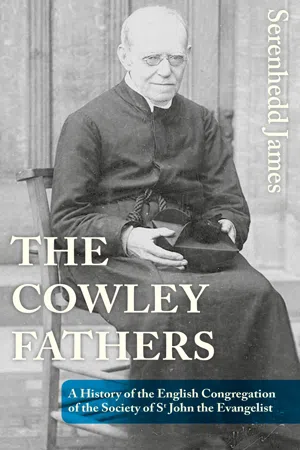
The Cowley Fathers
A History of the English Congregation of the Society of St John the Evangelist
This book is available to read until 23rd December, 2025
- 640 pages
- English
- ePUB (mobile friendly)
- Available on iOS & Android
eBook - ePub
Available until 23 Dec |Learn more
The Cowley Fathers
A History of the English Congregation of the Society of St John the Evangelist
About this book
A definitive history of one of the most significant religious orders to emerge in the Anglican church, the Cowley Fathers - the first men's religious order to be founded in the Church of England since the Reformation.
Frequently asked questions
Yes, you can cancel anytime from the Subscription tab in your account settings on the Perlego website. Your subscription will stay active until the end of your current billing period. Learn how to cancel your subscription.
No, books cannot be downloaded as external files, such as PDFs, for use outside of Perlego. However, you can download books within the Perlego app for offline reading on mobile or tablet. Learn more here.
Perlego offers two plans: Essential and Complete
- Essential is ideal for learners and professionals who enjoy exploring a wide range of subjects. Access the Essential Library with 800,000+ trusted titles and best-sellers across business, personal growth, and the humanities. Includes unlimited reading time and Standard Read Aloud voice.
- Complete: Perfect for advanced learners and researchers needing full, unrestricted access. Unlock 1.4M+ books across hundreds of subjects, including academic and specialized titles. The Complete Plan also includes advanced features like Premium Read Aloud and Research Assistant.
We are an online textbook subscription service, where you can get access to an entire online library for less than the price of a single book per month. With over 1 million books across 1000+ topics, we’ve got you covered! Learn more here.
Look out for the read-aloud symbol on your next book to see if you can listen to it. The read-aloud tool reads text aloud for you, highlighting the text as it is being read. You can pause it, speed it up and slow it down. Learn more here.
Yes! You can use the Perlego app on both iOS or Android devices to read anytime, anywhere — even offline. Perfect for commutes or when you’re on the go.
Please note we cannot support devices running on iOS 13 and Android 7 or earlier. Learn more about using the app.
Please note we cannot support devices running on iOS 13 and Android 7 or earlier. Learn more about using the app.
Yes, you can access The Cowley Fathers by Serenhedd James in PDF and/or ePUB format, as well as other popular books in Theology & Religion & Religion. We have over one million books available in our catalogue for you to explore.
Information
1. In the Beginning
Every plant must have its seed.
—Godfrey Callaway SSJE1
Richard Meux Benson was born on 6 July 1824, and baptised a month later in the parish church of his family’s London home, St George’s, Bloomsbury; where the successors of Nicholas Hawksmoor’s heraldic beasts gambol at the base of his ziggurat to the glory of the house of Hanover. Benson’s childhood seems to have been one of happy, pious affluence, and both his parents were wealthy in their own right: Thomas Starling Benson had business interests in the City, and Elizabeth Meux was the heiress to the Meux brewing fortune. “They were so rich”, observed Mildred Woodgate, “that complete security surrounded them at all times”.2
Benson’s young mother was the third wife of his much older father; and, while the Clapham Sect had influenced the entire family, she was a member of Holy Trinity, Clapham, where John Venn had been Rector.3 Elizabeth Benson was particularly religious,4 and her spirituality was a formative influence in the family. Geoffrey Curtis CR called her “a devout Christian woman”, and she imparted similar qualities to her infant boy.5 The Bible was at the fore of his childhood reading, and Woodgate considered that his early years were spent “in an atmosphere of love and almost unsullied happiness”. He was particularly close to his mother, and, rather than follow his elder brother to Harrow, was educated at home by a tutor.
Woodgate’s analysis of the Bensons’ domestic affairs may well have been padded with a mixture of legend and speculation, but she pointed to an important consideration when she reminded her readers that Benson was born over a decade before the death of William IV, and that in his late childhood “the wildest stories were abroad” relating about the originators of the new ecclesiastical thinking coming out of Oxford, and their best-selling Tracts for the Times.
In 1841 the young Benson sat for a scholarship at Balliol, which he failed to win. But while in Oxford he wandered into the University Church on Sunday morning, and happened to hear John Henry Newman preach. Woodgate did not, perhaps, quite have the measure of the man and his co-workers with her assessment that Benson, “with his Evangelical background, and brought up on the teachings of the Clapham Sect, would have been quite out of sympathy with all that Newman and his followers were fighting for”; but he was deeply moved by the experience and convinced that, whatever the prevailing mood, Newman was sincere and “no charlatan”. The young Benson became aware of the affairs of men at a time when much of literate England’s attention was focussed on the nascent Oxford Movement.
After a second unsuccessful attempt at the Balliol scholarship, it was agreed that Benson would go up to Christ Church at Michaelmas 1843; but an extended trip to Italy delayed his arrival. In the late summer of 1843 Benson and his sister Sarah took a house in Rome. There they became acquainted with much of Roman society, including Cardinal Acton, discussed theology at length with Jesuits, and were received in audience by Pope Gregory XVI. Benson was nevertheless fastidious about his attendance at the English Church, and any who looked for his conversion to Roman Catholicism were disappointed. On his way back to England, however, he called at the great Benedictine monastery at Monte Cassino.6
Meanwhile, in Oxford, controversy dragged on. Arguments continued to rage over the issues raised by the Tracts – which had come to an abrupt end in 1841 – and at least some part of the discourse involved the place of monasticism in the life of the Church.7 For his part, Newman insisted that although not everyone was called to the monastic life, “there are certain individuals raised up from time to time to a still more self-denying life”.8 In 1842 he retired to Littlemore, and in 1843 he resigned from the University Church. Benson matriculated at Christ Church a year later.
The Oxford in which Benson arrived as an undergraduate in 1844 was still in a period of religious upheaval that had begun in the early 1820s when the Regius Professor of Divinity, Charles Lloyd,9 had set about reforming the way in which theology was taught in the University. Lloyd revitalised the system by providing a series of lectures and tutorials that would be recognisable to today’s undergraduates; and among the young college fellows to benefit from this overhaul were the founding fathers of the movement of which Benson would later become a leader, including John Keble, Edward Bouverie Pusey, and Newman himself.
By the time of Benson’s matriculation, the Tracts for the Times were over, and W. G. Ward had just brought out his infamous Ideal of A Christian Church. Keble had retired to Hursley; Newman was on his “Anglican death-bed”; and Pusey was still banned from preaching in the University after the controversy over his sermon of May 1843, The Holy Eucharist A Comfort to the Penitent. However much he tried to avoid the limelight, Pusey’s influence was enormous – not only in Christ Church and in Oxford, but also in the wider Church – and the ban did little more than raise his profile further and make the sermon a bestseller.10
At Christ Church Benson gathered around himself a remarkable group of luminaries who went on to eminence and distinction in one way or another. Charles Dodgson was his contemporary, and later achieved fame – and, still later, notoriety – as Lewis Carroll. Frederick Ouseley had inherited his father’s baronetcy and went on to become Professor of Music in the University; and Henry Parry Liddon became Professor of Exegesis and a Canon of St Paul’s. One of Benson’s nearest neighbours and closest associates was Frank Buckland – perhaps one of the most bizarre and talented figures of his age – who was at least as eccentric as his remarkable parents and kept a menagerie in his rooms opposite Benson’s own in Fell’s Buildings.11 His father, by then Dean of Westminster, had been a Canon of Christ Church; and as a boy, Buckland junior had ridden a turtle in Mercury, the deep pond in the middle of Tom Quad: a turtle, it seems, destined for the soup course at the dinner to celebrate the Duke of Wellington’s installation as Chancellor in 1834.12 Perhaps it was this familial association that induced the college authorities to tolerate, to a greater or lesser degree, the presence of “marmots, guinea pigs, several snakes, a monkey, a chameleon, while in the courtyard outside were an eagle, a jackal, a pariah dog and even a bear”.13 After a series of unfortunate incidents, however, the bear had to go.14 Tiglath Pileser, or “Tig”, as the bear was known for short, was in the end exiled to Dean Buckland’s country living at Islip to join the eagle and the monkey, which had also disgraced themselves.15
There was,...
Table of contents
- Copyright information
- Contents
- Dedication
- Acknowledgements
- Acknowledgement of Sources
- Abbreviations
- Introduction
- I want to go and be a Cowley Father
- 1. In the Beginning
- 2. Young Vipers
- 3. Hopes Dashed and Restored
- 4. Floreat Cowley
- 5. Growing Pains
- 6. Building for Success
- 7. Subjects Missionary and Religious
- 8. A New Century
- 9. Fruit Formed and Forming
- 10. Wreaths of Empire
- 11. One Big Family
- 12. Faith and Works
- 13. Brothers in Arms
- 14. In the Furnace
- ‘IN THE PRIME OF HIS LIFE’
- 15. Re-Pitching the Tent
- LAUDEMUS CORPUS CHRISTI
- 16. Catholic and Evangelistic
- 17. Life and Vigour
- 18. Battle on Two Fronts
- 19. Winds of Change
- 20. Comings and Goings
- 21. Axes and Hammers
- 22. A New Look
- 23. Back to the Future
- 24. Beyond the Sunset
- 25. The Long Day Closes
- Appendix 1
- Appendix 2
- Select Bibliography
- Plates