A fresh and sharp-eyed history of political conservatism from its nineteenth-century origins to today's hard Right
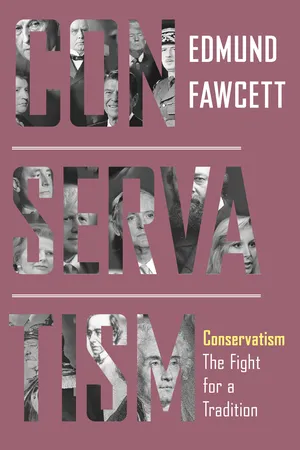
For two hundred years, conservatism has defied its reputation as a backward-looking creed by confronting and adapting to liberal modernity. By doing so, the Right has won long periods of power and effectively become the dominant tradition in politics. Yet, despite their success, conservatives have continued to fight with each other about how far to compromise with liberalism and democracy—or which values to defend and how. In Conservatism, Edmund Fawcett provides a gripping account of this conflicted history, clarifies key ideas, and illuminates quarrels within the Right today.
Focusing on the United States, Britain, France, and Germany, Fawcett's vivid narrative covers thinkers and politicians. They include the forerunners James Madison, Edmund Burke, and Joseph de Maistre; early friends and foes of capitalism; defenders of religion; and builders of modern parties, such as William McKinley and Lord Salisbury. The book chronicles the cultural critics and radical disruptors of the 1920s and 1930s, recounts how advocates of laissez-faire economics broke the post 1945 consensus, and describes how Donald Trump, Boris Johnson, and their European counterparts are pushing conservatism toward a nation-first, hard Right.
An absorbing, original history of the Right, Conservatism portrays a tradition as much at war with itself as with its opponents.
- English
- ePUB (mobile friendly)
- Available on iOS & Android
eBook - ePub
About this book
Information
Publisher
Princeton University PressYear
2020Print ISBN
9780691233994
9780691174105
eBook ISBN
9780691207773
PART I
Conservatism’s Forerunners
1
Critics of Revolution
i. The Hard Authority of Punishment and the Soft Authority of Custom: Maistre and Burke
Conservatism, like liberalism, has no Decalogue, no College for the Propagation of the Faith, no founding Declaration of Independence, and no doctrinal compendium to match the Marx-Engels Standard Edition. Into that gap, at the end of the nineteenth century, when conservatives were hunting for an intellectual tradition, the writings of Edmund Burke (1729–97) on the French Revolution were rediscovered as a rich and ever-giving second best. Burke’s themes—the authority of tradition, the folly of political intellectuals who ignored tradition, and the organic but vulnerable character of society—were singled out as dialectical weaponry.
Burke’s writings gave conservatism in retrospect, particularly conservatism in Britain and the United States, a tone of balance, openness to facts, and all-round moderation that stood out in contrast to the blind zeal of conservatism in France and Germany. The works of Joseph de Maistre (1753–1821), a Savoyard lawyer and exile from the French Revolution, were commonly cited to illustrate the extreme, unbridled character of the continental right. Burke bequeathed to Anglo-American conservatism a tone of enlightened good sense and worldly-wise competence. Maistre became the Counter-Enlightenment forerunner of right-wing authoritarians and fascists. This contrast sees too much of the early twentieth century in the late eighteenth. It relies on selective editing and neglects telling elements that the thinkers shared. Maistre was never going to sit well in conservatism’s front parlor but belongs in the household as much as Burke.
Maistre and Burke each had unusual rhetorical power and a rare gift of phrase. Maistre argued in black and white with Manichean ferocity. He drove contrasts to extremes and stretched good points past breaking. “Every government is despotic: the only choice is to obey or rebel.” “The only institutions that last are religious.” “Liberty was always the gift of kings.” As if to seize back the guillotine from unworthy hands, he wrote of the scaffold’s sacredness and the hangman’s piety. Burke’s writings, which often began as speeches, were less angry and more to the English taste. His targets—religious enthusiasm, political intellectualism, legal codification—were welcome to ears at ease in their world and suspicious of meddling questioners. Burke’s irony was parliamentary and teasing; Maistre’s, wounded and, like Jonathan Swift’s, savage. Maistre was a lawyer. Burke studied law. Neither argued as philosophers, although Burke had so argued when younger in his attack on the thought that there were presocial people, and when establishing the sublime among the categories of aesthetics. On political topics, Burke’s favorite argumentative pace was presto, and he could be vicious as well as lyrical. The Boston council was “vermin”; the commoners of 1789 were like “a gang of Maroon slaves suddenly broke loose from the house of bondage.”
Both he and Maistre were social outsiders. Burke was a Dublin-born commoner of Anglo-Irish parentage. Maistre was a member of the provincial administrative nobility from Savoy, the French-speaking part of a northern Italian kingdom that had bounced back and forth between France, Spain, Austria, and fragile independence since the sixteenth century. As workaday officials or servants to political masters, both wrote of politics from the inside.
Both thinkers suffered a long decline and slow recovery in their reputations. William Gladstone read Burke through (as he did most things), and Burke had a following among bookish American Whigs, notably Rufus Choate (1799–1859), who ranked him with Homer, Cicero, and John Milton as required reading to “liberalize” the study of politics and law. Walter Bagehot, by contrast, ranked Burke as an early influence on conservatism lower than Pitt the Younger. T. E. Kebbel’s A History of Toryism (1886), one of the tradition’s first scholarly surveys, mentioned Burke only in passing.
In the liberal ascendancy of the 1830s, criticisms of the French Revolution of the kind Burke and Maistre had made were widely felt to have missed their historical mark. Blackening “constitutional” 1789 with the “popular-despotic” 1793–94 and treating the Revolution as a single criminal folly were unconvincing, given how widely the gains of 1789 were accepted and how even the Restoration had not reversed the French middle classes’ economic gains. As for the Terror, Maistre and Burke had grasped the self-defeating character of revolutionary excess, which made sustained opposition look redundant. The Revolution, to Maistre, was “a monstrous interlude” in an otherwise reasonable and virtuous national history, albeit an interlude with a purpose. As “divine chastisement,” the Revolution had purged and rescued France. Recast in terms of his God-governed history, Maistre was echoing Burke’s insight into the self-curing character of revolutionary delusion. For the Jacobins, the Revolution itself, Burke wrote, was “just punishment for their success.” The liberal middle classes of the 1830s and 1840s did not need reminding that Terror was bad, the wrong way to govern, and, above all, self-destructive.
Neither Burke nor Maistre believed that people in general were capable of self-government, though for different reasons. Maistre took a bleak view of unregenerate humanity. It could never be relied on to keep the rules and it needed harsh discipline and submissive faith together with the threat of swift punishment. Burke was sunnier in his philosophical anthropology. Unlike Maistre, he made no sweeping factual claim that, given a chance, people were free riders (who recognized rules but counted on others to keep them) or wantons (who recognized no rules). The trouble with trusting people to govern themselves lay for Burke not in their inability to keep rules but in their incapacity to make rules. For nobody, strictly, made rules. To think so was the intellectualist mistake of declaration writers and legal codifiers. Rules emerged from custom, and the customs that endured were those that suited a society and its people.
Whether the rules of society came from a divine source, as Maistre insisted, or from custom, as Burke held, their origins were closed to intelligent enquiry. Divine providence was for Maistre inscrutable. The roots of custom were for Burke obscure. Neither could be argued with and made to yield up a standpoint of criticism for the rules they had generated. Without “ancient opinions and rules of life,” Burke wrote, “we have no compass to govern us” and no longer know “to what port to steer.” Try as they might, intellectualists in politics could not escape that difficulty. So each claimed.
Neither God’s providence nor custom, however, could be relied on alone for social order. Both Maistre and Burke thought a common faith guided and sustained by an established church was also needed. Each recognized the usefulness of religion as a social expedient. Burke made the point soothingly: “The consecration of the state by a state religious establishment is necessary also to operate with a wholesome awe upon free citizens.” In a letter in 1815, Maistre declared much the same about faith’s utility in terms cynical enough to shock a secularist: “If I were an atheist and a sovereign, … I would declare the Pope infallible … for the establishment and the safety in my states.”
After the Revolution and the Napoleonic Wars, the first conservatives asked themselves whether the turmoil, suffering, and criminal excess had been due to liberty or to its perversion. Burke mildly and Maistre savagely had blamed modern liberty, that is, liberty understood in the wrong way. It was plain to Burke that, once freed from custom and good sense, people were capable of the worst follies and crimes. Maistre thought the same once people were freed from God and his earthly ministers. The foe for Burke was unrestricted, goalless dissent; for Maistre, satanically proud disobedience. For both, mistaken liberty led morally to bewilderment, politically to revolution, breakdown, and counterrevolution. Whether for Burke in this world or for Maistre in a next world, disruptive modern liberty made human life not better, but worse.
Maistre’s and Burke’s ideas ran side by side into the tradition of conservative thought that was later labelled anti-rationalist. They did not merge. Burke proscribed political reasoning that judged customary arrangements by insecure external standards. He trusted to common morality and social habit that doing without critical reason of the unwanted kind could yet be reasonable. Maistre proscribed reasoning in politics as such, celebrating instead faith and obedience. The less reasonable anti-reason could be, particularly the more offensive to Enlightened opinion, the more Maistre relished the shock.
In this regard, Burke was more open. In politics, he allowed for faction, argument, and disagreement. He spoke loudly against disrupters who sought to leap out of the frame of common assumptions that made argument possible. That aspect in Burke pointed to eventual accommodation also with liberal diversity. Burke insisted on the need for shared customs and a common faith within a unified society, without which, argument risked slipping into intellectual warfare.
Maistre, by contrast, wanted from politics authority and obedience. His anti-rationalist legacy passed to authoritarian, illiberal conservatism. The legacy runs to Charles Maurras, Georges Sorel, Carl Schmitt, and latter-day right-wing populists. The authority each appealed to varied: for Maistre, the Pope; for Maurras, a French monarch; for Sorel, the disaffected working class; for Schmitt, a temporary dictator; for present-day right-wing populists, “the people,” understood as excluding those with views populists dislike as well as elites whom populists of like background seek to replace.
What each of these thinkers wanted from authority was an argument-ender that would cut off debate and silence disagreement. They wanted something that, in the liberal view, would shut down politics itself, because politics to liberals meant unending dispute in a diverse society. The liberal side of Burkeanism could eventually come to terms with that picture of politics as argument. To the Maistrian side, the liberal picture was wrong in whole and part. No reconciliation was possible. Maistre has appealed to the rejectionist element in conservatism and to its authoritarian fringe, as well as to cultural anti-moderns like Charles Baudelaire, Friedrich Nietzsche, and their descendants, who relished his mocking disdain.
Unlike Burke, who saw them from the safety of Westminster, revolution and war made Maistre an exile. In 1792, French troops occupied Savoy, part of a dynastic kingdom that included Piedmont and Sardinia. As judge and senator, Maistre feared himself a marked man and fled. Years of wandering began in Switzerland and Italy. After Napoleon Bonaparte’s victories, when Austria ceded its Italian territories to France, the Savoy court decamped to Sardinia. Maistre followed, picturing the rest of his life as that of “an oyster stuck to a rock.” In 1802, he was sent to Russia as an envoy. His job was to plead for money and status on behalf of a crown without a kingdom. The Russians had more pressing worries but approved a small subsidy. Many small countries or minor powers were tinder that reignited war after moments of exhaustion in the long European conflict (1792–1815)—Sweden, Canada, Portugal, and the Romanian lands. Sardinia was too small to bother with. Once they grasped how little their island kingdom counted, Maistre’s employers in Cagliari cut his pay and told him to shorten his dispatches. Often Maistre ate his servant’s soup. In such conditions, Maistre wrote his best-remembered works.
At evening by the Neva River, in the Petersburg Dialogues (published posthumously in 1821), a worldly senator, a Catholic nobleman, and a count argue out the problem of evil: how to reconcile belief in an omnicompetent, well-meaning God with the fact of human suffering. Maistre’s younger brother, Xavier, an army officer and author of a satire on the Grand Tour, Journey around My Room (1794), may have written the descriptive prelude, on the charm of Russian summer nights, which lulls readers for the sustained dialectical skirmish to follow. With more wit and oratory than close argument, the count, speaking for Maistre, puts forth the old Christian answer that human suffering, even undeserved suffering, had its place in an inscrutable divine plan. For God’s justice, though perfect, was slow. In human eyes, the innocent suffer and malefactors go free. It may not look it, but on God’s plan every ill was compensated for and every crime punished, so long as time was allowed. As a rationale for a moral economics of retributive and compensatory justice, such argument was never going to win adepts in the early nineteenth century, when philosophers were commonly looking for a naturalistic, post-theological grounding to morality. The Dialogues contain also Maistre’s sallies against Francis Bacon’s mechanistic world picture and John Locke’s empiricist account of the mind, English thinkers he wished had thought more like Burke.
Of more political moment were Maistre’s critique of the Revolution and his constitutional thinking found in the earlier works, Considerations on France (1796–97) and The Generative Principle of Constitutions and Other Human Institutions (1814). The Revolutionary Terror was God’s punishment for Enlightenment denial of faith. Once purged in blood, France merited salvation and was duly rescued by the European allies from Napoleonic captivity. The Enlightenment took a callow view of humanity’s preoccupations and capacities that ignored its irrationality and violence, as well as its need for sacrifice, obedience, and submission. There were no presocial humans, but neither was humankind one society. There was no “man in general,” only particular men belonging to one of many national types.
Maistre took his predecessors’ lessons and drove them to the limit. With David Hume he agreed that feeling, not reason, underlay political obligation, yet what Maistre meant was not worldly prudence and sensible habit, as with Hume, but human self-abnegation and the solidarity of collective guilt. Burke noted that some obligations were not chosen. Maistre insisted that none of our deeper obligations were chosen. Endurance in a human institution was evidence of divine—that is, ungraspable—origin and whatever the human mind could not grasp should not be touched. A state did not win credit by support from an established church; rather, the state itself should make itself sacrosanct. Nations did not have constitutions, let alone write them. Habits, manners, and norms constituted a nation. The most authoritative law was unwritten law. There was no humankind, only the French, Spanish, English, and Russians. Politically, Maistre, following Burke, claimed to reject ideal constructions but insisted that theocracy was the best form of government. Social order was unachievable without an undivided, sovereign power submitted to unquestionably in a latter-day equivalent of religious awe. Institutions could not survive if they were subject to impious doubt: “If you wish to conserve all, consecrate all.” Obedience to authority, whether from faith or fear, must be blind and unquestioning, at the risk, otherwise, of anarchy. Maistre’s shadeless picture of politics and society was too stark ever to serve as conservatism’s official portrait. His overblackened picture of unregenerate, undependable humankind was still a conservative one. It stood out against the liberal picture, which allowed for human improvability and progress. That liberals could and often did oversweeten their picture in no way erased the contrast.
Readers who come to Burke’s works for the first time are struck by their rhetorical power, fertility of metaphor, and subtlety of argumentative suggestion. They are also struck that many or most of the contemporary traditions that Burke was defending as essential to the well-being of society—a dominant landed interest, limited suffrage, an authoritative national church—are long gone. Indeed, they were going or had gone by the late nineteenth and early twentieth centuries, by which time conservatives, particularly those in Britain, began to rediscover a forgotten Burke and adopt him as their intellectual godfather. Scared by the Paris Commune (1871) and prodded by Taine’s counterrevolutionary history of modern France, conservatives revived Burke’s Reflections on the Revolution in France (1790) as the nearest thing to a founding text. Grand as it is, the work raises a second puzzle, which is, how, for all its literary brilliance, an occasional and in ways polemical work should have earned its high place in conservative thought.
Burke’s topical attack on the French Revolution took aim at intellectuals in politics and at the holders of public debt. Burke’s “political men of letters” had come to the fore as shapers of public opinion for a growing and demanding readership. The state’s creditors had sought profits in lending against the security of nationalized church lands. Intellectuals, tied to no particular class or interest, were prone to indeterminate ideals and callow impracticality. Self-seeking creditors, often foreigners, were anonymous and without stake in France’s institutions. Both intellectuals and financiers were given to experiment and innovation, with unpredictable but, as Burke also insisted, reliably grim results. The intellectuals were unflightworthy “aeronauts,” both foolhardy and out of touch. Their carping undermined the twin guardians of social “manners” and public faith on which a decent commercial society depended: an open, economically productive aristocracy and a tutelary church. Right or n...
Table of contents
- Cover
- Title Page
- Copyright
- Dedication
- Contents
- Preface
- Acknowledgments
- Part I: Conservatism’s Forerunners
- Part II: What Conservatism Is
- Part III: Conservatism’s First Phase (1830–80): Resisting Liberalism
- Part IV: Conservatism’s Second Phase (1880–1945): Adaptation and Compromise
- Part V: Conservatism’s Third Phase (1945–80): Political Command and Intellectual Recovery
- Part VI: Conservatism’s Fourth Phase (1980–the Present): Hyper-Liberalism and the Hard Right
- Coda: Choices for the Right
- Appendix A: Conservative Keywords
- Appendix B: Philosophical Sources of Conservative Thought
- Appendix C: Conservative Lives: A Gazetteer
- Works Consulted
- Index of Names
- Index of Subjects
Trusted by 375,005 students
Access to over 1.5 million titles for a fair monthly price.
Study more efficiently using our study tools.
Frequently asked questions
Yes, you can cancel anytime from the Subscription tab in your account settings on the Perlego website. Your subscription will stay active until the end of your current billing period. Learn how to cancel your subscription
No, books cannot be downloaded as external files, such as PDFs, for use outside of Perlego. However, you can download books within the Perlego app for offline reading on mobile or tablet. Learn how to download books offline
Perlego offers two plans: Essential and Complete
- Essential is ideal for learners and professionals who enjoy exploring a wide range of subjects. Access the Essential Library with 800,000+ trusted titles and best-sellers across business, personal growth, and the humanities. Includes unlimited reading time and Standard Read Aloud voice.
- Complete: Perfect for advanced learners and researchers needing full, unrestricted access. Unlock 1.5M+ books across hundreds of subjects, including academic and specialized titles. The Complete Plan also includes advanced features like Premium Read Aloud and Research Assistant.
We are an online textbook subscription service, where you can get access to an entire online library for less than the price of a single book per month. With over 1.5 million books across 990+ topics, we’ve got you covered! Learn about our mission
Look out for the read-aloud symbol on your next book to see if you can listen to it. The read-aloud tool reads text aloud for you, highlighting the text as it is being read. You can pause it, speed it up and slow it down. Learn more about Read Aloud
Yes! You can use the Perlego app on both iOS and Android devices to read anytime, anywhere — even offline. Perfect for commutes or when you’re on the go.
Please note we cannot support devices running on iOS 13 and Android 7 or earlier. Learn more about using the app
Please note we cannot support devices running on iOS 13 and Android 7 or earlier. Learn more about using the app
Yes, you can access Conservatism by Edmund Fawcett in PDF and/or ePUB format, as well as other popular books in Politics & International Relations & Political Philosophy. We have over 1.5 million books available in our catalogue for you to explore.