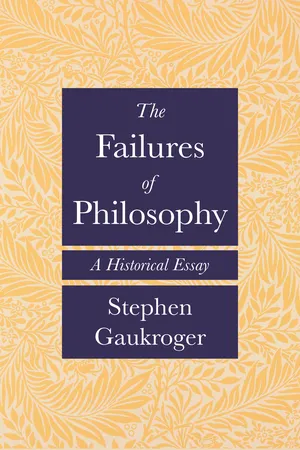
The first book to address the historical failures of philosophy—and what we can learn from them
Philosophers are generally unaware of the failures of philosophy, recognizing only the failures of particular theories, which are then remedied with other theories. But, taking the long view, philosophy has actually collapsed several times, been abandoned, sometimes for centuries, and been replaced by something quite different. When it has been revived it has been with new aims that are often accompanied by implausible attempts to establish continuity with a perennial philosophical tradition. What do these failures tell us?
The Failures of Philosophy presents a historical investigation of philosophy in the West, from the perspective of its most significant failures: attempts to provide an account of the good life, to establish philosophy as a discipline that can stand in judgment over other forms of thought, to set up philosophy as a theory of everything, and to construe it as a discipline that rationalizes the empirical and mathematical sciences. Stephen Gaukroger argues that these failures reveal more about philosophical inquiry and its ultimate point than its successes ever could. These failures illustrate how and why philosophical inquiry has been conceived and reconceived, why philosophy has been thought to bring distinctive skills to certain questions, and much more.
An important and original account of philosophy's serial breakdowns, The Failures of Philosophy ultimately shows how these shortcomings paradoxically reveal what matters most about the field.
- 280 pages
- English
- ePUB (mobile friendly)
- Available on iOS & Android
eBook - ePub
About this book
Information
Publisher
Princeton University PressYear
2020Print ISBN
9780691241746
9780691207506
eBook ISBN
9780691209579
Topic
PhilosophySubtopic
Philosophical EssaysPART I
The Rise and Fall of Philosophy in Antiquity
CHAPTER ONE
The Emergence of Philosophy
PHILOSOPHY IN ANTIQUITY EMERGES AS A NOVEL, distinctive form of enquiry, of unprecedented intellectual power, albeit one that harbours a number of deep-seated problems. The conception of what philosophy is—how it identifies and engages its subject matter—comes down to us from Plato, reinforced and refined by Aristotle. It initially takes shape in Plato’s early dialogues, and is revised and built up as he moves from a Socratic concern with morality to a focus in the later dialogues on what subsequently came to be known as metaphysics. In asking what is distinctive about the kind of enquiry that we find in Plato and Aristotle, two forms of characterization, one identifying a gulf between archaic and classical Greek thought, the other identifying continuities, have been pursued. The first sets up a contrast between philosophy and forms of enquiry, or more generally ways of engaging with the world, that are structured in an entirely different way from it. The contrast commonly drawn here has been between myth and reason, and the sticking point is how it was possible to move from the one to the other. If there were to be such a transition, then the boundary must be more porous than the distinction would suggest, but any middle ground has been difficult to discern, and commentators such as Cornford, who have pursued this path, have not in the end been willing to sacrifice the characteristic features of reason in order to secure such middle ground.1
The second characterization identifies precursors of the mature philosophical enquiry that we find in Plato and Aristotle. Here, the focus has been on metaphysics and on the matter theory of thinkers from Thales onwards. The category under which these are included, ‘Presocratics’, dates from the late eighteenth century, and it only takes on significance with Hegel, who offered an evolutionary schema for philosophy in which tracing forebears played a crucial historiographical role. As the term indicates, it is Socrates who marks the turning point, and in spite of the fact that no one in antiquity doubted that Socrates was the key figure, there was disagreement on just what was distinctive about him. It is usual to consider his approach in contrast to the sophists, skilled as they were in forensic debate and oratorical display, but this contrast is somewhat fluid. The sophist Protagoras had notoriously boasted that he could make the weaker argument seem the stronger, but this is just how Aristophanes, in The Clouds, portrays Socrates, and writers in the generation after Plato, such as Isocrates and the orator Aeschines, classed him as a sophist.2
Plato and Xenophon were clear that what marked out their teacher Socrates was the fact that he abandoned enquiry into nature (peri phuseōs historia) for the study of ‘human things’ (ta anthrōpina): the good man and the practice of virtue, as Xenophon put it. Yet when one turns to Plato’s pupil Aristotle, Presocratic philosophy is principally associated with those figures identified by Aristotle as holding views on the nature of the world which he criticizes in the course of setting out his own natural philosophy (above all his theory of matter). In other words, ‘human things’, while treated in an exemplary way by him, are not constitutive of philosophy, and enquiry into nature is not only not disparaged, but comes to the fore of philosophical enquiry. But then, on the other hand, once one asks what establishes the credentials of philosophy in classical antiquity, it is above all the Socratic turn to ‘human things’. Cicero, in the Prologue to the fifth book of his Tusculan Disputations—a core philosophical work from Roman antiquity, throughout the Renaissance, to the early modern period—writes that philosophy, in large part through its (Platonic) doctrine that virtue is sufficient for happiness, is responsible for the move from barbarism to civilization: the social, cultural, legal, and moral foundations on which the rise of cities was built.
Moreover, although Aristotle himself is clear that it is not Thales but Socrates who is the pivotal figure, he conceives of philosophy in terms of matter theory and an associated cosmology, tracing its origins back to a tradition that starts with Thales, and which Socrates not only makes no contribution towards, but shuns. The difficulty is compounded by the fact that a little probing reveals a gulf between what one and the other was doing. If indeed Thales was pursuing a ‘matter theory’, it was nothing like Aristotle’s metaphysically orientated natural philosophy.
In trying to resolve these questions, we shall be exploring the conception of philosophy in Plato and Aristotle—taking this as constitutive of ancient ‘philosophy’—and focusing on two sets of questions. First, are there ways of engaging cognitive issues that are distinct from the epistemological exercises that take over questions of cognition from Plato onwards? Second, what exactly is the relation between ethics, metaphysics, ‘dialectic’, and natural philosophy as they figure in the classical and Hellenistic conceptions of philosophy, where they are treated as part of a common project? Our initial focus will be on contrast classes, that is, practices among Plato’s predecessors and contemporaries that offer something different from philosophy, but overlap with it, and can be seen as being in competition with it. In particular, our interest is not in ‘the origins of philosophy’, but to understand what marks ancient philosophy out, by distinguishing its characteristics from those of exercises in antiquity that share some of its concerns but pursue them in a different way. In fixing the nature of philosophical enquiry in this way, we can understand how it comes to replace other forms of enquiry in classical antiquity: in what way philosophical forms of enquiry were marked out from, and valued over, non-philosophical ones. Having done this, we can in subsequent chapters begin to explore how Plato and Aristotle and their Hellenistic successors were able to work within this understanding of philosophy.
Coming to Terms with the World
Commenting on the fact that the Greek thinkers of the fourth century were the first to call themselves philosophers, and to define philosophy as a specialized discipline and a unique cultural practice, Andrea Nightingale notes that creating a professional discipline of philosophy ‘required an extraordinary effort of self-definition and legitimation. In addition to developing ideas and arguments, these philosophers had to stake out the boundaries of their discipline and articulate the ways that it differed from other modes of wisdom.’3 One thing that writers in classical antiquity stress, and one thing on which philosophers since have agreed, is the abstract nature of philosophical enquiry. This is something that applies equally to the treatment of the natural and the human realms. Whatever the subject matter, philosophy raises investigation to an abstract level, and this is a qualitative shift, from first- to second-level enquiry. ‘Abstraction’ is not just a feature of philosophy: it goes to the heart of philosophical investigation. Philosophy is an essentially second-order form of enquiry. Accordingly, we need to clarify just what the abstractness in question is, and what the distinctive features of second-order enquiry are. In the first instance, we can consider second-order enquiry into natural processes, before we turn to the more complex case of second-order enquiry into morality.
In order to be more specific about the nature of the ‘abstractness’ at issue, we need a contrast case, that is, an example of a way of thinking about natural processes that is not philosophical. There is one feature of an abstract philosophical approach that stands out as potentially an identifying feature. The abstractness of philosophical enquiry comes through standing back from or above phenomena, by contrast with engaging with them directly, such as when attempting to understand them by immersing oneself in them.
Classical Chinese thought offers a striking contrast here. The sinologist François Jullien sets it out in these terms:
Western thought seeks to adopt a commanding position that provides a theoretical perspective ordering all the material to be organized. This makes abstract thought about it possible, resulting in a vantage point from which one can usually derive some classificatory principle of homogeneity. Chinese reasoning, by contrast, seems to weave along horizontally, from one case to the next, via bridges and bifurcations, each case eventually leading to the next and merging into it. Western logic is panoramic, whereas Chinese logic is like that of a possible journey.4
What underlies this conception in Chinese thought is the notion of ‘opportunity’ or ‘propensity’ (shi5), which, dating from the fourth century BCE, took military strategy as a model of understanding, most notably in the idea of using the minimum effort to achieve maximum effect. Can we find something like this in pre-classical Greek thought?
In the most general terms, what we are concerned with is cognitive grasp: coming to terms with the world by means of our intelligence and skills. In classical philosophy, intelligence and skills are separated. The separation is not there from the start, however. The earliest accounts of cognitive enquiry indicate that the classical Greek contrast between epistēmē and technē—knowledge versus art or skills—arose from an earlier pre-classical unitary conception of cognitive grasp. This earlier conception was centred around the notion of mētis (‘cunning’, or ‘ingenuity’), and the model of outwitting opponents was central to the archaic understanding of cognitive grasp.
The idea behind the archaic Greek notion is that, in overcoming an adversary, whether this be in hunting, fishing, racing, working resistant materials such as metals, or overcoming a fast flowing river, there are only two routes open. Either the stronger will win, or, by the power of mētis, one reverses the natural course of events through cunning, disguise, quick-wittedness, or some cognate skill: generally speaking, some way of coming to terms with events that involves a form of understanding which enables one to overcome obstacles—including cognitive obstacles—rather than through subsuming these under general principles. An image that we find on a number of occasions is that of changing more swiftly than a rapidly changing nature. One comes to terms with something that is constantly changing by outwitting it—not by standing back from it so that one can fix or resolve it—and nature is a prototypically changing realm.6 This conception shares with the classical Chinese notion the absence of any idea of immunity to change. The Chinese sage is someone who adapts to change, ‘shifting with the ever shifting situation itself’, as Geoffrey Lloyd puts it.7
The mētis model is not confined to what will later be identified as practical pursuits, and has a basis in Greek mythology. In these myths, before Zeus became the sovereign god, there was anarchy amongst the gods and constant battles for supremacy. On overthrowing his father Kronos, Zeus was warned that, like his father before him, he should fear any son. To forestall such an eventuality, he devoured his wife, Metis. In doing so, he not only put an end to the threat, but also gained supremacy over the other gods. In order to understand how he manages to achieve this, we must appreciate the significance of his wife’s name. Zeus is not omniscient; his power derives from always being one step ahead. He achieves mastery and absolute order through the power of cunning and deceit, a power that he gains from eating his wife, which renders him the paradigm of mētis.
At the terrestrial level, things are different. Divine order and stability are not to be found on earth, and we are constantly faced with unforeseen happenings and ambiguous situations. Earth is a place of becoming and change. In overcoming an adversary, there are only two routes open. Either the stronger will win, or, by the power of mētis, one reverses the natural course of events through cunning, disguise, or quick-wittedness: generally speaking, some way of coming to terms with events that involves a form of understanding that enables one to outwit rather than explain, such as building a bridge over a fast flowing, and hence otherwise impassable, river.
Notice the way in which the description of the behaviour of the gods here is completely on a par with the account of natural processes. The traditional opposition in modern commentators between myth and reason—absent in Aristotle, for whom ‘he who loves myth is, in a way, a philosopher’8—trades largely on the importation of the assumptions of Christianity. Greek religion did not have a basis in dogma or fundamental beliefs, and hence was immune to any conflict between orthodoxy and heterodoxy. Its myths and rituals, which varied radically from city to city, relied on the visibility of cult worship. As Maria Michela Sassi points out, this situation is contradicted only in appearance by what the sources tell us regarding the trials for impiety against Anaxagoras, Protagoras, Diagoras, and Socrates (the only historically documented case). She notes that these trials took place in the aftermath of the Peloponnesian War, a particularly difficult time for independent thinkers, especially those who, like Anaxagoras, had belonged to Pericles’s entourage. In the case of Socrates, it is quite clear that ‘the prosecution used Socrates’s alleged or actual inobservance of cult as a pretext in order to silence an inconvenient critic of the Athenian political class’.9
In the light of the nature of myths in the Greek context, consider the transition from ‘myth to reason’. In both archaic and classical thought, we find seemingly unobtrusive mention of the gods and elaboration of myths, although the level of integration in the former seems greater, in that in Plato’s dialogues, in the Symposium for example, discussion in terms of the gods parallels philosophical investigation, whereas in archaic thought it feeds into it more directly. Nevertheless, if we think in terms of a transition from the kind of enquiry centred around ideas such as mētis to that centred around the classical notion of knowledge, epistēmē, it is wholly misleading to think of it in terms of a move from myth to reason. Mētis-based enquiry is as indebted to the use of reason as classical philosophical thought is. There is no move to reason, and philosophy does not have a monopoly on reason. Mētis has an aim, which in the most general case is that of understanding how to deal with situations subject to constant change, and it uses a reasoned path to achieve that aim. This path is not irrational, or just a question of story-telling. Moreover it is something in which some people are more skilled than others, and the outcome is a sign of this skill: as in the case of the prediction of fluctuations in the olive harvest by Thales, whose skills, as we about to see, were very much within the preserve of mētis, not that of epistēmē.
The difference between archaic and classical Greek thought lies not in a move to reason, but in the role of disambiguation. This turns on t...
Table of contents
- Cover
- Title Page
- Copyright
- Epigraph
- Contents
- Preface
- Introduction
- Part I: The Rise and Fall of Philosophy in Antiquity
- Part II: Philosophy Re-Purposed as the Ultimate Arbiter
- Part III: The Decline of Philosophy and Its Re-Purposing as Metascience
- Conclusion
- Notes
- Index
Trusted by 375,005 students
Access to over 1.5 million titles for a fair monthly price.
Study more efficiently using our study tools.
Frequently asked questions
Yes, you can cancel anytime from the Subscription tab in your account settings on the Perlego website. Your subscription will stay active until the end of your current billing period. Learn how to cancel your subscription
No, books cannot be downloaded as external files, such as PDFs, for use outside of Perlego. However, you can download books within the Perlego app for offline reading on mobile or tablet. Learn how to download books offline
Perlego offers two plans: Essential and Complete
- Essential is ideal for learners and professionals who enjoy exploring a wide range of subjects. Access the Essential Library with 800,000+ trusted titles and best-sellers across business, personal growth, and the humanities. Includes unlimited reading time and Standard Read Aloud voice.
- Complete: Perfect for advanced learners and researchers needing full, unrestricted access. Unlock 1.5M+ books across hundreds of subjects, including academic and specialized titles. The Complete Plan also includes advanced features like Premium Read Aloud and Research Assistant.
We are an online textbook subscription service, where you can get access to an entire online library for less than the price of a single book per month. With over 1.5 million books across 990+ topics, we’ve got you covered! Learn about our mission
Look out for the read-aloud symbol on your next book to see if you can listen to it. The read-aloud tool reads text aloud for you, highlighting the text as it is being read. You can pause it, speed it up and slow it down. Learn more about Read Aloud
Yes! You can use the Perlego app on both iOS and Android devices to read anytime, anywhere — even offline. Perfect for commutes or when you’re on the go.
Please note we cannot support devices running on iOS 13 and Android 7 or earlier. Learn more about using the app
Please note we cannot support devices running on iOS 13 and Android 7 or earlier. Learn more about using the app
Yes, you can access The Failures of Philosophy by Stephen Gaukroger in PDF and/or ePUB format, as well as other popular books in Philosophy & Philosophical Essays. We have over 1.5 million books available in our catalogue for you to explore.