Piezoelectric surgery is an innovative approach to hard tissue surgery that meets the essential biologic criteria. The long-term stability of the periodontium and alveolar bone is facilitated by ultrasonic instrumentation that offers atraumatic surgical procedures; limited risk to surrounding tissue; and improved visibility, hemostasis, and postoperative conditions. This book presents the clinical applications of ultrasonic devices in bone surgery, including its indications, advantages, and limitations. New surgical protocols and numerous illustrated clinical cases help guide developing surgeons in the nuances of ultrasonic-based bone surgery for optimal clinical results.

eBook - ePub
Clinical Success in Bone Surgery with Ultrasonic Devices
- 92 pages
- English
- ePUB (mobile friendly)
- Available on iOS & Android
eBook - ePub
Clinical Success in Bone Surgery with Ultrasonic Devices
About this book
Information
Topic
MedicineSubtopic
Oral Health & Surgery| Ultrasounds: |  |
Medical and surgical applications | |
 | |
Piezoelectricity
Ultrasounds are waves with a frequency higher than 20,000 Hz (ie, cycles per second). A large number of ultrasonic frequencies used in everyday life—such as those used in car alarms and other antitheft systems—are not perceptible to the human ear. Humans perceive frequencies between 20 and 20,000 Hz. Ultrasound is therefore inaudible to humans but audible to certain animals such as dogs, bats, and dolphins. Developed in the 1950s, ultrasound technology is now widely used in the fields of medicine, dentistry, metallurgy, and aviation, and by the navy. It is also used for fishing, cleaning, and remote controls (eg, automatic gates).
The ultrasonic wave displaces itself in a medium and transmits its energy to the particles encountered. Ultrasonic vibrations are waves that are (1) displaced in a longitudinal direction, (2) displaced in a medium, and (3) reflected and absorbed at the interface of the different surfaces encountered (Van Der Weijden 2007).
Different mechanisms of ultrasonic wave production
Three vibrational systems have been developed for the different ultrasonic devices.
Magnetostrictive systems
A ferromagnetic bar and a copper spiral thread in the handpiece generate vibrations ranging from 18,000 to 45,000 Hz. These devices produce an elliptic movement of the tip resembling a hammering motion.
Sonic systems
An air turbine in the handpiece generates vibrations ranging from 2,500 to 16,000 Hz. These devices produce an elliptic or circular movement of the tip resembling hammering and abrasion motions.
Piezoelectric systems
Piezoelectric instruments are widely used in dentistry, and their effects are becoming better understood.
The physicists Pierre and Jacques Curie (younger and elder brother, respectively), in collaboration with Gabriel Lippmann, discovered the piezoelectric effect as early as 1890. According to these French researchers, the application of compression forces on certain solids generates an electric load. As a result, the term piezo, from the Greek verb piezein meaning “compress” or “press,” was chosen. Solids with this property have a crystalline structure, such as quartz, tourmaline, Seignette salt (also known as potassium sodium tartrate), and barium titanate. Today, quartz crystals have been abandoned, and most piezoelectric handpieces are made of ceramic crystalline structures.
Advantages of ultrasound use in the practice of bone surgery
Ultrasonic devices have six main properties (Gagnot and Poblete 2004).
1. Sweeping: Occurs when the tip is placed tangentially on the surface to be treated.
2. Irrigation: Needed to cool the tip. It also may be used to deliver antibacterial chemical substances into the periodontal pocket, which is particularly useful during ultrasonic scaling.
3. Chipping: May be observed every time the dorsal surface of the tip is placed against the surface to be treated.
4. Microcurrents: Generated by the vibration passing through the irrigation liquid (eg, physiologic saline solution, antiseptics) or through the fluids encountered during the intervention (eg, saliva, blood).
5. Cavitation: During the vibration, small depressions similar to bubbles are produced at the end of the tip at sites of maximum vibration (ie, at the tip extremity and 2 to 3 mm from the tip). These air bubbles vibrate with their source, increase in size, and then explode. This phenomenon, which has antibacterial properties, is called cavitation. It depends on the frequency, not the amplitude, of the ultrasonic vibration.
6. Abrasion: Relates to the vibrational frequency and the surface of the tip used (eg, stainless steel, diamond, or composite). It has a large effect on the quality of surface obtained and the cutting effect.
The piezoelectric effect can be defined as either:
- Direct: The electrical polarization (ie, displacement of positive and negative charges) that occurs when certain materials (eg, quartz or ceramic) with piezoelectric properties are subjected to mechanical force.
- Indirect: The deformation (eg, dilatation or contraction) that occurs when these same materials with piezoelectric properties are subjected to an electric field.
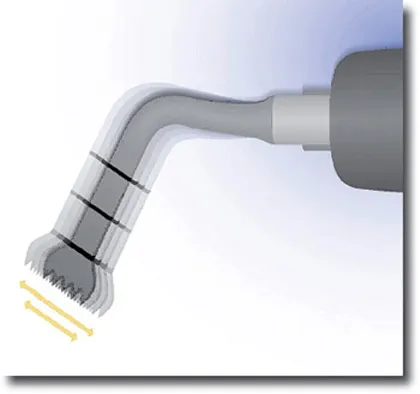
The electric current generates a distortion of the ceramic disks. These movements create vibrations in the axis of the transducer. The amplifier, bound to the tip, increases the combined vibratory displacements of the ceramic disks. The tip vibrations come into resonance with the piezoelectric disks, which increases their energy output and improves their efficiency. Therefore, the tip vibrates on a longitudinal axis as shown in Fig 1-1.
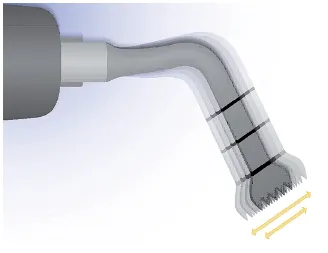
1-1 Vibrational direction of the “saw” tip attached to a functioning piezoelectric handpiece.
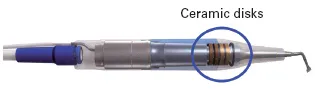
1-2 Handpiece meant for producing ultrasonic piezoelectric vibrations (Satelec).
The vibrational amplitude in the surgical mode is between 30 and 60 μm. The countermass absorbs the vibrations rearward and optimizes the electromechanical output.
These handpieces are submitted to an indirect or reverse effect (Fig 1-2). The use of appropriate frequencies allows a cutting effect under constant irrigation of the hard tissues, which makes these machines well suited for use in bone surgery.
Bibliography
Gagnot G, Poblete MG. Du bon usage des ultrasons: La maîtrise des vibrations. Rev Odont Stomat (Paris) 2004a;33:85–95.
Piezotome [clinical pamphlet]. Satelec Acteon, 2006.
Van Der Weijden F. The Power of Ultrasonics. Chicago: Quintessence, 2007.
| Indications and contraindications |  |
for bone surgery | |
in periodontology and implant dentistry | |
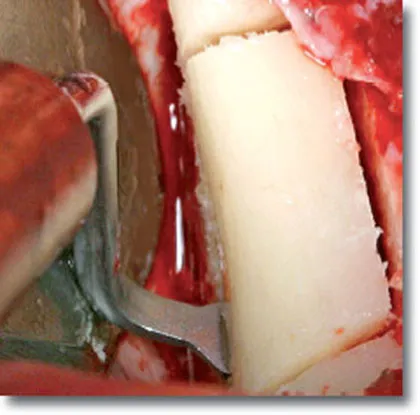 | |
The extraction of teeth following trauma results in a loss of substance, creating functional and esthetic consequences that are significant during oral rehabilitations (Fig 2-1).
According to Harris (1997), bone resorption may have four main causes:
- Pathologic (eg, periodontal diseases, cysts)
- Surgical (eg, extraction of impacted cuspids, apicoectomy)
- Congenital (eg, micrognathy, oligodontia, palatal clefts)
- Physiologic (eg, tooth loss, age, pneumatization of the maxillary sinus)
The most frequent causes of the loss of bone substance are aggressive periodontitis and postextraction trauma related to wearing an unadapted removable prosthesis. The following clinical case shows the consequences of these bone pathologies.
This radiographic example shows a 40-year-old woman in good general health but with severe chronic periodontitis that has been stabilized for 2 years with conventional periodontal treatment (ie, initial nonsurgical treatment, periodontal surgery, and replacement of tooth 16 with a conventional fixed bridge) (Fig 2-2).
For the past 15 years, she has received regular maintenance every 4 months....
Table of contents
- Cover
- Title Page
- Copyright Page
- Authors
- Acknowledgements
- Table of contents
- Foreword
- Introduction
- 1. Ultrasounds: Medical and surgical applications
- 2. Indications and contraindications for bone surgery in periodontology and implant dentistry
- 3. Ultrasonic-assisted bone surgery: Devices and instrumentation
- 4. Preoperative evaluation and premedication
- 5. Intraoral and extraoral donor sites in periodontal and implant surgery
- 6. Techniques – Clinical cases
Trusted by 375,005 students
Access to over 1.5 million titles for a fair monthly price.
Study more efficiently using our study tools.
Frequently asked questions
Yes, you can cancel anytime from the Subscription tab in your account settings on the Perlego website. Your subscription will stay active until the end of your current billing period. Learn how to cancel your subscription
No, books cannot be downloaded as external files, such as PDFs, for use outside of Perlego. However, you can download books within the Perlego app for offline reading on mobile or tablet. Learn how to download books offline
Perlego offers two plans: Essential and Complete
- Essential is ideal for learners and professionals who enjoy exploring a wide range of subjects. Access the Essential Library with 800,000+ trusted titles and best-sellers across business, personal growth, and the humanities. Includes unlimited reading time and Standard Read Aloud voice.
- Complete: Perfect for advanced learners and researchers needing full, unrestricted access. Unlock 1.5M+ books across hundreds of subjects, including academic and specialized titles. The Complete Plan also includes advanced features like Premium Read Aloud and Research Assistant.
We are an online textbook subscription service, where you can get access to an entire online library for less than the price of a single book per month. With over 1.5 million books across 990+ topics, we’ve got you covered! Learn about our mission
Look out for the read-aloud symbol on your next book to see if you can listen to it. The read-aloud tool reads text aloud for you, highlighting the text as it is being read. You can pause it, speed it up and slow it down. Learn more about Read Aloud
Yes! You can use the Perlego app on both iOS and Android devices to read anytime, anywhere — even offline. Perfect for commutes or when you’re on the go.
Please note we cannot support devices running on iOS 13 and Android 7 or earlier. Learn more about using the app
Please note we cannot support devices running on iOS 13 and Android 7 or earlier. Learn more about using the app
Yes, you can access Clinical Success in Bone Surgery with Ultrasonic Devices by Marie G. Poblete-Michel,Jean-Franҫois Michel in PDF and/or ePUB format, as well as other popular books in Medicine & Oral Health & Surgery. We have over 1.5 million books available in our catalogue for you to explore.