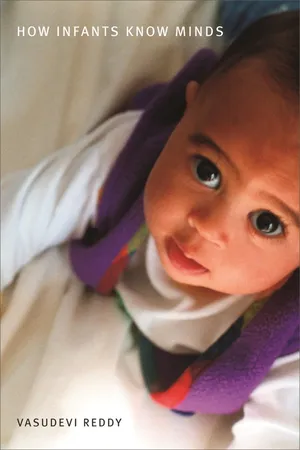
Most psychologists claim that we begin to develop a "theory of mind"—some basic ideas about other people's minds—at age two or three, by inference, deduction, and logical reasoning.
But does this mean that small babies are unaware of minds? That they see other people simply as another (rather dynamic and noisy) kind of object? This is a common view in developmental psychology. Yet, as this book explains, there is compelling evidence that babies in the first year of life can tease, pretend, feel self-conscious, and joke with people. Using observations from infants' everyday interactions with their families, Vasudevi Reddy argues that such early emotional engagements show infants' growing awareness of other people's attention, expectations, and intentions.
Reddy deals with the persistent problem of "other minds" by proposing a "second-person" solution: we know other minds if we can respond to them. And we respond most richly in engagement with them. She challenges psychology's traditional "detached" stance toward understanding people, arguing that the most fundamental way of knowing minds—both for babies and for adults—is through engagement with them. According to this argument the starting point for understanding other minds is not isolation and ignorance but emotional relation.
eBook - PDF
How Infants Know Minds
About this book
Information
Publisher
Harvard University PressYear
2009Print ISBN
9780674046078
9780674026667
eBook ISBN
9780674033887
Table of contents
- Cover
- Title page
- Copyright
- Dedication
- Contents
- Acknowledgements
- Chapter 1. A Puzzle
- Chapter 2. Minding the Gap
- Chapter 3. Engaging Minds: A Second-Person Approach
- Chapter 4. Making Contact: Imitation
- Chapter 5. Opening Conversations
- Chapter 6. Experiencing Attention
- Chapter 7. Feeling Self-Conscious
- Chapter 8. Playing with Intentions
- Chapter 9. Sharing Funniness
- Chapter 10. Faking in Communication
- Chapter 11. Other Minds and Other Cultures
- Notes
- Index
Trusted by 375,005 students
Access to over 1.5 million titles for a fair monthly price.
Study more efficiently using our study tools.
Frequently asked questions
Yes, you can cancel anytime from the Subscription tab in your account settings on the Perlego website. Your subscription will stay active until the end of your current billing period. Learn how to cancel your subscription
No, books cannot be downloaded as external files, such as PDFs, for use outside of Perlego. However, you can download books within the Perlego app for offline reading on mobile or tablet. Learn how to download books offline
Perlego offers two plans: Essential and Complete
- Essential is ideal for learners and professionals who enjoy exploring a wide range of subjects. Access the Essential Library with 800,000+ trusted titles and best-sellers across business, personal growth, and the humanities. Includes unlimited reading time and Standard Read Aloud voice.
- Complete: Perfect for advanced learners and researchers needing full, unrestricted access. Unlock 1.5M+ books across hundreds of subjects, including academic and specialized titles. The Complete Plan also includes advanced features like Premium Read Aloud and Research Assistant.
We are an online textbook subscription service, where you can get access to an entire online library for less than the price of a single book per month. With over 1.5 million books across 990+ topics, we’ve got you covered! Learn about our mission
Look out for the read-aloud symbol on your next book to see if you can listen to it. The read-aloud tool reads text aloud for you, highlighting the text as it is being read. You can pause it, speed it up and slow it down. Learn more about Read Aloud
Yes! You can use the Perlego app on both iOS and Android devices to read anytime, anywhere — even offline. Perfect for commutes or when you’re on the go.
Please note we cannot support devices running on iOS 13 and Android 7 or earlier. Learn more about using the app
Please note we cannot support devices running on iOS 13 and Android 7 or earlier. Learn more about using the app
Yes, you can access How Infants Know Minds by Vasudevi Reddy in PDF and/or ePUB format, as well as other popular books in Psychology & Psychiatry & Mental Health. We have over 1.5 million books available in our catalogue for you to explore.