eBook - ePub
Later Living: Housing with Care
ULI UK Residential Council: A Good Practice Guide
- 132 pages
- English
- ePUB (mobile friendly)
- Available on iOS & Android
eBook - ePub
Later Living: Housing with Care
ULI UK Residential Council: A Good Practice Guide
About this book
This publication offers guidance for investors, developers and architects on how to best design, build and operate housing with care, part of the later living sector in the UK.
Information
Topic
ArchitectureSubtopic
Residential ArchitectureCHAPTER ONE
The Ageing Opportunity

This chapter is our scene setter for housing with care. By explaining the purpose of this growing sector, the consumer, the model itself and the variety of tenures available, we hope to show how to unlock the opportunities and, at the same time, share good practice.
Housing with care brings together real estate and operation, delivering the potential for long-term investment and solid returns, while at the same time providing sustainable services to our ageing population. It is a modern solution to the modern phenomenon of longevity, and there is a huge market.
As with any operationally driven real estate, people are at the heart of housing with care. As such, there is a strong focus on consumers – what they want from their home, what services they need, or may need in future, and where they want to be located.
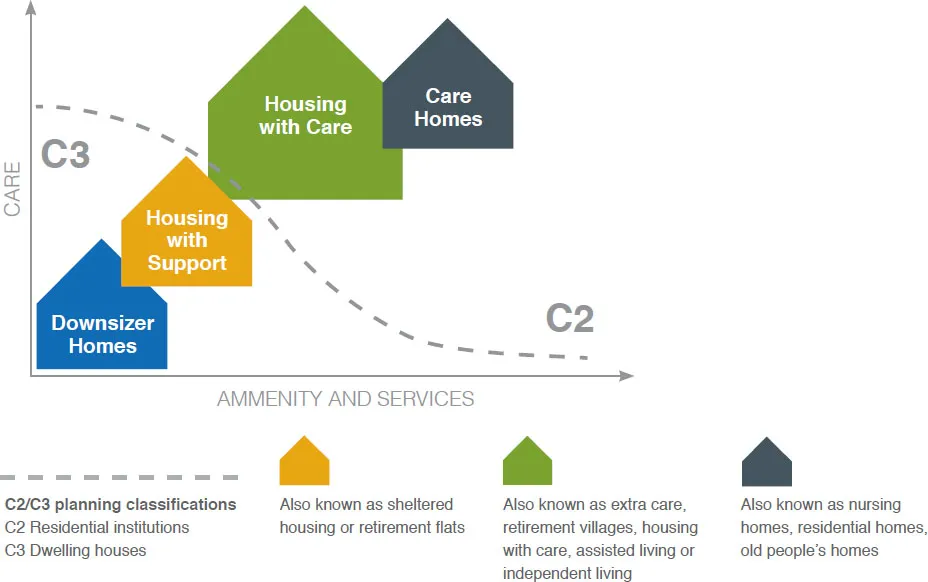
THE SPECTRUM OF OPTIONS FOR LATER LIVING
Who is the consumer for housing with care?
For planning purposes, age-defined housing is usually for those aged 55+ or 60+; however, most housing with care residents will not move into a scheme until they are in their mid 70s. According to the Associated Retirement Community Operators (ARCO), the average age of residents living within one of its members’ communities is 83. As they enter a housing with care community, consumers are likely to be at a stage in life when they are broadly unaffected by health or mobility problems; however, they may have the foresight to seek the comfort of being able to access care and support as they age. At a later juncture they may experience health and mobility problems which have a significant effect on wellbeing or quality of life. Data from NHS England in 2017 illustrates that 72 percent of those in the 65–69 age bracket are fit, with only 23 percent experiencing mild frailty, whilst conversely 39 percent of those aged 80–84 experience mild frailty and 35 percent are considered fit.
Housing with care thereby bridges the space between ‘downsizer/rightsizer’ – a common term for the step from the family home or equivalent to a smaller home – and traditional care homes.
What does the consumer want?
A recent RIBA publication on age-friendly housing5 asserted that there is general agreement on the need for a wider range of attractive, ‘care-ready’ housing options designed to meet the aspirations of the current baby boomer generation. What is paramount here is that most want to remain as independent as possible for as long as possible, so these options need to be both facilitators and enablers.
This means providing suitable housing and services, with access to flexible support and/or care as well as a range of communal facilities. Although operator models vary, the key shared factor is that you own or rent an independent, self-contained property with your own front door; as one person explained to a researcher: “It’s my own front door and I can shut it when I want to!”
With housing supply increasingly target driven and planning seen as a barrier to delivery, we need to be building at least 30,000 well-designed housing units for people in later life annually. This is still just 10 percent of all new housing but is the step change required to meet the lifestyle choices of a growing older population.
Recent research undertaken by ProMatura asking why residents of housing with care schemes in the UK chose their community, highlighted the dual wish for a reduction in maintenance and the availability of care and/or support on-site. The results reinforce the different drivers for those post retirement (low/no access to care), versus individuals who are becoming frailer.
FACTORS THAT INFLUENCED DECISIONS TO MOVE TO A COMMUNITY
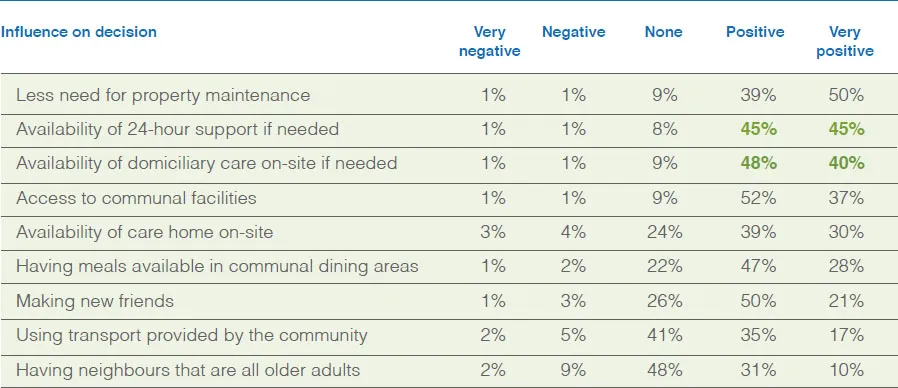
Other influences included: a sense of safety/security (40 mentions), property location (33), close to family (29), activities (16), property near public transportation (13), no stairs to climb (12), and friendliness of staff (9).
Source: ARCO/Promatura
Housing with care accommodation can also provide an opportunity for new friendships, social networks and mutual support. As people age, the numbers living alone increase. In 2017, there were 3.8 million people living alone aged 65 and over6. Generally, single living occurs most frequently following the death of a partner. Relationship changes or breakdowns in later life are also a factor and this is another driver for an increasing demand for market rental housing in later life7.
All of the factors described in the table on page 13 mean that the choice to move into a housing with care scheme is based not so much on the property itself but on the services and lifestyle on offer. Many operators will facilitate on-site activities, often resident-led, to ensure a range of activities suited to the interests of residents as well as access to local amenities. There can also be links with local groups including community involvement in on-site activities.
The demand for housing with care
“We need a ‘residential revolution’ to meet the growing housing needs and aspirations of an ageing population.8”
The potential of this sector is overwhelming. Below we outline the key drivers behind the demand.
An ageing population
We are living longer and need to prepare for this eventuality. In 2037, one in four of us will be over 65 – that is a quarter of the population. As such, projections estimate that in the UK by 2033 there will be a 40 percent increase on 2008 of households headed up by someone of 65+, taking the total of households to 13 million.
Most UK government statistics focus on those aged over 65. Although helpful when evaluating an ageing population as a whole, this large cohort is not specific enough for the housing with care sector, where many residents moving into housing with care schemes will be 75+. There are, however, a few data points that underline the demographic imperative appropriately:
- By 2037 there are projected to be 1.42 million more households headed by someone aged 85 or over – an increase of 161 percent over 25 years.9
- 5.7 million people are aged 75 and above. Representing 8.5 percent of the total population in 2019; by 2025 they will number 6.9 million.10
- The number of people over 85 in the UK is predicted to more than double in the next 25 years to over 3.2 million.11
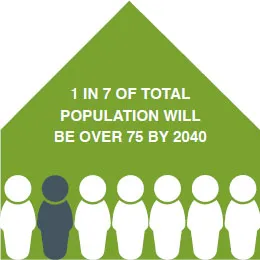
- By 2040, almost 1 in 7 people is projected to be aged over 75 in the UK.12
- Currently 76 percent of older people (65+) are owner-occupiers, but this is expected to decline over the next 20-30 years.13
- The proportion of older private renters is expected to increase significantly.
- The share of those aged 80 years or above in the EU-28’s population is projected to increase by two and a half times between 2018 and 2100, from 5.6 percent to 14.6 percent.14
Available stock
As highlighted by the Communities and Local Government (CLG) Select Committee15 in its recent housing and older people inquiry report, most of the UK’s existing housing stock is not ‘futureproofed’ for an ageing population. New build housing has to be built in accordance with the Building Regulations Part M changes in 2015. Building Regulations Approved Document M, section M4(1), visitable dwellings, is mandatory as a minimum, with M4(2), Accessible and Adaptable, and M4(3), Wheelchair User dwellings, being optional and addressed in planning approval conditions in accordance with the specific Local Authority policy. M4(2) is the approximate equivalent of the former Lifetime Homes16. As such, new build homes may or may not adapt for individuals as they age.
The Elderly Accommodation Counsel (EAC) provides information and advice to older people regarding their housing. It reports that between 1999 and 2018 the total delivery of housing with care across sale, rent and shared ownership was 61,000 units, with an average of 3,000 units being supplied each year. Over that time period the highest number of units delivered in any given year was 5,700 in 2015. The numbers have been steadily increasing; however, with only 3,800 completed in 2018, the volume is low17. It is estimated that there will be a shortfall of 68,500 housing with care units in England and Wales by 2030.
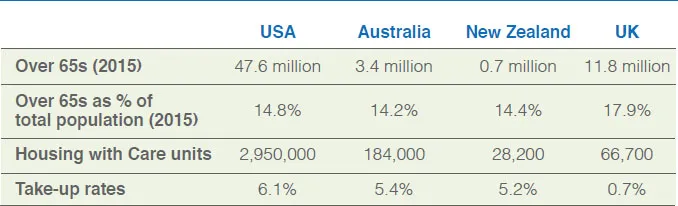
The UK also currently falls behind international benchmarks of mature economies relating to home ownership within retirement communities providing care and support, with only 0.7 percent of the over-65 population living in such schemes, compared with 5 percent in New Zealand, 5.25 percent in Australia and 5.6 percent in the US18.
COMPARABLE RETIREMENT LIVING MARKETS
Sources: JLL, EAV, NIC, MAP, Property Council of Australia
“There is a massive opportunity to support an ageing population while at the same time redressing the balance in our housing stock.”
Case study
When John Ryder and Kevin Hickman founded Ryman Healthcare in 1984, they could not have conceived what their fledgling company would become...
Table of contents
- Cover
- Copyright
- Contents
- Forewords
- About ULI and the UK Residential Council
- Chair Introduction
- Chapter one: The Ageing Opportunity
- Chapter two: Facilitating Lifestyle: Managing, Operating and Financing
- Chapter three: Facilitating Lifestyle: Care
- Chapter four: Design
- Chapter five: Tenure and financing
- Chapter six: Policy and planning
- Glossary
- Acknowledgements
- Steering Group, Working Group and Independent Review Panel members
- Biographies
- References
Trusted by 375,005 students
Access to over 1.5 million titles for a fair monthly price.
Study more efficiently using our study tools.
Frequently asked questions
Yes, you can cancel anytime from the Subscription tab in your account settings on the Perlego website. Your subscription will stay active until the end of your current billing period. Learn how to cancel your subscription
No, books cannot be downloaded as external files, such as PDFs, for use outside of Perlego. However, you can download books within the Perlego app for offline reading on mobile or tablet. Learn how to download books offline
Perlego offers two plans: Essential and Complete
- Essential is ideal for learners and professionals who enjoy exploring a wide range of subjects. Access the Essential Library with 800,000+ trusted titles and best-sellers across business, personal growth, and the humanities. Includes unlimited reading time and Standard Read Aloud voice.
- Complete: Perfect for advanced learners and researchers needing full, unrestricted access. Unlock 1.5M+ books across hundreds of subjects, including academic and specialized titles. The Complete Plan also includes advanced features like Premium Read Aloud and Research Assistant.
We are an online textbook subscription service, where you can get access to an entire online library for less than the price of a single book per month. With over 1.5 million books across 990+ topics, we’ve got you covered! Learn about our mission
Look out for the read-aloud symbol on your next book to see if you can listen to it. The read-aloud tool reads text aloud for you, highlighting the text as it is being read. You can pause it, speed it up and slow it down. Learn more about Read Aloud
Yes! You can use the Perlego app on both iOS and Android devices to read anytime, anywhere — even offline. Perfect for commutes or when you’re on the go.
Please note we cannot support devices running on iOS 13 and Android 7 or earlier. Learn more about using the app
Please note we cannot support devices running on iOS 13 and Android 7 or earlier. Learn more about using the app
Yes, you can access Later Living: Housing with Care by Urban Land Institute in PDF and/or ePUB format, as well as other popular books in Architecture & Residential Architecture. We have over 1.5 million books available in our catalogue for you to explore.