Based on a series of interviews with key leaders of Europe's real estate development industry, this book offers wisdom and lessons learned through decades of experience. It provides guidance for surviving the inevitable downturns and taking advantage of rising economies. Future leaders of the industry will gain pointers as they create road maps for their careers, while experienced leaders will find tips and insights from some of the best and brightest in the industry.
eBook - ePub
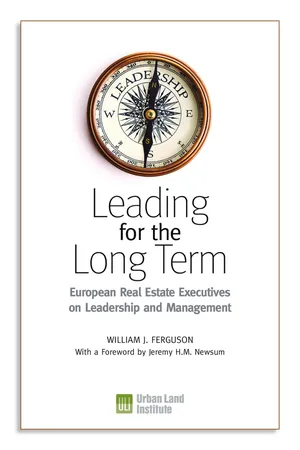
Leading for the Long Term
European Real Estate Executives on Leadership and Management
- 135 pages
- English
- ePUB (mobile friendly)
- Available on iOS & Android
eBook - ePub
Leading for the Long Term
European Real Estate Executives on Leadership and Management
About this book
Information
CHAPTER ONE
The Lay of the Land
IN ANY BUSINESS OR INDUSTRY, and especially one as cyclical as real estate, the test of a leader comes not when things are going well—when it seems to the uninitiated that the sky’s the limit and there’s fast money to be made. The real badge of honor is earned over the long haul by persevering through the inevitable downturns. Recognizing that the good times will not last forever and pullbacks are a reality, industry survivors manage businesses prudently by managing risk proactively.
When a downturn becomes more than the typical correction, escalating to crash and crisis, survival is not guaranteed. Only the most prepared, disciplined, and well-capitalized businesses will sustain themselves through the fall. In such times, humility more than hubris dictates survival.
Most of the real estate leaders interviewed for this book admit to surprise at the severity of the 2008–2009 global economic crisis. Even those who had an inkling that a downturn was coming did not expect it to lead to the worst drop in commercial property values since the 1920s.
Although not without their share of scars and lingering bruises, the most notable leaders in European real estate are still standing largely because of their leadership principles. And chief among those principles: avoid the temptation to chase short-term returns in what is, by nature, a long-term business. While overleveraged and overexposed competitors fell by the wayside during the crisis and in its aftermath, companies led by people with long-term strategies were able to stay the course through the downturn and position themselves to seize the first opportunities that emerged. Theirs were the first cranes back on the skyline and the first sizable developments in markets that once again were showing promise.
Yes, timing plays a role in success in the real estate field, as it does in any business or sector. But values matter even more in a transaction-oriented business like real estate. This author’s previous book, Keepers of the Castle, contains interviews with U.S. real estate executives who endured many cycles, including the most recent fiscal crisis, demonstrating that they understood the fundamentals and never chased the fads as they built great companies with long-term vision. Similarly, in its follow-up, Market Discipline—The Competitive Advantage: Lessons from Canada’s Real Estate Leaders, a clear connection is made between the value system of Canadian real estate executives and the health of the sector in that country. In Canada, more stringent bank lending practices, strong relationships among real estate leaders in a tightly knit industry, and a general aversion to too much risk exposure shielded the industry from much of the impact of the financial crisis.
In this book, the focus is on Europe, where Ferguson Partners has been active for many years, including at its London office, established in the mid-1990s. Through its executive recruitment activities, the firm has had a front-row view of trends in the industry and an opportunity to observe and relate to its leaders. From this perspective and through the interviews conducted for this book, certain fundamental leadership principles have emerged—such as having the right instincts and experiences, managing risk, and taking the long-term view—that are as central in Europe as they are elsewhere. Other leadership values, however, appear to be more uniquely European, such as stewardship and legacy. There is a real sense of caring for what has been entrusted to the current generation by those who have gone before, as well as a feeling of obligation to provide for those who will follow. In a landscape of such historic depth, the long-term view takes on another dimension.
Other values evidenced among European real estate leaders relate to the reality of running a pan-European business. Even with economic unification of the European Union, significant differences remain among countries in language, culture, and ways of doing business. To bridge these differences, pan-European real estate firms place great value on the local team. This team is crucial to risk management, which becomes even more important in running a pan-European business. Investing in various regions in the United States (West Coast versus East Coast) or in Canada (Toronto versus Vancouver) is not as risky as dealing with the pronounced differences one encounters in Europe. Consider, for example, how different Greece is from Germany—economically, politically, and culturally. The complexities of executing a pan-European strategy are not for the inexperienced.
As the profiles of leaders in the following chapters show, many tend to specialize in a particular market (London, for example) or sector (such as retail). Although their company portfolios may be diverse, their core businesses tend to be focused on those few things they do extremely well. Trying to be all things in all markets carries huge risk, especially during downturns.
The European Environment
The most challenging environment for real estate companies was the global financial and economic meltdown of 2008–2009, which began in the U.S. housing market, detonated in the financial sector, and resulted in decimated investor portfolios. The crisis hit like a tidal wave, buffeting financial and government institutions and ultimately all businesses with unprecedented force. As the European Investment Fund wrote in its 2009 annual report, “2009 was the year in which the global economy experienced its most severe downturn since the Second World War. The unprecedented period from 2008 through 2009 will be recalled as the Great Recession.”1 To shore up the system, massive government and central bank interventions were launched to avoid doomsday scenarios. Across Europe, plans for recapitalization, purchases of problem assets, and some nationalization of banks were part of a systemwide rescue plan. Amid a weak world economy, European economic activity contracted by about 4 percent—evidence of a steep recession.
By 2010, modest improvement began to evidence itself over much of Europe, but there were significant differences among the European Union countries. A debt crisis erupted first in Greece, with threats of similar crises emerging later in Ireland and Portugal, followed by fears in Italy and Spain. With every new wave of panic, many doubted the future of both the Eurozone and the euro. Those fears, as discussed later in this chapter, have proved largely unfounded.
Amid the economic wreckage, however, opportunities began to surface. As the European Investment Fund noted in its annual report for 2011, “a crisis is also a source of opportunities since, as valuations decrease, acquisitions can be completed at more favourable prices.”2 Although the report did not mention real estate specifically, clearly the sector reflects the opportunism that often emerges after a crisis and in the early phases of recovery.
Global investors have come to Europe looking for deals on distressed property. Ireland’s National Asset Management Agency (NAMA) and Spain’s Sareb—both so-called bad banks, established by the government to absorb toxic assets—have portfolios of distressed loans and properties expected to be sold to investors at discounts (although perhaps not as steep as bargain hunters, particularly those from the United States, might have hoped). Among the most active have been American investors who, having witnessed the repricing in the United States, are eager to be first movers in Europe to gain a competitive advantage over those who follow.
Activity is not confined to sales of distressed properties, which began in earnest in 2013. Development, particularly in core markets, has strengthened as well. “Optimism has returned to Europe’s real estate industry,” the Urban Land Institute and PwC declared in their Emerging Trends in Real Estate® Europe 2013 report. “Sentiment among industry leaders about the prospects for their businesses is more positive than at any time since 2008, despite the uncertain macroeconomic outlook. Equity for investment in prime commercial real estate is expected to increase, but bank debt is predicted to contract further.” Although confidence is running higher within the European real estate industry, there is still caution; a full recovery, ULI and PwC noted, “is still some way off.”3
The Good News
Although economic growth across the Eurozone has been feeble, there is good news. For one thing, the worst appears to be over. Real estate leaders interviewed for this book rated the survival of the euro and the Eurozone at about a 90 to 95 percent certainty. Looking across Europe today, it is clearly a more stable and predictable place than it was in the midst of the financial crisis. After five long, hard years with much bad news—austerity plans, rising unemployment, and doubts regarding survival of the euro—a corner has been turned. Still, real concerns remain, and the European economy will need more time to fully recover.
“Europe will be an unequal place,” one senior real estate leader commented. “It’s probably a reasonable bet that the currently prosperous areas will increase at a faster rate than the disadvantaged areas.”
Yet even amid disappointment over what appears to be stagnating growth in Europe—which will affect real estate, particularly in secondary and tertiary markets—fears over the fate of the Eurozone have been quelled. In the West in particular, speculation about the fate of the euro and the future stability of the Eurozone had made for regular fodder in the news and on opinion pages, leading some to opine that such a political patchwork of constitutions, cultures, economies, and fiscal policies could not stand the pressure of the crisis. In the critics’ view, having one currency among 18 countries with separate fiscal policies is a recipe for instability—especially as the Eurozone struggles with high levels of debt and unemployment and weak banks.
The Eurozone got a shot in the arm, however, in July 2012 when European Central Bank (ECB) president Mario Draghi famously pledged that the ECB would do “whatever it takes” to save the euro. Another vote of confidence for the Eurozone was the September 2013 reelection of German Chancellor Angela Merkel, who became the only major European leader to be reelected twice following the financial crisis. Merkel has said Germany will continue its Eurozone policies, adding that the political victory for her party was “a very strong vote for a unified Europe.”4
In a speech at Harvard University in October 2013, Draghi took on the critics again, specifically those based in the United States. “In the dark days of the crisis, many commentators on this side of the Atlantic looked at the euro area and were convinced it would fail,” he said. “They were wrong…. [T]hey had underestimated the depth of European’s commitment to the euro.”5
Given the deep roots of the European Union and the widespread desire in Europe to use economic cooperation to promote stability, prosperity, and peace, one can see that too much is at stake to allow the bloc to come apart.
A Unified Europe
A comprehensive history of the European Union is beyond the scope and intention of this book. However, a brief overview provides perspective on the scope of the region, which has a population of 500 million and combined economic power of €12.5 trillion. The history of the European Union stretches back to shortly after World War II, with the creation of the Council of Europe among western European nations in 1949. By 1951, six countries—Germany, France, Italy, the Netherlands, Belgium, and Luxembourg—took the next step, with a treaty to formalize cooperation in the running of their heavy industries, such as coal and steel, which would prevent any of them from making weapons of war to be used against the other.
By the 1960s, change was afoot in Europe. The European economy had grown, helped by the lifting of custom duties among the six founding countries on goods imported from each other. For the first time, free cross-border trade was allowed. In addition, the six countries imposed the same duties on imports from outside countries, thus forming the world’s biggest trading group. The 1970s saw expansion of what was then the European Community, with three new members—Denmark, Ireland, and the United Kingdom—bringing the total to nine. The community grew again in 1981, when Greece was admitted.
The 1990s saw the beginning of structural changes, with initial steps taken for the establishment of a single currency. During the decade, a single market was established—with the free movement of goods, services, people, and money—and a name change was enacted, from European Community to European Union. By the mid-1990s, the bloc was 15 members strong, covering almost all of western Europe. By the end of the decade, monetary union was adopted by 11 countries—Austria, Belgium, Finland, France, Germany, Ireland, Italy, Luxembourg, the Netherlands, Portugal, and Spain—with Greece joining in 2001.
The divisions between western and eastern Europe were later negated with the admission of eight former Eastern Bloc countries—the Czech Republic, Estonia, Hungary, Latvia, Lithuania, Poland, Slovakia, and Slovenia. Cyprus and Malta also became members. In 2007, Bulgaria and Romania joined, and in 2013 Croatia became the 28th E.U. member state.
In the five years since the onset of the financial crisis, the European Union has undertaken a significant overhaul of its financial system, including stricter regulatory standards to promote transparency and accountability. As José Manuel Durao Barroso, president of the European Commission, stated in his prepared remarks for the September 2013 State of the Union address, “If we look back and think about what we have done together to unite Europe throughout the crisis, I think it is fair to say that we would never have thought all of this possible five years ago. We are fundamentally reforming the financial sector so that people’s savings are safe. We have improved the way governments work together, how they return to sound public finances and modernise their economies. We have mobilized over €700 billion to pull crisis-struck countries back from the brink, the biggest effort ever in stabilization between countries.”6
Barroso’s bold and upbeat remarks contrast with the atmosphere a year earlier when,...
Table of contents
- Cover
- Title Page
- Copyright
- Contents
- Foreword
- Preface: Leadership Matters
- Chapter One: The Lay of the Land
- Chapter Two: Adopt the Long-Term View
- Chapter Three: Think Like an Entrepreneur
- Chapter Four: Be a Mapmaker, Not a Map Reader
- Chapter Five: Go Your Own Way
- Chapter Six: Think Globally, Act Locally: An International Perspective
- Chapter Seven: Be Passionate about the Business
- Chapter Eight: Pursue Lifelong Learning
- Chapter Nine: Build and Preserve a Legacy
- Chapter 10: What Differentiates the European Real Estate Leader?
Trusted by 375,005 students
Access to over 1.5 million titles for a fair monthly price.
Study more efficiently using our study tools.
Frequently asked questions
Yes, you can cancel anytime from the Subscription tab in your account settings on the Perlego website. Your subscription will stay active until the end of your current billing period. Learn how to cancel your subscription
No, books cannot be downloaded as external files, such as PDFs, for use outside of Perlego. However, you can download books within the Perlego app for offline reading on mobile or tablet. Learn how to download books offline
Perlego offers two plans: Essential and Complete
- Essential is ideal for learners and professionals who enjoy exploring a wide range of subjects. Access the Essential Library with 800,000+ trusted titles and best-sellers across business, personal growth, and the humanities. Includes unlimited reading time and Standard Read Aloud voice.
- Complete: Perfect for advanced learners and researchers needing full, unrestricted access. Unlock 1.5M+ books across hundreds of subjects, including academic and specialized titles. The Complete Plan also includes advanced features like Premium Read Aloud and Research Assistant.
We are an online textbook subscription service, where you can get access to an entire online library for less than the price of a single book per month. With over 1.5 million books across 990+ topics, we’ve got you covered! Learn about our mission
Look out for the read-aloud symbol on your next book to see if you can listen to it. The read-aloud tool reads text aloud for you, highlighting the text as it is being read. You can pause it, speed it up and slow it down. Learn more about Read Aloud
Yes! You can use the Perlego app on both iOS and Android devices to read anytime, anywhere — even offline. Perfect for commutes or when you’re on the go.
Please note we cannot support devices running on iOS 13 and Android 7 or earlier. Learn more about using the app
Please note we cannot support devices running on iOS 13 and Android 7 or earlier. Learn more about using the app
Yes, you can access Leading for the Long Term by William J. Ferguson,Jeremy H. M. Newsum in PDF and/or ePUB format, as well as other popular books in Business & Business internazionale. We have over 1.5 million books available in our catalogue for you to explore.