- 288 pages
- English
- ePUB (mobile friendly)
- Available on iOS & Android
eBook - ePub
About this book
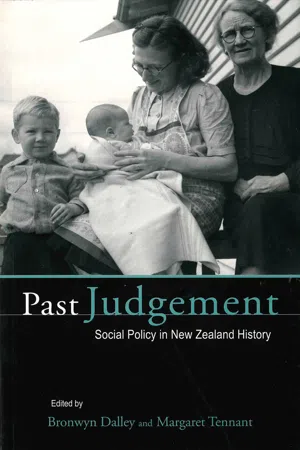
Appreciating New Zealand's distinctive social policy history is important in formulating future social policies. This is one of the premises in
Past Judgement: Social Policy in New Zealand History, which brings together recent research on a range of social policy contexts.
Information
1: History and Social Policy
Perspectives from the Past
Margaret Tennant
Social policy has been variously defined. In a recent text it involves ‘actions which affect the well-being of members of a society through shaping the distribution of and access to goods and resources in that society’.1 While discussion of social policy is often more narrowly restricted to social service provision in areas such as health, housing, education and income maintenance (as it is in most chapters of this book), some definitions extend to economic activity, the arts and recreation. In the case of W.H. Oliver’s historical survey for the 1988 Royal Commission on Social Policy it even extends to public works, land settlement, and agricultural efficiency. Oliver’s compass, though wide in one sense, was narrow in another, for his emphasis on ‘things deliberately done by government to promote wellbeing and to limit the effects of misfortune’ would now be regarded as too state-focused.2 The role of the market and the voluntary and community sector, and their interface with government are now an integral part of most discussions of social policy. And an effect of developments of the late 1980s and 1990s has been to consider things deliberately not done by government and other social service sectors. This reminds us that theories, definitions and approaches to study are themselves products of a particular historical context and need to be historicised. The concept of social policy itself has a history, and although the term is a product of the twentieth century, debates about pathways to social well-being are not. The historiography of welfare probes and itself reflects these debates – this volume falls within a longer historiographical tradition which has been played out at popular as well as academic levels.
Policy and nostalgia
For many New Zealanders the connection between history and social policy is probably visual and nostalgic – if it exists at all. A core of familiar and now widely promulgated images reinforces a largely positive and progressive view: old-age pensioners from the 1890s, the state house, men at 1930s depression work camps, young dental nurses at the Willis Street Training School in Wellington, children sipping school milk, the district nurse weighing a baby with her hand-held scales, ‘toothbrush drill’ at health camps, and on the voluntary sector side, Plunket’s Karitane nurses and the first meeting of the Maori Women’s Welfare League, with Whina Cooper and Mira Szaszy to the fore. Often enough, the benevolently smiling Michael Joseph Savage also appears as the personification of Labour’s welfare state. Photographic collections such as Those Were the Days and Looking Back, illustrated (and reprinted) histories such as The Sugarbag Years and school resources have played their part in this process of cultural imprinting.
Film images have likewise tended towards the positive, based, as they often were, on government ‘propaganda’ films (to use a term which once had less negative connotations). The 1940 Centennial film One Hundred Crowded Years follows its historical re-enactment of settlement with images of schools, hospitals, old-age pensioners and Plunket babies and a rousing script extolling ‘the monuments which testify to the national concern for human wellbeing’. Here, emphatically, ‘New Zealand leads the world!’3 Material from the National Film Unit subsequently became a firm part of our welfare state imagery. It was screened in short clips and commercially repackaged as part of video collections for the 1990 Centennial ANZ Magic Minutes series, and some footage was rolled out again for TV1’s The Way We Were hosted by Paul Holmes in 1995 and Millennial Moments at the end of the decade. Greater ambivalence was shown in the Cradle to the Grave programme which was part of TV1’s 2000 series, Our People, Our Century. The past century had ‘not delivered the egalitarian society which seemed possible in 1900’ and the ‘old dream of godzone where none would be too rich or too poor and where all would be cared for from cradle to grave has only in part been fulfilled’.4 Recent social policy directions produced a more trenchant critique in the 1996 film Someone Else’s Country. Described as ‘the story of how the new right elite took power and exercised it relentlessly to turn our country into their version of the model free market state’, this was played in cinemas around the country and viewed mostly by audiences antagonistic to the changes of the period.5
Inasmuch as they touched upon social policy, autobiographies have also tended to reinforce a nostalgic view of the welfare state, or of its early years at least. As a generation which had lived through the depression reviewed their lives, the Labour Party’s 1935 election victory and the promise of social security became ‘Almost like a Second Coming’ in memoirs such as To the Is-land. Janet Frame provides the image of her father ‘in a spontaneous dance of delight in which we all joined’, removing the family’s medical bills from behind the clock and thrusting them all into the fire, while the children made ‘whooping cowboy shouts of joy’.6 Gathered in the chook house which doubled as her father’s office, Lauris Edmond and her family likewise greeted the Labour victory with shrieks of delight: ‘we’d wanted Utopia to come, and as far as we could see, it had’.7 For Dorothy Ford memories of neighbours’ jubilation at the Labour victory were supplemented by Savage’s (unfulfilled) election promise of ‘Every woman a washing machine’.8 And Ruth Park recorded her mother’s bliss when, after depression experiences of family dispersal and depression hardships such as ‘snagging’ (queuing outside the biscuit and jam factories or the bakery for crumbs and rejects), the family reached the top of the list for one of Labour’s state houses: ‘“Just imagine! …. A new house! I’ve never lived in a new house in my life. And we’ll be together again”’.9 These memoirs show how depression mandated Labour’s family-oriented welfare state. They also chart the levels and varieties of depression poverty as well as informal means of support from family and relatives which can so easily escape considerations of social policy (though ever since the 1846 Destitute Persons Ordinance, social policies have certainly promulgated such transfers in the guise of ‘family responsibility’).
Personal memoirs alert us to changes in discourse, and language provides reminders of the more ambiguous aspects to our welfare pasts. ‘Snagging’ may have disappeared from common usage, but soup kitchens (nowadays serving more than soup) have not. The ‘loafer’ and ‘degenerate’ of the nineteenth century did not vanish from the social compass but reappeared in the ‘dole bludger’, solo mum, and long-term beneficiary of the late twentieth century. ‘Charity’ and ‘philanthropy’, at one time honourable terms, gained negative connotations of condescension and control, and were partially replaced in the twentieth century by ‘voluntary sector’ and the more recent (and so-far largely academic) ‘third sector’. In the guise of ‘civil society’ and ‘social capital’, however, they are increasingly promulgated as social desiderata: charity has been reformatted and rehabilitated as a fundamental and politically sanctioned ‘social glue’.10 Sometimes it is less the term than the meaning attached to it which has shifted over time. In charting the historical registers of a term such as ‘dependency’ in the United States context, Nancy Fraser and Linda Gordon disclosed its ideological basis in relation to ‘broad institutional and social-structural shifts’.11 A similar approach to the genealogy of ‘need’ has been attempted in the New Zealand context by Bronwyn Labrum.12 She shows how a burgeoning consumer society established a set of ‘needs’ which became ‘the terrain on which negotiation between the state and families was carried out’. Its meaning was particularly malleable as applied to Maori, she suggests. While Labrum’s focus is discretionary assistance and state social work, ‘need’ is also a key motif in McClure’s work on social security and in Belgrave’s discussion of social policy more broadly over the twentieth century. As Belgrave points out, the state was eventually expected to respond to psychological and cultural needs as well as material.
At various times the state and other agencies have actively promoted a language shift in an attempt to alter or shape popular perceptions. ‘Lunatic asylums’ were officially renamed ‘mental hospitals’ in the 1900s, an indication of the medical profession’s ascendancy in the treatment of mental illness and an attempt to remove stigma. ‘Native Affairs’ became ‘Maori Affairs’ in 1947, and growing reference to ‘whanau’, ‘hapu’ and ‘iwi’ in recent reports, and in such legislation as the 1989 Children, Young Persons and Their Families Act, acknowledges Maori language, social structures and collective ethos much more deliberately than before. The connection between history and social policy is marked by language shifts as some terms are promoted and others disappear or go underground on account of an acquired stigma or perceived offensiveness. Attitudes have proven more resilient, sometimes surviving to taint the new terminology, sometimes giving new meanings to words in constant usage. The introduction of the term ‘benefit’ was an attempt to disassociate social security measures from the stigma attached to receipt of a pension. It was a term associated with friendly societies and company superannuation schemes, with ‘respectability, work and worthiness’, as McClure has noted (until it, too, acquired negative connotations).13 And meanings attached to the term ‘reform’ took a new direction over the 1980s and 1990s as the so-called ‘New Right’ captured a term previously associated with initiatives of the political left.
The exalting of past golden ages is an attractive activity, be they times of individual striving, or of collective responsibility for the well-being of fellow citizens. The Business Roundtable-sponsored work of David Green (From Welfare State to Civil Society, 1996) was soon found to be less than robust in its depiction of a New Zealand past where flourished family responsibility, mutual associations and community and voluntary welfare – before the voluntary sector, too, was corrupted by expectation of state support. But those on the left who position their golden age in the 1930s and 1940s often neglect the continued moralism and means testing built into social security, the generational transfers which meant that some sections of the community benefited more generously from its outreach than others, and the plight of those, especially unmarried, divorced or separated women, whose situation did not fit the ideal family construct underpinning Labour’s welfare state. Nonetheless, the popular depiction of the welfare state is still relatively benign. It remains to be seen whether a new generation will supplant Savage, the state house and school milk with Muldoon, multi-generational dependency and union militancy, as in Michael Bassett’s The State in New Zealand, for example.14
Themes in the history of welfare
At a more academic level, recent research has complicated such simplistic scenarios. Overall, the history of social policy has tended to operate at three levels. The first is the macro-level, with a focus on welfare regimes. These often compared a range of welfare states, but typologies of government and voluntary (or non-profit) sector interaction have also emerged. The second approach has been largely political, examining at a national level ideological and political struggles in one or more policy areas; while the third has focussed on welfare implementation, often drawing upon localised examples.15 The essays in this book concentrate upon these last two levels, and, although many are alert to overseas developments, their main focus is on the local scene and indigenous influences on social policy. Nonetheless local developments frequently fed upon the international image of New Zealand as a ‘social laboratory’ – a label earned, in the first instance, by the enactment of labour legislation, old-age pensions and female suffrage in the 1890s, by social security in the 1930s and 1940s and, conversely, by the speed with which New Zealand appeared to be dismantling the welfare state and embracing a market ethos by the early 1990s. It is the characteristic speed of ‘short sharp’ periods of rapid reform which makes New Zealand’s social policy history quite different from most western states, Belgrave suggests.
A now considerable social science literature on welfare regimes has produced a number of typologies of welfare states, from the residual, institutional–redistributive and industrial–achievement models proposed by sociologist Richard Titmuss in the 1970s, to more complex ‘league tables’ which rank countries according to social expenditure as a percentage of Gross Domestic Product.16 Just as Titmuss’ model characterised Anglo-Saxon countries such as Britain, Australia and New Zealand as residual welfare states covering only basic needs, later scales also tended to rank New Zealand and, more especially, Australia, relatively low, despite the fact that both have at times been regarded internationally as welfare innovators. One of the most influential of typologies of the 1990s was formulated by Gøsta Esping-Anderson, and it placed Australia and New Zealand in a category of ‘liberal’ welfare states in which means-tested pensions and only modest universal transfers predominate. Setting aside issues about comparability of data, criticisms of these studies have noted their narrow focus on income maintenance, and the way in which they ignore pre-tax and pre-transfer income as well as a whole range of other services which contribute to policy outcomes.17 Michael Hill has noted that much of this analysis is dependent upon when data were collected and it often lacks a historical dimension to explain why some states moved from being ‘welfare state leaders’ to ‘apparent laggards’. Adding this dimension to quantitative studies has proven complex but, Hill argues, it is needed to put ‘“flesh” upon the picture emerging from the statistics’.18
Where historical analysis has emerged from welfare state comparisons, it has often focused on the influence of the political left. One attempt to do this in relation to Australia and New Zealand came from Frank Castles in his 1985 book, The Working Class and Welfare. Castles argued that New Zealand and Australia were ‘workers’ welfare states’ where political activity from the left resulted in pensions and other forms of social security being subordinated to wage regulation and protection.19 In other words, social amelioration came through the protection of wage earners, usually at the expense of the dependent poor (and, some have pointed out, at the expense of women’s status as independent citizens). This explains why Australia and New Zealand did not rank well in tables which stressed universalism and citizen entitlement and why, in more recent years, they have also been characterised as ‘reversible’ welfare states.20 As Belgrave notes in Chapter 2, this policy fractured as the dependent population expanded in relation to the labour force and New Zealand came to accept much higher levels of unemployment in the 1980s. He argues for a shift from moral welfare state, to family welfare state, to rights-based welfare state and finally into a targeted and residual welfare state, but he also suggests that sufficient residues remained from older patterns to create contradictions in the way the welfare state continued to operate.
If political scientists and economists have focused on broad international comparisons of welfare regimes, historians have developed national welfare analyses that extend over time rather than space. Historians are sometimes taken aback by the limited time perspective of policy-makers whose notion of ‘history’ may encompass a twenty or thirty-year span at the very most. As a specialist in British as well as New Zealand history, David Thomson is among those advocating a longer-term view on welfare which ranges over centuries and looks for cycles of response to human need.21 Their argument is that over successive generations the emphasis given to central and local government, to charity, kin and informal neighbo...
Table of contents
- Front Cover
- Title Page
- Copyright
- Contents
- Preface
- 1 History and Social Policy: Perspectives from the Past
- 2 Needs and the State: Evolving Social Policy in New Zealand History
- 3 Mixed Economy or Moving Frontier? Welfare, the Voluntary Sector and Government
- 4 The Voice of Inspiration? Religious Contributions to Social Policy
- 5 Out of the Shadows: Some Historical Underpinnings of Mental Health Policy
- 6 Driving Their Own Health Canoe: Maori and Health Research
- 7 ‘Plunket’s Secret Army’: The Royal New Zealand Plunket Society and the State
- 8 Beyond the Statute: Administration of Old-age Pensions to 1938
- 9 A Badge of Poverty or a Symbol of Citizenship? Needs, Rights and Social Security, 1935–2000
- 10 Negotiating an Increasing Range of Functions: Families and the Welfare State
- 11 Deep and Dark Secrets: Government Responses to Child Abuse
- 12 Maori and ‘the Maori Affairs’
- 13 The Treaty is Always Speaking? Government Reporting on Maori Aspirations and Treaty Meanings
- 14 A Practitioner’s Perspective on Change
- About the Author
- Notes
- Index
Trusted by 375,005 students
Access to over 1.5 million titles for a fair monthly price.
Study more efficiently using our study tools.
Frequently asked questions
Yes, you can cancel anytime from the Subscription tab in your account settings on the Perlego website. Your subscription will stay active until the end of your current billing period. Learn how to cancel your subscription
No, books cannot be downloaded as external files, such as PDFs, for use outside of Perlego. However, you can download books within the Perlego app for offline reading on mobile or tablet. Learn how to download books offline
Perlego offers two plans: Essential and Complete
- Essential is ideal for learners and professionals who enjoy exploring a wide range of subjects. Access the Essential Library with 800,000+ trusted titles and best-sellers across business, personal growth, and the humanities. Includes unlimited reading time and Standard Read Aloud voice.
- Complete: Perfect for advanced learners and researchers needing full, unrestricted access. Unlock 1.5M+ books across hundreds of subjects, including academic and specialized titles. The Complete Plan also includes advanced features like Premium Read Aloud and Research Assistant.
We are an online textbook subscription service, where you can get access to an entire online library for less than the price of a single book per month. With over 1.5 million books across 990+ topics, we’ve got you covered! Learn about our mission
Look out for the read-aloud symbol on your next book to see if you can listen to it. The read-aloud tool reads text aloud for you, highlighting the text as it is being read. You can pause it, speed it up and slow it down. Learn more about Read Aloud
Yes! You can use the Perlego app on both iOS and Android devices to read anytime, anywhere — even offline. Perfect for commutes or when you’re on the go.
Please note we cannot support devices running on iOS 13 and Android 7 or earlier. Learn more about using the app
Please note we cannot support devices running on iOS 13 and Android 7 or earlier. Learn more about using the app
Yes, you can access Past Judgement by Bronwyn Dalley,Margaret Tennant in PDF and/or ePUB format, as well as other popular books in Politics & International Relations & Australian & Oceanian History. We have over 1.5 million books available in our catalogue for you to explore.