- 120 pages
- English
- ePUB (mobile friendly)
- Available on iOS & Android
eBook - ePub
About this book
The basic forces that drive societal change—from demographic shifts, to advances in technology, and transitions in economic functions—have influenced the shape of cities throughout history. This book explains America's urban renaissance and establishes a framework to understand and capitalize on the range of real estate opportunities available in cities across the country. Cities are classified into four categories of development potential. The result of the analysis is an important and inspiring conclusion that goes to the heart of this book: that every American city, irrespective of its economy, market dynamic, and geography, has unique real estate opportunities and potential for progress. A big-picture view of urban America, this book covers prospects for each major urban property type. It analyzes four key categories of cities and discusses specific metropolitan areas in terms of their real estate investment potential. It covers investment strategies and capital sources, explains 13 trends that are converging to create a paradigm shift in urban America, and provides real-world case studies that demonstrate how to make forward-thinking real estate decisions.
Information
CHAPTER 1
New Dynamics, New Opportunities
O beautiful for patriot dream That sees beyond the years Thine alabaster cities gleam Undimmed by human tears!
—“America the Beautiful”
—“America the Beautiful”
Across the globe, for the first time in history, more people now live in cities than in rural areas. The sheer force of population movement to urban areas is propelling consumer markets, economic growth, public infrastructure expenditures, research and scientific investments, and returns on entrepreneurship and innovation in the world’s great metropolitan areas. A new age of prosperous, vibrant cities with increasingly diverse populations is at hand that will provide a myriad of investment opportunities as metropolitan areas morph into the dominant engines of the world economy.
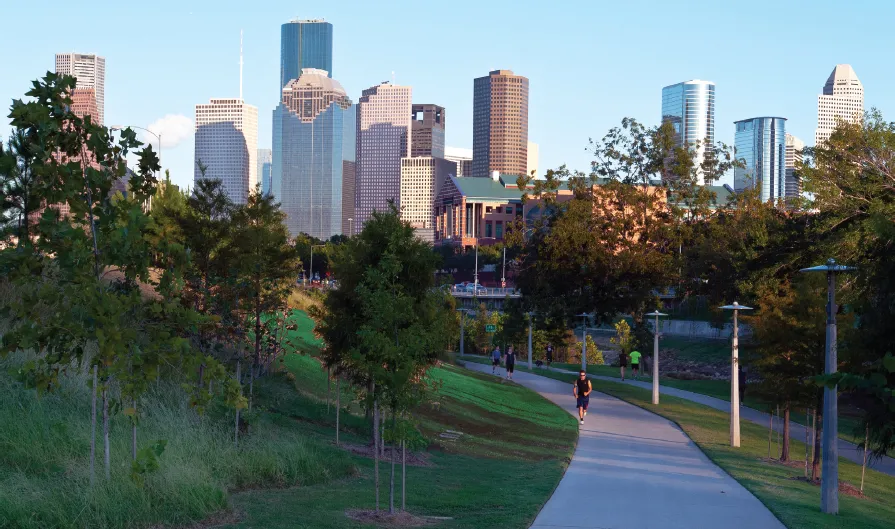
Houston has been booming, despite the recession, largely because of its strong energy industry.
This global trend is evident in the United States. Great cities such as New York, Boston, and Washington, D.C., which a generation ago were suffering a net outflow of residents, are now destinations of choice for those seeking the opportunities of urban life. The nation’s tech centers—among them San Francisco, Austin, and Seattle—are suffering shortages of affordable housing due to an influx of new residents. Real estate is booming in the energy cities, including Houston and Denver.
Still, as Aristotle observed, a great city is not to be confused with a populous one. To his point: in the United States, 65 percent of the population lives just in the 100 largest metropolitan areas—but those great centers produce 75 percent of the nation’s gross domestic product (GDP), generate 76 percent of knowledge-economy jobs, and account for 78 percent of all patents and research value.1 Demographers project that by 2050, the United States will have a population of 439 million2—an increase of almost 120 million people from nearly 320 million in 2014, with much of that increase occurring in metropolitan areas.3
The positive forces converging to strengthen U.S. cities are identifiable and understandable. First, the new American economy is driven by ascendant industry sectors that are concentrated in urban areas: health care and the life sciences, international trade, business and professional services, tourism and hospitality, international trade, technology development and marketing, and new media. The new economy has been replacing the older, manufacturing-driven industrial base. In retrospect, what was called “the urban crisis” of the 1960s and 1970s was much more than an urban breakdown; it was an American industrial transformation. The deindustrialization of the economy pulled jobs out of cities and moved them to green-grass sites in the exurbs, to rural regions of the United States, and overseas. The cities were left with the physical residue of the older economy—the empty factories and polluted sites—and it has taken them more than 50 years to establish their new economic momentum. It is now clearly accelerating.
Other contributors to the urban momentum are anchor institutions—the building blocks of the new economy—such as great universities, medical centers, corporate headquarters, and cultural complexes. The roles that the University of Southern California plays in supporting Los Angeles or that Marquette University has assumed in sustaining Milwaukee neighborhoods are examples of the convergence of their economic importance and their capacities for community service. Great medical institutions, such as the Johns Hopkins Medical Center in Baltimore, have reinvigorated entire sections of major cities. And cultural complexes, such as the New Jersey Performing Arts Center in Newark, contribute cultural vitality as well as fulfill economic purposes.
Still another force at work in the urban rebirth is the positioning of a new breed of city leaders who are entrepreneurial and business oriented. The best mayors are no longer patronage chiefs or just competent managers of basic services. They lead as orchestrators of public/private partnerships. An analysis of America’s best mayors of the 20th century described Mayor Richard Daley of Chicago as one of the nation’s most effective. Through iron-fisted political direction and administrative skill, he built Chicago’s reputation as “a city that works.” But analysts of cities in this century conclude that his son, Mayor Richard M. Daley, was probably a stronger mayor. While he did not enjoy political dominance in the traditional sense, he interpreted his job as bringing public and private resources together to create the momentum that characterizes modern Chicago.
Daley’s successor, Rahm Emanuel (elected in 2011), is following in the footsteps of legendary mayors and faces new challenges following the Great Recession (2007–2009) to maintain Chicago’s strong place in the world economy. The best mayors today understand that their role is akin to that of a traffic cop, ensuring that resources and institutions are moving in productive directions and avoiding collisions of public and private interests.
A number of urban dynamics converge to create this era of possibilities for cities. In the most progressive metropolitan areas, community development groups that during the 1960s viewed themselves as adversaries of local government today cooperate with municipal officials as sophisticated developers of neighborhood shopping districts and of workforce housing in redevelopment areas. Empty nesters who want the stimulation of urban life have spurred growth in urban neighborhoods such as Lower Downtown Denver and Deep Ellum in Dallas. Central Atlanta has gained population after 50 years—five census counts—of decline and is now on the upswing because the “creative class” wants to live and work in a vibrant urban setting.
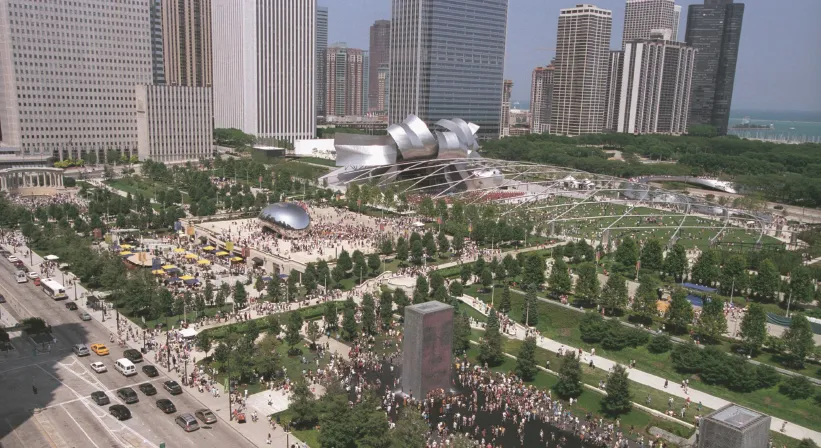
Mayor Richard M. Daly led the development of Chicago’s signature Millennium Park, which is known for its cutting-edge architecture, gardens, and sculptural work such as The Bean.
CITY OF CHICAGO, MILLENNIUM PARK INC.
Among larger societal trends strengthening cities are increasing suburban traffic congestion and intensifying environmental concerns, which make workers conscious of the need to be closer to central employment centers and avoid the long commutes that result from suburban sprawl. The smart growth movement emphasizes the efficiencies of modernized infrastructure, such as mass transit. Charlotte, North Carolina, is reaping the benefits of extending a light-rail line from its central business district to residential neighborhoods, which are now connected to its downtown banking headquarters as never before.

When Hurricane Katrina hit New Orleans in 2005, the city’s levees were breached, causing catastrophic flooding. In all, the storm killed more than 1,800 people and caused $108 billion in damage, and serves as a cautionary tale for cities that do not prioritize resilience in urban design.
WIKIMEDIA COMMONS
As dynamic engines of economic growth in the new economy, cities will lead the charge toward new and better “green” construction and development. Experts on global sustainability believe that cities must be the focal points of investment to solve the environmental challenges of our time. In a report titled Reinventing the City, the World Wide Fund for Nature concludes that, on their present course, cities will generate fully half the total emissions allowable to maintain a livable climate over the next 90 years within just the next 30 years. Put another way, the urban built environment without climate control interventions will generate one-half the total emissions in one-third the allowable time.4
While most assessments of climate change focus only on the environmental damage, some business leaders are calculating the economic costs. Resilience—understood to mean a city’s ability to prepare for and recover from extreme weather events—has a clear economic component. A study titled Risky Business: The Economic Cost of Climate Change in the United States, led by former New York Mayor Michael Bloomberg and former U.S. Secretary of the Treasury Hank Paulson, is designed to calculate such urban real estate impacts as higher flood insurance rates, increased water costs, lower construction productivity, and heightened fire risks.5
Recognizing that urban areas worldwide will spend about $350 trillion on the construction, operation, and maintenance of urban infrastructure over the course of those 30 years, cities can lead the way in changing the trajectory of environmental damage. Those infrastructure investments can be environmentally positive and financially sound. The juxtaposition of the scale of that forthcoming urban investment and the urgency of the global environmental problem requires that cities around the world be incentivized to plan advanced infrastructure that promotes environmental sustainability. Cities will lead in deploying new sustainability policies, new urban planning, new infrastructure, new communities, new homes, new building materials, new technologies, and new financing. As hurricanes Katrina and Sandy have painfully demonstrated, the stakes for not addressing climate change impacts and investing in resilience are too high.
These forces and others have created a metropolitan momentum that is both statistically measurable and anecdotally visible. New York City’s population reached 8.2 million in the 2010 U.S. Census; that city’s planning department is projecting 9 million people by 2040.6 Nearly a million additional people will need to be housed, go to work, and use transportation systems in New York City. That growth will be the fuel for new developments in the boroughs of Brooklyn, Queens, and the Bronx.
Similar trends are occurring—though on a smaller scale—in America’s other global gateway cities: San Francisco, Boston, Miami, Los Angeles, Seattle, Chicago, and Washington, D.C. These trends extend to the new “urban experience cities,” places where young talent is attracted to the jobs and lifestyle nexus, such as Dallas, Charlotte, Atlanta, northern Virginia, San Diego, Denver, San Antonio, Houston, and Portland. Urban creative centers affiliated with universities create magnets with their own attraction, as in Austin (the flagship campus of the University of Texas), the Research Triangle (Duke University and the University of North Carolina), Columbus (Ohio State University), and San Jose and the Silicon Valley (Stanford University). Research conducted by the Washington, D.C.-based International Downtown Association concludes: “The nation’s urban centers are growing rapidly in population and are now competing equally with suburbs as preferred places to work and live…. For decades, cities have been in a process of decline, but cities are rebounding as places to work, as thriving places to shop, and as vibrant places to live.”7
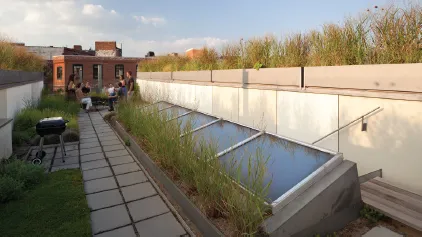
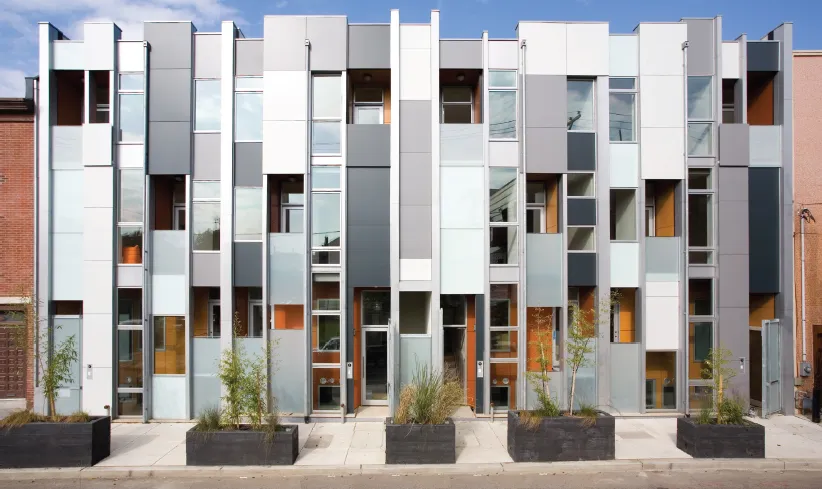
Thin Flats in Philadelphia is an urban apartment building that uses sustainable design. The building’s green roof provides an oasis for residents to relax and enjoy the outdoors, all within an urban environment.
ONION FLATS LLC
This metropolitan renaissance will drive a major part of the new construction needed to modernize and expand the nation’s built environment. By 2030, the United States will need 426 billion square feet of built environment to provide industrial space and retail and commercial sites—171 billion square feet more than currently exists. In addition, about 60 million square feet of present stock will become obsolete and need to be replaced, resulting in a total of more than 230 billion square feet of space that will need to be built. The growth of population and construction will also be evident in the residential sector. By 2050, the U.S. population is expected to grow from 320 million to 439 million. When projected occupancy patterns are considered, estimates are that growth will generate a need for more than 52 million new housing units, the majority in urban environments.8
This growth represents jobs, construction technologies, and investment that will be focused in the United States. It cannot be exported or constructed off shore because it is literally on the ground. In that sense, it is the classic high-priority, domestic industry—and it is indefinite in its duration. There is no end to real estate investment opportunity in cities. When an urban industrial function becomes obsolete—for example, when an old warehouse district is no longer functional because industries have modernized the way they manage logistics—cities can demolish the unsalvageable use and clear the ground to make way for a new structure for the next urban...
Table of contents
- Cover
- Title Page
- Copyright
- Contents
- Foreword
- Acknowledgments
- Introduction
- Chapter 1: New Dynamics, New Opportunities
- Chapter 2: Prospects for Urban Property Types
- Chapter 3: Categorizing Cities by Real Estate Potential
- Chapter 4: Investment Strategies and Capital Sources
- Chapter 5: 13 Trends behind America’s Urban Paradigm Shift
- Chapter 6: Case Studies
- Conclusion
Trusted by 375,005 students
Access to over 1.5 million titles for a fair monthly price.
Study more efficiently using our study tools.
Frequently asked questions
Yes, you can cancel anytime from the Subscription tab in your account settings on the Perlego website. Your subscription will stay active until the end of your current billing period. Learn how to cancel your subscription
No, books cannot be downloaded as external files, such as PDFs, for use outside of Perlego. However, you can download books within the Perlego app for offline reading on mobile or tablet. Learn how to download books offline
Perlego offers two plans: Essential and Complete
- Essential is ideal for learners and professionals who enjoy exploring a wide range of subjects. Access the Essential Library with 800,000+ trusted titles and best-sellers across business, personal growth, and the humanities. Includes unlimited reading time and Standard Read Aloud voice.
- Complete: Perfect for advanced learners and researchers needing full, unrestricted access. Unlock 1.5M+ books across hundreds of subjects, including academic and specialized titles. The Complete Plan also includes advanced features like Premium Read Aloud and Research Assistant.
We are an online textbook subscription service, where you can get access to an entire online library for less than the price of a single book per month. With over 1.5 million books across 990+ topics, we’ve got you covered! Learn about our mission
Look out for the read-aloud symbol on your next book to see if you can listen to it. The read-aloud tool reads text aloud for you, highlighting the text as it is being read. You can pause it, speed it up and slow it down. Learn more about Read Aloud
Yes! You can use the Perlego app on both iOS and Android devices to read anytime, anywhere — even offline. Perfect for commutes or when you’re on the go.
Please note we cannot support devices running on iOS 13 and Android 7 or earlier. Learn more about using the app
Please note we cannot support devices running on iOS 13 and Android 7 or earlier. Learn more about using the app
Yes, you can access Urban Real Estate Investment by Henry Cisneros,Henry Cisneros in PDF and/or ePUB format, as well as other popular books in Business & Real Estate. We have over 1.5 million books available in our catalogue for you to explore.